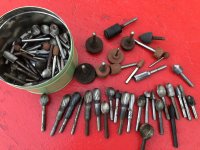
Is there a quick way to tell if carbide?...
I usually just look. Carbide comes in two flavors. Solid carbide, where the whole tool is carbide, and carbide brazed onto a shank, where the shank is steel, and you can usually make out a "yellow metal" line at the base of the burr head (better quality ones will have a harder to spot joint).
Carbide is a whole lot heavier than steel. That sets apart the solid carbide burrs pretty easily. Carbide doesn't rust, so the brown and blue/black tips are steel (but carbide can get coated in rusty grease). And by eye, polished carbide has a darker color than the mirror silver color steel polishes to. On the color spectrum of silver metals, I'd put steel halfway between carbide and aluminum.
Carbide also isn't all that magnetic (unlike steel).
As a quick guess as to what I'd be looking at first, there's that cylindrical burr in the middle of the picture that might be carbide on a steel shaft, and all the way to the right next to the countersink at the end, you've got that flame (could be solid carbide), and the flame tip next to it.
...-First thing after testing is you want to find a way to cover/protect the cutting edges whether HSS or carbide. Sitting in that can is not a good idea. Cutting edges rolling/banging into other cutting edges will chip the edges. Use small carboard tubes, wax, tape, or anything that will protect the edges. The only thing that should ever contact a cutting edge is either your finger or the material to be cut. Cutting edges are more fragile than most people realize.
...
-Had the package been crushed or the stone subjected to stress of any kind? You don't know, that's the problem.
...
-insufficient PSI/RPM puts more pressure/stress on the stone and increases the chance of it exploding unexpectedly. The tiny mounted stones that fit a Dremel type moto tool are a bit safer than the 1/4" shank types but they ALL can come apart. Stand off the debris path and wear appropriate eye/face safety equipment.
Agreed. Don't have your files or burrs banging around in a can.
I'll add to this that chemical exposure (oils and even humidity) and time will break down the stone's glue matrix.
As for the Dremel, I think it's a toss up. Running the bit too slowly will increase the shock impact of each bump because it wants to dig in more, but the centrifugal stresses from running at full speed are also enormous. At least the lower power of the Dremel reduces the energy available to the escaping chunks.