superautobacs
Well-known member
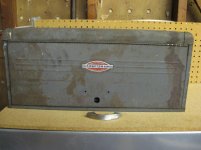
After purchasing this locally for just $20 CAN, it was destined to get a good soak in the bath, to have it all cleaned up fresh. Before I purchased it, I had to ask the GJ community as to what the box's vintage might be--that thread is here:http://www.garagejournal.com/forum/showthread.php?t=34212
From that thread, Lauver suggested a broad range of in between 1945-1959; T56 Impala, suggested it was pre-war. I did some research on my own and I was able to verify the box in a 1949 CM catalog. That particular Craftsman logo appears to have been used from as early as 1930 and can also be seen in a 1954 catalog as well. So, both Lauver and T56 Impala are right--this one could've been produced before or post war.
Knowing the vintage of this box, sanding it down and repainting it was out of the question. All I ended up doing was Re&Re, a thorough cleaning, dent/frame/slide staightening, and a lube job.
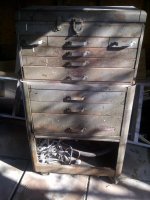
Here's the cabinet before I started working on it. It actually looks cleaner in photo than it really is in person:

Here's a picture of it with guts taken out, after a vacuum job (there was a lot of stuff in there ):
):

Here are the two drawers and the tray after cleaning:

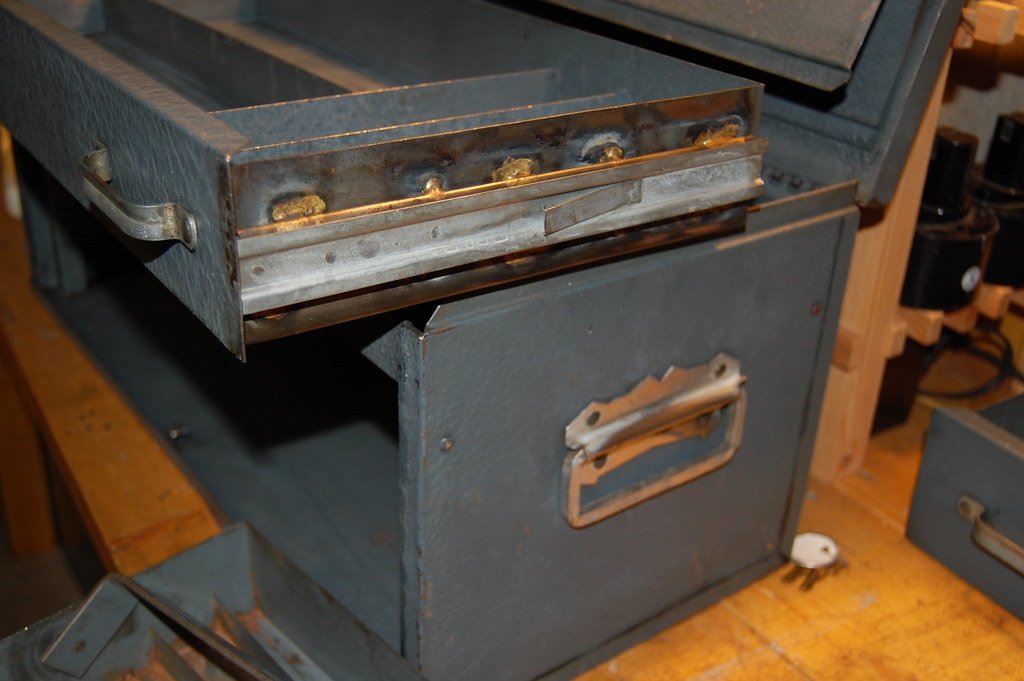
At some point in it's earlier lifetime, this top drawer slide had to be welded on for some reason or another. All slides were removed, straightened, cleaned, and coated with dry lube:
There was a small little surpise in the cabinet--a broken Snap-on socket tray:

After giving the frame a good bath, I had to ensure everything was 100% dry before reassembling. I left it in the sun for 15mins to let most of it evaporate, but I brought it in to let my hair dryer do the rest of the job. I went over all seams and rails and to finalize things, I used this can of dry lube. It does a good job of driving out any moisture out of the seams, as PTFE does not absorb moisture. Spraying the seams also leaves a coating to protect it from rusting as well:

So, after something like 8 hours, I was able to get it to look the way it is now; it surprised me how long this ended up taking. But, I think the results speak for itself, most notably, the drawers that slide smoothly without any bind, and how the fit and finish is proper after all the pulling/straightening.


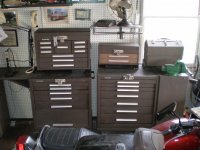
It's now resting in my small storage unit:

I found it really hard to clean the crinkle paint with years of caked on grease and oil; here it is, cleaned down to it's base.

From that thread, Lauver suggested a broad range of in between 1945-1959; T56 Impala, suggested it was pre-war. I did some research on my own and I was able to verify the box in a 1949 CM catalog. That particular Craftsman logo appears to have been used from as early as 1930 and can also be seen in a 1954 catalog as well. So, both Lauver and T56 Impala are right--this one could've been produced before or post war.
Knowing the vintage of this box, sanding it down and repainting it was out of the question. All I ended up doing was Re&Re, a thorough cleaning, dent/frame/slide staightening, and a lube job.
Here's the cabinet before I started working on it. It actually looks cleaner in photo than it really is in person:
Here's a picture of it with guts taken out, after a vacuum job (there was a lot of stuff in there
):
Here are the two drawers and the tray after cleaning:
At some point in it's earlier lifetime, this top drawer slide had to be welded on for some reason or another. All slides were removed, straightened, cleaned, and coated with dry lube:
There was a small little surpise in the cabinet--a broken Snap-on socket tray:
After giving the frame a good bath, I had to ensure everything was 100% dry before reassembling. I left it in the sun for 15mins to let most of it evaporate, but I brought it in to let my hair dryer do the rest of the job. I went over all seams and rails and to finalize things, I used this can of dry lube. It does a good job of driving out any moisture out of the seams, as PTFE does not absorb moisture. Spraying the seams also leaves a coating to protect it from rusting as well:
So, after something like 8 hours, I was able to get it to look the way it is now; it surprised me how long this ended up taking.
But, I think the results speak for itself, most notably, the drawers that slide smoothly without any bind, and how the fit and finish is proper after all the pulling/straightening.
It's now resting in my small storage unit:
I found it really hard to clean the crinkle paint with years of caked on grease and oil; here it is, cleaned down to it's base.