To avoid these ads, REGISTER NOW!

Coating masonite workbench surface, options?

57plymouth

Well-known member
Joined
Mar 10, 2011
Messages
74
I want to coat the masonite work surface of my workbench. The last layer of masonite lasted 10 years, which is good. I would like to get the same or better out of this layer. Last time I didn't treat it with anything. This time I want to coat it. I'm thinking about using mineral spirits and boiled linseed oil mixed roughly half and half. It won't make it harder but it may help keep solvents (read gasoline, carb cleaner, oil, gasoline, trans fluid, gasoline, carb cleaner, and maybe gasoline) from soaking it to death. Is my theory sound or would you use something else? I like the idea of the BLO and mineral spirits because it's cheap and easy. Will it work?
 
To avoid these ads, REGISTER NOW!

yeldogt

Well-known member
Joined
Jan 2, 2012
Messages
18,184
I was always told to leave alone for a bench. The absorption is what is nice about the product. I keep some around to use on top of other benches -- for just that reason. Toss them when they get too funky

I have used clear poly once -- I made some utility doors and used it for the inner face. It soaked in -- that I remember. Took a couple coats.
 

Lightning rod

Well-known member
Joined
Dec 1, 2012
Messages
283
Location
Toronto , Ontario
I coat my hardboard work bench top with SPAR varnish
Top is now 22 years old and holding up just fine
It soaks in and turns a little darker
Its got nicks and scrapes from motorcycle engine parts but
I can dab varnish on the exposed parts
A quick wipe down and your fresh again
 

4xdog

Well-known member
Joined
Aug 18, 2012
Messages
5,615
Location
Santa Fe, NM
There are two broad categories of hardboard (Masonite).

The tempered kind (which is treated with linseed oil and heat cured for better strength and durability) is what you want for a benchtop. Be sure you start with that before going further with coatings or sealants.

https://www.woodworkersjournal.com/regular-vs-tempered-hardboard/

I've had a piece of Masonite on my center island for almost forty years, but it's almost always covered with a large art supply/drafting cutting mat. That mat isn't solvent resistant, but it's a good surface for general around-the-home work. It's the blue piece in this crowded image:
i-qWCVpw6-X5.jpg
 

yeldogt

Well-known member
Joined
Jan 2, 2012
Messages
18,184
I'm confused ...

Is not the absorbing quality of the masonite what you want?

I have a few benches -- the one I have for fixing auto related things has the masonite. I can also toss an old pool motor on it .. any oil or dirt just wipes off or gets absorbed. If it's really bad -- like a leaking caliper ... I have cut cardboard sections that I keep around the shop from large boxes.

I also have one bench area that covered with a section of formica .... it seems that by coating the masonite -- it's becoming formica.
 
OP
5

57plymouth

Well-known member
Joined
Mar 10, 2011
Messages
74
I'm confused ...

Is not the absorbing quality of the masonite what you want?

No. Masonite is not the same as MDF. I do not want this to absorb. This is the very hard dark brown thin material. Not the thicker softer material used for furniture.

I want to make this more fluid resistant. I didn't use formica for 2 reasons: first the bench is 20 ft long and I'm very cheap. Second, I don't have a separate bench for metal work, so I often am cutting and welding on top of the bench.
 

JAYoung

Well-known member
Joined
Jun 19, 2018
Messages
85
Location
Butte, Montana USA
When I re-did my workbench top, I ditched the masonite for a leftover box of laminate flooring I got for $20 at Habitat ReStore. Couldn't be happier with the result.
 

Jagmandave

Well-known member
Joined
Nov 6, 2011
Messages
6,303
Location
Overland Park, Ks.
I have some Masonite cut offs that are about 2X3', perfect for a bench top and when they get funky I just toss them. I also use a lot of cardboard, especially when tearing down a dirty motor or transmission, then the cardboard and all the nasty stuff I scraped off just goes in the trash, leaving a whole lot less cleanup.

But to answer your question, I wouldn't coat it with anything, just leave it hard side up.
 
OP
5

57plymouth

Well-known member
Joined
Mar 10, 2011
Messages
74
Watching as I'm looking for inexpensive options for my new top.
m.

I bought 3 sheets of masonite for $8 each. My last layer of such lasted for 10 years. If I do nothing I'm good. If I coat it I may get an extra 5 years out of it.
 

isb cornbinder

Well-known member
Joined
Nov 3, 2010
Messages
7,073
Location
Pacific South West, BC, Canada
A local sheetmetal shop should be able to make a custom fit bench top. I used to build bench tops and complete benches for transmission shops. The tops had a center drain.
If your bench does not need any custom folding The Metal Supermarket will cut any sheet metal, they sell, to size. Galvanized gets a respectable work patina. Stainless is expensive. I prefer cold-rolled in 16 gauge or maybe 3/16"
My current workbench top is 3/16" diamond-plate. I have a fitted smooth 3/16" top for this bench. The bench has a hydraulic lift from 5 inches to nearly 40 inches.

I can build one of these for you, if you want to spend about $3500cdn.
 

Attachments

  • lift table 3.jpg
    lift table 3.jpg
    65.3 KB · Views: 121
  • LIFT TABLE and POWER UNIT WITH SAFETY.jpg
    LIFT TABLE and POWER UNIT WITH SAFETY.jpg
    84.7 KB · Views: 119
  • HYDRAULIC BOOST.jpg
    HYDRAULIC BOOST.jpg
    75.2 KB · Views: 115
  • IHC LB ENGINES.jpg
    IHC LB ENGINES.jpg
    98.7 KB · Views: 142

Jagmandave

Well-known member
Joined
Nov 6, 2011
Messages
6,303
Location
Overland Park, Ks.
I had a stainless top made for my bench, 2'X8' with a 6" backsplash on 3 sides with welded corners, front edge 1 1/2" bent over with a return.....$200 all in just for comparison.
 

rayra

Well-known member
Joined
Dec 1, 2014
Messages
4,724
Location
Escaped from Los Angeles
varnish or wax, or just put a new 1/8" thin skin on a little more often.

I've gone with melonite/melamine / coated particle board for my bench surfaces. East to work on, slightly slick, pretty resistant but you can't leave solvents on it forever. Thin I like the most is that it's easy to write notes on and relatively easy to clean them off after a project is done.

Only drawback of it is if you gouge the coating you'll get a lot of swelling in the particle board if solvents get to it later.

brick patio table 05 rough waste cuts.jpg
carriagelanterns32 faceplates.jpg
grillcounter058.jpg
 

kbs2244

Well-known member
Joined
Nov 11, 2006
Messages
14,065
Many years ago, when I was still in school, I got a xmas break job at a local starter and motor rebuild shop.
They were closed for the holidays and my job was to help replace the tops on the workbenches.
The owner used the white colored hardboard sold as bottom of the line bathroom paneling.
These benches were in 6 days a week use as motor repair surfaces.
They lasted apx a year and were replaced yearly.
I use the same stuff and it has lasted 20 years of hobby use.
I like the white work color.
The only thing that affects it is acetone
It wipes the white color off but leaves the brown under surface in fine shape
 

Kevin54

MEMBER EMERITUS
Joined
Jan 12, 2005
Messages
29,341
Location
Urbana, Ohio
I wouldn't even mess with masonite today. Use laminate flooring before you use masonite. Or get a cheap piece of formica.
 

yeldogt

Well-known member
Joined
Jan 2, 2012
Messages
18,184
Many years ago, when I was still in school, I got a xmas break job at a local starter and motor rebuild shop.
They were closed for the holidays and my job was to help replace the tops on the workbenches.
The owner used the white colored hardboard sold as bottom of the line bathroom paneling.
These benches were in 6 days a week use as motor repair surfaces.
They lasted apx a year and were replaced yearly.
I use the same stuff and it has lasted 20 years of hobby use.
I like the white work color.
The only thing that affects it is acetone
It wipes the white color off but leaves the brown under surface in fine shape

I remember that stuff -- I did a basement with it ..walls.
 

yeldogt

Well-known member
Joined
Jan 2, 2012
Messages
18,184
No. Masonite is not the same as MDF. I do not want this to absorb. This is the very hard dark brown thin material. Not the thicker softer material used for furniture.

I want to make this more fluid resistant. I didn't use formica for 2 reasons: first the bench is 20 ft long and I'm very cheap. Second, I don't have a separate bench for metal work, so I often am cutting and welding on top of the bench.

I know it's not MDF .....Sears used to sell most of the workbenches with MDF .. those I would use polly on.

With masonite -- I like that it absorbs and is a little soft .... it's a good wear surface.

Laminate has a place but it's hard .... like metal. I have one w/ laminate. I can't bring myself to mess up my Snap-on mental tops. !!
 
To avoid these ads, REGISTER NOW!

Stuart in MN

Well-known member
Joined
Sep 8, 2005
Messages
23,121
Location
Minneapolis
He wasn't asking about metal or laminate or other products...tempered hardboard is cheap, durable, it looks good, is easy to install, and easy to replace if necessary. Personally, I think it's a great choice.
 

Alchase

Well-known member
Joined
Jan 2, 2016
Messages
187
Location
Harrah, Oklahoma
My last bench had an untreated hardboard surface going on ten years when I sold that house. Current bench has the same, untreated, going on five years now and still looks great. Does putting a coating Spar varnish do much for the surface?
I would have thought the vanish would eventually crack? As it now, it would take me a couple hours at best to remove everything off the top, then to run to the nearest box store, buy three 4x8 sheets, cut it too size and replace the old top.
That might cost $30 at best?
 

Stuart in MN

Well-known member
Joined
Sep 8, 2005
Messages
23,121
Location
Minneapolis
Sure, the varnish will eventually get scratched up and worn out, but it will help protect it. If you have a can of it sitting around, it won't take hardly any time to slap on a coat when the hardboard is new.
 

Showkey

"MEMBER EMERITUS"
Joined
Aug 9, 2014
Messages
8,638
Location
Wausau WI
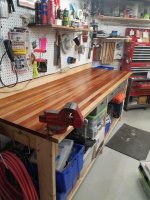
After many variations in many locations........I decided on danish oil sealed hardwood for the bench tops.

161F4B44-5044-4443-883D-FC5DAE605331.jpg

5C0CA49F-1FBA-43A0-9BB7-8B7E5F94809E.jpg
 

LeonardY

Well-known member
Joined
Apr 16, 2011
Messages
5,056
Location
Southern California
After many variations in many locations........I decided on danish oil sealed hardwood for the bench tops.

161F4B44-5044-4443-883D-FC5DAE605331.jpg

5C0CA49F-1FBA-43A0-9BB7-8B7E5F94809E.jpg

Nice bench top.

I bought an Ikea wood counter top. Hand Rubbed poly on it.

Since then I prefer Johnsons paste wax.
I waxed Masonite for another bench and it has held up for 10 years.

I had a desk I made and stuck a piece of Masonite on and never put a coating on it. One day I noticed my palms getting red and inflamed. The doctor said that the fibers were breaking off and embedding in my skin. Needless to say I never leave Masonite un-coated anymore.
 

HotrodHR

Well-known member
Joined
Nov 22, 2009
Messages
445
Location
North Alabama
OK, I'm sure all the woodworkers are gonna weigh in, but linseed oil on rags mix with other solvent covered rags are a recipe for a spontaneous combustion fire.

If the point is to protect the Masonite I'd use a water based "spar" product; wipe or brush on, low or high sheen, and dries quicker than real soar varnish. I'd personally not spend a bunch of time laying on coats and sanding between them, etc. on Masonite.

I did poly and sand and buff my butcher block workbench top though. :bounce: Covered part of it with some 1/4 inch or som leftover pvc sheet material. It's a work bench and I'm not too concerned if it gets cuts and dings. :lol_hitti
 

topcok88

Well-known member
Joined
Jun 3, 2013
Messages
660
What’s a 4’x8’ sheet cost? I think here in central VA it is about $8. I can’t think of a oil or film finish that will do what the op is asking without adding considerable cost, by considerable I mean cost more to apply than the cost of the Masonite itself. If the original top lasted 10 years I’d call that a pretty large success and inexpensive.


Sent from my iPhone using Garage Journal
 

Stuart in MN

Well-known member
Joined
Sep 8, 2005
Messages
23,121
Location
Minneapolis
I don't want to seem like I'm arguing the point, but doesn't everyone have a part used can of varnish sitting on the shelf? I agree hardboard is cheap, but the cost to put on a coat should be essentially zero.
 

topcok88

Well-known member
Joined
Jun 3, 2013
Messages
660
I don't want to seem like I'm arguing the point, but doesn't everyone have a part used can of varnish sitting on the shelf? I agree hardboard is cheap, but the cost to put on a coat should be essentially zero.


No, I’m a woodworker who doesn’t care for varnish in a can and the majority of oils/film finishes I throw out after each project. Usually buy a specific finish for a specific task and don’t like cluttering up my shop. What I can’t understand is putting a finish in a consumable object - tempered hardboard.


Sent from my iPhone using Garage Journal
 

ZRX61

Well-known member
Joined
Aug 15, 2006
Messages
28,716
Location
Solar Blight Valley, SoCal
No, I’m a woodworker who doesn’t care for varnish in a can and the majority of oils/film finishes I throw out after each project. Usually buy a specific finish for a specific task and don’t like cluttering up my shop. What I can’t understand is putting a finish in a consumable object - tempered hardboard.


I looked up the date I wrote on my bench..Mine has been on there since 1993... So actually 27 years... Consumable you say?
 

topcok88

Well-known member
Joined
Jun 3, 2013
Messages
660
I looked up the date I wrote on my bench..Mine has been on there since 1993... So actually 27 years... Consumable you say?


It sounds like the hardboard is a sacrificial layer of protection for the bench top. Much like a person putting cardboard on the concrete in their garage while doing an oil change. Some people use tempered hardboard due to its low cost and some use other materials. I myself use sheets of HDPE or UHMW because it is easy to clean, solvent resistant and is abrasion resistant. Not terribly expensive for a 4x8 sheet and won’t damage machined components. The only negative to mine is static so I don’t use it on my reloading bench.


Sent from my iPhone using Garage Journal
 

marinusdees

Well-known member
Joined
Oct 30, 2012
Messages
1,325
Location
Edgewood, Washington
My FIL used Masonite on his workbench tops. He also used it on the benches he built in my basement. He poured oil (any kind-- unused motor oil ) on the tops, then smeared it around with a paintbrush. I thought he was crazy. Now, I can say it works. No matter what you spill on the bench, a scraper will take it off.
 

Falcon67

Well-known member
Joined
Jun 11, 2009
Messages
18,371
Location
Merkel, TX
I used grey garage floor paint. Easy renewal, should I care to do so. In 9 years, I haven't needed to renew.

When new - Top is 3/4 ply + 7/16 OSB + 1/8 hardboard
Inside11.jpg
 

ZRX61

Well-known member
Joined
Aug 15, 2006
Messages
28,716
Location
Solar Blight Valley, SoCal
It sounds like the hardboard is a sacrificial layer of protection for the bench top. Much like a person putting cardboard on the concrete in their garage while doing an oil change.
Yup, that's why I installed it on my bench. It has a sheet of 1/2 plywood under it & 2x10's under that. It's 8ft x 28in. Still has the original *sacrificial* masonite top that got a coat of spar varnish 27 years ago.
 

er3456df

Well-known member
Joined
Dec 1, 2009
Messages
230
Does masonite, or "tempered hardboard", come in different grades?

I remember some stuff from when I was a kid in the 80s that was smooth on both sides, water resistant, and cut pretty clean. The stuff I'm seeing now is a lot fuzzier, and SUPER absorbent.
 

Lynden

Well-known member
Joined
May 23, 2015
Messages
672
Location
Southern California
As I understand it, there are currently two types of hardboard, Standard and Tempered. Here's some information about hardboard.

Why the bad rap on “Masonite”?

To begin with, the word “Masonite” is a brand name for “hardboard”. It has been commonly known as “Masonite” after the founder of the Masonite Corporation, William Mason invented this wood product in 1924. Today a few select manufacturers in the US as well as foreign companies produce hardboard.

In the 40’s and 50’s, tempered hardboard was made by immersing the panels in dipping tanks of tung or linseed oil to harden them, leaving an oily residue that caused adhesion problems. Untempered boards also had problems with chipping and fraying. Over 20 years ago, the high cost of tung and linseed oil forced U.S. manufacturers to change the way they manufacture hardboard. Today’s U.S. hardboard is made differently and does not have the characteristics of the old hardboard.

So, what is the difference between tempered and untempered?

Both untempered (or standard) and tempered hardboards are made by the same process. The only difference is that there is one final step for some tempered hardboard. A very small amount of oil (normally linseed) is applied with a roll coater and then baked. We have found manufacturers applying as little as 1.8 oz (approximately 2 tsp per side) on a 4 x 8 ft sheet.

Most of this oil is flashed off when the boards are baked at temperatures about 400 degrees F. This oil “tempering” is invisible and does not leave an oil residue on the panel that can cause adhesion problems, as did the outdated hardboard. The purpose of this process is to make the board stronger and less prone to warping.

The Manufacturing Process Explained

We have found that how the hardboard is manufactured and which species of wood is utilized, are more important questions than whether or not it is tempered. Three methods of manufacturing hardboard are used: 1) Wet Process, 2) Wet/Dry Process, and 3) Dry Process. In Wet Process after the wood chips are pulverized into wood fibers, they sit in water and are aligned in such a way that an internal bond is created using the natural resins already in the wood. This process produces the S1S (smooth one side) with a screen pattern on the back.

The Wet/Dry Process is essentially the same as the wet process except that a dryer is used to remove part of the water from the fibers so that the board can be pressed between two plates to create the S2S (smooth 2 side). Dry Process hardboards in comparison are manufactured without water by taking the pulverized wood chips and adding different synthetic additives to bind the fibers together and press them to make both S1S and S2S. The various methods can produce different quality hardboards depending on the species of wood, additives, and techniques used in manufacturing.
 

Daniel Dudley

Well-known member
Joined
Sep 4, 2009
Messages
3,546
Use poly. the wipe on stuff would be good, because what you want to do is saturate the material and let it soak in. The deeper it soaks, the tougher and longer wearing the surface will be. With the first coat, keep it wet for a while and keep feeding it for maybe 10 minutes before you buff it down.

This will get you what you want. Whoever told you to put a bunch of coats on was correct, just saturate the material. You don't want the water base stuff for this, the Minwax Wipe On Poly is what you want. You will not regret this.
 
Last edited:
To avoid these ads, REGISTER NOW!
Top Bottom