

You are using an out of date browser. It may not display this or other websites correctly.
You should upgrade or use an alternative browser.
You should upgrade or use an alternative browser.
Compression - Show Off Your Compressor
- Thread starter Mikeyworks
- Start date

TRWham
Well-known member
Wow, it seems like you are losing a lot of displacement to re-expansion because it's so over-square. Would a production version have a longer stroke?This is one of my prototype compressors. Powered by a 115V 2HP 1725 RPM motor. Displacement is 15.9 CFM. 1st stage bore is 4.5" and 2nd stage is 2.75". Stroke is 1".
Does not use a tank check valve. Uses a custom air operated gate valve instead. It has a pressure operated inlet restrictor. Tank fill time calculations show a actual SCFM of around 12. Maximum pressure reached 240PSI.
Stedlin
Well-known member
I believe re-expansion is not a significant factor because there is very little unswept volume and because the peak cylinder pressure is low due to the unrestricted flow path to the tank.Wow, it seems like you are losing a lot of displacement to re-expansion because it's so over-square. Would a production version have a longer stroke?
Mike65
Well-known member
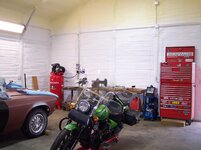
I just picked up a Craftsman 60 Gallon single stage electric vertical compressor. I have not used it yet since my garage is not finished yet but could not pass up a killer deal. Here is a pic once the garage got finished.
Last edited:
TRWham
Well-known member
Well, you’re losing ~25% of your displacement to something. What else could it be?I believe re-expansion is not a significant factor because there is very little unswept volume and because the peak cylinder pressure is low due to the unrestricted flow path to the tank.
Stedlin
Well-known member
Perhaps it's partially due to inlet flow restriction. On the other hand if I am indeed getting close to 6 SCFM/HP that in itself is pretty amazing don't you think?Well, you’re losing ~25% of your displacement to something. What else could it be?
In My Garage
Well-known member
Repost from 2011 and 2013 with additional lines and coalescing filters and regulators now added for a paint booth and media blasting booth.
RK Compressor DF-7580V, V4-cylinder, 2-stage, 7.5 HP, 80 gallon providing 24.0 CFM @ 150 psi...should give me a bit of air.
It was was a job getting the 717 pound compressor into the basement; I had to take it apart. Motor: 151 pounds, 4 cylinder pump: 309 pounds, 80 gallon tank: 257 pounds.
It sits atop a reinforced pallet I made of 3/4" plywood and 2x4 lumber (glued with PL Premium and screwed) atop a sheet of 1/2" closed cell foam to reduce vibrations into the concrete floor. Its in the corner of my basement and silent enough that I can sit in the room above it, watch TV and I can hardly hear it. Nothing like a low RPM pump.

And when you are alone and need to tighten the V-belts...

I installed an hours-meter just like we used in aircraft and a switch...

Topring S-05 - 22 mm polyamide airlines and fittings, shut-off ball valves and a Master Pneumatic regulator from TP Tools.

And at the other far end of the basement, a paint booth and media blasting booth. The Topring S-05 - 22 mm polyamide airlines are a bit overkill for the ~50 foot length, but I wanted the mechanical rigidity. Reduced to Topring S-05 - 15 mm polyamide airlines at the I-beam.
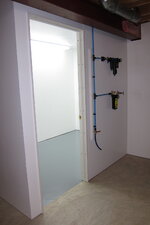
Media blasting booth components...Master Pneumatic components from TP Tools and Milton V-Style airline couplers.

Paint booth components...DeVilbiss components from TP Tools and Milton V-Style airline couplers.

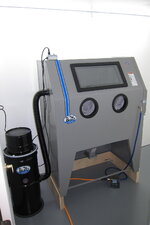
I don't think I could live without a media blasting booth from TP Tools. A Skat Blast 960. That was another job getting a 370 pound item into the basement.
And a 8' x 8' paint booth, the perfect size for smaller paint jobs (motorcycle gas tanks, car & motorcycle parts, etc). And of course the most important thing in painting, lots of light and the booth is vented.
RK Compressor DF-7580V, V4-cylinder, 2-stage, 7.5 HP, 80 gallon providing 24.0 CFM @ 150 psi...should give me a bit of air.
It was was a job getting the 717 pound compressor into the basement; I had to take it apart. Motor: 151 pounds, 4 cylinder pump: 309 pounds, 80 gallon tank: 257 pounds.
It sits atop a reinforced pallet I made of 3/4" plywood and 2x4 lumber (glued with PL Premium and screwed) atop a sheet of 1/2" closed cell foam to reduce vibrations into the concrete floor. Its in the corner of my basement and silent enough that I can sit in the room above it, watch TV and I can hardly hear it. Nothing like a low RPM pump.
And when you are alone and need to tighten the V-belts...
I installed an hours-meter just like we used in aircraft and a switch...
Topring S-05 - 22 mm polyamide airlines and fittings, shut-off ball valves and a Master Pneumatic regulator from TP Tools.
And at the other far end of the basement, a paint booth and media blasting booth. The Topring S-05 - 22 mm polyamide airlines are a bit overkill for the ~50 foot length, but I wanted the mechanical rigidity. Reduced to Topring S-05 - 15 mm polyamide airlines at the I-beam.
Media blasting booth components...Master Pneumatic components from TP Tools and Milton V-Style airline couplers.
Paint booth components...DeVilbiss components from TP Tools and Milton V-Style airline couplers.
I don't think I could live without a media blasting booth from TP Tools. A Skat Blast 960. That was another job getting a 370 pound item into the basement.
And a 8' x 8' paint booth, the perfect size for smaller paint jobs (motorcycle gas tanks, car & motorcycle parts, etc). And of course the most important thing in painting, lots of light and the booth is vented.
pcmeiners
Well-known member
....
Last edited:
TRWham
Well-known member
That is really good, but did measure the true input power for that calculation, or is that using the nameplate HP?Perhaps it's partially due to inlet flow restriction. On the other hand if I am indeed getting close to 6 SCFM/HP that in itself is pretty amazing don't you think?
Stedlin
Well-known member
Draws an average of 17 amps at 117V. Name plate reads 2HP.That is really good, but did measure the true input power for that calculation, or is that using the nameplate HP?
Stedlin
Well-known member
Correction:
I previously stated that the displacement of my compressor was 15.9 but I forgot to subtract the first stage piston rod area since the first stage pumps during the in stroke.. The correct displacement is 14.68 CFM.
I previously stated that the displacement of my compressor was 15.9 but I forgot to subtract the first stage piston rod area since the first stage pumps during the in stroke.. The correct displacement is 14.68 CFM.
TRWham
Well-known member
Draws an average of 17 amps at 117V. Name plate reads 2HP.
So 17 A at 120 V is only about 1 horsepower, meaning you are doing even better than you think. Reconsidering the ratio of free air to displacement I think your result is consistent with what a recip should do.Correction:
I previously stated that the displacement of my compressor was 15.9 but I forgot to subtract the first stage piston rod area since the first stage pumps during the in stroke.. The correct displacement is 14.68 CFM.
Stedlin
Well-known member
It would be impossible for me to be doing better than I think because I already think my compressor is more efficient than anything I am aware of. I don't know of any reciprocating compressor that can pump more than 4 SCFM per horsepower at these pressures. 3 and a half is pretty typical.So 17 A at 120 V is only about 1 horsepower, meaning you are doing even better than you think. Reconsidering the ratio of free air to displacement I think your result is consistent with what a recip should do.
Stedlin
Well-known member
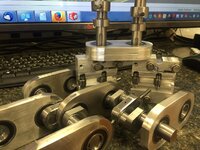
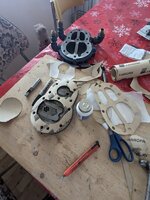
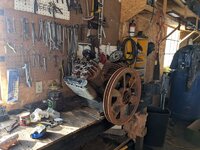
I made enough parts to build 5 air compressors. Here are some of the crankcase parts.

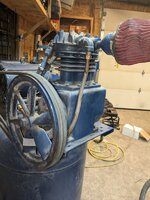
Picked up a couple 2 stage lately. 1965 brunner 212 and a dv 447. I only have one tank...the brunner is running. the devair i haven't put power to yet and will go over valves and cpr mech before i spool it up. fingers crossed. The oil drained sure was clean.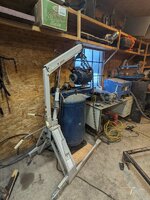
Attachments


Last edited:
dkmc
Well-known member

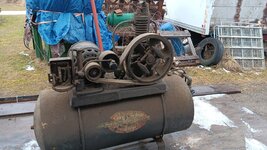
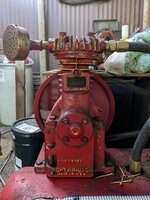
Curtis, 1925 patent date
The Tool Tyrant
ALLIANCE MEMBER
Any info on the governor setup on the pump sheave? I was sitting here thinking perhaps it was pre-electric motor driven to keep the pump from overspeeding? Very interesting for sure. I would like to know how exactly it functions.
Curtis, 1925 patent date
dkmc
Well-known member
Interesting question. I have no idea if it's an unloader, centrifugal clutch or......?? Seems like I read it could be an unloader. I've seen pics of these set up just like this, so I think factory setup. I haven't touched it since I got it several weeks ago. It was listed locally at $200, then $100. I inquired and seller said 'come get it for $50 or I'm scrapping it'. When I found out it was 0.6 miles from me, I went and saved it. I plan on washing off the dirt soon as it gets warmer. Will report back on function of the flywheel springs/weights.Any info on the governor setup on the pump sheave? I was sitting here thinking perhaps it was pre-electric motor driven to keep the pump from overspeeding? Very interesting for sure. I would like to know how exactly it functions.
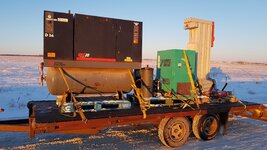
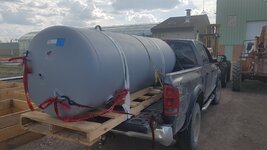
this is my largest, 30HP screw waiting for new shop to get built - it has about 1200 hrs on the clock. It will feed it's own tank with on board dryer for first stage, then through the big green dryer to 600 gal. primary tank (in truck = new). The huge alternating regenerative columns to the right will only be used to feed an "extra dry" circuit with about 400 gal tank only as needed as that level of dessication needs a constant flow. I also have a 5HP scroll waiting to be freshened up, a very old, but VERY good 3HP recip, in back yard shop, a 2 HP recip on farm and a pair of 2HP screws.
Attachments
TRWham
Well-known member
Curtis, 1925 patent date