To avoid these ads, REGISTER NOW!

Craftsman Drill Press

OP
F

FrankLee

Well-known member
Joined
Sep 13, 2010
Messages
3,557
Location
seMI, 48317
Okay, I have two issues with the top spindle bushing. First is is worn where the play is about .0085" which is way too much. I will replace it.
I agree. Replace.

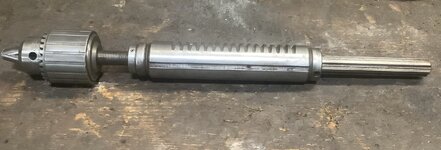
However, the two quill/spindle bushings have more effect on drill bit runout than the pulley bushing. Did you measure spindle runout at the chuck taper?

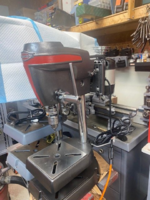
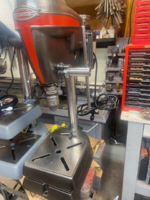
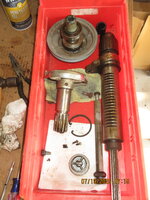
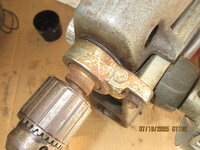
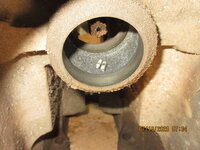
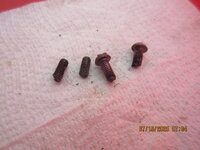
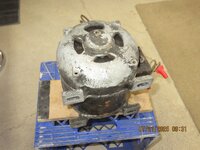
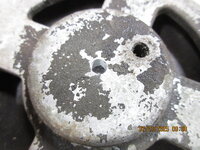
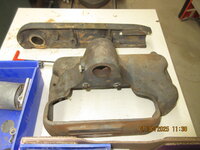
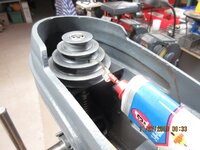
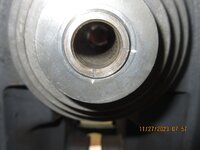
Second is the placement. I left my measurement in the shop but you can tell by the photos it is much more than the 3/32"- 1/8" which Frank suggested. The strange thing is this drill run just fine before taking it apart for the cleanup and rebuild. In the top photo you can see how far the bushing is raised and from the bottom photo it appears it can easily pressed down into a second holding area.
The last photo shows the pulley resting on the bushing and you can see the belt would still be below the casting.
I guess my concern is if pressing the new bushing lower, will I have restricted spindle movement?
Yes, the bushing is way too high. And yes, there are two machined bores that retain the bushing.

The area around the bushing between the bores is an oil reservoir. The oil port is that small hole in the head casting. There is a hole in the pulley that will align with the oil port to allow for refilling the reservoir without removing the pulley. With the bushing that high, any oil added may just flow through down the spindle/quill.

The splines are in the very bottom of the pulley shaft. I also think with the bushing that high, the spindle may feed out of the splines.

I'm not sure what you mean by restricted.

You should see the top of the spindle at/near the top of the pulley when assembled correctly.
1748529636382.jpeg

I make alignment marks on the shaft and pulley with a dremel. The marks on the shaft line up with the flats on the shaft. The marks on the pulley line up with the set screws. This makes it very easy to line up the set screws with the flats. Use a thread locker on the set screws, but do not tighten too hard. Otherwise the pulley may wobble excessively.
1748529926589.jpeg


Did you have any issues assembling the quill/spindle? If you're familiar with the larger drill presses, assembly is very different.
 
Last edited:
To avoid these ads, REGISTER NOW!

drs3317

Well-known member
Joined
Jan 31, 2016
Messages
124
Location
Western Maryland
Again, Thanks Frank. Very helpful information. I spent some more time studying the parts and drawings. Initially I was thinking if the bushing was lower it might restrict the feed distance. But now I can see it will not and I wonder how the bushing ever got so high in the first place? I take photos of all assemblies while taking them apart. I have rebuilt many of the larger models but this is the first of the smaller ones. Yes, I see the quill/spindle assembly is different. The runout measured just over .001" before I removed it. Everything there looks to be ok. I have a 5T arbor press and the top casting bushing came out without an issue. It was very snug and still I wonder how it ever got so high. There is no way it could have drifted!
I located a replacement at McMaster Carr and will install per your instructions.
Always fun and exciting to study and learn.
Danny
 

drs3317

Well-known member
Joined
Jan 31, 2016
Messages
124
Location
Western Maryland
Well I was just about to place my order, only thing left was the cc security code. Had to go get my wallet and was just enough to make me pause. I was using the provided information in the above chart. I now thought I better remeasure the bushing myself.
OH,...it measured 1.1875" or 30.1625mm or 1-3/16" outside. Not the 1.25" indicated in the above chart. The bore and length was correct. I could understand it being oversized if someone had rebuilt it before but not undersized. Anyone with thoughts?
danny
 
OP
F

FrankLee

Well-known member
Joined
Sep 13, 2010
Messages
3,557
Location
seMI, 48317
Well I was just about to place my order, only thing left was the cc security code. Had to go get my wallet and was just enough to make me pause. I was using the provided information in the above chart. I now thought I better remeasure the bushing myself.
OH,...it measured 1.1875" or 30.1625mm or 1-3/16" outside. Not the 1.25" indicated in the above chart. The bore and length was correct. I could understand it being oversized if someone had rebuilt it before but not undersized. Anyone with thoughts?
danny
Thanks for that correction. It's a good lesson for anyone ordering precision parts. Measure your parts.
My measurement was rather crude without removing the bushing.
1748597625368.jpeg
 

drs3317

Well-known member
Joined
Jan 31, 2016
Messages
124
Location
Western Maryland
I suppose I should follow-up on the bushing. After it arrived I checked it on the shaft and was a perfect fit. After I pressed it in, leaving about 3/16" exposed above I found like most sleeve bushings it would no longer accept the shaft. I used an adjustable reamer opening the bore about .0005 per pass until It finally would press through and then opened it another half thousandth. The side play is now just about .001". At that point I finished assembly and it turned out ok.1749955103598.png1749955128200.png1749955161135.png1749955187037.png1749955217650.png1749955256156.png1749955279374.png1749955076407.png
 
Last edited:
OP
F

FrankLee

Well-known member
Joined
Sep 13, 2010
Messages
3,557
Location
seMI, 48317
PSA: The Dangers of the Inexperienced and Importance of Column Collars

I posted the contents of the quote below a while back. It demonstrates how quickly bad things can happen.
When I went to buy DP#126 last March, I had the motor off and was carrying it to the car. While away, the seller decided to "help" me and loosened the head lock handle. Of course the head crashed to the table. When I got home, runout on the taper was 0.018"... F**K! Fortunately, I was able to correct it to an acceptable level.

Not long after that, a guy came to buy a Craftsman 80. I always have buyers dismantle their purchase so they know how to reassemble. I asked him to loosen the motor mount bolt. Instead, he loosened the head lock... another head crash. The damage to the DP is unknown. I didn't care because he already paid me, but I still have nightmares about what if my hand got crushed by the chuck.

I recently received a private message from a new GJ member seeking a replacement for a tilt table support. I didn't have one, but asked what happened. His response:
I let my neighbor use the press. It had a Palmgren vise on the table. He loosened everything at once and the the whole thing slid down the column shearing the part.

Below are a couple of his photos used with his permission. That is definitely a heart-breaker.
0.jpg 0-1.jpg

In all cases above, a column collar could have prevented the damage.

Atlas made a column collar that had lock sleeve cylinders that were identical to the table lock.
1751897763142.png

Early Craftsman column collars were cast iron with a ball-end lock screw.
1751896260431.png

The two above were accessories purchased separately.

Later Emerson Craftsman drill presses came with two pressed steel collars; one for the head frame and one for the table.
IMG_1614c.JPG

There are other versions including home-made using a muffler clamp, u-bolt or similar.
IMG_1616.JPG

IIRC, Jeff (@11b30b4) used this pipe clamp from Zoro:

There are several very nice options on Amazon with rubber cushioning.


The point is that something should be in place to prevent the head or table from free-falling.
 
Last edited:

bugzilla46310

Well-known member
Joined
Feb 4, 2023
Messages
147
Location
Demotte, IN
For bushing drill presses, this should be the correct pulley bushing. The quill bushing are in perfect condition on the drill I’m rebuilding and I’m not replacing them. On the quill, in the slot on left that the screw locks it in position there is a small hole which I ASSUME is for oiling the quill bushings. I believe the only way to access this would be to remove the lock screw and oil it through that hole. If it’s not mentioned in the owner manual, which who has one today, you would never know about it.

IMG_0563.jpegIMG_0562.png
 
OP
F

FrankLee

Well-known member
Joined
Sep 13, 2010
Messages
3,557
Location
seMI, 48317
For bushing drill presses, this should be the correct pulley bushing. The quill bushing are in perfect condition on the drill I’m rebuilding and I’m not replacing them. On the quill, in the slot on left that the screw locks it in position there is a small hole which I ASSUME is for oiling the quill bushings. I believe the only way to access this would be to remove the lock screw and oil it through that hole. If it’s not mentioned in the owner manual, which who has one today, you would never know about it.
I believe the oil port in the slot is accessible when the quill is fully extended. That oil port is for lubricating the lower bushing. To lubricate the upper bushing, apply a drop of oil in the splines from inside the head when the quill is fully extended. It will work its way down to the upper quill bushing.
 

bugzilla46310

Well-known member
Joined
Feb 4, 2023
Messages
147
Location
Demotte, IN
I believe the oil port in the slot is accessible when the quill is fully extended. That oil port is for lubricating the lower bushing. To lubricate the upper bushing, apply a drop of oil in the splines from inside the head when the quill is fully extended. It will work its way down to the upper quill bushing.
Thanks. I didn’t notice the hole until after I had everything disassembled.
 
OP
F

FrankLee

Well-known member
Joined
Sep 13, 2010
Messages
3,557
Location
seMI, 48317
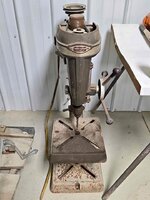
I picked up this 100 yesterday, DP#149. It's a model 103.23130 made in 1949/1950. It is in rough shape, but it's not as bad as it looks. I believe it will need paint, but we'll see.

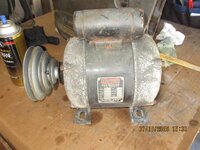
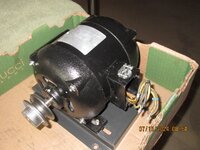
The motor is a Hoover 1/2 hp, 1725 rpm, ball bearing model. The frame is larger than the Craftsman motor mount plate, but it seems to be a good motor. The power-off-to-stop time is unacceptably long, so new/repacked bearings are indicated.

The only other things missing are the thrust collar nut and the chuck key. The motor pulley is also not oe.

Regardless, it was worth the price.

517920875_1312790063747076_6643947740967006555_n.jpg
The head dismantled easy enough,
IMG_1642.JPG IMG_1641.JPG

but based on the position of the feed stop bracket,
IMG_1634.JPG

I knew the spindle retaining screws were broken. Typical.
IMG_1637.JPG IMG_1639.JPG

8/19/2025

DP#149 is complete.
IMG_1804.JPG IMG_1799.JPG
 
Last edited:

BSWS

Well-known member
Joined
Jun 2, 2019
Messages
353
Location
Tucson AZ
After seeing Frank's recent picture of a ridiculously nice 115.6962 motor I knew I had to find one. I just got one in pretty decent shape. It will end up either on my 150, or this Model 80 I just picked up.

20250708_161123m.jpg


The 80 has a tilt table and a 1/4 HP Century motor. It will have a 1/2 HP when I'm done.

This 80 is just different enough from my 150 that I'll have a question or 2 for this group. I'll start with the first one. I've been searching GJ, and the rest of the web for information about a motor bushing. My 115.6962 appears to have a 1/2" shaft. The motor pully appears to be about 3/4". I've seen some bushings but what should I use? I see some have a hole for the setscrew, and others have an open slot that appears it would do the same thing. Is there a specific bushing I need? and can someone confirm the size?

And one more question. The bolt that locks the table tilt seems to have the same type of head as the quill lock bolt. Is there supposed to be a lever handle on it, like the quill lock?
 
OP
F

FrankLee

Well-known member
Joined
Sep 13, 2010
Messages
3,557
Location
seMI, 48317
After seeing Frank's recent picture of a ridiculously nice 115.6962 motor I knew I had to find one. I just got one in pretty decent shape. It will end up either on my 150, or this Model 80 I just picked up.

The 80 has a tilt table and a 1/4 HP Century motor. It will have a 1/2 HP when I'm done.

This 80 is just different enough from my 150 that I'll have a question or 2 for this group.
Except for the feed handle, the 80 is virtually the identical to the early 100 only on a smaller scale. The diameters of the pulleys, quill and spindle are all the same between the 80 and 100. The bearings are identical.

The differences between the early 100 and the early 150 are greater, but most parts are interchangeable.

The early 150 has a spring tension knob. The later 150 has no spring tension knob. Which is yours?

I'll start with the first one. I've been searching GJ, and the rest of the web for information about a motor bushing. My 115.6962 appears to have a 1/2" shaft. The motor pully appears to be about 3/4". I've seen some bushings but what should I use? I see some have a hole for the setscrew, and others have an open slot that appears it would do the same thing. Is there a specific bushing I need? and can someone confirm the size?
The 6962 shafts are 1/2". What is the exact size of the motor pulley bore?

I've never used a 1/2" to 3/4" bushing, but the 1/2" to 5/8" bushing with slot allows a 3/16" key to be used if the 5/8" pulley bore is slotted for a key. The bushing with a hole is for a set screw only.

And one more question. The bolt that locks the table tilt seems to have the same type of head as the quill lock bolt. Is there supposed to be a lever handle on it, like the quill lock?
No.
 
Last edited:

BSWS

Well-known member
Joined
Jun 2, 2019
Messages
353
Location
Tucson AZ
Except for the feed handle, the 80 is virtually the identical to the early 100 only on a smaller scale. The diameters of the pulleys, quill and spindle are all the same between the 80 and 100. The bearings are identical.

The differences between the early 100 and the early 150 are greater, but many parts are interchangeable.

The early 150 has a spring tension knob. The later 150 has no spring tension knob. Which is yours?


The 6962 shafts are 1/2". What is the exact size of the motor pulley bore?

I've never used a 1/2" to 3/4" bushing, but the 1/2" to 5/8" bushing with slot allows a 3/16" key to be used if the 5/8" pulley bore is slotted for a key. The bushing with a hole is for a set screw only.


No.
Sorry Frank, the bore actually looks like 5/8". I originally thought I measured 3/4". There is no key slot, just the one setscrew and the flat on the motor shaft. It looks like I need the bushing with the hole.

My 150 is from about 1962 so I do have the spring tension knob.

I agree, there's not a lot of difference from the 150.

And thank you for the post I found about correcting the base on the 115.6962, putting the switch on the right side with "off" in the down position. I haven't started into the motor yet but that's on my list of things to do.
 
OP
F

FrankLee

Well-known member
Joined
Sep 13, 2010
Messages
3,557
Location
seMI, 48317
Hoover, Atlas and Walker-Turner Motors

I picked up this 100 yesterday, DP#149. It's a model 103.23130 made in 1949/1950. It is in rough shape, but it's not as bad as it looks. I believe it will need paint, but we'll see.

The motor is a Hoover 1/2 hp, 1725 rpm, ball bearing model. The frame is larger than the Craftsman motor mount plate, but it seems to be a good motor. The power-off-to-stop time is unacceptably long, so new/repacked bearings are indicated.
I did a bit of research on Hoover motors. According to VM, Hoover merged with Kingston-Conley and produced motors for Atlas, Walker-Turner and several others along with their own Hoover-branded motors.

Yesterday, I started tearing down the Hoover motor.
1753183779757.jpeg

It is nearly identical to Atlas and Walker-Turner motors I had previously.
1753183893621.jpeg 1753183963692.jpeg

All three of these motors are ball-bearing models with a single pulley shaft Dismantling the Hoover motor was pretty straight-forward until it came time to remove the rotor from the switch-side frame. The ball bearing was stuck in the frame and the end frame is closed with no access to the end of the rotor.
1753184412364.jpeg

Here's how I extracted the rotor...

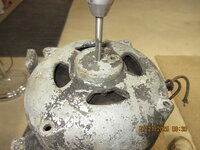
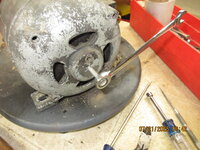
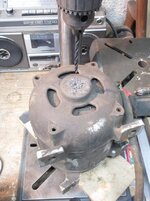
I scribed several lines ~60* apart on the bearing protrusion and punched a a center point.
1753184668268.jpeg 1753184760171.jpeg 1753184942856.jpeg
 
Last edited:
OP
F

FrankLee

Well-known member
Joined
Sep 13, 2010
Messages
3,557
Location
seMI, 48317
I then drilled and tapped for 1/4-20 threads.
IMG_1678.JPG IMG_1679.JPG IMG_1680.JPG IMG_1682.JPG

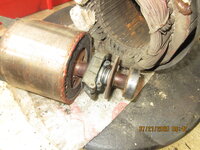
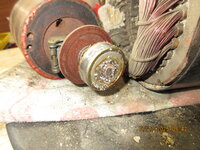
Using a longer 1/4-20 bolt, the rotor was pressed out.
IMG_1683.JPG IMG_1684.JPG IMG_1685.JPG IMG_1686.JPG IMG_1687.JPG

It worked great. I'll plug the hole with a short 1/4-20 screw during assembly.
 
OP
F

FrankLee

Well-known member
Joined
Sep 13, 2010
Messages
3,557
Location
seMI, 48317
The end frames on this Hoover motor were cast aluminum.

I used this same technique on the W-T motor with cast iron end frames.
1753185622998.jpeg 1753185666289.jpeg

The Atlas motor had a removable plug which made things a little easier.
1753185772314.jpeg 1753185802361.jpeg


Another nice thing about these three motors is that they all use the same bearings; 6203 on the fan side and 6301 on the switch side.
The 6203 bearing is 17 x 40 x 12mm.
The 6301 bearing is 12 x 37 x 12mm and passes through the centrifugal switch without damaging it.


7/30/2025

Progress on the Hoover motor.

IMG_1701.JPG IMG_1702.JPG IMG_1703.JPG IMG_1708.JPG


8/5/2025

The Hoover motor is complete.
 
Last edited:
OP
F

FrankLee

Well-known member
Joined
Sep 13, 2010
Messages
3,557
Location
seMI, 48317
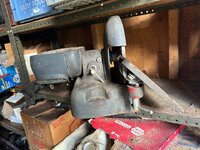
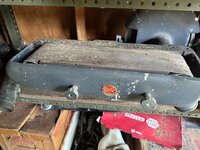
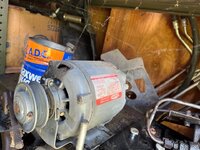
This morning, I picked up this Atlas 5010 sander (#2). The seller could not find the Dayton motor, but nbd, I'll use the Hoover motor above. Hoover made Atlas motors, so it's virtually identical.

This one is in much better shape than #1, but it is missing the stop fence. I can make something until I find the oe part. The stop fence is also the mount for the table when used with the belt.

This sander takes 4" x 37-13/16"(!?!?) belts. I still have one leftover from #1.

523834958_725180960485647_8229659231495483309_n.jpg 524199563_1529513575096441_6651118108211595984_n.jpg 523538128_758528263359721_5096455267397809732_n.jpg 523892822_1378204879943851_6719813050867727365_n.jpg 523873677_1106091844722017_6093589543655920007_n.jpg


7/30/2025

Progress on the sander.

IMG_1704.JPG IMG_1705.JPG IMG_1706.JPG IMG_1709.JPG


8/12/2025

Finished.


This Hoover motor will power it.


8/19/2025

I traded an Emerson motor for this 16" x 18" stand. Got it cleaned up, painted and assembled with new hardware. The Atlas 5010 sander and the Hoover motor will reside on it.
 
Last edited:
To avoid these ads, REGISTER NOW!

endangeredspecies

Well-known member
Joined
Apr 11, 2022
Messages
264
Location
SF Bay Area
Got to touch mine a little bit this weekend. Seems every time I do, something new goes wrong.

Reassembling the upgrade Dunlap 115.7448 motor to the base, the switch connection broke right off.
Old motor didn't have a swich. Instead, one was mounted to the press.
Any reason I shouldn't use this for the new motor?

Old power cord is in very rough shape - I couldn't find 8 salvageable inches with no cracks or splits. Do have some 14ga solid copper on hand. Wiring it up with that from column-mounted toggle switch to on-board stator wires, unless you guys advise me otherwise.


Also sheared the tip off one of the 6" through-bolts tightening it back down. So I'm going to try to find one of those somewhere. Are they #10?

Finally - I had the end frames on, with caps and all tight on the "switch" end, but no caps on the "opposite end". 3 functional through-bolts a little more than finger tight. Rotor spun like a top! So smooth on the new bearings. I then installed the bearing spring, end cap, felt, etc. Now it takes a lot of force to spin the rotor. Did I put the spring on backwards? Will it loosen up with use? Is it even safe to try to run when I get the 4th bolt in? I can spin it using both hands, but it's tough, and stops almost immediately. Feels smooth, though, and doesn't make any horrible noises.

(Not sure what's with the Imgur link. Didn't mean to include the audio room shot it there. But currently unable to remove it.)
 
Last edited:

endangeredspecies

Well-known member
Joined
Apr 11, 2022
Messages
264
Location
SF Bay Area
Finally - I had the end frames on, with caps and all tight on the "switch" end, but no caps on the "opposite end". 3 functional through-bolts a little more than finger tight. Rotor spun like a top! So smooth on the new bearings. I then installed the bearing spring, end cap, felt, etc. Now it takes a lot of force to spin the rotor. Did I put the spring on backwards? Will it loosen up with use? Is it even safe to try to run when I get the 4th bolt in? I can spin it using both hands, but it's tough, and stops almost immediately. Feels smooth, though, and doesn't make any horrible noises.
I turned the spring around. With the caps off, or very loosely affixed, rotor spins great. When I tighten them down, it's still tough to spin.
Old bearings were open on one side. Replacements have a plastic cover on one side - I believe what they call felt sealed (Accurate 87502 IK). Is the spring still indicated at reinstallation?
 
OP
F

FrankLee

Well-known member
Joined
Sep 13, 2010
Messages
3,557
Location
seMI, 48317
Got to touch mine a little bit this weekend. Seems every time I do, something new goes wrong.

Reassembling the upgrade Dunlap 115.7448 motor to the base, the switch connection broke right off.
Old motor didn't have a swich. Instead, one was mounted to the press.
Any reason I shouldn't use this for the new motor?
You could use that handi-box switch, but a new toggle switch is inexpensive. Amazon, HD and others have replacement switches. Verify that amps and volts are appropriate.

Old power cord is in very rough shape - I couldn't find 8 salvageable inches with no cracks or splits. Do have some 14ga solid copper on hand. Wiring it up with that from column-mounted toggle switch to on-board stator wires, unless you guys advise me otherwise.
New power cords are usually required. A new cord with ground is a good idea.

Also sheared the tip off one of the 6" through-bolts tightening it back down. So I'm going to try to find one of those somewhere. Are they #10?
Yes, usually 10-24 or 10-32. I may have one. What length?

Finally - I had the end frames on, with caps and all tight on the "switch" end, but no caps on the "opposite end". 3 functional through-bolts a little more than finger tight. Rotor spun like a top! So smooth on the new bearings. I then installed the bearing spring, end cap, felt, etc. Now it takes a lot of force to spin the rotor. Did I put the spring on backwards? Will it loosen up with use?
Check the end frames for any cracks. A crack can skew the alignment of the bearing bores.

Verify that no wires are pinched between the end frame and the stator.

Verify that the end frames are seated correctly onto the stator.

Verify that the bearings are fully seated onto the rotor shaft.

Verify the width of the new bearings are the same as the old bearings.

The fingers on the spring washer should be pressing the outer race of the bearing on the fan-side end frame only.

Is it even safe to try to run when I get the 4th bolt in?
I often test a motor under power with just two thru-bolts installed and sometimes without the bearing covers installed. It's nbd.

I can spin it using both hands, but it's tough, and stops almost immediately. Feels smooth, though, and doesn't make any horrible noises.
It shouldn't be too difficult to spin the rotor by hand.

I turned the spring around. With the caps off, or very loosely affixed, rotor spins great. When I tighten them down, it's still tough to spin.
Old bearings were open on one side. Replacements have a plastic cover on one side - I believe what they call felt sealed (Accurate 87502 IK). Is the spring still indicated at reinstallation?
The spring washer is required.

Review this post again.

More photos may help.
 
Last edited:

endangeredspecies

Well-known member
Joined
Apr 11, 2022
Messages
264
Location
SF Bay Area
You could use that handi-box switch, but a new toggle switch is inexpensive. Amazon, HD and others have replacement switches. Verify that amps and volts are appropriate.


New power cords are usually required. A new cord with ground is a good idea.


Yes, usually 10-24 or 10-32. I may have one. What length?


Check the end frames for any cracks. A crack can skew the alignment of the bearing bores.

Verify that no wires are pinched between the end frame and the stator.

Verify that the end frames are seated correctly onto the rotor.

Verify that the bearings are fully seated onto the rotor shaft.

Verify the width of the new bearings are the same as the old bearings.

The fingers on the spring washer should be pressing the outer race of the bearing on the fan-side end frame only.


I often test a motor under power with just two thru-bolts installed and sometimes without the bearing covers installed. It's nbd.


It shouldn't be too difficult to spin the rotor by hand.


The spring washer is required.

Review this post again.

More photos may help.
Thank you, FrankLee.
It'll probably be next weekend now. I've ordered new bolts and nuts. Will take a trip down to HD or my local Ace for power cord, 10ga wire, and switch. Then I'll re-seat the bearings and try again. I'm not great at taking pictures during the process, but I'll try to get a few to document progress.
 

endangeredspecies

Well-known member
Joined
Apr 11, 2022
Messages
264
Location
SF Bay Area
You could use that handi-box switch, but a new toggle switch is inexpensive. Amazon, HD and others have replacement switches. Verify that amps and volts are appropriate.


New power cords are usually required. A new cord with ground is a good idea.


Yes, usually 10-24 or 10-32. I may have one. What length?


Check the end frames for any cracks. A crack can skew the alignment of the bearing bores.

Verify that no wires are pinched between the end frame and the stator.

Verify that the end frames are seated correctly onto the rotor.

Verify that the bearings are fully seated onto the rotor shaft.

Verify the width of the new bearings are the same as the old bearings.

The fingers on the spring washer should be pressing the outer race of the bearing on the fan-side end frame only.


I often test a motor under power with just two thru-bolts installed and sometimes without the bearing covers installed. It's nbd.


It shouldn't be too difficult to spin the rotor by hand.


The spring washer is required.

Review this post again.

More photos may help.
No cracks, no pinched wires. I had neglected to fully seat the switch-end bearing! With that taken care of, she spins like a top. Double-checked spring orientation - all good!
I have a fairly new HD/Husky 3-wire power cord to the handi-box. But it's only 16ga. Since I had them upgrade the power circuit to a dedicated 20-Amp line, I think I'll get a bigger one. Neither of those existing switches has a ground wire provision, so I'll look into that. (For the old 1/4hp motor, the ground was just taped off inside the handi-box.)

I ordered 6" 10-24 bolts and new nuts. Seems the originals are 10-32. The broken one is darn near 6 inches, so I hope it's enough. I pulled a 5 5/8" one out of the old (115.7219) motor. It isn't long enough.

Ran it real quick, and I think it'll do great for this drill press.

This seemed so hopeless yesterday - was ready to start looking for a suitable NEW motor. Now it's kinda a piece of cake! I can't thank you enough for your help and guidance.
 
Last edited:

endangeredspecies

Well-known member
Joined
Apr 11, 2022
Messages
264
Location
SF Bay Area
Replacement toggle switch has arrived. I ordered screw terminals; they sent one with .250" blades. I can work with that. But the toggle doesn't have earthing provisions. Is one of the Base bolts the best place to run the ground wire, if I remove just a bit of paint from the base?

(New 12ga/20A power cord is still in transit, so I have time.)
 
To avoid these ads, REGISTER NOW!
Top Bottom