To avoid these ads, REGISTER NOW!

Craftsman Drill Press

To avoid these ads, REGISTER NOW!

saipan59

Member
Joined
Apr 5, 2026
Messages
6
Location
Colorado Springs
Question: The Craftsman manual says that the stock V-belt is 1/2" X 44". And that's what was with the machine when I got it.
But the spindle pulley seems to be a better fit with 3/8" belts. In particular, a 1/2" belt is difficult to mount on the largest pulley (5"), because there is not enough clearance with the housing casting - it requires some 'futzing' and cursing to get it in place. And then the belt doesn't ride quite all the way into the groove.
I'm running with a 3/8" belt now, and all seems good. Fortunately, the 3-step on the jack shaft will also handle 3/8" without bottoming-out.
Is this normal?

Pete
 
OP
F

FrankLee

Well-known member
Joined
Sep 13, 2010
Messages
3,554
Location
seMI, 48317
Question: The Craftsman manual says that the stock V-belt is 1/2" X 44". And that's what was with the machine when I got it.
But the spindle pulley seems to be a better fit with 3/8" belts. In particular, a 1/2" belt is difficult to mount on the largest pulley (5"), because there is not enough clearance with the housing casting - it requires some 'futzing' and cursing to get it in place. And then the belt doesn't ride quite all the way into the groove.
I'm running with a 3/8" belt now, and all seems good. Fortunately, the 3-step on the jack shaft will also handle 3/8" without bottoming-out.
Is this normal?

Pete
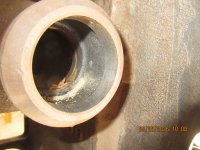
I've had a couple 150 head castings with a "thick skull". Does it look like there's a cast iron "patch" inside around the spindle pulley area?

I believe that some of the original belts were cloth wrapped. I thought I read somewhere that wrapped belts are
thinner (shorter taper, i.e., v vs. V ) than raw-edge belts, but I dunno.

I tried 3/8" wide belts before, but found that they did bottom out and slip in the oe pulley sheaves.

It looks like your belt does ride very high on the top intermediate pulley. Is that a new belt? Brand and part number? What does the width measure?
 
Last edited:
OP
F

FrankLee

Well-known member
Joined
Sep 13, 2010
Messages
3,554
Location
seMI, 48317
Update:
I have two old 150 head castings. I just checked and both have those thick skull "patches". I'm not sure what that's about, but it must be more common than I thought. I don't recall seeing this on a 100. It could definitely make belt installation a challenge.

IMG_0152.JPG IMG_0154.JPG
 
Last edited:

saipan59

Member
Joined
Apr 5, 2026
Messages
6
Location
Colorado Springs
Thanks Frank, for your detailed comments and photos!
Here's some data points from my side, in case it's helpful to someone.
The most important thing is that my spindle pulley's V-groove is only 0.44" at the widest point. I don't see how a 4L pulley can fit that properly, although I'm sure it would "work".
With a new Mitsuboshi 3L belt, I double-checked that it does not bottom-out on either pulley (one of my pics attempts to show that).
Regarding the "skull patches", I don't see them on mine. My top-down picture is deceptive - it looks like there is good clearance for a 1/2" belt, but there really isn't - it is tight on the two sides (top and bottom of my image). The belt has to stay 'straight' (not twisted) to get it through the gap. But it's easy to get a little twist, while using the other hand to support the weight of the motor to relieve the belt tension.

Pete

spindle_pulley.JPG

js_output.JPG
js_input.JPG
3L_fit_in_spindle.JPG
spindle_top.JPG
 

saipan59

Member
Joined
Apr 5, 2026
Messages
6
Location
Colorado Springs
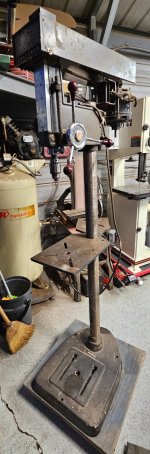
My new (to me) Craftsman 150 is ready for use.
I added a collar on the column (same one that FrankLee recommended) to avoid the possibility of another hand-smashing incident.
The light fixture is from an old outdoor security light. There is a pushbutton switch on top of the electrical switch box. The bulb is LED ("25 watt equivalent") - painted to not shine in my face.

Pete
Craftsman_150_DP.JPG
 
OP
F

FrankLee

Well-known member
Joined
Sep 13, 2010
Messages
3,554
Location
seMI, 48317
My new (to me) Craftsman 150 is ready for use.
I added a collar on the column (same one that FrankLee recommended) to avoid the possibility of another hand-smashing incident.
The light fixture is from an old outdoor security light. There is a pushbutton switch on top of the electrical switch box. The bulb is LED ("25 watt equivalent") - painted to not shine in my face.

Pete
Sweet! Nice work!
 
OP
F

FrankLee

Well-known member
Joined
Sep 13, 2010
Messages
3,554
Location
seMI, 48317
An Easier Way to Install the Spring/Pinion/Hub Assembly

One of the most difficult steps during reassembly of Craftsman drill presses with the double loop spring has always been the installation of the spring/pinion/hub assembly. One loop of the spring must be slipped over a roll pin that is installed into the head casting. It's not easy to do because the spring must be stretched to reach the roll pin.

In the past, I used needle nose pliers to grab the loop, stretch the spring and slip it over the roll pin. This required holding the assembly about 1/2" out of the head casting while stretching the spring. It was somewhat difficult on a 150, but even more of a challenge on a gen 2.

This technique uses a short piece of flat shim stock or similar bent to 90 degrees to pre-stretch the spring. I used a piece of 1/2"wide stainless steel strap. Whatever is used, it must be small enough so it will not interfere while inserting the pinion into the head casting.

I did this with the head casting upside down on a work bench. I tested this technique on a 150 and a gen 2. It should also work on gen 3 and gen 4 Craftsman drill presses.

Clamp the loop of the spring in a vise, stretch the spring about an inch and insert the shim into the spring coils at the end of the pinion shaft. The shim will prevent the spring from retracting back into the pinion shaft.
IMG_0226.JPG IMG_0212.JPG IMG_0220.JPG

Insert the pinion into the head casting until the spring loop reaches the roll pin.
IMG_0214.JPG

Reach into the quill bore and press down the loop while pushing in the hub until the loop catches the roll pin.
IMG_0215.JPG IMG_0216.JPG IMG_0217.JPG

Draw out the hub and retrieve the shim. Done!
IMG_0222.JPG

 
Last edited:
OP
F

FrankLee

Well-known member
Joined
Sep 13, 2010
Messages
3,554
Location
seMI, 48317
An Easier Way to Install the Spring/Pinion/Hub Assembly - Part 2

Another option is to back out the roll pin. Note that the roll pin is too long to drive it through to remove.

Use a c-clamp and a small socket to press out the roll pin about 3/4".


Insert the spring/pinion/hub assembly.


Hold the loop onto the end of the roll pin.


Hammer down the roll pin into the spring loop.


Use a roll pin punch to fully seat the roll pin

 
OP
F

FrankLee

Well-known member
Joined
Sep 13, 2010
Messages
3,554
Location
seMI, 48317
3. Vintage Craftsman Drill Press. Tools from the 1940s make me genuinely happy in a way that is difficult to explain to a normal person. The build quality, the look, the sheer density of the things. But the 103.231.40 earns its place on this list for a simpler reason: it works, and it never stops working. I have no reason to ever own another drill press. This one will outlive me.

@Ryan, did you ever fix your feed stop bracket? As shown in this photo, it's barely attached to the quill.
08.jpg

PSA: Check your feed stop bracket

About a year after I completed the refurb on my keeper machine, dp#15, I discovered that the feed stop bracket had started sliding down the quill. Shortly after that, I swapped out the quill with one that had the snap ring.

If its been a while since you refurbished your early Craftsman 100, it may be time to check your feed stop bracket to verify that it's still fully seated. A fully seated bracket should be about 3/32" below the bottom edge of the quill.

1742824295970.png

There are several clues that will help identify an out-of-position bracket.

Your bracket may be sliding off the quill if:
  • you can see the pulley lift up at the end of a feed return
  • you can hear the spindle collar bumping up against the spindle pulley shaft on a feed return
  • you can feel the spindle collar bumping up against the spindle pulley shaft on a feed return
  • you cannot see the entire thrust collar below the bracket
1742824446937.png
  • you can see too much spindle sticking up above the pulley

    1742824557176.png


The bracket on one of my recent machines was badly worn when it made contact with the chuck collar.

1742824611973.png


Check this post for the consequences of the feed stop bracket sliding off the quill.


I now normally use a green bearing retainer on feed stop brackets/quills when assembling these drill presses.

1742824769769.png
.
 
Last edited:
OP
F

FrankLee

Well-known member
Joined
Sep 13, 2010
Messages
3,554
Location
seMI, 48317
DP#151 Part 11

I cleaned and installed the final pieces. I'm calling this one complete.

I'm thinking this may be my own refurb swan song (although I thought that at DP#100, LoL!). I've got too much other **** going on; starting with cataract surgery on Feb 3rd.
Who was I kidding? Only myself.

My left eye cataract surgery on 2/3 went well.
A major bathroom renovation was started on 2/23 and completed on 4/7, $$$. (I had to paint the bathroom.)
I painted the kitchen ceiling on 4/20 and installed five additional can-less light fixtures.
I replaced 40 kitchen cabinet hinges with the 35mm soft-close hinges. (That Kreg hinge jig works great!)
Cataract surgery on my right eye on 4/28 went well.
I painted the kitchen walls on 5/13 and then installed all new switches, receptacles and replaced three other light fixtures.


DP#152 - Part 1, Acquisition, Assessment, Disassembly Overview

The last week was relatively quiet. When I saw this 150 on FB a few days ago, I knew I was going for it. I broke that news to my wife this morning and went to get it early this afternoon in Grosse Pointe Park, Mi.

700424819_1256437336572261_2195765400742100737_n.jpg

The seller said that he had it only a few months and that the original spring was fubar. He also said that he found someone selling new springs (@11b30b4 ?} and installed one.

The original paint is nice enough to save. The milled surface of the table appears to be in great shape. The bare metal parts are moderately rusted. The rapid-adjust feed collar is only missing original part besides the spring.

The v-belt was too tight which contributed to the noise when running. The quill was very gummy which required the spring to be tensioned too much.

I had to use jams nuts to remove one of the feed handles from the hub.
IMG_0284.JPG

One spindle pulley retaining screw did not back out, so it had to be broken to get the pulley out.
IMG_0285.JPG

There was some sort of weird tissue paper around the bearings. Perhaps it acted as a shim to tighten the bearings in the head
casting? :dunno:

IMG_0290.JPG IMG_0288.JPG

The column still needs mechanical persuasion to be extracted. Otherwise the machine is apart; sub-assemblies to be dismantled yet.
IMG_0282.JPG

So, the saga continues with DP#152. This is a model 113.24501 manufactured in June '66; the tail end of the 150 era. I'll be taking my time on this refurb.
 
Last edited:
OP
F

FrankLee

Well-known member
Joined
Sep 13, 2010
Messages
3,554
Location
seMI, 48317
DP#152 - Part 3, Removing the Chuck from the Spindle

I removed the chuck from the spindle. This was one of the more stubborn and difficult chucks, but my pin spanner was up to the challenge.

IMG_0265.JPG IMG_0266.JPG IMG_0267.JPG
Run-out on the spindle taper is a very respectable ~0.001".
IMG_0276.JPG IMG_0278.JPG

 
Last edited:
OP
F

FrankLee

Well-known member
Joined
Sep 13, 2010
Messages
3,554
Location
seMI, 48317
DP#152 - Part 4, Extracting the Pulley Retaining Screw

In Part 1, I mentioned that one of the spindle pulley retaining screws had to be broken to remove the spindle pulley. The screw slot is fubar, so it's not coming out with a screw driver. Below is an easy technique to remove the fubar screw. This is very unusual for a 150 with the snap ring on the lower quill.

IMG_0272.JPG IMG_0270.JPG


Removing a Fubar Spindle Pulley Retaining Screw

The screw head is recessed about 1" deep into a larger hole in the head frame casting. The diameter of that larger hole is 7/16".
full
full

I use a 7/16" drill bit to drill off the screw head. I had to buy a 7/16" bit with a reduced shank so it would fit in my cordless drill chuck. The 7/16" bit stays centered on the screw and does a very nice, clean job to remove the screw head.

Below are some in-progress photos where the screw head is being removed. Notice in photo #4 that the outer edge of the drill bit has started to remove a very small portion of the head casting. This is not a problem because there is plenty of cast iron material there. It has no affect on the installation or effectiveness of a new retaining screw. The screw head is completely removed in the last photo. The key is to drill in short bursts and check often. Do not drill through with the 7/16" bit!
full
full
full
full
full

The 7/16" bit may start turning out the threaded portion of the screw.
full

The 7/16" bit also creates a nice center point on the remaining portion of the screw. I used a #26 drill bit to drill and turn the threaded segment clockwise out of the casting and into the bearing cavity. There is no damage to the original female threads in the head casting and no need to resize the threads.
full
full
IMG_0310.JPG
The last step is to run a 8-32 tap through to clean out any residual swarf.
full
full
full
 
Last edited:
To avoid these ads, REGISTER NOW!

SMOKEYBEAR

Well-known member
Joined
Jan 3, 2016
Messages
449
An Emerson Craftsman gen 2 bench top (DP#151). This one is easily in my top 5 of outstanding original-condition machines!
The owners manual, a drill press operation guide and the ORIGINAL sales receipt were included.
IMG_0034.JPG IMG_0027.JPG
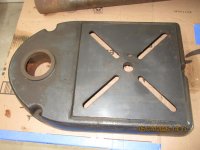
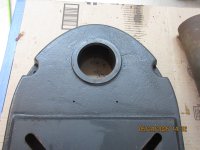
I just randomly snagged the floor version of this with the dual tables. $50 Craigslist find, drug it home. I've never seen the dual table deal..I decided I needed it for the base, post and tables.. the rest would just be stripped down for parts for another future project.
 

Attachments

  • RCLF1.jpg
    RCLF1.jpg
    96 KB · Views: 15
  • RCLF2.jpg
    RCLF2.jpg
    433 KB · Views: 15
  • RCLF3.jpg
    RCLF3.jpg
    365.3 KB · Views: 15
  • RCLF4.jpg
    RCLF4.jpg
    433.4 KB · Views: 16
OP
F

FrankLee

Well-known member
Joined
Sep 13, 2010
Messages
3,554
Location
seMI, 48317
I sure appreciate these great tips Frank, and it's good to know that you run into some struggles with these too.
Thank you.

I have had my share struggles and WTF moments. The common and predictable issues prompted the fabrication of specialized tools. Below is a link to a list of most of the tools and jigs I made.
Many of these are not very practical for a one-off refurb, but others are easy to make and very helpful.

I'm in my 70th year. My real struggle will eventually be finding an appropriate new home for all that stuff without it going to waste.
 
Last edited:
OP
F

FrankLee

Well-known member
Joined
Sep 13, 2010
Messages
3,554
Location
seMI, 48317
DP#152 - Part 5.1, The Base

I got the base cleaned today. Nothing works better than Grez-Off!

IMG_0320.JPG IMG_0321.JPG IMG_0322.JPG IMG_0324.JPG
IMG_0325.JPG IMG_0326.JPG IMG_0327.JPG

5/25/2026

DP#152 - Part 5.2


This morning, I finished the base. To reattach base badges, I prefer to drill and tap the holes for button head machines screws and eliminate the panel screws. If you ever want to remove the badge for some reason, it's a much easier process to remove machine screws.

Verify the hole is #36 for a 6-32 tap.
full
full
full
full

Run a 1/2-13 tap through for the shoe lock bolt to clean out rust and swarf.
full

Wax and buff. It's not perfect, but IMO, it's much better than a repaint.
full
full


Last edited:

BSWS

Well-known member
Joined
Jun 2, 2019
Messages
351
Location
Tucson AZ
Thank you.

I have had my share struggles and WTF moments. The common and predictable issues prompted the fabrication of specialized tools. Below is a link to a list of most of the tools and jigs I made.
Many of these are not very practical for a one-off refurb, but others are easy to make and very helpful.

I'm in my 70th year. My real struggle will eventually be finding an appropriate new home for all that stuff without it going to waste.
Wow, that looks like a great list I'll need to go through. I'm in the same boat when it comes to my tools, I'll be 70 in a couple weeks.

I just looked at that list. You might need to attach your pictures and explanations to some of those rare tools you've built or someone's going to have some real puzzles to figure out. I see a few I might have to make myself.
 
Last edited:

Junkman

Well-known member
Joined
Dec 18, 2006
Messages
6,611
Location
Northeastern CT
I have a friend who is also getting up in years. He has a lot of specialized tools to repair transmissions, and those transmissions are from the 1950s. I suggested that he ID the tool with a tag saying what it is and what it does in a few words. That will help stop the head-scratching, because if you know which transmission it is, you can usually figure out which car it was used in.
 
OP
F

FrankLee

Well-known member
Joined
Sep 13, 2010
Messages
3,554
Location
seMI, 48317
I have a friend who is also getting up in years. He has a lot of specialized tools to repair transmissions, and those transmissions are from the 1950s. I suggested that he ID the tool with a tag saying what it is and what it does in a few words. That will help stop the head-scratching, because if you know which transmission it is, you can usually figure out which car it was used in.
I do have some labelled, but need to do better.


DP#152 - Part 6.1-4, Cleaning and Installing the Column

This column is heavily rusted, but pitted only at the bottom.
full
full
full
full

The first step is to scrub it down with mineral spirits and a Scotch-Brite pad to remove any grease and loose rust.
full
full
full
full

Then, wire-wheel the pitted area.
full
full

I inserted a stopper in the bottom of the column to keep the column off the bottom of the pvc soaking chamber. For a floor-standing column, I also use a stopper in the top to reduce the amount of CA solution.
I used three scoops of citric acid in 1-1/2 gallons of the hottest tap water. I'll soak it overnight and assess whether it needs a second bath.
full
full
full
full
full
 
Last edited:

y'sguy

Well-known member
Joined
May 1, 2010
Messages
1,308
Location
Tulsa, Oklahoma
^^^This seems like an effective method. I just spun the column like you have done in the past. Wondering why this process? More than one way to skin a cat, I guess. Thanks for the tip.
 
OP
F

FrankLee

Well-known member
Joined
Sep 13, 2010
Messages
3,554
Location
seMI, 48317
^^^This seems like an effective method. I just spun the column like you have done in the past. Wondering why this process? More than one way to skin a cat, I guess. Thanks for the tip.
I soak it in citric acid first to remove the rust, scrub it with steel wool or Scotch-Brite pad while still wet after the soak, rinse, dry. Then turn it on my lathe. The lathe sanding then cleans quicker and is less dusty. I do try to control the dust though. I use only a couple grits of fine/medium grit sandpaper dry and finally a 3M Ultra Fine Hand Sanding Pad. Then, finish with a paste wax. I do not want a high-polished mirror finish. The only parts I high-polish are some screw heads. I'll highlight all that in later posts. IMO, the whole process overall is more effective.

Prior to my lathe, I used a strip of old sandpaper from a 6x48 belt sander in a "shoe-shining" fashion; up, down and around the column. That worked really well, but it's labor intensive.

I don't really bother with the inside of the column too much. I might force a dry, balled-up rag through to get the loose stuff. The inside of bench-top columns get the citric acid treatment, the floor standing columns don't.
 
Last edited:
OP
F

FrankLee

Well-known member
Joined
Sep 13, 2010
Messages
3,554
Location
seMI, 48317
DP#152 - Part 6.2

The column has been soaking since early yesterday.

I dumped the citric acid in a bucket and removed the column from the pipe. Here's the column right out of the citric acid. This is normal for the rusty condition.

full
full

I started scrubbing off the rust residue with a Scotch-Brite pad and CA from the bucket. The residue comes off rather easily.
full

Afterward, a rinse with hot water and towel dry. Then a dry rag pushed through the column.
full
full

Believe it or not, it's looking pretty good... another soak is not necessary. It's ready to mount on the lathe.
full
full

I have to mark the location of the weld seam on the outside of the column and orient the seam in the gap between the chuck jaws. Otherwise, the column will spin out of balance.
full
full
full

 
Last edited:
OP
F

FrankLee

Well-known member
Joined
Sep 13, 2010
Messages
3,554
Location
seMI, 48317
DP#152 - Part 6.3

This morning, I poured some used citric acid from yesterday into a jar and heated it the microwave for two minutes. I inserted the column lock shoe and bolt to get that cooking while completing the column. The CA really starts percolating after a few minutes.
full
full
full
full


So here is my lathe set-up. I have two box fans sitting on a saw horse behind the lathe. A piece of used furnace filter is held in place with the fans running on high. The filter does a pretty good job catching the dust. You can see trapped dust from previous uses.
full
full


Below is a start-to-finish video of my cleaning process. I started with 220 grit, then 400 grit, then the 3M ultra-fine pad. That's it, and that's enough for me.

I need to wax it yet, but here's the finished product. Not bad considering the condition it was in.
full
full

full
full
 
Last edited:
OP
F

FrankLee

Well-known member
Joined
Sep 13, 2010
Messages
3,554
Location
seMI, 48317
DP#152 - Part 6.4

I pulled the lock shoe and bolt from the citric acid, rinsed, dried and wire wheeled them.
full
full
full
full


Here's a tip that I learned from @terratrac20 many years ago. Dissolve some paraffin wax in mineral spirits and dip clean steel parts. The mineral spirits will evaporate leaving a nice wax coating. The lock shoe is a perfect candidate for this process.
full
full

I inserted the lock shoe into the base, applied some anti-seize to the bolt and started the bolt into the base.
full
full
full

The next step is to install the column. I applied paste wax to the lower 8" of the column and inserted it into the base. I see no need to buff off the portion of the column inside the base as it will provide additional rust prevention. The column and base are tilted 90 degrees, the column is adjusted so the bottom is flush with its bore in the base. This keeps the column off the bench (or the floor for a floor-standing dp) which can prevent wobbling on an uneven surface. Orient the column with the nicest side forward and tighten the lock bolt.
full
full
full
full

Lastly, finish waxing the upper column and buff.
full
full
full
 
Last edited:

SMOKEYBEAR

Well-known member
Joined
Jan 3, 2016
Messages
449
Working on an idea of mine. I came across the Gen 2 I mentioned earlier with the double table, it had some issues with the head and motor. I'm working on the base, post and tables. I'll be casually looking for a 100 or 150 of the previous generation and blend the two together. Cleaned, prepped and primer yesterday, Some top coat work today. It will be a 3 tone color scheme. Black, charcoal and orange. Plan to make a PVC tube for the rusty post/ citric acid soak.. reduce some elbow grease in the process.
 

Attachments

  • Gen2DP1.jpg
    Gen2DP1.jpg
    341.5 KB · Views: 14
OP
F

FrankLee

Well-known member
Joined
Sep 13, 2010
Messages
3,554
Location
seMI, 48317
Working on an idea of mine. I came across the Gen 2 I mentioned earlier with the double table, it had some issues with the head and motor. I'm working on the base, post and tables. I'll be casually looking for a 100 or 150 of the previous generation and blend the two together. Cleaned, prepped and primer yesterday, Some top coat work today. It will be a 3 tone color scheme. Black, charcoal and orange. Plan to make a PVC tube for the rusty post/ citric acid soak.. reduce some elbow grease in the process.
You may have already discovered that several parts from the gen 2 will fit on your 100.
- the 1/2-13 feed handles and hub (not the pinion or spring)
- the spindle pulley
- the rapid adjust feed stop assembly. You have to cut down the feed stop rod, but it works great.

 
Last edited:
OP
F

FrankLee

Well-known member
Joined
Sep 13, 2010
Messages
3,554
Location
seMI, 48317
DP#152 - Part 7.1, The Table

The table and lock were grimy and as rusty as the column.
full
full
full
full
full

For the lock assembly, my first step is to de grease the cylinders with lacquer thinner in the sonic cleaner and the lock handle with steel wool.
full
full
full
full
full

Then, soak overnight in citric acid, rinse and wire wheel. A tube brush through the cylinder bores cleans the inside.
full
full
full
full
full

full
full
full
 
Last edited:
OP
F

FrankLee

Well-known member
Joined
Sep 13, 2010
Messages
3,554
Location
seMI, 48317
DP#152 - Part 7.2

The first step for the table is to de-grease the milled surface with mineral spirits and a Scotch-Brite pad. This will prevent sandpaper from getting clogged. I wanted to sand before cleaning because of how rusty the table was.
full
full
full

Next, scrub with Grez-Off. The grime just melts off.
full
full

Rinse, towel dry and re-sand. Then, run a tube brush through the lock bores.
full
full
full
full

Finally, wax and buff.
full
full
 
Last edited:
OP
F

FrankLee

Well-known member
Joined
Sep 13, 2010
Messages
3,554
Location
seMI, 48317
DP#152 - Part 7.3

Installation begins with lubricating the lock bores. I sparingly use Super Lube grease.
full

Sometimes I use a cardboard tube over the column before installing the table.
full
full

To prep the lock, I use Super Lube on the lock handle; one drop for the sleeve cylinder and one drop on the threads for the lock cylinder.
full
full
full


The Table Lock

The table lock handle can be installed on either side of the table depending on your preference. I like the handle on the right.

The lock cylinder with threads usually has two bevels. This allows the handle to be oriented in one of two positions 180 degrees apart.
full

My preference for handle orientation is between 1 o'clock and 4 o'clock. I insert the lock cylinder on one side of the table and the lock handle with sleeve cylinder on the other side.

In the photo on the left, the handle landed at the 10 o'clock position. It's too easy to unintentionally knock the handle loose. In the photo on the right, I removed the lock cylinder, rotated it 180 and re-installed the handle. The lock handle now lands at the 4 o'clock position.
full
full

The installation of the table is complete.
full
 
Last edited:

SMOKEYBEAR

Well-known member
Joined
Jan 3, 2016
Messages
449
Next step of the paint...

Not pictured, I finally put together a 4" x 6' PVC tube to soak the post in the acid. rust remover concoction.
 

Attachments

  • HDDP3.jpg
    HDDP3.jpg
    519.6 KB · Views: 8
  • HDDP4.jpg
    HDDP4.jpg
    189.6 KB · Views: 8
OP
F

FrankLee

Well-known member
Joined
Sep 13, 2010
Messages
3,554
Location
seMI, 48317
Last edited:
To avoid these ads, REGISTER NOW!
Top Bottom