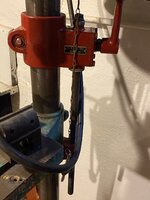
rg17, is it off the column yet? Or are you asking how to get it off and maintain it?
I have found the following to work for the Atlas lifts I was lucky enough to get. Once the headframe is off, lock the bottom lift collar, and unlock the top. If it easily turns, rotate the handle so that the top collar assembly rises up and once the screw clears the bottom collar, lift it off the column. Then remove the table, then the bottom collar.
If it does not turn freely, remove the four bolts on the upper gearbox and expose the gearbox. You may find 50 years of sawdust, grime and dried grease inside that needs cleaning and then get enough fresh grease, or PB blaster on the gears so that it will freely turn. To be able to then crank it up and off the bottom collar, you will then have to reassemble the gearbox so that the handle and newly cleaned handle gear will re-engage the threaded post gear.
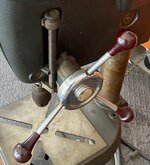
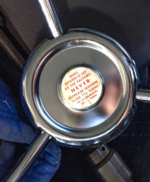
The first attached pic was from a 1940s Atlas made DP I bought with the attached head and table lift. The gears were frozen and opening the gear box showed 70 year old rock hard grease. I used a small pick, and simple green to remove the gunk so that it would turn and could be removed. The second pic shows how I greased up the gears once it was cleaned and going back on.
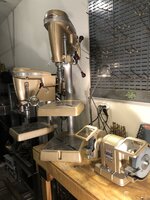
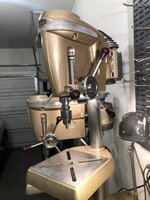
Frank had a very insightful observation about the thrust bearing you see riding atop the gear box in pics 3 and 4. The lift is actually a "head and table" lift, although most people use it exclusively to move the table up and down and not the head. Because of this, if you plan on primarily lifting only the table up and down, once you have it all apart and begin reassembly, put the thrust bearing on top as it will absorb the weight of the table as you lift it up and down. It's original location inside the gearbox (as shown in pic #1) was to absorb the weight of the entire head frame, motor, spindle assembly, etc. Finally, the 2 lock nuts on top should not be cinched down hard onto the thrust bearing but rather riding on top to allowing ease of turning. They should only be locked onto each other. You see that I have an acorn nut on top instead of the original lock nut. That's because this is easier to turn on and off, and because Frank had one, and because it looks cool.
Last picture is the entire Atlas head and table lift, with all the parts visible, the paint is the original color.
Remember to lightly apply super lube or similar along the threads and all points of friction. I used Lucas red and tacky anti-seize grease for the actual gears. Good luck!