billymade
Well-known member
Maybe that was when the steel they used wasn't so SOFT! 


Heres something interesting
http://cgi.ebay.com/1950-Vintage-Craftsman-1-2-Inch-Ratchet-6-Piece-Set_W0QQitemZ190225716539QQihZ009QQcategoryZ4122QQssPageNameZWDVWQQrdZ1QQcmdZViewItem
Notice its the type without the cutout in the neck and a 1950 dated receipt is included
I emailed the Seller to ask if there's a "V" on that ratchet. I'm guessing there isn't, and we can move the dates to 1950 -1954 somewhere for the appearance of the indent (and probably the "V" code)...
 )... The Seller responded saying the receipt was dated May, 1950 and the ratchet is indeed a "V"-series.
Sorry Gary, but some of this is not accurate...
It sounds like you're describing MDF, Easco, & Danaher as separate, concurrent companies rather than essentially a single, continuous entity. Now, obviously, they were 3 different companies, but for our purposes - trying to determine the manufacturers of Craftsman products - they are for all intents & purposes a single concern. At least, this is my understanding!
Easco Hand Tools purchased Moore Drop Forging in 1968, so I don't know how they "dropped out of the picture about 1986". The actual original MDF only closed its doors within the past 3-4 years, IIRC, but was still a part of Easco/Danaher.
I've also never encountered your lack-of-capacity theory to explain the Taiwanese Stanley ratchets before. Is that speculation or have you discovered something? I always assumed it was an attempt to reduce costs by producing in a lower-wage country rather than a capacity problem...
And Easco certainly produced ratchets for Sears. We've been discussing the fine-tooth, round-head Easco/Craftsman twins all day in the EASCO ratchet thread!
LG,
Sorry it's taken so long to get back to you but I've been busy with other matters. Let me respond to your concerns in the order that you have presented them:
1) Are MDF, Easco, and Danaher 3 seperate companies or 1 evolving company. I think a case can be made for either view and I think it remains to be seen which view is correct or more correct. Further, I'm willing to change my view if the evidence leads me there.
2) Did Easco purchase MDF in 1986? No, Easco purchased MDF in 1968. So yes I stated it incorrectly. Was it because I didn't know the correct date? No, I simply transposed the date as I was writing...my bad!
3) Do I have a lack-of-capacity theory? Yes and no; there is such a theory but it ain't mine. In fact, this lack-of-capacity theory goes back to MDF and continued with Easco. I found newpaper article (New York Times or Washington Post) that included an interview with the president of MDF just before Easco acquired them. When asked why MDF was being sold, the president indicated that the problem was not a lack of tool orders, but rather a lack of productivity and cost issues. He went on to say that MDF had a history of unfilled orders at the end of several recent years. He then went on to say that MDF was then currently running 2 shifts per day, 6 days per week, and was unable to meet demand. He didn't address the issues of a third shift and/or a 7th day. I'm guessing MDF had considered these options and rejected them on the basis of cost and profitablility.
I ran across a similar series of posts regarding Easco on a tool/machinery website. There was a thread on the demise of Easco-made Craftsman tools with a post by a former Easco employee. He summarized the situation as follows: Easco was up for a contract renewal with Sears. Sears was well aware of Easco's productive capacity. Sears wanted something on the order of 1.2 million tools per year and Easco's existing capacity was something on the order 650 thousand tools per year. Sears demanded, as a condition of the new contract, that Easco develop a plan that would demonstrate their ability to increase tool production to the 1.2 miilion tool level over an 18 month period. The former employee of Easco said he was hired for the specific task of developing this plan. He said the obvious fixes (i.e. more workers and more machinery) were not feasible because there was no available room in the Easco facilities and because it would have increased the tool costs beyond contract levels. Long story short, he came up with a method that significantly reduced the down time on existing equipment. He sold this plan to Easco and Sears management. The contract was issued to Easco, which carried them over until Easco was acquired by Danaher. He didn't say how well the plan worked over the long run, but given the acquisition of Easco by Danaher, the "big fix" was likely a temporary fix.
Is this definitive proof of lack-of-capacity during the 1980s and early 1990s. No, but it is suggestive and plausable.
4) Did Easco provide ratchets to Sears? If you read my post carefully, you should have noted I did not say that Easco didn't provide ratchets. I said, I (personally) was not sure if Easco provided ratchets. I'm open to the possibility, but I personally think there are a lot of unanswered questions on the Easco connection.
Thanks MADD, that was interesting reading but it was anything but light. Why was this contract and amendments filed with the SEC. Is this normal practice or was there some "special situation" that required the filing? I've run across other SEC filings by tool companies and always wondered.
MADD,
Did you see my comment/question in post #94 regarding 1980's EE series ratchets and the possible connection to National Tool Corp/Stanley?
Do you know anything about NTC, their acquisition by Stanley, or a possible link to the EE series code?
Do you have, or have you ever run across, any of the following EE ratchets (PN's 43772, 43582, & 43771)? Just asking because you seem to have a knack for the obscure.
__________________
moved from the Easco ratchet thread to try to keep that one on topic:
I do not know much about NTC but I would say that Stanley was the likely OEM for those tri-wing Craftsman ratchets. I have a Master Mechanic socket set from the mid 90s that has extremely similar looking ratchets with no country of origin marked. The sockets that came in the set are marked USA and are identical (other than brand) to a set of Stanley Professional branded sockets I have from the same time period. Those tri-wing round head ratchets are different from all of the ratchets that are from the companies now owned by Danaher so I would say that Stanley is more of an informed guess for the EE marking. I have never seen any evidence to indicate that any Easco related Craftsman tool had a EE marking on it. I think someone just guessed at that one based on Easco being the major contractor and having a name that begins with E.
It is certainly likely that Stanley made those Tri-Wing ratchets for C-man. I would like to find out the truth one day.
While I agree that we don't know for sure if Easco made the EE series, I am far less skeptical than you are about this. If Stanley made the EE series, why have I never seen a Stanley socket with the same chrome color as the EE series? I have some NOS Easco universal sockets somewhere and IIRC they most resemble the EE series.
I was going through an old box of wrenches and came across a 9mm combination wrench marked: "9mm Chrome Molybdenum BF Japan" on one side and "9mm = CRAFTSMAN =" on the other. I have never had a Japanese Craftsman wrench, but I'm sure it's probably not so uncommon for certain time frames. There is also an upside down "C9" on the wrench.
a390st,
Thanks for the post and heads up. We do have the BF series code on our list, made in Japan, possibly by Hozan, during the period 1969-1987. This code has been found on open end and combination wrenches. I have two sets of these wrenches. They are the standard raised panel, V series, design that Craftsman has used for years; the only difference I can see are: the alloy they are made from is different, the chrome plating is different (a little brighter or whiter), and if you drop the tools on the floor, they have a different "ring". Otherwise, they are the same as V series tools and are of comparable quality.
Maybe you touched on this already, but I found some C-man pliers the other day at an estate sale that say "Japan" on them. The series code started with a B for sure, so it might verywell be BF.
Well, I was quite sure that you had seen them, but I didn't see it this thread. I probably missed it in all of these pages, but I wanted to chip in where I could. Thanks for the information.
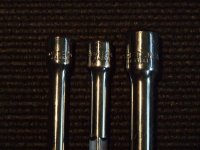
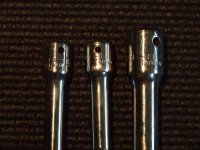
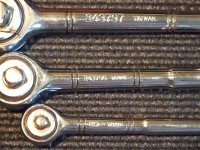
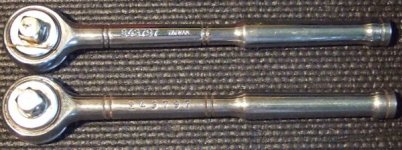
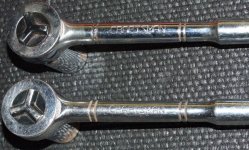
Here are some comparison pictures of the Taiwanese 1/2" ratchet, 43797, alongside the same-numbered made in USA version which I believe was purchased when I got out of college in 1990, either as a graduation gift or among my first tool purchases.
Hope this helps!
Best,
Joel

Here are some comparison pictures of the Taiwanese 1/2" ratchet, 43797, alongside the same-numbered made in USA version which I believe was purchased when I got out of college in 1990, either as a graduation gift or among my first tool purchases.
Hope this helps!
Best,
Joel
I remember those ratchets coming is a zippered vinyl case with a ratchet and socket set all in one.

I'm pretty sure both were made in Taiwan...
...I was just thinking that maybe there is a chance they were made in the USA for a time. Either that, or they were warned, and started putting Taiwan on them before they got in trouble.
heelsroll,
Thanks for the posts and photos. Your Taiwanese tool set photos have cleared up an issue we had with the E and EE series tools. I think we can now safely say that the E/EE series tools were not manufactured by Easco. And because of the ratchets, we can now reasonably link the E/EE series to Stanley.
Unless someone can provide a persuasive argument that the E/EE series were not made by Stanley, I'm going to update our working list and change the likely manufacturer to Stanley.
Sorry, but you lost me. I can sorta see how you made that determination about the E series, but how did you determine the EE series was made by Stanley as well? Plus, it seems odd to me that the E series was made in Taiwan, but the EE series says Made in the USA. Of course, I'm assuming that the EE series would have come after the E series. I'm going by their past history on this one. (G,G1,G2...)
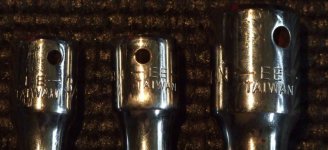
My pictures were a little unclear, here's a close-up of the extensions showing series EE and Taiwan.
J
Thank you sir, I can see where he was coming from now.
Ok then, playing devil's advocate here, I can see C-man not putting a country of origin on some of their E series stuff to disguise that they were made overseas, but I don't understand why they put Made in the USA on some of their EE series sockets if they were made by Stanley overseas. Is it that part of this series was made by Easco in the USA, and then production of some of the EE series stuff was filled in by Stanley? We all know that C-man contracts different items to different manufacturers, and then even contracts the exact same item to different manufacturers. Bottom line, I'm not ready to rule out another manufacturer besides Stanley.
heelsroll and 64merc,
64merc makes a good point, some of the EE tools are marked made in the USA. I own a set of EE impact sockets marked made in the USA. It's possible that Stanley had facilities in both countries at the time. That is, they may have moved some of their production at one point in time, and then completed the migration at a later point in time. This of course, is speculation, but it is reasonable and plausable. This seems more plausable to me than the two manufacturer/one code explanation. Bottom line, though, given Sears history, we've got to remain open minded and see where the evidence takes us.
I'm interested in the same info...
The first Craftsman "series" seems to have been C, and they appear to have run from the late 20s through the mid-to-late 30s.
You're right that the BE and H series tools were concurrent. The BEs may have been slightly earlier than the Hs... This theory is supported by the type of Craftsman logo on the tools; the underlined-C logo is present on all BE tools, while the H tools have either the underlined-C logo or the newer double-line logo. These two series ran from roughly 1934-47.
The 1947 catalogue shows both the older New Britain-manufactured BE and H series as well as the new model line by Moore Drop Forging Co. that would become the V series.
I, too, have a recently-acquired vintage 1/4" ratchet set. Like you, my ratchet has no "series" marking (just the newish double-line logo), but the sockets in the set are all marked "V". I believe it is from the late 1940s since the sockets are also cold-broached! I have perused a PDF 1949 Mechanics Tools catalogue and my set appears therein; the ratchet looks like mine, but the sockets don't appear to be cold-broached, leading me to believe my set is from 1945-48.
The next catalogue year I have been able to find is 1954. By then, the ratchet is different and so is the box!
Moore Drop Forging Co. was acquired by Easco in 1968. Therefore, I would expect the V series (V, VV, and V-with-a-small-upside-down-V?) to have run from roughly 1945-68, when it would have been replaced by the E-series (which you didn't mention).
It was around this time too that the tools started being marked with part numbers. Does anyone have a V-series tool marked with a part number too? I don't know if such a thing exists, but if so, it's a later V-series.
Easco was bought by Danaher in 1990. Therefore I assume the Es and EEs ran from 1968-90 or thereabouts. E = "Easco"?
The Gs are the most recent (and current) series, and the "G" may stand for the Danaher plant in Gastonia, North Carolina.
Interesting!
I have a V series 1/4 ratchet marked 43175.
Willy
64merc,
As I said before, you make a very good point. Now you bring up a conspiracy. I love conspiracy; if you had brought this up from the git go, I would have agreed with you immediately.
More seriously though, I'm not ruling out your theory, I'm just sharing my "working theory" (subject to change with new and more compelling information) with you. If we ever get to the thruth of the E/EE series, you and I will probably be laughing our asses of at how wrong we both were.
Keep your theories coming and remember, it's not about me or you. It's about a bunch of folks collectively and incrementally mulling this series code thing over and moving towards consensus and something "resembling the truth".
Lauver, I was reviewing your list on post #69 (very well done BTW), and it looks like you left off G1 series code. I'd have to confirm, but I'm almost positive that I've seen this on a socket before.
Also, be aware that there is a G code and an upside down G code. I noticed this last night while looking at some sets that I pieced together from pawn shop tool bins. Except for this detail, the sockets look identical.
Lastly, I found a G series socket that is different that the other G series sockets I have. The engraving is much much deeper than the others and the color reminds me of the EE series of sockets. At first I was thinking that there was an EE series and then a "preliminary" G series made from the same basic tooling, but I was mistaken. I compared the strange 18mm G socket to the metric EE sockets and they are totally different. The EE series lacks the band of notches around the bottom, signifying that it is metric. Can I assume that the band was put on their somewhere between the EE series and the G series? Does this finding support my most recent theory of multiple manufacturers/same series code? Just food for thought.
Sorry if I am discussing something that has already been discussed. I got lost a long time ago.