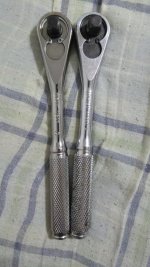
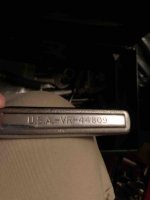
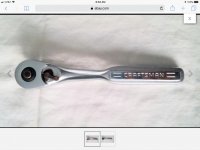
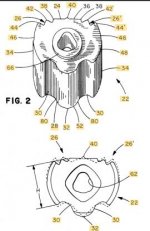
Thanks guys! If the V(x) codes are date codes here's what I've worked up using the code list and the teardrop ratchet study: there are 16 codes excluding A, B, C, D, I, O, X, Y, Z, and V because V was already in use. Theories numbers 1 and 2 rely on the assumption that V continued past 1986 at least in ratchets.
Theory 1: VE started in 1990, the QR gen 3 ratchets were actually out of production at the end of 1992 and were sold into '93 so Danaher and Sears could get rid of current stock and Danaher could focus production of the gen 4 ratchets in '93 so they would be ready for 1994. The letter codes would then continue until 2005.
Theory 2: VE started in 1991 and gen 3 ratchets were out of production in 1993. The letter codes would continue until 2005, but the VW code would correlate to 2006 because they planned for next year, so they produced some 2006 coded ratchets in 2005.
Theory 3: They aren't date codes and they are production run codes.
Based on what I found in my RHFT ratchet and Jim C.' teardrop ratchet research, the Vx code began about 1985-1986 with VE, so this predates 1990. The second letters are indeed sequential, and appear to change in rapid progression which hinted at being a year code. Todd F has an extensive collection of both RHFT and TD rats, and was able to help establish this sequence. We also found a few other notable changes that took place when Easco came under new ownership circa 1985-86 (such as FINALLY removing the oil port on the TD 1/4" to conform with its removal on the 3/8 and 1/2 years before), so this also ties in well with the code changes, especially since we can also see the two-character code commencing with this oil port's removal.
I didn't spend much time dwelling on this because my primary goal was to establish the various historical RHFT Types, but Vx certainly suggested a date code. My initial thought were they started with E instead of A for perhaps one of two reasons:
#1. Some of the letter combinations starting with A may have been too publicly established as to their meaning:
VA-Veteran's Administration (could also be why they introduced an inverted V for a second character instead of an A, since they used actual letters for all others)
VB- Visual Basic programming language (or simply skipped over as being bracketed by the others)
VC- Viet Cong
VD- venereal disease
I believe that VA, VC and VD all had a strong enough established public connotation to justify their omission. So VE might have been seen as the safest place to start.
I also surmised that "I" was skipped over because it would look too much like a number 1. O could have been skipped because of it looking too much like a zero (or Seagram's VO!). X, Y, and Z could have been eliminated simply because the number of years did not extend long enough to include them in a date coding system.
#2. it is a date code that theoretically starts back to 1981:
A-81
B-82
C-83
D-84
E-85 (first use?)
This seems weak at first because the evidence appears to point to 1986 as the start date for Vx. They may have started a date code system with E simply because of reason #1. However, the actual start date for Vx may indeed be 1985, and any single-V for 1986 might be NOS. If 1985 is the true start date for Vx, this system would work.
Going on Lesserstore's analysis that there are 16 total letter codes coupled with a V after the ones he mentioned are eliminated, and if we count 1985 as the first year of the Easco ownership change where the second letter may have been added late in that same year, we would have:
1985-VE
1986-VF
1987-VG
And so on through the 16th assignment (VW), which would be 2010. 2010 is the year that Danaher merged Easco with Cooper to form the Apex Tool Group, and shut down the Gastonia plant, and so may also represent the end of the Vx code.
This is all speculative, but I still believe there is some substance to reason #1, and the synchronicity between 16 unique secondary code letters and the 16 years of Easco changing hands to the beginning of Apex Tool as per #2 is too close to dismiss out of hand.