To avoid these ads, REGISTER NOW!

Craftsman Socket Evolution 1948-2024

BlakeTheCarGuy

ALLIANCE MEMBER
Joined
Oct 10, 2018
Messages
9,299
Location
Roanoke Virginia
Hmm. Never seen anything like that before, sure it's not custom?


It’s not at least that’s what I am guessing anyway. I have multiple ones like it some from different places like some from yard sales the rest from pawn shops. It’s the =V= series with the pointed A so I know it’s fairly old anyway I know they slightly changed the design over time with the V double line but not sure how much each time. Maybe this was only done for a limited time or maybe it’s when Sears contracted multiple producers at one time and that was the distinction for them maybe but I don’t know.


Sent from my iPhone using Garage Journal
 
To avoid these ads, REGISTER NOW!

le6920

Well-known member
Joined
Jan 17, 2008
Messages
266
Interesting. I have many of the =v= sockets and have never seen one with indents like this.


fa14fac4f90873de409c6e0b3057de98.jpg

f3a976392048ea20b3559f4aa8354436.jpg

Here you go this is what I mean this is a V double line socket pointed A and it has those indentions around the circumference of the socket. Have you found anything about that model yet because I have some like that which don’t have it but I have a few that have it.


Sent from my iPhone using Garage Journal
 

BlakeTheCarGuy

ALLIANCE MEMBER
Joined
Oct 10, 2018
Messages
9,299
Location
Roanoke Virginia
Interesting. I have many of the =v= sockets and have never seen one with indents like this.


Yeah I have found several used ones in my area like this. This one was just the first one I found in my sockets I picked up some at the pawn shops, estate and yard sales and everything so I don’t think it’s custom my buddy has one like this too he bought at a swap meet in a different state so I have no doubts that it was made in the factory like this.


Sent from my iPhone using Garage Journal
 
OP
L

Lesserstore

Well-known member
Joined
Mar 18, 2020
Messages
863
Location
Texas
Here's a theory that just came to me: What if it was an attempt by Sears to make it easier to pull the socket off the non quick release ratchets? It reminds me of scalloped cuts in wood stocks of old military rifles to make it easier to pull barrel bands off.
 

BlakeTheCarGuy

ALLIANCE MEMBER
Joined
Oct 10, 2018
Messages
9,299
Location
Roanoke Virginia
Here's a theory that just came to me: What if it was an attempt by Sears to make it easier to pull the socket off the non quick release ratchets? It reminds me of scalloped cuts in wood stocks of old military rifles to make it easier to pull barrel bands off.


It’s a possibility for sure. Or maybe they were transitioning between manufacturers or something and they did that as a mark to show which manufacturers made it maybe and I had found a picture of them a few months ago online but wasn’t able to find it again it was on a different forum and nobody had said anything about it.


Sent from my iPhone using Garage Journal
 

DadsTools

Well-known member
Joined
Jul 27, 2017
Messages
1,852
fa14fac4f90873de409c6e0b3057de98.jpg

f3a976392048ea20b3559f4aa8354436.jpg

Here you go this is what I mean this is a V double line socket pointed A and it has those indentions around the circumference of the socket. Have you found anything about that model yet because I have some like that which don’t have it but I have a few that have it.


Sent from my iPhone using Garage Journal
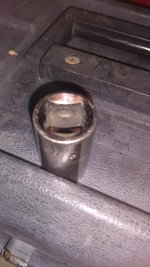
This socket is user modified. First, the circumference of every arch is different, or in other words, if you continued the curve of each arc to form a complete circle, each circle would be of a different size. That's way too sloppy for a factory job. Second, the divots don't appear to be chromed inside, a step that Craftsman would have almost certainly had made. And they would have beveled the edges so the chrome didn't start peeling.

As to finding one here and there on occasion, who knows how many people read an article in Popular Mechanics back in the day where the writer suggested this modification for some reason.

Throughout the years I've encountered multiple examples of end wrenches where the user filed these kinds of divots into the sides of the handles as owner ID marks. They were certainly not factory, and clearly more than a few mechanics came up with the idea independent of each other--I've seen examples dating back to the carbon steel tools of the 1920s. I think it's the more probable answer.
 
Last edited:

BlakeTheCarGuy

ALLIANCE MEMBER
Joined
Oct 10, 2018
Messages
9,299
Location
Roanoke Virginia
This socket is user modified. First, the circumference of every arch is different, or in other words, if you continued the curve of each arc to form a complete circle, each circle would be of a different size. That's way too sloppy for a factory job. Second, the divots don't appear to be chromed inside, a step that Craftsman would have almost certainly had made. And they would have beveled the edges so the chrome didn't start peeling.

As to finding one here and there on occasion, who knows how many people read an article in Popular Mechanics back in the day where the writer suggested this modification for some reason.

Throughout the years I've encountered multiple examples of end wrenches where the user filed these kinds of divots into the sides of the handles as owner ID marks. They were certainly not factory, and clearly more than a few mechanics came up with the idea independent of each other--I've seen examples dating back to the carbon steel tools of the 1920s. I think it's the more probable answer.


Very interesting it would make sense if they read it in a magazine or something as my friend has one too and I have a couple but mine were bought together at the pawn shop and I did find a picture on another forum it seems as it’s only this date code is the ones with it on there though maybe it was the time when they had seen it somewhere or something that this would of been the code they were using. Also maybe you can verify this too I read the =V= were not actually chrome they were a different metal with like a chrome plating on them cause lots of mine are peeling too so I was just wondering.


Sent from my iPhone using Garage Journal
 
Last edited:

DadsTools

Well-known member
Joined
Jul 27, 2017
Messages
1,852
Very interesting it would make sense if they read it in a magazine or something as my friend has one too and I have a couple but mine were bought together at the pawn shop and I did find a picture on another forum it seems as it’s only this date code is the ones with it on there though maybe it was the time when they had seen it somewhere or something that this would of been the code they were using. Also maybe you can verify this too I read the =V= were not actually chrome they were a different metal with like a chrome plating on them cause lots of mine are peeling too so I was just wondering.


Sent from my iPhone using Garage Journal
By the look of them, the divots are definitely user modifications. Nothing would have come out of Moore Drop Forging looking like that.

I'm not sure what you mean by a "date code". There are mfr codes that have proposed ranges of dates. If it's a Moore Drop Forge double-line V and Craftsman having pointed As, that could be anywhere from 1946ish to 1968-69. I looked at the 1968 catalog, says nickel chrome plated. 1960 catalog says chrome-plated. I'm sure you'll find similar in other catalogs. I've read that for a short period of time in the early 1950s, they were using cadmium, but they only did that for a couple of years. The socket in the photo is not cadmium.

Think about this: these notches are very prominent. If Sears designed this socket-defacing, it would have been for a very pronounced reason that would have to have been marketable in some way. They would have plastered this "improvement" all over the catalog socket pages. There are no such catalog references to any such divots on any period Cman sockets.

I still say the best bet is that they are owner ID markings using filed notches, a practice that goes back a long way.
 

BlakeTheCarGuy

ALLIANCE MEMBER
Joined
Oct 10, 2018
Messages
9,299
Location
Roanoke Virginia
By the look of them, the divots are definitely user modifications. Nothing would have come out of Moore Drop Forging looking like that.

I'm not sure what you mean by a "date code". There are mfr codes that have proposed ranges of dates. If it's a Moore Drop Forge double-line V and Craftsman having pointed As, that could be anywhere from 1946ish to 1968-69. I looked at the 1968 catalog, says nickel chrome plated. 1960 catalog says chrome-plated. I'm sure you'll find similar in other catalogs. I've read that for a short period of time in the early 1950s, they were using cadmium, but they only did that for a couple of years. The socket in the photo is not cadmium.

Think about this: these notches are very prominent. If Sears designed this socket-defacing, it would have been for a very pronounced reason that would have to have been marketable in some way. They would have plastered this "improvement" all over the catalog socket pages. There are no such catalog references to any such divots on any period Cman sockets.

I still say the best bet is that they are owner ID markings using filed notches, a practice that goes back a long way.


It probably is something the previous owner(s) did because on one of the other ones I have it has two notches right next to each other on there and not on each side like this one. But the rest are like this one. They are very smooth on the inside so someone took the time to do it right I just wonder how they could of done something like that if it wasn’t from the factory. And these might be the nickel ones or something they don’t have a model number or anything and are all 12 points and pointed A so I am guessing they are early ones.


Sent from my iPhone using Garage Journal
 

DadsTools

Well-known member
Joined
Jul 27, 2017
Messages
1,852
It probably is something the previous owner(s) did because on one of the other ones I have it has two notches right next to each other on there and not on each side like this one. But the rest are like this one. They are very smooth on the inside so someone took the time to do it right I just wonder how they could of done something like that if it wasn’t from the factory. And these might be the nickel ones or something they don’t have a model number or anything and are all 12 points and pointed A so I am guessing they are early ones.


Sent from my iPhone using Garage Journal
Double-line, pointed A, no model numbers, 1946 to 1968-69. You don't need to keep wondering how old they are. Those are the dates. This is common knowledge within the Craftsman collector community.

Someone apparently took the time to do them nicely. But the bottom of the socket shows enough irregularities to see they weren't done all THAT nicely. They're not even positioned perfectly symmetrical, The irregularities are proof this was NOT done in the factory.

Nickel Chrome is the plating--they are not nickel sockets.

Those notches can be cut by a variety of means. Anyone having even a dremel tool or similar could do it. Or a skilled filer. Or a cutting wheel. They were definitely cut by hand. You don't have to wonder about that anymore either.

You need to go look at some old Craftsman catalogs and get schooled on the sockets. They're online to be found.
 

BlakeTheCarGuy

ALLIANCE MEMBER
Joined
Oct 10, 2018
Messages
9,299
Location
Roanoke Virginia
Double-line, pointed A, no model numbers, 1946 to 1968-69. You don't need to keep wondering how old they are. Those are the dates. This is common knowledge within the Craftsman collector community.

Someone apparently took the time to do them nicely. But the bottom of the socket shows enough irregularities to see they weren't done all THAT nicely. They're not even positioned perfectly symmetrical, The irregularities are proof this was NOT done in the factory.

Nickel Chrome is the plating--they are not nickel sockets.

Those notches can be cut by a variety of means. Anyone having even a dremel tool or similar could do it. Or a skilled filer. Or a cutting wheel. They were definitely cut by hand. You don't have to wonder about that anymore either.

You need to go look at some old Craftsman catalogs and get schooled on the sockets. They're online to be found.


Thanks for all the info I love the Craftsman forums here and everything I will take a look at some catalogs for sure and I’ll let my friend know the info too. I’m glad to know the history and everything. Thanks.


Sent from my iPhone using Garage Journal
 
OP
L

Lesserstore

Well-known member
Joined
Mar 18, 2020
Messages
863
Location
Texas
Update 9/9/20
I added sections in all parts describing, to the best of my ability, the manufacturing processes used. Also, since I did this on my phone, the pictures maybe sort of wacky until I adjust them on my computer.
 
OP
L

Lesserstore

Well-known member
Joined
Mar 18, 2020
Messages
863
Location
Texas
I have a question: would V, VV, an G series ever be mixed in a socket set? I wouldn't be surprised if V and VV were mixed since they came from the same factory, but would G ever be mixed in with them since they came from Gastonia?
 

BlakeTheCarGuy

ALLIANCE MEMBER
Joined
Oct 10, 2018
Messages
9,299
Location
Roanoke Virginia
I have a question: would V, VV, an G series ever be mixed in a socket set? I wouldn't be surprised if V and VV were mixed since they came from the same factory, but would G ever be mixed in with them since they came from Gastonia?


I found an old set at a yard sale once V and VV but not G I don’t believe it would be in the same set I have also found sets of just solid G so I don’t think they would of been mixed.


Sent from my iPhone using Garage Journal
 

BlakeTheCarGuy

ALLIANCE MEMBER
Joined
Oct 10, 2018
Messages
9,299
Location
Roanoke Virginia
Re: Part III ADDED Craftsman Socket Evolution 1948-2011

Do you know anything about the B series ones were they the stainless ones? I have a 4mm B series it doesn’t appear to be early so I am wondering.


Sent from my iPhone using Garage Journal
 
To avoid these ads, REGISTER NOW!
OP
L

Lesserstore

Well-known member
Joined
Mar 18, 2020
Messages
863
Location
Texas
Re: Part III ADDED Craftsman Socket Evolution 1948-2011

Do you know anything about the B series ones were they the stainless ones? I have a 4mm B series it doesn’t appear to be early so I am wondering.


Sent from my iPhone using Garage Journal

Never seen a B code. Have a pic?
 
OP
L

Lesserstore

Well-known member
Joined
Mar 18, 2020
Messages
863
Location
Texas
Re: Part III ADDED Craftsman Socket Evolution 1948-2011

IMG_4348.jpg
Here you go. This is the B code socket I was talking about.


Sent from my iPhone using Garage Journal

I can't find any craftsman 4mm socket that has those first 4 digits in the model number. Odd. Maybe it's a Canadian craftsman code/number?:dunno:
 

BlakeTheCarGuy

ALLIANCE MEMBER
Joined
Oct 10, 2018
Messages
9,299
Location
Roanoke Virginia
Re: Part III ADDED Craftsman Socket Evolution 1948-2011

I can't find any craftsman 4mm socket that has those first 4 digits in the model number. Odd. Maybe it's a Canadian craftsman code/number?:dunno:


Possibly I got it at the pawn shop one time. I was told it might be one of the stainless steel ones. It doesn’t say USA so it could be made anywhere it also is not the pointed A style so I know it’s later. Let me know if you are able to find out anything else.


Sent from my iPhone using Garage Journal
 

BlakeTheCarGuy

ALLIANCE MEMBER
Joined
Oct 10, 2018
Messages
9,299
Location
Roanoke Virginia
Re: Part III ADDED Craftsman Socket Evolution 1948-2011

I can't find any craftsman 4mm socket that has those first 4 digits in the model number. Odd. Maybe it's a Canadian craftsman code/number?:dunno:


The complete model number is 42431 on the socket. When I try to search for it on Google all that comes up is 9mm wrenches so I don’t know.


Sent from my iPhone using Garage Journal
 
OP
L

Lesserstore

Well-known member
Joined
Mar 18, 2020
Messages
863
Location
Texas
Updates to Part II-
Factory closure timeline section added, more G series information as well.
Some questions came up as well. I have a theory as to why VV series exists, but I want to ask before I put it in the article. I think VV might be a code for the Arkansas plant since the plant opened in '69 and VV was started around '74. My theory as to why it took 5 years to introduce VV is because it took time to tool up. What do y'all think?
Another theory I came up with is about the K2 and K2D series. My theory is that they were paired with the craftsman premium 84t ratchets that were sold from 2010-15. But my question is, was Craftsman professional or industrial still USA after 2011? Because another part of my theory is that they were also sold under the professional and/or industrial lines post 2011.
 
OP
L

Lesserstore

Well-known member
Joined
Mar 18, 2020
Messages
863
Location
Texas
And if anybody has catalogs from '95-'05, can you tell me when their environmentally friendly (trivalent?) chrome plating was introduced?
 

DadsTools

Well-known member
Joined
Jul 27, 2017
Messages
1,852
Updates to Part II-
Factory closure timeline section added, more G series information as well.
Some questions came up as well. I have a theory as to why VV series exists, but I want to ask before I put it in the article. I think VV might be a code for the Arkansas plant since the plant opened in '69 and VV was started around '74. My theory as to why it took 5 years to introduce VV is because it took time to tool up. What do y'all think?
Another theory I came up with is about the K2 and K2D series. My theory is that they were paired with the craftsman premium 84t ratchets that were sold from 2010-15. But my question is, was Craftsman professional or industrial still USA after 2011? Because another part of my theory is that they were also sold under the professional and/or industrial lines post 2011.
The use of the VV code signifying an alternate plant within the Easco empire seems to be the most viable hypothesis. It's highly unlikely that Sears would have assigned a V maker code to any other company. It's also clear that the VV was used to distinguish something specific that was different than the single V, and an alternate facility makes a lot of sense.

During the V era, tools marked with the double VV are always a 'minority' code, being far less in number than the identical tools marked with the single V. Jim C., who composed the extensive Craftsman Teardrop Ratchet study, believes that the VV was employed by another facility to produce additional product when the demand was too great for the main V factory to fill. I'm on-board with that. During my research in the RHFT study I uncovered the documentation for the the Roberts-Sears lawsuit, which revealed the staggering numbers of the quick-release ratchets that were being made and sold each year. It's easy to imagine how a single factory might not be able to handle the volume.

However, please be aware that the date given by Lauver for the start of VV (1974) is one of a number of inconsistencies in his list (not knocking him--it's a great accomplishment and a valuable resource and contribution). The VV code was actually used at least as early as 1968-69, as wrench examples exist with the double line =VV= and with no model numbers on the tool while also having the 'flat-A' (the RHFT study established the first use of a flat-A in 1968-69 and also finally established the first year of model numbers on the tools as 1970).

The 1968-69 first use of the double VV fits well with the 1969 date for the Arkansas factory. You may have something here.
 
Last edited:

BlakeTheCarGuy

ALLIANCE MEMBER
Joined
Oct 10, 2018
Messages
9,299
Location
Roanoke Virginia
Re: Part III ADDED Craftsman Socket Evolution 1948-2011

I believe it was 2011 the Craftsman Professional and Industrial went overseas along with the rest of the regular production as well. It may have been Taiwan instead of China but it did go overseas.


Sent from my iPhone using Garage Journal
 
OP
L

Lesserstore

Well-known member
Joined
Mar 18, 2020
Messages
863
Location
Texas
Re: Part III ADDED Craftsman Socket Evolution 1948-2011

I believe it was 2011 the Craftsman Professional and Industrial went overseas along with the rest of the regular production as well. It may have been Taiwan instead of China but it did go overseas.


Sent from my iPhone using Garage Journal

According to Todd's Craftsman Professional and Industrial wrench case study, Craftsman Industrials were USA until 2015, and he even had boxes with either manufacturing or packaging dates of 2015. So I figured if premium ratchets and industrial wrenches were USA until 2015, surely there had to be sockets along with them.
Reply #57
http://www.papawswrench.com/vboard/index.php?topic=25550.45
 
OP
L

Lesserstore

Well-known member
Joined
Mar 18, 2020
Messages
863
Location
Texas
The use of the VV code signifying an alternate plant within the Easco empire seems to be the most viable hypothesis. It's highly unlikely that Sears would have assigned a V maker code to any other company. It's also clear that the VV was used to distinguish something specific that was different than the single V, and an alternate facility makes a lot of sense.

During the V era, tools marked with the double VV are always a 'minority' code, being far less in number than the identical tools marked with the single V. Jim C., who composed the extensive Craftsman Teardrop Ratchet study, believes that the VV was employed by another facility to produce additional product when the demand was too great for the main V factory to fill. I'm on-board with that. During my research in the RHFT study I uncovered the documentation for the the Roberts-Sears lawsuit, which revealed the staggering numbers of the quick-release ratchets that were being made and sold each year. It's easy to imagine how a single factory might not be able to handle the volume.

However, please be aware that the date given by Lauver for the start of VV (1974) is one of a number of inconsistencies in his list (not knocking him--it's a great accomplishment and a valuable resource and contribution). The VV code was actually used at least as early as 1968-69, as wrench examples exist with the double line =VV= and with no model numbers on the tool while also having the 'flat-A' (the RHFT study established the first use of a flat-A in 1968-69 and also finally established the first year of model numbers on the tools as 1970).

The 1968-69 first use of the double VV fits well with the 1969 date for the Arkansas factory. You may have something here.

Thanks I'll put VV as most likely being the code for the Arkansas plant in the wrench/socket articles later today.
 

BlakeTheCarGuy

ALLIANCE MEMBER
Joined
Oct 10, 2018
Messages
9,299
Location
Roanoke Virginia
Re: Part III ADDED Craftsman Socket Evolution 1948-2011

According to Todd's Craftsman Professional and Industrial wrench case study, Craftsman Industrials were USA until 2015, and he even had boxes with either manufacturing or packaging dates of 2015. So I figured if premium ratchets and industrial wrenches were USA until 2015, surely there had to be sockets along with them.
Reply #57
http://www.papawswrench.com/vboard/index.php?topic=25550.45


Interesting I didn’t know that. But that’s good to know.


Sent from my iPhone using Garage Journal
 
OP
L

Lesserstore

Well-known member
Joined
Mar 18, 2020
Messages
863
Location
Texas
Update- added the Springdale, Arkansas plant as the reason for VV series and added more info in detents to Part I.
 

Auctionhunter

Member
Joined
Apr 24, 2015
Messages
10
No. it usually comes down to Long C BE/(H)/(U)(K) and =V=. There's not too many people out there arguing for -VV- or EE etc. My take is that most of the =V= proponents have never really truly held a Long C tool in their hands and their opinion is skewed by emotion. The =V= line is what they think of as Grandpa's tools, Dad's tools, and the pinnacle of good old Made in the USA Craftsman "modern" production.

In order of priority what are the top 5 socket types? Long C, =V=, -V-, -G-, upsideown G ?
I ask for a reason, I am building a set from the odds one finds in Pawn Shops, thrift stores, and garage sales.
I am working to fill in the Craftsman Socket Draw organizers sold a few years back by sears ( see photo). I am using a list called Parts List for 311 piece socket accessory set #27034. I don't want the new stuff, I want to fill it with classic made in usa craftsman sockets.
Until I read this thread I was preferring sockets with 'made in usa' on them, I now see that the =V= is likely a better quality, although not marked 'made in usa', even though it was.
My frankenstein set is now about 1/2 complete. I haven't come across a single long C type, so what other types are the best in descending order of quality ?
Also, and suggestions about storing the Deep sockets? the organizers are just for STD types.
 

Attachments

  • sockettray.jpg
    sockettray.jpg
    89.1 KB · Views: 12

BlakeTheCarGuy

ALLIANCE MEMBER
Joined
Oct 10, 2018
Messages
9,299
Location
Roanoke Virginia
In order of priority what are the top 5 socket types? Long C, =V=, -V-, -G-, upsideown G ?

I ask for a reason, I am building a set from the odds one finds in Pawn Shops, thrift stores, and garage sales.

I am working to fill in the Craftsman Socket Draw organizers sold a few years back by sears ( see photo). I am using a list called Parts List for 311 piece socket accessory set #27034. I don't want the new stuff, I want to fill it with classic made in usa craftsman sockets.

Until I read this thread I was preferring sockets with 'made in usa' on them, I now see that the =V= is likely a better quality, although not marked 'made in usa', even though it was.

My frankenstein set is now about 1/2 complete. I haven't come across a single long C type, so what other types are the best in descending order of quality ?

Also, and suggestions about storing the Deep sockets? the organizers are just for STD types.


The V, -V- and =V= and long C and all the older stuff is the stuff people go after. I personally like all of it. I have a little bit of each and I can say any of the V is good the VV is as well. I’d steer clear of EE. As for the G series those are fine and upside down G as well I use them all as a professional mechanic and they are fine even the EE just the quality of the EE doesn’t feel the same and for some of the EE it was Taiwan. The stuff to really stay away from is the laser etched USA ones they are kinda junk I break a lot of those. The G2D laser etched with the date stamp are fine it’s just the plain laser etched ones that aren’t any good. As for deep socket organizers I use ones that have shallow and deep from Rural King and they work absolutely amazing.


Sent from my iPhone using Garage Journal
 
OP
L

Lesserstore

Well-known member
Joined
Mar 18, 2020
Messages
863
Location
Texas
I would skip Easco G series as the chrome on some seems to peel more frequently on those and some have very thick walls as well. I would skip the long C craftsman stuff just because they are very old and not common (at least in my area). V and VV are good with their thin walls, although you will occasionally come across some very late V series with thick walls. Modern sockets, Danaher G series onward, are good because they do have flank drive, but a downside to some people is that G1 and later have double detents. If you want flank drive but not the double detents, G series and early GK series is the way to go. The easiest way to tell an Easco G series from a Danaher upright G is to look at the detents in the drive end. Easco will have a vertical slot, while Danaher will have oval detents.
 

Attachments

  • 16023518650384891438350468594269.jpg
    16023518650384891438350468594269.jpg
    72.9 KB · Views: 17
  • 16023520470013954489674417926788.jpg
    16023520470013954489674417926788.jpg
    53 KB · Views: 21
To avoid these ads, REGISTER NOW!
Top Bottom