
You are using an out of date browser. It may not display this or other websites correctly.
You should upgrade or use an alternative browser.
You should upgrade or use an alternative browser.
Cree T8 4ft LED Review
- Thread starter Denwood
- Start date
I'm with the team that saves the most energy, and provides reasonably accurate CRI light  Trying to replicate sunlight exactly is obviously a monstrous challenge. I think it's great that a lot of R&D is going into making LED lights the best they can be.
I'm very interested in E36jon's review of the Cree LS4 here: http://www.garagejournal.com/forum/showthread.php?t=277492
One of the items I really appreciate is what's being done with low voltage dimming and "daylight" harvesting where the lights dim when sufficient window light dictates it. We have a pile of Wattstopper ceiling sensors (like 30 of them!) here that hold banks of the TL-950s off (for example in our interior hallway which is entirely lit by Solatubes on a bright day) but they are bank specific. Having that tech on each light (and have them communicate) has great energy savings potential.
Trying to replicate sunlight exactly is obviously a monstrous challenge. I think it's great that a lot of R&D is going into making LED lights the best they can be. I'm very interested in E36jon's review of the Cree LS4 here: http://www.garagejournal.com/forum/showthread.php?t=277492
One of the items I really appreciate is what's being done with low voltage dimming and "daylight" harvesting where the lights dim when sufficient window light dictates it. We have a pile of Wattstopper ceiling sensors (like 30 of them!) here that hold banks of the TL-950s off (for example in our interior hallway which is entirely lit by Solatubes on a bright day) but they are bank specific. Having that tech on each light (and have them communicate) has great energy savings potential.
Last edited:
Electric_Light
Well-known member
- Joined
- Jan 3, 2015
- Messages
- 74
I'm with the team that saves the most energy, and provides reasonably accurate CRI light
I'm very interested in E36jon's review of the Cree LS4 here: http://www.garagejournal.com/forum/showthread.php?t=277492
One of the items I really appreciate is what's being done with low voltage dimming and "daylight" harvesting where the lights dim when sufficient window light dictates it. We have a pile of Wattstopper ceiling sensors (like 30 of them!) here that hold banks of the TL-950s off (for example in our interior hallway which is entirely lit by Solatubes on a bright day) but they are bank specific. Having that tech on each light (and have them communicate) has great energy savings potential.
Hello Denwood, I guess I am confused here. Lamps such as C50 and TL950 are specialty lamps exempt from the efficiency standards and they're used in museums, graphic arts industry and such. These lamps are not specified for just "reasonably good color". Why are you using graphic arts lamps if you only need "good enough" ?

0-10v dimming is not an LED attribute. It's the driver. You can select this option for fluorescent or LED, but you have to select a driver or a fixture with a driver that supports it. Since places like CA now require dimmable lighting in commercial lighting code, dimming ballasts are coming down in price thanks to mass production. The efficiency is comparable with non-dimmable ballasts in latest models.
To cut it short, LED products aren't even in the same league as those lamps nor are they meant to be. LEDs can compete in the game with CFLs and U-bent lamps(which is going out of style anyways...) as these lamps are quite costly. CFL is the primary target since their efficiency is quite low and they have a long term lumen loss that LEDs have a fair chance of game against. CFLs get such a poor efficiency mainly because of trapped light since the tubes or the spiral point into each other.
CRI is just a standardized number that offers more objective view than mushy gushy sales rhetorics. I suppose we can say that CRI is a consumer lexicon these days holding about the same significance as relating powerful with the SAE J1349 horsepower rating on cars. We know that it's a marketing lexicon that means that it can produce the value when tested per SAE J1349 and the power is allowed to be somewhere in the sky high RPM that prevents it from getting utilized when used as intended.
When people want "reasonably good color" high efficacy lighting, we use spec grade bulbs like F32T8/741 (CRI 70-79, generally 78) or RE80 F32T8/841 (80-89, generally 82-86). The more significant reason for using RE80s is that they hold their light output as well as efficiency without needing the ballast to boost the power over time to make up for the performance loss like it is done with LEDs. They can get 100 LPW and remain at 92-93 LPW for the life of the lamps which can go over 50,000 hours including ballast losses. 50-95% of these lumens are utilized by the fixture. This is completely dependent on the fixture design. The high efficiency types commonly used for commercial lighting are often in the 90s.
C50 bulbs having a 90 CRI aren't used in places of F32T8/850 rated at 86 CRI for the four points of CRI as you take close to a 40% hit on efficiency. TL950 is the same deal. They have a very good actual color rendition and make high kelvin light that incandescent lamps can not make. High efficacy T8 lamps like 32W F32T8/841/HL with 3,100 rated lumens and 85 CRI or 2,500 lumens for the identical sized lamp rated at 25W. The TL950 is a full wattage 32W lamp that's only rated at 2,000 lumens. This is not the level of compromise users will accept for "reasonably good color".
Sylvania makes a full range of full 32W 2450 lumen 90 CRI. Same CRI as C50, but they don't render the color as well. They're compliance lamp that produce an acceptable lumen level in place of banned spec grade 741 lamps. Our government says they must meet 88-89 rated lumens per watt unless the CRI score is 90 or better. Despite the higher "CRI" these lamps do not cost as much as RE80s.
Although marketing wouldn't phrase it like that, above mentioned "compliance bulbs" or 90+ CRI LED lamps are not meant to provide realistic color rendition performance competitive with color critical lamps like TL950 you're using or C50. 90+ CRI spec score is a marketing ploy from the LED industry to sway specifiers to select LEDs. The lighting giants GE, Philips and Sylvania have CMH, LED fixtures, screw-in LED, fluorescent and practically anything you can name that makes light. Philips and Sylvania have 4' T8 shaped LED bulbs in various flavors just like CREE. LEDs have their place like refrigerated areas and when NSF shatter proof requirements have to be met as well as clients who are adamant about using LEDs.
In contrast, Cree only sells LED, so their clear motive for their clear technology bias towards LEDs is clear. The three are basically competing against each other + C, while the Cree is putting a fight against them and the "evil fluorescent" in general.
DLC QLP MINIMUM requirements is 1,600 lumen per lamp, 80 CRI or higher.
The actual output is a big challenge for LED drop-ins as LEDs become less efficient the harder you run them. CREE's 2,100 lumen takes a crack at meeting the phased out 700 series lamps operating on standard 88% output. You'll see in CREE's PDF that it's only a drop in replacement for 48" T8 25W which produces 2,200 lumens on a standard output ballast.
http://www.ledsmagazine.com/article...proved-performance-but-lumen-output-lags.html
When high lumens are needed, T8s can be driven harder with a "high light" ballast. You can drive six 3,100 lumen lamps in a 2 x 4 space for 21,000 lumens, or six T5 54 HOs for 30,000, eight T5s for 40,000.
When exceptional color renditions are needed in addition to just padding the CRI score, halogen, C50 fluorescent or ceramic metal halide lamps are used. LEDs can be used in place of CMH when you only can compromise with "good enough" rendition in exchange for higher efficiency since LEDs make a better use of light in spot lights.
I'm using TL-950s because I've standardized that bulb across my business. We manufacture equipment for the film industry with very high standards, therefore even variations in black anodizing during assembly need to be recognized. My team prefers this light, so for my shop, I've gone with the same. If I had used a different tube more in the 3000lumen range, the CREE would have tested a fair bit dimmer. My main lighting will remain in that 98CRI range at the expense of some lumens and watts both in terms of psychology in the shop (it's a place where I test, tinker and unwind) and accuracy when doing automotive painting. For over bench lighting, it's likely going to be 5000K 94 CRI CFL because I have a case of them.
Our film studio is equipped with several types of lighting (including purpose designed LED) but our goto lights are ProFoto 800 HMIs. These run $6K each, but are well equipped with light shaping tools. They also eat HMI bulbs at $200 a pop.
I would agree that the trade off between watts/lumens still favors flourescent, however that will change shortly I'm sure.
Our film studio is equipped with several types of lighting (including purpose designed LED) but our goto lights are ProFoto 800 HMIs. These run $6K each, but are well equipped with light shaping tools. They also eat HMI bulbs at $200 a pop.
I would agree that the trade off between watts/lumens still favors flourescent, however that will change shortly I'm sure.
Electric_Light
Well-known member
- Joined
- Jan 3, 2015
- Messages
- 74
For over bench lighting, it's likely going to be 5000K 94 CRI CFL because I have a case of them.
Just one point. Very high CRI phosphors don't age well under heavy load. Take a CFL and pretend to stretch the bulb out into a straight piece and visualize the surface area inside the tube vs the wattage. You'll see that it's very high. CFLs run a very high watt density so you can fit the output into the size constraints. CRI score might be high, but don't equate that to rendition quality. Without having a spectral power distribution, we can't tell. Many no-name foreign made lamps also do not live up to specs.
Our film studio is equipped with several types of lighting (including purpose designed LED)
Those purpose designed LEDs are very expensive and they're almost cost no matter projects within a reason. Those LED studio lights use many different LEDs to cover the entire spectrum to avoid the flaws I talked about. The ones we're talking about in the threads are fluorescent lamps using blue LEDs and fluorescent powders.
Solid state fluorescent lamps like the Cree white LEDs actually have eight or so LED chips per pierce and smothered in a yellow phosphor. Special lights may look similar on the outside, but configured with different colored LED chips within each package that can be addressed separately with the balancing lined together using intricate calibration settings. I would argue that they're different enough to the point of calling them different technologies.
I would agree that the trade off between watts/lumens still favors flourescent, however that will change shortly I'm sure.
There are two parts to lumens per watt. First part is the watts of light per watt of electric input. Second is the lumen for each watt of light. The second part is entirely because of the sensitivity difference in our eyes. The second part is the overwhelming limits with wide spectrum lamps that produce light over the entire visible spectrum + slightly into the UV rather than merely padding up the CRI score. The second part can not be changed by technology. When you craft up LEDs to not just pad the CRI score, but match the entire spectrum of C50 or TL950, efficiency plummets.
The reason sodium lights are so efficient is because they put out light where they line up very well with where our eyes respond well to. You said you use them for anodizing quality inspection. This is an application where what I said is very very very relevant. Pick up a box of that Triscuit and do the challenge. It's not like I'm asking you to spend a bunch of money. You'll be out $3 at the worst.
The difference is so clear and obvious that you'd be like damn... unless you're color blind.
There's no bias of any sort in pushing the importance of watt consumption spread over the expected life. I don't see how anyone can find using brand new condition performance acceptable especially when the performance loss is disproportionately larger than competing technologies. Energy retrofit SALES are probably only concerned with setting a good first impression. They have no interest in long term quality. If you bought a fleet of vehicles, get 25mpg the first month, but the entire fleet average drops to 17.5mpg near the end of warranty, who wouldn't be livid?
Last edited:
Plat, before doing this review, I actually did not realize how much of a hit the TL-950 takes in terms of lumens. I'm tempted to try these out: http://www.bluemaxlighting.com/product_180_detailed.htm
The CRI rating is a fair bit lower at 91 at 5000K, however lumens is up from 2000 on the TL-950 to 3300 per bulb on the "Maxum 5000" bulb.
The other thing I'm thinking is to use some of these higher output bulbs at the business location and running one instead of two in the fixtures where it makes sense. Our monthly power bill is about $375 (9500 square feet), and much of it is lighting. Do you have any thoughts on mixing CRI lighting? For example, a bank that uses the Maxum bulbs and TL-950. I wouldn't mix in the fixture itself (all two bulb, with Philips Advance electronic ballasts), just in the bank. We have virtually no switches in our building. All lighting is controlled by line level overhead WattStopper sensors: http://www.wattstopper.com/products/sensors/ceiling-or-wall-mount-sensors/dt-355.aspx#.VMEllC50bQs

I also see that the same company is now selling dimming photosensors to "harvest" natural light more intelligently. Right now, the above sensors are programmed in all parts of the building that see natural light. For most of the day, these lights stay off.
It's very cool to see our internal hallway (about 45 ft long) lit completely by three SolaTubes on a sunny day. The ambient programming on the wattstoppers holds these lights off, particularly Spring/summer/fall when solar azimuth is more favorable to the light tubes.
The CRI rating is a fair bit lower at 91 at 5000K, however lumens is up from 2000 on the TL-950 to 3300 per bulb on the "Maxum 5000" bulb.
The other thing I'm thinking is to use some of these higher output bulbs at the business location and running one instead of two in the fixtures where it makes sense. Our monthly power bill is about $375 (9500 square feet), and much of it is lighting. Do you have any thoughts on mixing CRI lighting? For example, a bank that uses the Maxum bulbs and TL-950. I wouldn't mix in the fixture itself (all two bulb, with Philips Advance electronic ballasts), just in the bank. We have virtually no switches in our building. All lighting is controlled by line level overhead WattStopper sensors: http://www.wattstopper.com/products/sensors/ceiling-or-wall-mount-sensors/dt-355.aspx#.VMEllC50bQs
I also see that the same company is now selling dimming photosensors to "harvest" natural light more intelligently. Right now, the above sensors are programmed in all parts of the building that see natural light. For most of the day, these lights stay off.
It's very cool to see our internal hallway (about 45 ft long) lit completely by three SolaTubes on a sunny day. The ambient programming on the wattstoppers holds these lights off, particularly Spring/summer/fall when solar azimuth is more favorable to the light tubes.
Last edited:
Electric_Light
Well-known member
- Joined
- Jan 3, 2015
- Messages
- 74
Plat, before doing this review, I actually did not realize how much of a hit the TL-950 takes in terms of lumens. I'm tempted to try these out: http://www.bluemaxlighting.com/product_180_detailed.htm
The CRI rating is a fair bit lower at 91 at 5000K, however lumens is up from 2000 on the TL-950 to 3300 per bulb on the "Maxum 5000" bulb.
The other thing I'm thinking is to use some of these higher output bulbs at the business location and running one instead of two in the fixtures where it makes sense.

These are 2450 lm and 90 CRI. It's actually better than 88 or 89 CRI of CWX. So, it can look like a "well rounded, superior product with a good color rendition and brightness" in layman's words, but it doesn't indicate anything but scoring higher on the standard eight sample average. The typical consumer would say overshooting the red is "better rendition" than "under shooting" on the red even if the amount of overshoot in red is high. Those high CRI fair lumen lamps have been around for a long time and marketed as extra ultra super high CRI performance bulbs.
The 3,300 lumen for a 32W lamp is hard to believe unless it's exploiting every loophole they can find.
An old lamp called WW is 3000K 53 CRI, but consumer finds it quite acceptable due to the pattern and direction of distortion despite getting a low score mathematically.
https://assets.sylvania.com/assets/Documents/FL113.d53ff75e-c6d2-4b61-89ca-5ade8976b7a0.pdf
Your not really getting it. It's a stupid marketing game. You gotta stop taking the "CRI" so literally.
Specifications can be written with good intent.
or they can have a built-in loop hole
or the loopholes maybe discovered
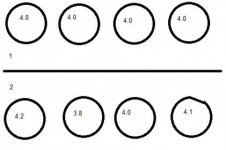
Say you furnish these requirements. The requirements are in the order of importance. Given the requirements are met, priority is given for better score for higher importance requirements.
-The average shall be 4.05 +/- 5%. This is what I would equate to "CRI". CRI uses eight samples, then only publish the average of the eight samples.
-No single sample shall fall outside +/- 10% of 4.05. Both sets fall within the requirements.
The set A is 4.00, set B is 4.05, so the set B actually scores higher based on your system. Can you tell me which set of rollers will give you more problems if you were to assemble them into an equipment?
You can exploit the loopholes to make the product completely unfit for the purpose while at the same time meeting specifications. Look at the 4th wheel on the second set. That is how I view the problem that is freshly created by LEDs in a way that was not thought about in the past.
Attachments
Last edited:
This is an excellent read (and a very balanced evaluation) of the t8 vs LED discussion. I was doing some searching on the long term energy footprint of both technologies factoring longer replacement times etc. : http://www.ledsmagazine.com/article...ds-vs-linear-fluorescent-debate-magazine.html
Electric_Light
Well-known member
- Joined
- Jan 3, 2015
- Messages
- 74
This is an excellent read (and a very balanced evaluation) of the t8 vs LED discussion. I was doing some searching on the long term energy footprint of both technologies factoring longer replacement times etc. : http://www.ledsmagazine.com/article...ds-vs-linear-fluorescent-debate-magazine.html
This too.
Page 8:
http://www.pnnl.gov/main/publications/external/technical_reports/PNNL-22727.pdf
Color shift. January 2014.
http://www.ies.org/lda/HotTopics/LED/20.cfm
Platonic Solid
Well-known member
That Bluemax bulb is certainly interesting. Assuming their figures are honest, the secret is in the phosphor blend. I think going from 98 to 91 CRI in the same room would be very noticeable especially considering the industry you're in. That doesn't mean you can't still save energy. Exactly what ballast are you using? I'd also like to know what fixture housing, reflector, lens, where is the ballast located in the fixture (might be easier to just open a fixture and post a picture).Plat, before doing this review, I actually did not realize how much of a hit the TL-950 takes in terms of lumens. I'm tempted to try these out: http://www.bluemaxlighting.com/product_180_detailed.htm
The CRI rating is a fair bit lower at 91 at 5000K, however lumens is up from 2000 on the TL-950 to 3300 per bulb on the "Maxum 5000" bulb.
The other thing I'm thinking is to use some of these higher output bulbs at the business location and running one instead of two in the fixtures where it makes sense. Our monthly power bill is about $375 (9500 square feet), and much of it is lighting. Do you have any thoughts on mixing CRI lighting? For example, a bank that uses the Maxum bulbs and TL-950. I wouldn't mix in the fixture itself (all two bulb, with Philips Advance electronic ballasts), just in the bank. We have virtually no switches in our building. All lighting is controlled by line level overhead WattStopper sensors: http://www.wattstopper.com/products/sensors/ceiling-or-wall-mount-sensors/dt-355.aspx#.VMEllC50bQs
I also see that the same company is now selling dimming photosensors to "harvest" natural light more intelligently. Right now, the above sensors are programmed in all parts of the building that see natural light. For most of the day, these lights stay off.
It's very cool to see our internal hallway (about 45 ft long) lit completely by three SolaTubes on a sunny day. The ambient programming on the wattstoppers holds these lights off, particularly Spring/summer/fall when solar azimuth is more favorable to the light tubes.
Though I haven’t seen any studies to this effect, it seems logical that higher color rendering = better contrast, thus less lumen output should be necessary to achieve the same contrast from a 98 CRI fixture than a 91 CRI fixture. It would be nice to have a mathematical formula that equates CRI to lumen output.
If we could say that 1 CRI = 100lm of perceived light, then the difference would be 700lm. BlueMax doesn’t publish a mean lumen output, only an approximate 3300lm figure, so I’ll assume the mean or design lumens to be 3100lm – 700lm CRI penalty = 2400lm.
Your TL950 has a mean output of 1860lm. If you’re using a normal Ballast Factor (BF) ballast = 0.88, then you’re only getting 1637lm (1860 x 0.88). If you changed the ballast to a high BF = 1.15, then you’d get 2139lm. Now if we add a 95% specular reflector (assuming you’re not using one already) we can increase the light output another 10% to 2353lm.
Obviously I’m making lots of assumptions about your ballast, your fixtures, and taking a lot of liberties with my 1 CRI = 100lm guestimate, but I think this warrants deeper research.
Last edited:
Platonic Solid
Well-known member
None of the above. Our company is a small privately owned business with no allegiance to any outside corporation. I use components from all of the above, plus Cooper, Hubbell, Lutron, Epistar, ... the list is really endless. I prefer to maintain some anonymity.So can everyone DISCLOSE which "team" they're on in ******* match ??
a) CREE
b) Philips
c) Sylvania
d) GE
e) others ?? (list specific company)
(now back: "On Topic")
My understanding of the tech that fluorescent manufacturers implement to attempt duplication of solar spectra is that there are a lot going on with phosphor coatings etc. under the hood. They're generally proprietary which means a correlation between CRI and lumens would be moving target. Kino-Flo has been around for some time in the flourescent lighting for cinema area. They have quite a few specialized bulbs:
http://www.kinoflo.com/PDF/News/Literature PDF/2014 Kino Flo Catalog PDF Sections/Kino Flo Lamps.pdf
They do several color temps (2900, 3200, 5500) and list spectra for them. Their 5500K 32wT8 is listed at 2040 lumens, so it looks like very similar to the TL950 I'm using.
With regard to the mixing CRI/bulb question, here is the information for both my shop, and a much larger install at Cinevate.
The fixture we're using: http://www.pioneerlighting.com/new/index.php/surface/78-wraparound
Ballast they use:
http://www.kinoflo.com/PDF/News/Literature PDF/2014 Kino Flo Catalog PDF Sections/Kino Flo Lamps.pdf
They do several color temps (2900, 3200, 5500) and list spectra for them. Their 5500K 32wT8 is listed at 2040 lumens, so it looks like very similar to the TL950 I'm using.
With regard to the mixing CRI/bulb question, here is the information for both my shop, and a much larger install at Cinevate.
The fixture we're using: http://www.pioneerlighting.com/new/index.php/surface/78-wraparound
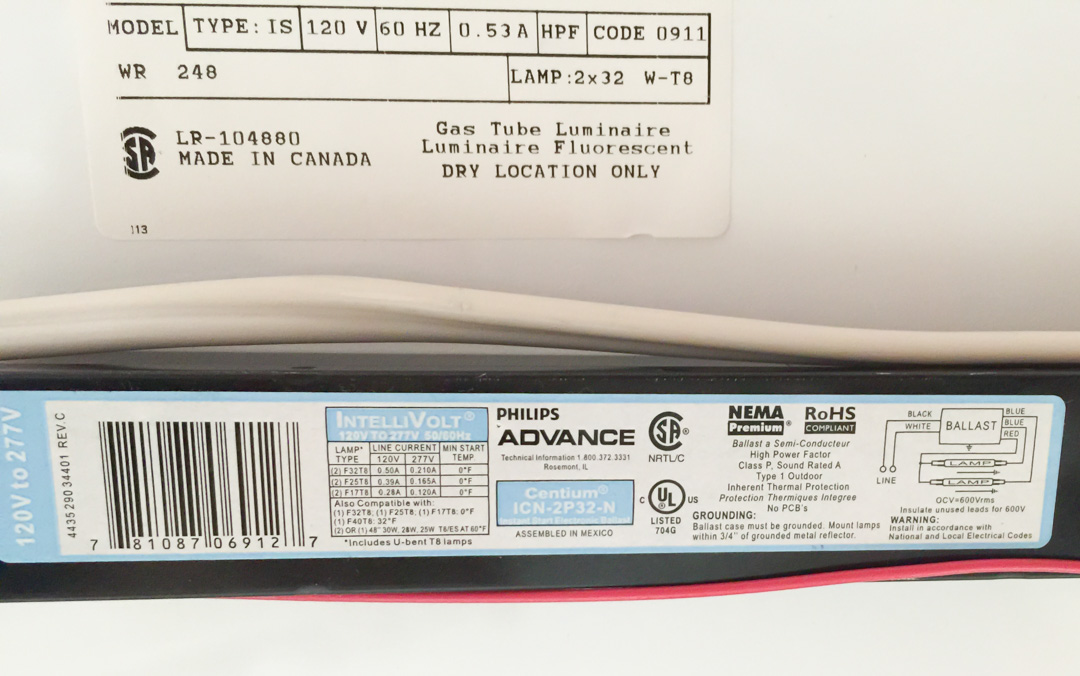
Ballast they use:
Last edited:
Platonic Solid
Well-known member
That fixture housing is not conducive to de-lamping from 2 to 1 lamp. I don't think you'd be satisfied with the resulting distribution pattern. I assume these fixtures are ON most of the time and not subject to continuous ON/OFF cycles via an occupancy sensor.My understanding of the tech that fluorescent manufacturers implement to attempt duplication of solar spectra is that there are a lot going on with phosphor coatings etc. under the hood. They're generally proprietary which means a correlation between CRI and lumens would be moving target. Kino-Flo has been around for some time in the flourescent lighting for cinema area. They have quite a few specialized bulbs:
http://www.kinoflo.com/PDF/News/Literature PDF/2014 Kino Flo Catalog PDF Sections/Kino Flo Lamps.pdf
They do several color temps (2900, 3200, 5500) and list spectra for them. Their 5500K 32wT8 is listed at 2040 lumens, so it looks like very similar to the TL950 I'm using.
With regard to the mixing CRI/bulb question, here is the information for both my shop, and a much larger install at Cinevate.
The fixture we're using: http://www.pioneerlighting.com/new/index.php/surface/78-wraparound
Ballast they use: Advance ICN-2P32-N
I would say the electrical engineer who spec'd the fixtures did not match the ballast to the intended purpose as virtually all of our banks are manged by the wattstopper ceiling sensors. The banks held off by virtue of ambient light sensors spend most of their time off though.
Platonic Solid
Well-known member
Hmm, then you're killing your expensive bulbs with that ballast.
That depends on the activity of those sensors. After all, a motion sensor is just a fancy switch.Hmm, then you're killing your expensive bulbs with that ballast.
I'll agree that, normally, one would pair a programmed start ballast with occ/vac sensors, but it can be overkill if the sensor only turns the lights on/off a few times a day.
On/off is what kills fluorescent lamps. Instant Start ballasts are especially harsh to fluorescent lamps.
I have seen data from lamp manufacturers that states T8 bulbs can withstand about 15,000 on/offs from Instant Start ballasts.
You can do the math pretty easily. If the lamps life (B50) is rated 24,000 hours, then theoretically the sensor could turn the lights on/off every 1.6 hours without effecting the life of the lamp. That's almost 13 times in the course of an 8 hour work day. That's an extremely active sensor, but certainly not unheard of (restrooms, etc).
There are tons of people out there that are a little OCD about turning the lights off every time they leave a room. Sometimes, they do it more often than a sensor would.
CD
Electric_Light
Well-known member
- Joined
- Jan 3, 2015
- Messages
- 74
Even better, the Cree Retrofit Lamp IES report actually defines the fixture used. So here we go:
One 2X4 troffer with 2 F32T8 Fluorescent Lamps.
One 2X4 troffer with 2 CREE LEDT8-48-22L-35K Lamps.
Lithonia Lighting Fluorescent "GT8" Series
Model: 2GT8 2 32 A12
Total Lumens: 4658
Wattage: 58
L/W: 80
Lithonia Lighting "GT8" Series enclosure w/CREE LEDT8
Model: LEDT8-48-22L-35K (Scroll down and click on IES 3500K)
Total Lumens: 3795
Wattage: 44
L/W: 86
You didn't do it right. The GT8 system as described above is around 4,100 lumens and 71 LPW when you adjust for BF.
Lighting is complicated
Many people make this mistake because of the 0.88 T8 nuance and the way photometric reports are written. You can verify it by calculating backward. It gets complicated even more, because things are not rated consistently between LEDs and FL lamps.
2 lamps, rated Lumens/lamp: 2850 This is a 700 series lamp.
Efficiency: 81.7% Optical
0-180 : 4,657.8 (assumption of 1.0 BF)
INPUT WATTAGE: 58 not a 1.0 ballast.
4657.8/0.817/2 =2850.5
When you divide the lumen output from the fixture by the reported efficiency and lamp quantity and it comes back exactly to the lamp rated lumens, it becomes obvious that 1.0 was assumed. So you need to manually multiply the total lumen by 0.88.
However, the 58W input wattage reported is consistent with a non NEMA premium 0.88 "N" ballast. REL-2P32-SC is a pre NEMA premium.
The actual output is more like 4,100 lumens / 58W. 2850 rated initial lumens would be 700 series lamps, which is no longer legal to make.
Fluorescent lamps radiate all the way along the circumference and there's no difference regardless of brand. LEDs only radiate on the lower half. I believe the Cree T8 is 210*, so it goes 15 degrees above horizon on each and fixtures that make worse utilization of output from the upper half of the lamps make LEDs look better on paper. The distribution within 210* isn't necessarily equal. So the test result is pretty only valid for that particular lamp in that fixture. T8 drop-in lamps do not perfectly emulate the fluorescent lamp electrically or optically so the test result is only valid for that ballast-lamp-fixture combination. Calculations for LED fixtures tend to be much more straight forward. The lumen and watts printed on the box is what you get... (at least on the day you plug it in for the first time)
I suppose Cree T8 drop-in would be considered a "high end" drop-in so it's only fair to reference to modern high performance fluorescent if you use NEMA Premium ballast, RE80 HL and initial rating as well especially if you're not forced to use the existing fixture/ballast in place.
http://www.acuitybrandslighting.com/library/ll/documents/specsheets/2es8x-2x4.pdf is 85.6% optical efficiency.
Using 0.89 ICN2P32N (The N can vary between 0.85-0.9 model to model, brand to brand. 0.87 is rule of thumb, but you need to get the exact value if you're calculating lumens and watts)
ICN2P32N at 0.89 BF and 56 input watts.
3100 rated lamps x 0.89 multiplier x 2 lamps = 5,518 lumens
5,518 x 85.6% fixture = 4,723 lumens
4,723 lumens / 56 W = 84.3 LPW
4,570 lm/56W = 81.6 mean LPW at 40% of lamp rated life.
Since LED T8 drop-ins only emit in the bottom half (roughly) fixtures that increase the utilization of light from the upper half of the lamps don't give the same boost to LEDs. The 2ES8X and Cree TLED are shoulder to sholder at 86 vs 84.3 LPW. This is only comparing the initial LPW.
It is a known fact that the super T8 lamps lose less than 10% of output in lifetime and LEDs are generally rated to 30% loss. The depreciation is not a straight line. We don't know for sure how LEDs depreciate in the long run and the rated life is calculated by extrapolation.
Platonic Solid
Well-known member
Dang dude, you used a whole page to say what could have been left at the first sentence. You are correct. I have fixed it so everyone can please stop posting these long winded run-on novels.You didn't do it right. The GT8 system as described above is around 4,100 lumens and 71 LPW when you adjust for BF.
For the record (not that it's relevant) the 800 series F32T8/TL830 ALTO = 2850lm and the ballast used in the photometric report of the fixture you linked to is QHE2X32T8/UNV ISN-SC 0.88BF.
Modern Jess
Well-known member
Dang dude, you used a whole page to say what could have been left at the first sentence. You are correct. I have fixed it so everyone can please stop posting these long winded run-on novels.
I think he must be getting paid by the word. It's the most plausible explanation for his constant spew.
The thing elec has not figured out is that 99% of readers have already tuned out to posts like those because of their length and verbosity. Platonic on the other hand posted a spreadsheet and thread which illustrates the point far better. Lumens/watt, T8 flourescent is the best choice for most garages right now. Because there is so much speculation on LED longevity (more the driver reliability) and actual (not predicted) long term falloff it's hard to make a convincing long term sustainability evaluation. That said, for a larger installation where light levels are engineered carefully, I suspect even 4 watts savings where there are 1000s of lights is very significant. We are quickly distorting global "equilibrium" with our activities, therefore spending more money now for a few watts savings and less light may end up making more sense than we think.
I've learned a lot in this thread. Thanks to all for your contributions so far
I've learned a lot in this thread. Thanks to all for your contributions so far
Electric_Light
Well-known member
- Joined
- Jan 3, 2015
- Messages
- 74
Hmm, then you're killing your expensive bulbs with that ballast.
I would say the electrical engineer who spec'd the fixtures did not match the ballast to the intended purpose as virtually all of our banks are manged by the wattstopper ceiling sensors. The banks held off by virtue of ambient light sensors spend most of their time off though.
It's hard to say. Do you have a logging device tracking the pattern?
It was a conventional wisdom to not use instant start with sensors, but this is no longer true all the time with better management of time.
You blast off some lamp life every single start. You actually extend the lamp life if the time left off per cycle is greater than the life shaved away from starting. The exact amount is something where there's no exact agreement on. All this aside, the starting lag of programmed rapid start is objectionable for many applications.
Instant start:
+cheaper, starts instantly
BUT.. shaves off more lamp life per start.
Programmed start:
+minimal lamp life use with each start.
-each ballast costs more
-1 to 1 1/2 second starting lag, every time.
After a solid two yrs in commercial use, 6 bulbs have required replacement out of several hundred. The majority have been in our shared kitchen area, also a traffic route, where on/off cycles are the highest. From what I gather, replacing these ballasts with programmed start...or dropping the Cree t8s in there would make sense.
After a solid two yrs in commercial use, 6 bulbs have required replacement out of several hundred. The majority have been in our shared kitchen area, also a traffic route, where on/off cycles are the highest. From what I gather, replacing these ballasts with programmed start...or dropping the Cree t8s in there would make sense.
It's a common business decision. In this case, you've replaced 6 x $3 bulbs =$18. And that's over 2 years. Most folks wouldn't sweat it. The programmed start ballast will likely cost you near that amount plus the labor to install it...(or is that you?). Be mindful that you likely have the wrong sockets as well. There are alot more wires to connect on a programmed start ballast than on an instant start which is a big reason that contractors dont like to use them and manufacturers dont, either.
Since you already have the Cree tubes, this would be a good place to drop them in. Easy peasy.
CD
Electric_Light
Well-known member
- Joined
- Jan 3, 2015
- Messages
- 74
After a solid two yrs in commercial use, 6 bulbs have required replacement out of several hundred. The majority have been in our shared kitchen area, also a traffic route, where on/off cycles are the highest. From what I gather, replacing these ballasts with programmed start...or dropping the Cree t8s in there would make sense.
Without a traffic pattern log, it's hard to say if you benefit from PRS. Just to compare, a PRS CFL would last longer, but I believe anything that takes 0.5 seconds or more don't meet Energy Star, because consumers expect light-bulb like starting. A quad pin-based CFL, T8 or T5 PRS takes anywhere from 1/2 to 2 seconds to start and ballasts that are closer to the 2 second side, it gets rather annoying. Even if the ballast cost the same, this can be a huge deterrent factor. I've seen anywhere from 50,000 to several hundred thousand starts advertised for life, but I do not know exactly how long they run between cycles or if they just run it for a minute or two.
Platonic Solid
Well-known member
So far in my research of this Cree LED Tube I've unearthed 3 different part numbers:
LEDT8-48-22L-40K (on the IES report dated 3/4/14)
LEDT8-48-21L-40K (on DLC website)
LEDT8P-48-21L-40K (on DLC website)
Data from DLC website:
LEDT8-48-21L-35K = 2,264lm, 22.56W, 100.35lm/W, CRI 90, CCT 3,634K (DLC 4/28/14)
LEDT8P-48-21L-35K = 2,529lm, 23.25W, 108.77lm/W, CRI 90, CCT 3,352K (DLC 8/28/14)
Here is my DLC search link (just click the search button when there and you'll see the parent lamps tested = 35K versions with above data): https://www.designlights.org/qpl/en/saved/J4D9ZQ4#results
Denwood, what is the exact part number on your lamp?
LEDT8-48-22L-40K (on the IES report dated 3/4/14)
LEDT8-48-21L-40K (on DLC website)
LEDT8P-48-21L-40K (on DLC website)
Data from DLC website:
LEDT8-48-21L-35K = 2,264lm, 22.56W, 100.35lm/W, CRI 90, CCT 3,634K (DLC 4/28/14)
LEDT8P-48-21L-35K = 2,529lm, 23.25W, 108.77lm/W, CRI 90, CCT 3,352K (DLC 8/28/14)
Here is my DLC search link (just click the search button when there and you'll see the parent lamps tested = 35K versions with above data): https://www.designlights.org/qpl/en/saved/J4D9ZQ4#results
Denwood, what is the exact part number on your lamp?
Electric_Light
Well-known member
- Joined
- Jan 3, 2015
- Messages
- 74
So far in my research of this Cree LED Tube I've unearthed 3 different part numbers:
LEDT8-48-22L-40K (on the IES report dated 3/4/14)
LEDT8-48-21L-40K (on DLC website)
LEDT8P-48-21L-40K (on DLC website)
Data from DLC website:
LEDT8-48-21L-35K = 2,264lm, 22.56W, 100.35lm/W, CRI 90, CCT 3,634K (DLC 4/28/14)
LEDT8P-48-21L-35K = 2,529lm, 23.25W, 108.77lm/W, CRI 90, CCT 3,352K (DLC 8/28/14)
Here is my DLC search link (just click the search button when there and you'll see the parent lamps tested = 35K versions with above data): https://www.designlights.org/qpl/en/saved/J4D9ZQ4#results
Denwood, what is the exact part number on your lamp?
https://assets.sylvania.com/assets/Documents/ECS402.f06fbcb6-bfc2-4dd1-a58c-1d34689b4960.pdf Breaks the 100 here.
Philips ICN2P32N and 25 watt 48 T8 Philips lamp gets you 2 by 2500 x 0.92 for 45W, so you get 102.2 LPW at 4600 lm. This lamp is $4-5. Cree lamp is $30-35. Cree lamp is only about 75 LPW at end of life. HPT8s are 90-92LPW at end of life with a NEMA Premium ballast as used for Cree test as well. Unacceptable for a lamp that costs 7 times more.

JohnnieMo
Well-known member
I read this entire thread, and much like one of the poster's right in the middle..... "Which one do I buy?"
I think I would prefer LED with no ballast for my cold climate and power savings. Anyone got a link where I can buy in Canada?
I think I would prefer LED with no ballast for my cold climate and power savings. Anyone got a link where I can buy in Canada?
Johnnie, I would conclude the thread like this.
Our winters here are cold, and my shop is left unheated when not in use. The shop seems to hover just below 0C if left for a few days where outside temps are in the -20C range. The electronic ballasts with the TL950s have been no issue in terms of cold starts.
For high CRI lighting (the TL 950s are 98 CRI) there is nothing out there as good in LED that I'm aware of.
If you are ok with ~90 CRI, then you will likely still find more lumens/watt using fluorescents.
The Cree T8s would be my choice for lights seeing temps less than -10C, or lights that would be see very frequent on/off cycles. Because LEDs are so new in terms of long term tests, it's hard to predict long term reliability based on real world use, however the data would suggest LEDs are more cost effective if the power supplies live as long as the LEDs.
Platonic has posted a thread which would point you to the most efficient ballast/t8 tube combination: http://www.garagejournal.com/forum/showthread.php?t=278420
Our winters here are cold, and my shop is left unheated when not in use. The shop seems to hover just below 0C if left for a few days where outside temps are in the -20C range. The electronic ballasts with the TL950s have been no issue in terms of cold starts.
For high CRI lighting (the TL 950s are 98 CRI) there is nothing out there as good in LED that I'm aware of.
If you are ok with ~90 CRI, then you will likely still find more lumens/watt using fluorescents.
The Cree T8s would be my choice for lights seeing temps less than -10C, or lights that would be see very frequent on/off cycles. Because LEDs are so new in terms of long term tests, it's hard to predict long term reliability based on real world use, however the data would suggest LEDs are more cost effective if the power supplies live as long as the LEDs.
Platonic has posted a thread which would point you to the most efficient ballast/t8 tube combination: http://www.garagejournal.com/forum/showthread.php?t=278420
JohnnieMo
Well-known member
Much appreciated. I'm happy to go that route and save a few bucks. My shop always stays above freezing so it won't ever be too cold.
Sent from my Passport
Sent from my Passport
E.Marquez
Well-known member
QUESTION: What LED tube would you choose?
Shop: 22x28 (garage, built and outfitted as a 5th room on the house except it has a garage door in the outside facing 4th wall..and I use it as a shop)
Current lighting: 9 twin tube 4ft T8 fixtures with a mix of electronic and other ballasts. plus several small, directed LED and halogen spot lighting for machine tools.
Use: machining, metal fabrication, motorcycle build, repair.
Common shop temps, 30degf (winter)-(summer)120degf
Needs: LIGHT and lots of it, with limited "dead" spots or shadows I work near a machine, lift or bike.
Color rendition: Not critical, not much of a concern at all.. Hand held or floor lighting will be used in the rare case color correction is needed.
Have several ballast that will likely not make it through summer months (commonly when mine die) I have been taking that opportunity to replace with an electronic ballast. But considering LED now.
Direct wire or ballast ready whichever is financially a better choice.
What say you Garage Journal?
Shop: 22x28 (garage, built and outfitted as a 5th room on the house except it has a garage door in the outside facing 4th wall..and I use it as a shop)
Current lighting: 9 twin tube 4ft T8 fixtures with a mix of electronic and other ballasts. plus several small, directed LED and halogen spot lighting for machine tools.
Use: machining, metal fabrication, motorcycle build, repair.
Common shop temps, 30degf (winter)-(summer)120degf
Needs: LIGHT and lots of it, with limited "dead" spots or shadows I work near a machine, lift or bike.
Color rendition: Not critical, not much of a concern at all.. Hand held or floor lighting will be used in the rare case color correction is needed.
Have several ballast that will likely not make it through summer months (commonly when mine die) I have been taking that opportunity to replace with an electronic ballast. But considering LED now.
Direct wire or ballast ready whichever is financially a better choice.
What say you Garage Journal?
QUESTION: What LED tube would you choose?
financially a better choice.
What say you Garage Journal?
Wait a year or two.....choice will be better........prices most likely will drop like a rock and quality and warranty issues will be sorted out................
E.Marquez
Well-known member
Wait a year or two.....choice will be better........prices most likely will drop like a rock and quality and warranty issues will be sorted out................
Wait.. hold on a sec let me take stock of my known qualities......
Ya NO, patience is not one them listed
Gona have to pass on that idea..
There will always be something better, cheaper next year. I have lived long enough and made the mistake enough times >>>WAIT.. make do......only to learn time and time again.... lifes too short to make do.. Get the best you can today and enjoy that.... Buy the best available later as well if it is a big enough difference.
Platonic Solid
Well-known member
If I had to buy an LED lamp today I would look at the spreadsheet I made in this thread and pick the best bang-for-the-buck LED there. Want cheaper, go on eBay and buy a ULO (Unidentified Lighting Object).Wait.. hold on a sec let me take stock of my known qualities......
Ya NO, patience is not one them listed
There will always be something better, cheaper next year. I have lived long enough and made the mistake enough times >>>WAIT.. make do......only to learn time and time again.... lifes too short to make do.. Get the best you can today and enjoy that.... Buy the best available later as well if it is a big enough difference.
E.Marquez
Well-known member
The problem is you asked best financially best choice...........the debate that goes on and on and on and on is ...............currently T8 is the best bang for the buck, but that is changing quickly.
Good point.. I was talking buy in vs light produced.. not run cost.
but yes I can see how that criteria muddies the water.
Want I meant by that is if a light that gets me 93% of what i need is $100, I have no desire to spend $350 a light to get one that gives me 98% of what I need.
Johnnie, I would conclude the thread like this.
Our winters here are cold, and my shop is left unheated when not in use. The shop seems to hover just below 0C if left for a few days where outside temps are in the -20C range. The electronic ballasts with the TL950s have been no issue in terms of cold starts.
For high CRI lighting (the TL 950s are 98 CRI) there is nothing out there as good in LED that I'm aware of.
If you are ok with ~90 CRI, then you will likely still find more lumens/watt using fluorescents.
The Cree T8s would be my choice for lights seeing temps less than -10C, or lights that would be see very frequent on/off cycles. Because LEDs are so new in terms of long term tests, it's hard to predict long term reliability based on real world use, however the data would suggest LEDs are more cost effective if the power supplies live as long as the LEDs.
Platonic has posted a thread which would point you to the most efficient ballast/t8 tube combination: http://www.garagejournal.com/forum/showthread.php?t=278420
Just posting an article I found on CRI. I doubt everyone will agree with this, and I'm not going to claim to know it all on this either, but I found it interesting. Just figured it might add to the discussion. If this is too off-topic, let me know and I'll delete.
Thanks,
http://www.nist.gov/pml/div685/grp03/vision_color.cfm