Now that I've officially finished the Craftsman project, it's time to look over what I spent on it to bring it to spec.
First, a little explanation on how I buy used mowers. My process involves a daily scroll of Facebook Marketplace. When I find something up my alley, I'll follow through... but it has to meet my requirements.
There are two types of sellers on this platform. The first is someone who has just bought a new mower and is trying to get rid of the old one. This person is happy to get some money for something they want out of the garage. The second seller is doing this with the intention to make money. They acquire a mower on the cheap, clean it up, fix anything major, then flip it. These mowers are either bought at a tip shop for $10 or retrieved from the side of the road for nothing. Then they list them for $100–$200. It's a very lucrative endeavour, especially when very few parts are needed.
There is nothing wrong with either type, but the key is knowing what type of seller you're buying from. Over time, you start to recognise the regular mower flippers and which are one-off sales. From what I've noticed, the flippers are selling entry-level mowers — ones the previous owner didn't care for and therefore left on the side of the road or dumped at the tip. Think entry-level engines and banged up, rusting steel bases. If the previous owner didn't see value in the mower by letting it go for nothing, how much life is really left in it?
The ones you want to buy from are the one-off sellers. In wanting to exchange some money, they obviously see value in what they're selling. These mowers are usually higher-end models with bigger engines, an alloy chassis, and more life left in them. You pay a little more, but you get a better starting point and a more honest transaction.
So it's safe to say I'm normally very selective in what I take on. I don't want to pay money for someone else's neglect or misuse, or for work I'd only end up redoing myself. I also don't like to haggle, so I choose very carefully and pay the asking price — everyone's happy.
Which leads me to this Rover Craftsman. At first glance, it looked honest — a little banged up, but nothing I couldn't deal with. On this occasion, the seller came to me, which was probably a mistake on my part; he made the effort to turn up, so telling him no thanks would have been awkward. Having said that, I was happy enough to pay the asking price after it fired up and ran smoothly. Turns out the guy had left one of the local mower shops and was fixing up mowers on the side — so in effect, I was paying a little more for that apparent expertise. In hindsight, I paid too much after finding some hidden faults. But that's how it goes sometimes.


The most obvious issue was the lower oil seal, leaking like a sieve. To me, this really should have been addressed by the seller. As a mechanic, he would be well aware of the implications of leaving a seal in that state — and he knew it was an issue, because the underside of the deck was spotless while the blade carrier was soaked in oil. Again, this comes back to the desire to maximise profit rather than always doing right by the customer. If it were me selling that mower, I wouldn't feel comfortable handing it over with such a major issue without either admitting to it or pricing accordingly.
So with that, let's look at what this mower
needed to be a functional machine.
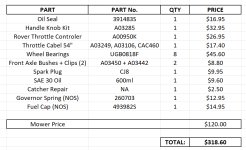
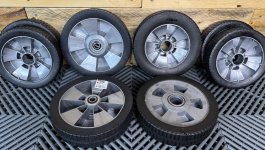
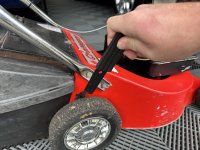
The oil in it was brand new, but with the leaking seal I drained it to contain the mess during the seal removal process — hence the oil change. The handlebar locks were toast and absolutely needed attention. I decided to include the throttle parts because the original throttle wasn't working very well. The fuel cap was leaking, and the governor spring had been tampered with. The wheel bearings were totally necessary, as was repairing the catcher. Other items like the plug and axle bushes were common service replacements.
Now let's look at what I
actually threw at it — and this is the difference between what most would consider a working mower, and one that a nutjob like me considers worthwhile.

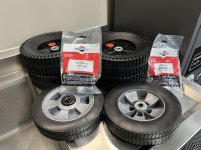
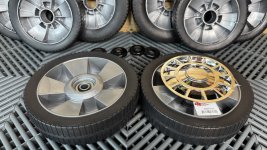
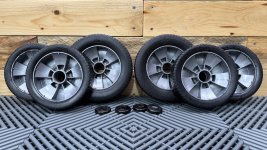
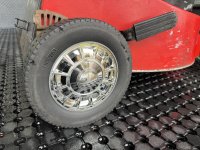
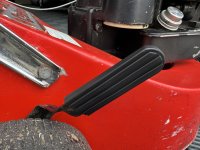
Many of the additional items were "because I can" and "because I want to" replacements. I could have got away with new bearings in the wheels, but that didn't address the cosmetic faults. The starter handle was purely cosmetic. The head and valve clean wasn't necessarily needed, but worth doing. The blades still had life in them, but I was concerned about the disc and the aged bolts — hence a total replacement of the cutting hardware. New wheels and hubcaps were mostly cosmetic. The muffler was indulgence.
So, just over $500 for a 40-year-old lawn mower worth $150, tops. While this mower has needed the most remedial work of any I've done, that doesn't make it financially viable. But... what price do you put on learning how to remove and replace a crank seal? Or the process of hunting down the right parts — especially ones considered NLA? How do you value the enjoyment of working on something and seeing the fruits of your labour? How do you value sentimental contentment?
I always come back to the same argument: what does the total cost of buying and restoring this old mower get you when shopping brand new?
Firstly, I’m not even going to bother looking at the various no-name stuff sold through hardware stores, Aldi or Amazon. So, lets look at three machines from established players.
Bushranger – For around $500, your only choice here is the $459 46TL4M Mulch & Catch (Bushranger really need to work on their product names). This one uses the old 18-inch Rover steel chassis and powered by a 139cc Loncin engine. For $499 you can also have the SupaSwift version. Pass on both.
https://bushrangerpe.com.au/products/lawn-mowers/46tl4m-mulch-catch-lawn-mower
https://supaswift.com.au/products/lawnmowers/supaswift-777amc-18-push-mower
Masport – At this price point you are looking at 16.5-inch and 18-inch steel decks fitted with crappy wheels, and 123 to 139cc Chinese AL-KO Chonda’s. At least here you would have a dealer network behind you. I’ve never been a fan of the steel Masport’s, so again, pass.
https://masport.com.au/category/outdoor-garden-products/petrol-lawnmowers/other-petrol-models/
Victa – There are four sub $500 models, none of them I would choose. Of those, the V144 uses a real Victa chassis, but it has that crappy Chinese engine. The other three are just rebadged junk. So, the real entry point is the $539 Corvette 100 or Super Mulcher with the 140cc Briggs.
https://www.victa.com.au/products/lawn-mowers/victa-2691845-18-corvette-100-steel-base-push-mower
https://www.victa.com.au/products/lawn-mowers/victa-18-super-mulcher-petrol-lawn-mower-2691982
But what about a new Rover? Doesn’t exist anymore. Actually, that Bushranger and SupaSwift are about as close to a new Rover you can buy these days. Of those above, I’d favour the Bushranger or Victa Corvette 100.
But the common theme here is that all of the models shown above come from China — from the Chinese Honda knock-off engines to the steel chassis. The Rover Craftsman was made in Eagle Farm, Brisbane. The engine was made in the USA. The chassis is aluminium. The catcher flap is steel, not plastic. The height adjuster quadrant is steel, not plastic. The wheels have double ball bearings; the Victa has a single ball bearing and plastic bushing. So even though it's 40 years old, the Rover still has plenty of years left in it. I'm not confident you'd be saying the same about one of those Victas, Masports or Bushrangers at that age.
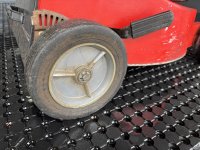
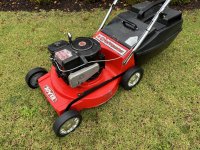
Before -
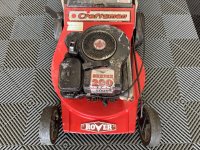
After -

So, that’s my story and I’m sticking with it. I’ve had fun with this one, and that’s all that matters.