Battery vs petrol — a conundrum that is just as divisive in the garden care industry as it is with cars. There will be those who refuse to entertain battery power, while others see it as a cleaner, easier proposition. For the average consumer tending to their garden at the weekend, battery power is the move. Most petrol-powered tools suffer from sitting for long periods of time, usually from gummed-up fuel systems. For the professional user, though, the debate is more involved.
Firstly, I think you want battery power where it makes sense. Hedge trimmers, pruning saws, and grass trimmers are far nicer to use when battery powered. For example, a hedge trimmer is often held at head height and at awkward angles and elevations. A 2-stroke engine banging away at eye level is super noisy and super fatiguing on your shoulders and neck. Battery power usually means a lighter, quieter machine — in other words, less fatiguing.
But there are certain areas where battery power just isn't possible or time efficient. For me, that applies to lawn mowers and leaf blowers. I need sustained performance for both, especially in summer on long, thick grass, and in autumn when a blower is held wide open for extended periods of time. From experience, once you put electric under load, it drains batteries super quick. Blowers in particular seem to deplete even the most robust battery eco-system. The same applies to chainsaws making moderate to large cuts. And that's before you consider the investment required to buy enough batteries to keep you running throughout the day, and then making sure to put everything on a charger at the end.
So, in 2026 petrol power still has its place, but the benefits of battery power make it hard to ignore.
In my business, I wasn't the first to move into battery-powered garden tools, but then I'm hardly late to the party either. Those first purchases were in 2018 — a Stihl HSA 56 hedge trimmer and the HSA 25 handheld clippers. When I bought the HSA 56, I kept my petrol-powered HS 45 just in case — and never used it again. From there, I added blowers, a chainsaw, pole saw, and long-reach hedger.

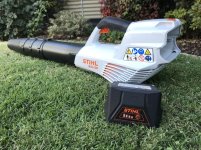
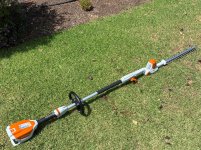


For the last decade, Stihl have been offering three different battery ecosystems, in turn providing a solution to every type of user. All three differ in battery design, charging system, and the physical size of the tool itself, with no interchangeability between them. They do this to optimise the cost and performance demanded by each consumer type.
AS System – This is the entry-level solution for occasional users. Originally, many of these tools had an integrated lithium-ion battery, but later evolved to have external 10.8V batteries. Lightweight and ease of use are the focus here.
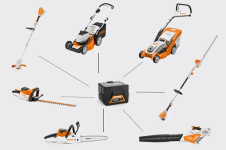
 AK System
 – A mid-tier option for residential and light commercial use. These tools are based around a 36V battery in three capacities. This larger battery supports longer running times and larger tools in general. The above-mentioned hedge trimmers and saws run on the AK battery system, and I've found them a nice balance for my needs.
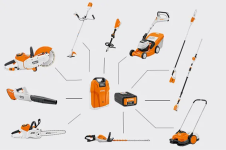
 AP System
 – These are professional-grade tools designed for frequent heavy use. Also based around a 36V architecture, the batteries are physically larger and heavier for increased output and performance. The AP system got a refresh for Stihl's 100th year, with 60% more peak power and faster charging, able to reach 80% charge in just 9 minutes with the quick-charge function.
In terms of the AS system, I already had the ASA 20 and HTA 25, and the charger and batteries to support them. Picking up my prize yesterday, I now have an assortment of AS system tools. These won't be used commercially, rather around my own garden and garage. Unlike the AK and AP systems, there is only one battery within the AS range, the AS-2, and two different chargers, the AL-1 and ALS-31.

The one annoyance I have with buying battery tools is the dance you play around skin or kit. In particular, you get one or the other: the kit, with significantly discounted batteries and a charger, or simply the tool alone. So, if you decide to take advantage of discounted batteries, you then end up with redundant chargers clogging up your cabinets. And it's not like you can sell the chargers — everyone ends up in the same predicament. I find this a somewhat wasteful use of the world's resources and landfill capacity.
In my case, I now have five AS-2 batteries, but also three battery chargers.
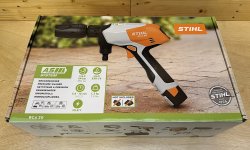
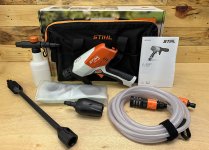
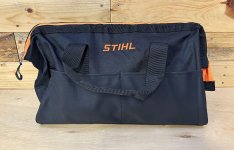
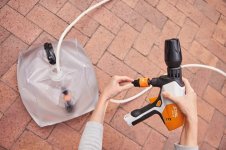
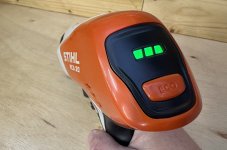
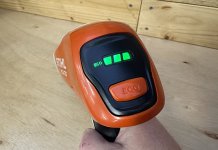
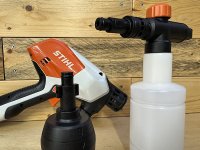
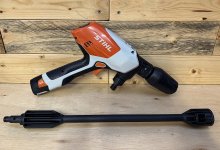
So, enough babble, it's time to open some boxes. Of everything in the prize haul, the RCA 20 mini pressure washer interests me most, so let's kick off with that.....