To avoid these ads, REGISTER NOW!

Above 1200 Sq/FT DFB's Garage

Wokspaces above 1200 squarefeet.
To avoid these ads, REGISTER NOW!

customh

Well-known member
Joined
Feb 18, 2013
Messages
565
Location
East Bethel, MN
The funny thing is, you can order all of the special edition parts for the saw at similar prices to the normal 500i............in theory you could build your own from a donor saw.
I think theories should be tested. I suppose they'll want a SN to allow you to order the parts though. I suppose if your dealer was inclined they would let you borrow the SN of their collector piece.
 
To avoid these ads, REGISTER NOW!
OP
D

D.F.B

Well-known member
Joined
Aug 2, 2023
Messages
1,627
Location
Australia
Battery vs petrol — a conundrum that is just as divisive in the garden care industry as it is with cars. There will be those who refuse to entertain battery power, while others see it as a cleaner, easier proposition. For the average consumer tending to their garden at the weekend, battery power is the move. Most petrol-powered tools suffer from sitting for long periods of time, usually from gummed-up fuel systems. For the professional user, though, the debate is more involved.

Firstly, I think you want battery power where it makes sense. Hedge trimmers, pruning saws, and grass trimmers are far nicer to use when battery powered. For example, a hedge trimmer is often held at head height and at awkward angles and elevations. A 2-stroke engine banging away at eye level is super noisy and super fatiguing on your shoulders and neck. Battery power usually means a lighter, quieter machine — in other words, less fatiguing.

But there are certain areas where battery power just isn't possible or time efficient. For me, that applies to lawn mowers and leaf blowers. I need sustained performance for both, especially in summer on long, thick grass, and in autumn when a blower is held wide open for extended periods of time. From experience, once you put electric under load, it drains batteries super quick. Blowers in particular seem to deplete even the most robust battery eco-system. The same applies to chainsaws making moderate to large cuts. And that's before you consider the investment required to buy enough batteries to keep you running throughout the day, and then making sure to put everything on a charger at the end.

So, in 2026 petrol power still has its place, but the benefits of battery power make it hard to ignore.

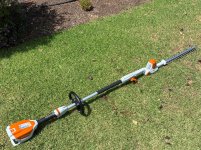
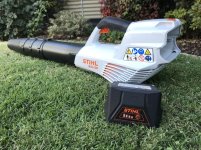
In my business, I wasn't the first to move into battery-powered garden tools, but then I'm hardly late to the party either. Those first purchases were in 2018 — a Stihl HSA 56 hedge trimmer and the HSA 25 handheld clippers. When I bought the HSA 56, I kept my petrol-powered HS 45 just in case — and never used it again. From there, I added blowers, a chainsaw, pole saw, and long-reach hedger.

IMG-2182.jpg

IMG-2900.jpg

IMG-4536.jpg

may32.jpg

IMG-7793.jpg

For the last decade, Stihl have been offering three different battery ecosystems, in turn providing a solution to every type of user. All three differ in battery design, charging system, and the physical size of the tool itself, with no interchangeability between them. They do this to optimise the cost and performance demanded by each consumer type.

AS System – This is the entry-level solution for occasional users. Originally, many of these tools had an integrated lithium-ion battery, but later evolved to have external 10.8V batteries. Lightweight and ease of use are the focus here.

AS-battery.png

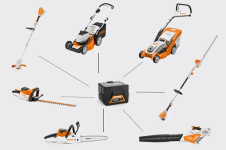
AK System – A mid-tier option for residential and light commercial use. These tools are based around a 36V battery in three capacities. This larger battery supports longer running times and larger tools in general. The above-mentioned hedge trimmers and saws run on the AK battery system, and I've found them a nice balance for my needs.
AK-Battery.png

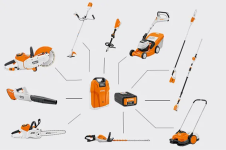
AP System – These are professional-grade tools designed for frequent heavy use. Also based around a 36V architecture, the batteries are physically larger and heavier for increased output and performance. The AP system got a refresh for Stihl's 100th year, with 60% more peak power and faster charging, able to reach 80% charge in just 9 minutes with the quick-charge function.
AP-System.png

In terms of the AS system, I already had the ASA 20 and HTA 25, and the charger and batteries to support them. Picking up my prize yesterday, I now have an assortment of AS system tools. These won't be used commercially, rather around my own garden and garage. Unlike the AK and AP systems, there is only one battery within the AS range, the AS-2, and two different chargers, the AL-1 and ALS-31.

IMG-9106.jpg

The one annoyance I have with buying battery tools is the dance you play around skin or kit. In particular, you get one or the other: the kit, with significantly discounted batteries and a charger, or simply the tool alone. So, if you decide to take advantage of discounted batteries, you then end up with redundant chargers clogging up your cabinets. And it's not like you can sell the chargers — everyone ends up in the same predicament. I find this a somewhat wasteful use of the world's resources and landfill capacity.

In my case, I now have five AS-2 batteries, but also three battery chargers.

So, enough babble, it's time to open some boxes. Of everything in the prize haul, the RCA 20 mini pressure washer interests me most, so let's kick off with that.....
 
OP
D

D.F.B

Well-known member
Joined
Aug 2, 2023
Messages
1,627
Location
Australia
RCA 20 Pressure Washer -

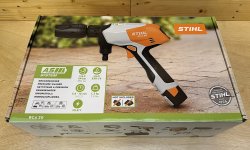
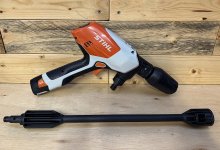
The RCA 20 is a small, handheld, battery-powered pressure washer. This style of machine isn't unique to Stihl — multiple tool manufacturers had come up with something similar before Stihl launched their version last year. But Stihl is fast becoming a battery power expert, so it was natural for them to do something of their own.

https://www.stihl.com.au/en/p/press...sher-as-system-203022#rca-20-skin-only-203022

IMG-2373.jpg

So, what do you get? The RCA 20 is available in two formats:

RCA 20 Kit – Machine, accessories, two batteries and a charger
RCA 20 Skin – Machine and accessories only

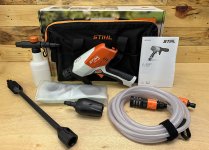
Mine came as a skin, with batteries and charger coming from elsewhere in the overall prize. In addition to the machine itself, you get a handy bundle of accessories:

- 4-in-1 nozzle, with jet, fan, turbo and flood modes
- Spray lance extension
- Soap cannon
- Vacuum hoses with filter
- Water pouch
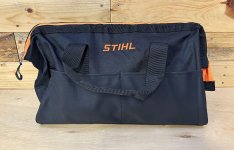
- Storage bag

IMG-2380.jpg

IMG-2382.jpg

IMG-2383.jpg

IMG-2385.jpg

IMG-2390.jpg

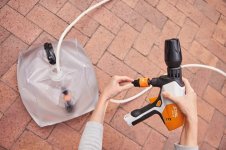
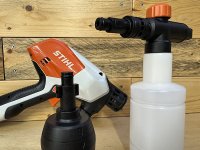
The nozzle attachment can be used with or without the extension. Using the vacuum hose, you can siphon water from a bucket or the supplied pouch. Note how I didn't call the soap cannon a "foam" cannon — you won't be generating foam from that thing, primarily because the machine itself just doesn't produce enough pressure to make that possible. However, you could fill it with an APC like Purple Power or Surfex to get some pre-soak action going before the rinse off.

rca-20-2.jpg

RCA-promo.jpg

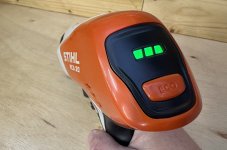
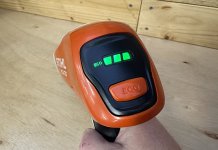
The unit with a battery fitted is super light and ergonomic, even when you have a hose connected to the inlet. The machine powers up automatically when the trigger is squeezed. When not in use, you can lock the trigger to avoid activating the pump. There is a battery charge indicator on the back of the unit, and an eco mode to extend the running time, which you'd realistically never bother with. The soap cannon features an adjustment dial, though again you'll likely run it wide open. Each attachment is connected with a bayonet push-and-turn arrangement.

IMG-2406.jpg

IMG-2405.jpg

IMG-2404.jpg

IMG-2399.jpg

Let's be clear here, this isn't going to clean your driveway or, if I'm honest, a whole car. With its compact size and user-friendly approachability, the RCA 20 would be perfect for smaller spaces with restricted storage or connections to water and power. Think apartment blocks and courtyards — ideal for cleaning windows and outdoor furniture. As such, the spec sheet reads rather modestly.

Max Pressure – 350 psi
Max Water Flow – 230 LPH (3.8 LPM)
Weight – 1.3 kg (2.8 lbs)
Min Run Time – 8 min
Max Run Time – 15 min

For context, an equivalently priced Karcher K2 would make 1700 psi and 6.0 LPM (1.6 GPM). My big dog, the Kranzle KHD10, does 1500 psi and a strong 11 LPM (2.9 GPM). But that's missing the point — the RCA 20 is what it is: light, compact, easy to handle. And because there's no separate gun and hose, you never have to deal with the chronically awful hoses that come with cheap pressure washers. Invest in a great garden hose, though. Funnily, I used my German-made Gardena hose — a brand which sits under the same company group that owns Husqvarna — sorry, Stihl. ;)

IMG-2394.jpg

IMG-2396.jpg

IMG-2392.jpg

I used the RCA 20 on the Wildtrak today. Not the whole vehicle — the lack of pressure and flow rate meant it wouldn't have been time efficient. However, it tackled smaller parts such as the floor mats, side steps, wheels and tyres. I really like how wieldy it is, be that the low weight or the ergonomic balance. It's also nice and quiet, with an instant start response and none of the wheeziness some pressure washers exhibit. Build quality is exceptional, and the bayonet fittings are smooth and secure.


So, that's the RCA 20. It's not going to clean your whole house or car, but as an addition to a lineup of AS batteries, it's a handy little thing.
 
OP
D

D.F.B

Well-known member
Joined
Aug 2, 2023
Messages
1,627
Location
Australia
KOA 20 Battery Air Inflator (Kit) –

Who here hates pulling up at your local petrol station to fill tyres with air? You know how it is: parking next to a hose reel that doesn't work properly, snagging the hose on the tyres, leaking connections, an inaccurate pressure gauge, and a grotty inflator covered in funk. Yeah, not my idea of fun. So, you either dealt with that annoyance, or went and bought an air compressor of some sort.

I've had a decent air compressor for 15 years, initially purchased for tyres, but also useful for detailing tools. And while I now have a retractable hose reel, I always detest firing up the noisy compressor and attempting to manage the hose while avoiding smacking it into a car. But that all changed once tool companies started making battery-powered compressors/inflators. Compact inflators always existed, but you were tethered to a power cord or jumper leads and all the inconvenience that comes with that. So, you no longer have a hose or cord trailing behind you. Instead, you get a thoroughly portable solution that isn't limited to the confines of your garage — think road trips, worksites, camping. For example, inflating camping beds, or as a backup should you run into trouble on the open road.

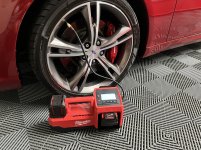
Put it this way: I haven't filled tyres with my compressor since getting a Milwaukee M18 Inflator (M18BI0). While it's noisy, you get complete mobility moving around the car. My only complaint is that I wish Milwaukee would send these out with a quick-connect chuck. Apart from that, I've been happy with it.

IMG-0784.jpg

I did try fitting a quick-chuck, but the machine didn't like it.

IMG-1459.jpg

IMG-1454.jpg

Stihl's interpretation of a portable inflator is built around the 10.8V AS battery architecture. While the Milwaukee is only available as a skin, the Stihl can be purchased in skin or kit form. In my case, I scored the kit, which includes the following:

https://www.stihl.com.au/en/p/compr...03667#koa-20-with-battery-and-charger-1003668

- KOA 20 Inflator
- AS 2 battery x1
- AL 1 standard charger
- 4 inflator attachments

IMG-2415.jpg

IMG-2416.jpg

IMG-2419.jpg

IMG-2423.jpg

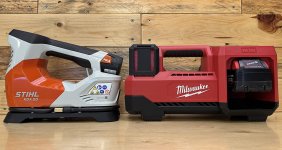
Circling back to my Milwaukee, in terms of price, the M18 is about $100 more than a Stihl KOA 20 skin. So in theory, the smaller Milwaukee M12 Compact Inflator is a closer competitor — both are within $10 of one another. And yet, the M12 doesn't quite have the same performance figures as the Stihl. Which of the three you choose would probably come down to what battery ecosystem you're already in, or which you could get more value from after the initial purchase.

Stihl KOA 20 -
Max Pressure – 150 psi
Max Air Flow – 360 LPM
Run Time – 23 minutes
Noise - 77 to 90 dB(A)
Weight – 1.5 kg

Milwaukee M18 M18BI0 -
Max Pressure – 150 psi
Max Air Flow – ND
Run Time – 30 minutes (5.0Ah battery)
Noise - 96 to 97 dB(A)
Weight – 3.2 kg

Milwaukee M12 M12BI-0 -
Max Pressure – 120 psi
Max Air Flow – ND
Run Time – 10 minutes (max. duty cycle to prevent overheating)
Noise - 92 to 96 dB(A)
Weight – 1.42 kg

IMG-2440.jpg

IMG-2441.jpg

IMG-2443.jpg

IMG-2444.jpg

Looking over the machine, the KOA 20 is super lightweight, with or without the battery fitted. I also love the form factor, which has been cleverly designed to integrate storage for the attachments and the main hose. The LED light, soft touch handle grip, and rubberised feet for reduced vibration are nice touches.

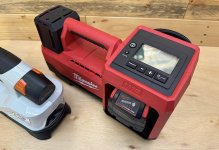
The control panel is well thought out, pairing a high-quality display with simple buttons to cycle through modes, pressure levels and measurement units:

- Main power button
- Start and pause button
- Plus & minus buttons for selecting pressure
- Inflate or deflate modes
- A high-pressure mode for tyres and sports equipment
- A high-volume function for inflating or deflating camping beds, pool toys etc
- LED light activation
- Unit Measurement (BAR, PSI, KPA)
- Battery charge level
- Display for chosen pressure setting and current pressure level

IMG-2435.jpg

IMG-2433.jpg

IMG-2430.jpg

IMG-2436.jpg

For the demo, I used the KOA 20 to inspect and inflate the tyres on the XR6. Operationally, the Stihl is noticeably quieter than the M18 inflator, although at a higher pitch. The pressure settings are increased or decreased by one measurement point at a time, same as the Milwaukee. Once the desired pressure is achieved, the unit automatically stops the pump. To save power, the unit powers down after 5 minutes of inactivity. I will say, the KOA 20 takes longer to achieve the chosen pressure than the larger M18, but that's a fair trade-off for the lighter weight and overall footprint. And like the Milwaukee, it would be nice to have a quick-release chuck.


Overall, I like the lightweight and compact form factor of the KOA 20. With that in mind, it would be an ideal travel companion for road trips and caravanning. For volume inflating, I'd probably favour the M18 Milwaukee for its higher duty-cycle capability. Realistically, you will buy whatever battery system you're already invested in. But the KOA 20 is a nice piece of kit and meets my approval.
 
To avoid these ads, REGISTER NOW!
Top Bottom