To avoid these ads, REGISTER NOW!

Drill bits for thin metal

JackOfDiamonds

Well-known member
Joined
Jul 31, 2020
Messages
706
Location
Idaho (USA)
I make a lot of bikes from thin wall steel tubing.

When I need to drill holes I'm always frustrated with using regular twist drill bits. Once you finally get them started they don't cut a nice round hole, they make a bowtie -shaped hole then they get sucked in. You never get a hole until you force it then the edges are pulled up.

There must be some kind of special bit or a way to grind regular bits that is adapted to metal much thinner than the hole diameter. Such a a micro hole saw or something. I tried carbide burrs in a Dremel but they tend to catch and go rogue.
 
To avoid these ads, REGISTER NOW!

larry_g

Well-known member
Joined
Apr 28, 2007
Messages
16,877
Location
oregon
Last edited:

dutchgray

Well-known member
Joined
Sep 28, 2014
Messages
6,467
Location
Dorset. England.
Use a small square of cloth rag folded up under the drill point after getting the drill started, it will prevent the drill from grabbing, makes it much easier to get a nice hole in thin material.
 

RoninB4

Well-known member
Joined
Jul 22, 2020
Messages
3,539
Location
Under My House
I make a lot of bikes from thin wall steel tubing.

When I need to drill holes I'm always frustrated with using regular twist drill bits. Once you finally get them started they don't cut a nice round hole, they make a bowtie -shaped hole then they get sucked in. You never get a hole until you force it then the edges are pulled up.

There must be some kind of special bit or a way to grind regular bits that is adapted to metal much thinner than the hole diameter. Such a a micro hole saw or something. I tried carbide burrs in a Dremel but they tend to catch and go rogue.
-Drilling thin material with a twist drill having standard geometry is indeed difficult. The length of the tip pierces through the material before reaching full diameter, the flutes become a ramp as the cutting edge "bites" the material. This pulls the drill in, making that bow-tie shaped hole, because pulling the drill in takes less force than removing all the remaining material in one revolution of the drill. Makes sense? Let's explore options.

Standard cutting geometry for a twist drill (118°) is a compromise angle that works well enough for most drilling applications. Sometimes production drilling of certain materials (harder/softer) dictate that the 118° be changed for optimum performance. There are too many applications to list here.

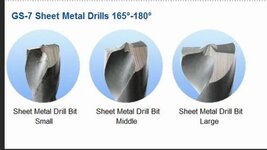
For thin material what is commonly used is a 180° grind with a center "nib", and very little back relief. This allows the drill to create a full diameter cut before it pierces the material. Minimal back relief is to avoid the drill grabbing in the material. I'll attach an image of what this looks like. It's fairly easy to freehand grind this but the trick is to get the nib centered so it doesn't produce an oversized hole. If hole size is important I'd suggest using a machine to grind this in. Since this sounds like making bike frames is a commercial (for profit) operation just consider it a business expense that will result in less aggravation and better/cleaner looking holes. There are other cutting options so we're not done yet

What device are you using for drilling? If it's a hand drill it's little wonder it's not working out will. A hand drill has almost zero control over the downward feed of making the hole. Remember the "ramp" effect I wrote about earlier? It's best to have some control over how much material is being cut per revolution. Feed rate is critical in any milling/drilling/turning operation. Even one of those $100 Chinese milling machines has better control/alignment (with a V-block) than doing this by hand. I'd even advocate using a center cutting end mill for popping a small hole in tubing, Makes a nice clean hole too if you use the quill lock on a partial drag setting.

But wait....there's more. How/when you're cutting the holes makes a difference too. Making holes in tubing at the component level? Do what I suggested above. Drilling at assembly level? Small mill almost certainly won't have enough room for the entire assembly and you may need to use a hand drill with the 180° flat grind. But you can help yourself by using a small fixture clamped on the tubing to eliminate drill wander. I've even made/used a small drill collar to stop the drill after it's pierced the material (preventing the drill pulling in). I had an acquaintance that was fabricating bike frames for a while, I made a bunch of things for him. Were you closer I'd make them for you too.

Forgot to include an image of the drill geometry for thin material.
Drill Geometry.JPG
 
Last edited:

tool_scrounge

Well-known member
Joined
Jul 20, 2010
Messages
4,187
Location
Southern California
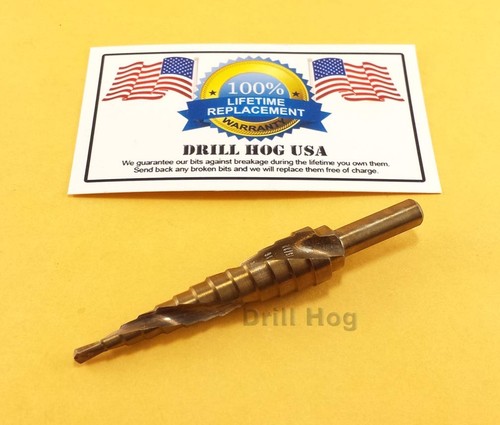
Does this step drill have enough range for your needs?


Monza Harry

Well-known member
Joined
Dec 29, 2018
Messages
1,433
Location
Windsor ON
Ronin has you well down the path to success with his post above. Other things to try, use a drill doctor to set you tip angle. Drilling 180° tip by hand will not work without a drill locating guide/machine/pilot [ there are a few sizes of piloted drill available. So consider using a center drill to start, then switch to a flattened twist drill [135°-150°] but lessen the relief angle and then flatten the cutting edge shoot for neutral/zero you only need a 0.020" flat. This helps with pull through, and gummy materials like stainless and some copper compounds, as well your situation. These techniques tend to be hard to learn when you aren't a drill sharpening guru. So don't be afraid to seek help from someone in a metal cutting trade, I'm told we are all show-offs, I don't think so but I am biased :rolleyes:. Get back to us we have more to share. Harry
 

mogandave

Well-known member
Joined
Nov 4, 2021
Messages
3,052
Location
Bangkok

RoninB4

Well-known member
Joined
Jul 22, 2020
Messages
3,539
Location
Under My House
Split point drill geometry is nice, I sometimes hand grind them for easier starting. A split point does have a thinned web, making the tip a bit more fragile and susceptible to chip/shatter under heavy pressure. Nothing to be excessively worried about, just don't lean on the drill so much. The video posted by The Cobbler was good (thanks for posting it) but have doubts about how well this would work on thin wall tubing, seems like the wall is unsupported because it's a hollow tube and partly susceptible to the same ragged hole conditions. Having a hard wood backing below like the video also makes a difference in addition to the cloth above. Somebody should try it and report back.

Per the topic: I don't see a split point being a good solution for the OP on drilling tubing. It should start easier but the problem the OP has/had is when the tip of the drill pierces through the material. Even with flat material the problem will exist with a split point. Making clean holes in tubing without deforming the tube, or having heavy burrs needs a particular solution. The annular cutter would work like an end mill, similar geometry, but they're a bit expensive and may require a particular holder/machine to use them. The least expensive, readily useable cutter is a twist drill that's been ground for thin material.

Annular cutters are available (so are end mills), ready to use, but a bit expensive (not easy to find in 1/4") for the task. End mills are widely available, a wide variety of shapes, fairly inexpensive (HSS or carbide are $20 or less) but aren't for use in a drill chuck. Twist drills are cheap, made to use in a drill chuck, but require the 180° grind (with center nib) to work well in thin material.

For a one time project, use whatever is available. I've got a lot of experience and I try NOT to drill thin material with a hand drill because I know it likely will make a ragged hole with standard twist drill tip geometry. For a tube that goes on a product I sell, the customer will think I'm a hack if the hole looks ragged. All that's really required here is a motor and a controlled down feed. A mag-drill is expensive, so are most drill presses. One of the cheap Chinese mini-milling machines (buy used) will do a much better job and likely be less expensive than a mag-drill or drill press. A mill also opens up the possibilities for joining where/how tubes intersect, lessening the need to hand fit them. I hate to advocate crappy, cheaply made, Chinese machinery but I can't think of a better solution per cost. This is all just my opinion and your particular situation may direct a different solution. Hope this helped somebody.
 
Last edited:
To avoid these ads, REGISTER NOW!

sqznby

Well-known member
Joined
Oct 26, 2013
Messages
982
Location
Coastal NC

exmaxima1

Well-known member
Joined
Jun 25, 2011
Messages
6,341
Location
Midwest
I've had good luck with Pilot Point "Bullet" bits. Basically as described by RoninB4 as far as tip geometry. You can buy a nice USA-made set for $30:


Attachments

  • bulletdrill.jpg
    bulletdrill.jpg
    7.5 KB · Views: 10

jeepinerdeep

Well-known member
Joined
Dec 28, 2013
Messages
2,099
Location
South Central PA
Step bits and rotabroaches are made for this, though the rotabroaches are usually in the 5/16 and up area. A decent step bit you can buy in multiple (14) size configs are TEMO on Amazon.
 

Dagny

Well-known member
Joined
Jul 25, 2014
Messages
2,986
Location
Northern Wi.
For sheet metal like ductwork 22 to 30 ga. I have had bad luck with the split point and will no longer buy them as soon as you get through the first layer they grab on the second and break.
 
OP
J

JackOfDiamonds

Well-known member
Joined
Jul 31, 2020
Messages
706
Location
Idaho (USA)
I think the step bits will solve the problem, I just wasn't aware they came in the skinny sizes down to 1/8.

I do know how to sharpen drill bits but I'm not sure what changes to make. I can reduce the amount of relief or change the angle from 135 degrees to something flatter or steeper but I'm not sure what changes would help and there's nothing I can do about the twist helix angle and that seems to be the key difference with the step bits which have no helix at all.
 

RoninB4

Well-known member
Joined
Jul 22, 2020
Messages
3,539
Location
Under My House
The flute helix is not really the source of the problem, it's just what comes into play when the drill pierces through the material and stops rotation. Several other posts advocate using a step drill, I'm not going to say they're wrong. I don't have a very high opinion of step drills (most machinists don't) and have only used them once or twice when I had no choice. They can be handy for a field expediency tool to avoid carrying a full drill index (or two) on a job site outside the shop. In a machine shop they are rare as hen's teeth because hole size/depth is harder to control or impossible for material thickness greater than the length of the step. They are often made from of cheaper quality steel, this is disguised with a colored coating (imitation TiN usually). The coating (real TiN trashes the grinding wheel) and the reduced length of the step makes these more difficult to re-sharpen. As such they are considered a disposable tool. A twist drill can be resharpened many times.

For a ready made cutter solution, with no further preparation, a step drill may be what you prefer but I expect you'll need to replace these on a regular basis. I also don't see it working well/better on tubing but I could be wrong.

"I'm not sure what changes would help" -I've included a visual image and text explanations, I guess I'm not very convincing or not explaining things well enough. That's my lacking not yours.

"there's nothing I can do about the twist helix angle and that seems to be the key difference with the step bits which have no helix at all." -That's not really the root cause of the problem. The flute helix amplifies the uncontrolled down-feed into the material. I've drilled through thin wall tubing with a standard twist drill geometry with no problems (not by a hand drill) because I could control the feed at the machine quill. Same results using an end mill, a clean hole with no trouble. It's less about what cutter you use and more about how it's used.

None of my posts really matter, it's your operation and what you feel is best for your situation. I don't always take the advice of people that are professionals either if that advice isn't best for my situation.
 
Last edited:

Farmall450

Well-known member
Joined
Dec 23, 2011
Messages
13,358
Location
Marengo, Illinois
The flute helix is not really the source of the problem, it's just what comes into play when the drill pierces through the material and stops rotation. Several other posts advocate using a step drill, I'm not going to say they're wrong. I don't have a very high opinion of step drills (most machinists don't) and have only used them once or twice when I had no choice. They can be handy for a field expediency tool to avoid carrying a full drill index (or two) on a job site outside the shop. In a machine shop they are rare as hen's teeth because hole size/depth is harder to control or impossible for material thickness greater than the length of the step. They are often made from of cheaper quality steel, this is disguised with a colored coating (imitation TiN usually). The coating (real TiN trashes the grinding wheel) and the reduced length of the step makes these more difficult to re-sharpen. As such they are considered a disposable tool. A twist drill can be resharpened many times.

For a ready made cutter solution, with no further preparation, it may be what you prefer but I expect you'll need to replace these on a regular basis. I also don't see it working well/better on tubing but I could be wrong.

"I'm not sure what changes would help" -I've included a visual image and text explanations, I guess I'm not very convincing or not explaining things well enough. That's my lacking not yours.

"there's nothing I can do about the twist helix angle and that seems to be the key difference with the step bits which have no helix at all." -That's not really the root cause of the problem. The flute helix amplifies the uncontrolled down-feed into the material. I've drilled through thin wall tubing with a standard twist drill geometry with no problems (not by a hand drill) because I could control the feed at the machine quill. Same results using an end mill, a clean hole with no trouble. It's less about what cutter you use and more about how it's used.

None of my posts really matter, it's your operation and what you feel is best for your situation. I don't always take the advice of people that are professionals either if that advice isn't best for my situation.
I don't think step drills were invented for a machine shop; more for electricians and hvac guys (not to mention all of us) that need to drill thin material by enlarging holes. They're easy to gage depth with a sharpie or some tape. Or, buy one whose largest hole is the size you need.

I agree they aren't right for everything, but I've had great success using them where, like the OP, a drill grabbing can tear out/deform material.
 

WoodsTruck

Well-known member
Joined
Jan 12, 2013
Messages
1,023
One advantage of the step bit I take advantage of is the ability to use the start of the next step to deburr the hole I just drilled. May not be the proper way, but it works for me.
 

theoldwizard1

Well-known member
Joined
Feb 22, 2011
Messages
43,142
Location
SE MI
Get a drill press. 3/8"
Get a vice designed to hold tubes. Bolt it to the drill press table. The key to getting a good hole in tubing is to start perfectly square to the tube !
Use a pilot drill. Keep several on hand.
Once you have a good starter hole, you should be able to switch to a hand held drill and regular bits.
 

tarbellb

Well-known member
Joined
Apr 17, 2011
Messages
5,754
Location
Oregon
Step bits will change your entire work flow

and the nice thing about them is even the cheap ones produce good results. The best I've used are Lennox but even the HF and Amazon specials are fine.
 

RoninB4

Well-known member
Joined
Jul 22, 2020
Messages
3,539
Location
Under My House
I'd like to begin this post by saying that I hope we're only having a discussion, I don't feel the need to insist that I'm right. Nor are my assertions correct for anybody but me. Everybody has a different opinion about their application/situation. If I need to stop then just say so, I'd rather not generate bad feelings on a board I'm becoming rather fond of. All my posts, on any given thread, are my contribution only aimed at offering help/insight into something I have experience with. I don't need to be The Authority on anything, it's just a discussion with friends I haven't met yet. If my posts bore you.......well..... I bore everybody at some point.

Farmall450 made a good posting and is exactly what I've been saying, the step drill is a handy tool for those on a job site in the field where the tech is already carrying too much equipment.

Several members also advocate using the step drill, even a cheap one. Will it work? Perhaps, but how many holes will it make before going dull? Will you notice it's dull before it's too late? In a commercial venture, like the OP has, disposable tooling may not be the most economical solution over the life of the cutter. Is a cheap hack saw blade a better buy than an more expensive one that last longer? A dull cutter may also deform the workpiece (excess downward pressure on thin wall tubing) or leave an ugly shaped hole that the customer may find objectionable. Everything about a product should look good to a customer. With the amount of time/labor involved in a bicycle frame do you really want to take a chance on f'ing up something as simple as a hole? This isn't a hole in a tractor implement.

Something that hasn't been presented for consideration is the actual application. All the annular cutter suggested (which are similar in cutting geometry to an ordinary end mill) are good, I've used just about every type of cutting tool out there. I've checked the supplied links and they all depict the cutter starting on flat surfaces, none of them start on a round surface. Why does this make a difference? Try it yourself with an unguided annular cutter, the cutter will wander until it cuts at least 70% of a full seat. Use a small guided fixture to hold it in place? That's what I stated earlier. Will it work better if piloted? Sure it will. A 1/4" annular cutter that utilizes a pilot drill (1/8?) to start? Sure, good luck finding one that's reasonably priced. For that price I'd be shopping for used machinery that will work better than a hand held drill.

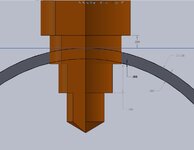
The other potential issue I see with using a step drill also concerns the shape of the round workpiece and the importance of cosmetics. This may/may not be important to the OP. I've created a few CAD models to illustrate the point. The models are based on some assumptions I've made about the tube and the step drill itself, which are all hypothetical. The tube is 1-1/8", the wall thickness is .037", the drill step from one diameter to the next is .100". I've attached screen shots of the process for visual clarity. Using these models, when the 1/4" hole cuts through the tube ID by .003 there's only .044 remaining before the next diameter begins to cut into the tube, that's approximately 1/32". This means there's very little time/room to affix a stop in down-feed. If/when the next diameter begins to cut into the tube a small "flat" will be produced that will be quite noticeable. Does this make a difference? Only the OP and the customer can say so. Can it be stopped with a quill stop on a drill press or milling machine? Sure, if so then why even use a step drill when better cutters are available? Customers of custom bicycles are a somewhat finicky bunch (nothing wrong with that either) and eye appeal is important. A hole appropriate for a tractor implement is probably not appropriate for a high end custom bicycle frame. That's what an ex-frame builder made clear to me.

The screen shots are below, if I need to just STF up then I can do that too. Discussion is where/how we learn, even me.
Cut-1.JPGCut-2.JPG
 
Last edited:

Monza Harry

Well-known member
Joined
Dec 29, 2018
Messages
1,433
Location
Windsor ON
I want to address some points here. The helix remarks, I covered this a ways back, the step drill is a zero cutter [ cutters are positive (normal twist drill) zero/neutral (step drill geometry) and negative (most carbide flycutters)] a twist drill can be "neutralled" by flattening the cutting edge [RoninB4 could you show pic/drawing? I'm recuperating from rotatorcuff surgery so mouse operationis are limited right now and no way to do this on my phone]. I also remembered another cutter that may help here, if the right diameter is available, a spot weld cutter may be a solution, it is piloted and then has a flat faced cutter. Harry


RoninB4

Well-known member
Joined
Jul 22, 2020
Messages
3,539
Location
Under My House
I also remembered another cutter that may help here, if the right diameter is available, a spot weld cutter may be a solution, it is piloted and then has a flat faced cutter. Harry
-I agree with what you posted, a twist drill can have the back rake altered, but chose not to mention this as I've already made tooling selection confusing enough as is. The back rake of the cutting edge at the flute helix is altered per the material being cut, this is often done in machine shops when drilling tougher materials or brass. The spot facing tool you posted is the type of cutter geometry I've been advocating but a 1/4" piloted spot facer isn't going to be easy to find or inexpensive.

Hope you heal up soon Harry, I hate surgeries.
 

Monza Harry

Well-known member
Joined
Dec 29, 2018
Messages
1,433
Location
Windsor ON
Thanx Ronin, Spot weld facers/cutters like those come pretty standard in 5/16" and 3/8" dia's. I'm not sure if 1/4" is available or not but with some searching something should be available. Spot weld cutters are very perishable and take enormous abuse, so they are built to an appropriate price point Eastwoods are better than HF or PAL cutters but still not budget breakers. If hole diameter isn't super critical drill undersized and consider a "repairman reamer" to finalize dia. Harry
 

MBfreak

MEMBER EMERITUS
Joined
Dec 10, 2010
Messages
2,301
Location
Linkoping , Sweden
Have built loot of electronic equipment chassis in 2 mm aluminium. For all holes larger than 6 mm we used MALCUS drillbits with three flutes 110 degree. And lubed with ethanol to stop oxidizing when drilling.
Perfectly round holes, just needed a quick backside cut to remove a few hangers on ( sorry do not know the correct name)
 
To avoid these ads, REGISTER NOW!
Top Bottom