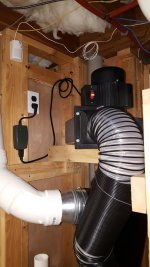
I'm going to try to convince you guys my name is drivesitfar and start a new 101 thread.
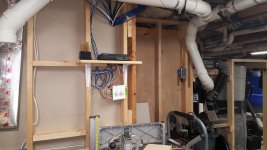
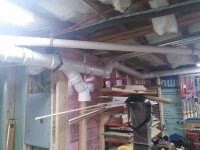
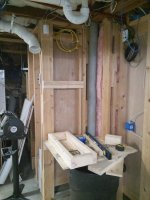
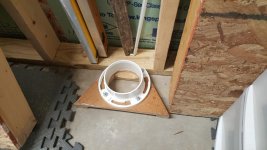
Here are some threads as a reference from the past, with some photos
Homemade or low buck dust collection systems?
Show us your woodworking dust collection systems
and a recent question that came up while I have been working on my own system recently and have collected my last bit of questions made me think we need more discussion about the process and design rather than just to show off the finished products.
I will start with a few basic questions that can (to me) get someone started with a good half of the questions they are going to come up with during the design and budget process.
what is the correlation between your blower's CFM, pipe ID, and linear feet (I assume let's exclude bends and losses due to friction for a 'rough' design and then considering bends if a resource is available for a more specific design step)
what if any correlation is there to the size of a 'box' or 'shroud' (example miter saw station) to the pipe ID and CFM available at the mouth of it?
for a given tool that has a 2" dust port as most non-pro tools will, and a shop with 4" 6" or 8" pipe for DC, would you be better off reducing at the mouth of the pipe to a 2" hose, or running the 4"/6"/8" hose to the tool and adapting it at the tool?
Some guys are lucky enough to have a shop where most machines are stationary and have their own dedicated dust port. For those whose tools are mostly portable, shared areas where some tools could connect up one at a time to the same port, where do you decide to put the blast gates? Most with stationary tools use blast gates at the mouth of each pipe before a change to flex or into the tool itself. Do many suggest using blast gates to close off a leg of the system not at the mouth, but after a wye or say on a common run (example between the 'tool port' to the pipe down to the floor sweep, on a common run).
While my questions are focused mostly on woodworking tools I know some guys that do auto body work, machine work, or maybe setting up something like a CNC may have similar questions even if they have separate specifics.
Thanks in advance
Here are some threads as a reference from the past, with some photos
Homemade or low buck dust collection systems?
Show us your woodworking dust collection systems
and a recent question that came up while I have been working on my own system recently and have collected my last bit of questions made me think we need more discussion about the process and design rather than just to show off the finished products.
I will start with a few basic questions that can (to me) get someone started with a good half of the questions they are going to come up with during the design and budget process.
what is the correlation between your blower's CFM, pipe ID, and linear feet (I assume let's exclude bends and losses due to friction for a 'rough' design and then considering bends if a resource is available for a more specific design step)
what if any correlation is there to the size of a 'box' or 'shroud' (example miter saw station) to the pipe ID and CFM available at the mouth of it?
for a given tool that has a 2" dust port as most non-pro tools will, and a shop with 4" 6" or 8" pipe for DC, would you be better off reducing at the mouth of the pipe to a 2" hose, or running the 4"/6"/8" hose to the tool and adapting it at the tool?
Some guys are lucky enough to have a shop where most machines are stationary and have their own dedicated dust port. For those whose tools are mostly portable, shared areas where some tools could connect up one at a time to the same port, where do you decide to put the blast gates? Most with stationary tools use blast gates at the mouth of each pipe before a change to flex or into the tool itself. Do many suggest using blast gates to close off a leg of the system not at the mouth, but after a wye or say on a common run (example between the 'tool port' to the pipe down to the floor sweep, on a common run).
While my questions are focused mostly on woodworking tools I know some guys that do auto body work, machine work, or maybe setting up something like a CNC may have similar questions even if they have separate specifics.
Thanks in advance
Last edited: