To avoid these ads, REGISTER NOW!

E-tek Restorations: PROJECT THREAD

MP&C

Well-known member
Joined
Oct 21, 2009
Messages
4,396
Location
Leonardtown, MD
I'll remove some more of the old filler from the quarter so I can see where the old damage is holding the metal up, but I don't really want to remove it to the top of the quarter, as it's in decent shape....and that'd just make a lot more work where it's not really required. In cases like this you have to strike a balance between finishing the new repairs so as not to require a half inch of filler, but still having to blend the new repair into the old filler....

***Here's where I'd like to hear what you do Robert! ****


At this point your name is on the car, (it's repair, anyhow), and IMO, given some of the substandard repairs you have already seen (lack of sufficient welds when tail light panel was installed, etc) I would say all repairs are suspect and need to be seen. I would remove all filler to be certain of what you have to work with and if any more corrections will be needed. This may also involve further discussion with the owner to "draw the line in the sand" as to how far to take the repairs. But at this stage in the game, removing filler to expose bare metal for inspecting it's condition is cheap. Once that finish coat goes on, anything that pops up later just became real expensive (comparatively). If the owner decides against further "exploration", then they should also assume liability for any premature rust/bubbling damage that may occur to their new paint job due to issues that should have been discovered otherwise. I think I mentioned the small, dark circle discolorations to you before that indicate pitting starting to attack from the rear of the panel and getting ready to break through. Covered in filler, areas like these are never seen, you have to get the area exposed in bare metal to see them.
 
Last edited:
To avoid these ads, REGISTER NOW!
OP
E

e-tek

Well-known member
Joined
Dec 19, 2007
Messages
10,690
Location
Saskatoon, SK
Did some panel-beating and weld-cleaning on the Cougar today. Here's all the metal that was cut out and replaced, as well as some of the cut-off wheels I went through! (Some of them came apart before they were used up - one hit me in the knee, one glanced off my face mask...yikes)

106_1719.JPG


106_1723.JPG


Then, after a ride-around in the Galaxie to visit our rental properties and stop by the Hell's Angels party, I got distracted by engine work:

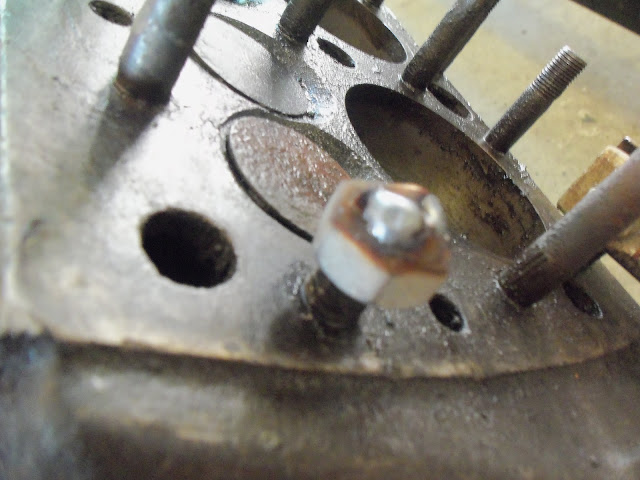
First up, trying to remove head studs from one of the FH's:

106_1736.JPG


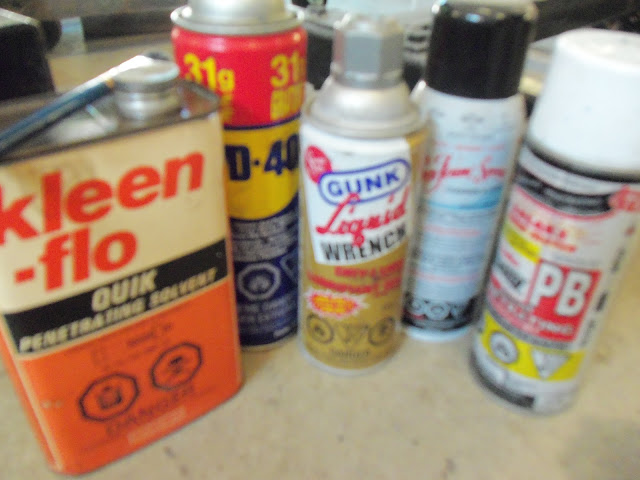
After days and weeks of using all these release agents, I decided to start on the studs the PO broke when removing the heads - but they still wouldn't budge... I even used some heat, then soaked them down again hoping the wicking effect would help...

106_1737.JPG


106_1738.JPG


So onto the "tried and true" method...

106_1740.JPG


106_1741.JPG


106_1742.JPG


106_1743.JPG


106_1744.JPG


106_1745.JPG


106_1746.JPG


106_1747.JPG


106_1748.JPG


AHA! SUCCESS!!!

106_1751.JPG


106_1750.JPG


About now, I'm feeling pretty damn 'POTENT'!!
And my Daddy always told me: "If you's gonna act im-potent, then you gotta make yourself IM-POTENT!"

Of course the next one didn't go as smoothly (D'OH!!). Look closely:

106_1752.JPG


After that brutal happening - and thinking of the drill and easy-out fun I wwas now in for...I decided I needed another "feel-good", so I finished up the 390:

106_1753.JPG


106_1755.JPG


106_1754.JPG


Also, the owner of the '40 Ford rod that is up next came by yestarday for a visit. He was driving his last project, a kick-*** '56 GMC Step with a front clip, 350 and custom interior. He had done it over 10 years ago and driven it regulary in the summers - over gravel and down highways - and it still looked good! I wish now I would have taken some photo's - Maybe he'll read this and post some up for us (c'mon Leonard, I know you're reading this!)
 

bgott

Well-known member
Joined
Oct 31, 2005
Messages
3,512
Location
Houston, TX.
If you did just one quarter panel would you get custom plates that said "ILENE" ?

Not if you add a couple of leaves to the springs on that side. Something that I noticed when I was looking at Google pictures of Cuban cars, a lot of them have straight axles on cars that didn't come with straight axles. Being that they are not gassers I figure that the bodies have been mounted on old Russian truck chassis.

http://www.google.com/imgres?q=cuba...=2100&h=1313&ei=nYILUOzVH-jD2QXDm8D1Dw&zoom=1
 
OP
E

e-tek

Well-known member
Joined
Dec 19, 2007
Messages
10,690
Location
Saskatoon, SK
As I mentioned, the owner/builder of this sweet 56 GMC Step came by to talk about having me finishing up his 40 Ford custom. He built this truck nearly 15 years ago and still drives the paint off it! Life is busy, so he's asked me to help him finish it out, including wiring up the 5L Ford with EFI and chassis, all the interior work, including the dash, gauges, custom console, all the actuators and final body mods. Sounds like a challenge!

20120721_210517.jpg


20120721_210941.jpg


But first, let's make Trent's Cougar a winner!
 

padstack

Well-known member
Joined
Feb 25, 2010
Messages
246
e-tek - you are no bodyman. No. Not a body man at all. You're a freaking ARTIST! Nice job man! Totally jealous of your skills. Keep up the good work! Always love your threads!
 
OP
E

e-tek

Well-known member
Joined
Dec 19, 2007
Messages
10,690
Location
Saskatoon, SK
e-tek - you are no bodyman. No. Not a body man at all. You're a freaking ARTIST! Nice job man! Totally jealous of your skills. Keep up the good work! Always love your threads!

HeHe - Thanks man. I started reading that and thought: "uh-oh, someone's on to me....." :evil:
 
OP
E

e-tek

Well-known member
Joined
Dec 19, 2007
Messages
10,690
Location
Saskatoon, SK
OK Robert - ya *******! LOL!! Here's what was under all that filler....

Ahead of the right rear wheel there was a brazed-in patch panel. I'm not gonna disparage the old repairs, because some of it is just "old-school" production shop style repair, not really "butcher-work". This was before mig welders and new replacement panels (although you still cannot get new replacement panels for this car!). The slide hammer and brass filler where staples for this kind of repair. Remember, in the the 70's and 80's, this was not yet a collector-car!

106_1756.JPG


You can see where the patch extends, the brazing being soft enough to move and pucker over the years:

106_1757.JPG


106_1766.JPG


Further up, the slide hammer was used to pull a crease out. I might have accepted this repair back in the day - if the holes would have been welded shut...

106_1769.JPG


106_1771.JPG


This is the leading edge of the same quarter, where it meets the door. The damage here was filled but it really should have been banged out, so as to avoid a weak-spot at the edge.

106_1772.JPG


These patches lasted quite a while - but you can see the rust/contamination creeping past the edges. Had I not removed the filler it would have breached (broached?) the surface at some point. (Thanks again to Robert for pushing me to do what I knew I need to do - DAMN you!! ;))

I'm surprised there isn't more rust behind the filler around these holes...Owner says it was an Arizona car, which would explain it. These repairs wouldn't have lasted as well up here!

106_1774.JPG


Along the wheel arch edge, some brass was used to fill what mist have been pin-hole rust spots....

106_1778.JPG
 
Last edited:
OP
E

e-tek

Well-known member
Joined
Dec 19, 2007
Messages
10,690
Location
Saskatoon, SK
Continuing on the Left side...

The damage here wasn't worked out enough to meet the quarter panel extension. I think they tried, but due to the damage still evident it would have shortened the panel some. They likely pulled it as much as they could but it must have kept breaking at the rear edge, based on the amount of weld (braze) that is present:

106_1782.JPG


106_1784.JPG


106_1785.JPG


Here's a nice hole that was likely made when a tab was welded and pulled on at the edge:

106_1786.JPG


Slide hammer holes...

106_1787.JPG


Front side:

106_1788.JPG


Back side (!):
106_1789.JPG


I'll have to make a new piece to replace the entire corner, leading into the quarter panel. This way I can remove the brass and put metal to extend the edge where they had used filler.

Fun stuff!
 
OP
E

e-tek

Well-known member
Joined
Dec 19, 2007
Messages
10,690
Location
Saskatoon, SK
On the door, another brazed patch panel was showing it's age:

106_1762.JPG
[/IMG]

106_1790.JPG


One on the underside too:

106_1792.JPG


The entire corner will need to be fabricated:

106_1794.JPG


So there you have it. All the "issues" have been uncovered. Now we (meaning me...) can address each area with "modern" repair methods and thus give the old gal (Cougar - get it??) at least another quarter century of turning heads! Now I know what Joan Crawford's plastic surgeon feels like....
 

Carguy99

Well-known member
Joined
May 25, 2012
Messages
717
Location
Warrenville IL
I have heard you use the term "slap file"??? could you please explain? Is it used for high spots or low.
oh, FYI because of this thread and I guess you. I acquired a fender with a dent and some rust. I'm going to give body work a try. If you hear any swearing... that would be me.
 

MoonRise

Well-known member
Joined
Nov 5, 2010
Messages
4,025
Location
NJ
First up, trying to remove head studs from one of the FH's:

So onto the "tried and true" method...

106_1740.JPG


106_1741.JPG


106_1742.JPG


106_1743.JPG


106_1744.JPG


106_1745.JPG


106_1746.JPG


106_1747.JPG


106_1748.JPG


AHA! SUCCESS!!!

106_1751.JPG


106_1750.JPG


About now, I'm feeling pretty damn 'POTENT'!!
And my Daddy always told me: "If you's gonna act im-potent, then you gotta make yourself IM-POTENT!"

Of course the next one didn't go as smoothly (D'OH!!). Look closely:

106_1752.JPG


After that brutal happening - and thinking of the drill and easy-out fun I wwas now in for...

Ummm, unless you were just really in the mood to make some threads using the die on the protruding lump of the stud, why did you go to all the time and effort to make those threads? :dunno:

Since the nut is being welded to the stud 'post' and then the extracted pieces tossed, I usually just grab a nut that slips over the broken 'shaft' and weld said nut to said 'shaft'. No threading needed.

Let cool (so the intense heat from welding gets a chance to hopefully break loose the frozen threads from the block/item and so that you don't burn yourself on the hot metal :lol: ). Then apply wrench to nut and (hopefully) remove nut-n-stud (sort of like NutN-Honey, but different :evil: ).

If the nut don't work and either the nut breaks loose from the stud (weld failure) or the stud breaks off flush with the tapped hole or slightly under (like what happened with your second stud attempt), don't despair or immediately run for the drills or Ez-Outs. Just grab a washer (optional, ID hole just slightly smaller in diameter than the root diameter of the stud threads) and another (slightly bigger) nut. Put (optional) washer over stud end (helps keep you from buggering some weld onto/into the block surface or the edges of the threads). Place (slightly bigger size) nut on top of the washer and again mostly centered over the stud remains underneath. Proceed to weld the ID of the nut to the remains of the stud end. Let cool (heat to hopefully help break the corroded threads loose and so you don't burn yourself :lol:). Remove nut-n-stud. Repeat as needed or until you don't feel comfortable trying to weld deep into the tapped hole in the block.

At which point you can either attempt using a SMAW electrode pointed straight down into the hole (the flux coating kind of lets you reach down into the tapped hole without instantly jumping the arc to the female threads of the block and you can hopefully just arc to the end of the stud, if really cautious you can put a piece of tube/pipe/whatever into the threaded hole so you really can't jump the arc right to the threads in the tapped hole in the block) and building up some weld up protruding past the top of the block and again putting a big nut on it or going with a fine touch and blasting out the steel stud remains out of the cast iron block with an oxy-acetylene cutting torch (the oxygen cutting shouldn't cut or burn the block but instead should burn the carbon steel stud remains out, I'm not personally experienced or comfortable enough with this to completely recommend it, but several others have reportedly used it successfully).

Or you are then to the point of using the drills or Ez-Outs. :lol_hitti Or a shop with an EDM machine.

Speaking of welding, that pic with the solid-wire GMAW (aka MIG) wire looks like maybe just 0.025 inch diameter wire? Great size wire for body panels and sheetmetal, maybe a little small for trying to get the nut attached to the stud remains. Short-circuit transfer with 0.025 solid wire can get you up to about 100 amps or so, 0.030 wire up to about 130 amps or so, and 0.035 wire up to about 180 amps or so (dependent a bit on the shielding gas being used). Higher amperages than that and you are pushing the wire past short-circuit transfer into globular (not really a problem for trying to stick a nut to a stud, just watch out for spatter onto the rest of the parts) or up into spray-transfer territory (not getting an actual spray-transfer with C25 or CO2). My usual 'Go-To' wire for small GMAW is 0.030 (workpiece thickness and machine ouput power 'sweet-spot), unless doing sheetmetal mostly (change to 0.025 wire) or slightly thicker stuff (change to 0.035 solid or some FCAW in 0.035 or 0.045 or grab the stick welder). YMMV, but I'd probably slap at least the 0.030 wire in to get the nut attached to the stud remains to get a bit more 'heat' into the weld and the stud.

:beer:
 
Last edited:

MP&C

Well-known member
Joined
Oct 21, 2009
Messages
4,396
Location
Leonardtown, MD
OK Robert - ya *******! LOL!! Here's what was under all that filler....


Now that's exactly how my luck runs as well.....and why I like to see what I've got to work with. Looking forward to seeing you tackle the various issues!
 
Last edited:
OP
E

e-tek

Well-known member
Joined
Dec 19, 2007
Messages
10,690
Location
Saskatoon, SK
Thanks for the input Moon-rise! Reason I like to run a thread is that's how I was taught, doesn't take but a few minutes and it makes it easy to keep the nut centred and at the top if the stud for welding.

I've tried welding another nut onto a broken and now flush stud, but have never seen where it's worked. If the stud wouldn't come out with the extra weld surface we had to start with, it's unlikely (in my experience) that it would come out now with even less. Of course it may be worth a try and even if it worked once it sure would be nice!

As far as a larger wire giving more holding power in this situation, I believe I'm using 0.030 - do you really think there'd be that much difference in holding power going to .035? Again, I'm up for anything that might work so I'll research that a bit further for sure.
 
OP
E

e-tek

Well-known member
Joined
Dec 19, 2007
Messages
10,690
Location
Saskatoon, SK
There is a Cougar out at Amigo's. Do you want some panels?

If there was a donor with a CLEAN quarter, right down to the bottom, we could skin a larger section - but even if there's one that's just clean around the rear portion, where it meets the extension, we could splice it out to give us a clean mating section. Have to decide what's gonna give us the best over-all repair.

Now that's exactly how my luck runs as well.....and why I like to see what I've got to work with. Looking forward to seeing you tackle the various issues!

Well don't be shy - here's where we need your expertise/input!
 

gustoffur

Well-known member
Joined
Jan 14, 2011
Messages
45
Here are a few pictures of the Cougar at Amigo's.
014.jpg


012.jpg


Might be easier just to cut that section off the car at Amigo's than trying to repair the damage on my Cougar.
 
To avoid these ads, REGISTER NOW!

1948

Well-known member
Joined
Oct 14, 2011
Messages
569
Location
IL WI border
on the flathead studs. ive done a ton of flatheads! and one thing i can tell you, is you need to get those studs CHERRY RED! get them things nuclear, then while they are still hot wiggle them a bit. once they cool, then grab em with a vice grip or do as you did with the nut. spray some pen oil on them and then wiggle them some more. once it seems loose THEN try and unscrew em.
 

MoonRise

Well-known member
Joined
Nov 5, 2010
Messages
4,025
Location
NJ
Thanks for the input Moon-rise! Reason I like to run a thread is that's how I was taught, doesn't take but a few minutes and it makes it easy to keep the nut centred and at the top if the stud for welding.

I've tried welding another nut onto a broken and now flush stud, but have never seen where it's worked. If the stud wouldn't come out with the extra weld surface we had to start with, it's unlikely (in my experience) that it would come out now with even less. Of course it may be worth a try and even if it worked once it sure would be nice!

As far as a larger wire giving more holding power in this situation, I believe I'm using 0.030 - do you really think there'd be that much difference in holding power going to .035? Again, I'm up for anything that might work so I'll research that a bit further for sure.

I usually figure that as long as the nut is 'reasonably' centered over the shaft remains, that is usually "Good Enough". If you feel happy/comfortable running the die and threading the tip of the shaft, that's fine. :beer: It's not like you are spinning the nut/stud at several thousand RPM and have to worry about being off-center or anything. You are just slowly wrenching the stud/bolt out of wherever it is stuck and then scrapping/tossing the welded nut-n-stud. :)

As to the "holding power", if the weld itself (either on/at the nut or the stud/shaft) breaks then you didn't fuse/penetrate adequately into the parent metal on the nut or the stud/shaft. If the stud/shaft breaks, then it's because you exceeded the material strength of the metal there.

I usually leave the nut a little 'high' so the stud/bolt is a little recessed below the face of the nut. Makes it easier to see and center the weld with the hood on and get a bit more overall heat into the shaft. You're welding the pieces together so it's not like you are relying on the threads there to actually hold the nut and stud together. :p

I usually figure that getting 'adequate' heat into the (corroded/frozen/jammed) threads is a good side benefit of welding the nut onto the stud/shaft. Instead of having to break out a torch flame and heating the threaded fastener remains up to RedHot to get some thermal expansion/contraction going on to try and break the rusted/frozen threads loose from one another, you are just using the residual heat from welding to do the thermal expansion/contraction. That's kind of why we weld the nut on (something to wrench on and the heat from welding to give the thermal expansion/contraction) instead of just sticking a pair of vise-grips onto the protruding stud end and yanking (no thermal expansion/contraction, so unless you can end up 'overpowering' the rust/whatever you end up spinning the vise-grips on the stud end or snapping the stud flush with the block (where the threads are still holding tight).

As to the wire size, over the Net the pic just looked a bit 'small' on the wire diameter. I figured if you were welding sheetmetal then you probably had some 0.025 wire in the machine and just grabbed that when you went to weld the nut onto the stud.

0.025 wire = tops out ~100 amps

0.030 wire = tops out around 130 amps. That's 30% more heat into the weld (better fusion/penetration into the nut/stud) and just overall heat into the stud (thus getting the stud hotter for hopefully a little more expansion/contraction to loosen the rusted/frozen threads).

0.035 wire = tops out around 180 amps. That's almost double the amps and heat into the weld and into the stud (good fusion and more thermal expansion/contraction to hopefully loosen the rusted/frozen threads). It's not like you are all that worried about blowing through the nut/stud from too much heat/amps like you are when welding the sheetmetal. :spit:

(amps numbers are for short-circuit transfer GMAW. If your machine can do spray transfer and you are running the 'appropriate' gas, those number can go higher.)

If the stud/bolt breaks off, then the threads are still rusted/frozen. Heat it again from welding another (bigger) nut on and/or heat the stud RedHot with a pin-point torch flame (not a big wide propane plumber's torch). Thermal expansion/contraction to help loosen the rusted/frozen threads. Repeat until stud is out or you run out of welding wire, shielding gas, spare/scrap nuts, or patience. :spit:

:beer:
 
Last edited:
OP
E

e-tek

Well-known member
Joined
Dec 19, 2007
Messages
10,690
Location
Saskatoon, SK
Good info, but now I'm almost sorry I started that!
Oh well, back to "E-tek's Projects Thread"!

Specifically, the door corner repair:

106_1790.JPG


106_1794.JPG


Starting the cutting:

106_1800.JPG


What's behind window number One?!

106_1801.JPG


This brace is on the inside corner...wonder if they knew how well it would trap dirt and moisture?

106_1803.JPG


The cutting continues underneath....

106_1804.JPG


Lots of brass to get through...

106_1805.JPG


...and more rusty bits of course....

106_1808.JPG


As usual, any surface rust underneath gets treated with MetalReady, then sealed with POR15:

106_1815.JPG


With the pieces removed, I can use them to shape the replacement pieces:

106_1809.JPG


106_1814.JPG


106_1816.JPG


Cut and bend...

106_1818.JPG


and shape...

106_1819.JPG


106_1821.JPG


106_1822.JPG


106_1824.JPG


First try...almost!

106_1827.JPG


Outer corner:

106_1828.JPG


106_1835.JPG


106_1834.JPG


106_1833.JPG


Lots more fun to come!:thumbup:
 

machine_punk

Well-known member
Joined
May 14, 2011
Messages
2,540
Location
Napa Valley, California
I love seeing you do this with very basic tools...whatever it takes to get the shape. Do you have a huge collection of body hammers and dollies, or do you just make do with whatever you have lying around the shop?

M_P
 
OP
E

e-tek

Well-known member
Joined
Dec 19, 2007
Messages
10,690
Location
Saskatoon, SK
I love seeing you do this with very basic tools...whatever it takes to get the shape. Do you have a huge collection of body hammers and dollies, or do you just make do with whatever you have lying around the shop?

M_P

No big collection here! I have 4 body hammers, of which the chisel-end is my most-used. I have maybe 6 dollies and use 2 often. I like to use the anvil, vice and a few heavy pieces of scrap. That's it.
 
OP
E

e-tek

Well-known member
Joined
Dec 19, 2007
Messages
10,690
Location
Saskatoon, SK
I have heard you use the term "slap file"??? could you please explain? Is it used for high spots or low.
oh, FYI because of this thread and I guess you. I acquired a fender with a dent and some rust. I'm going to give body work a try. If you hear any swearing... that would be me.

Hey CarGuy - sorry I didn't see this post until now. Kinda surprised someone else didn't reply too. Anywho - I was taught/introduced to this tool years ago by an old time bodyman at my Dad's shop. A slam-file is similar to a slap hammer, which spreads the blows out over a larger area than a hammer, with the addition of being able to "shrink", or move the metal ever so slightly.

Slap Hammer:

images


Shrinking Hammer:

images


Slap File:

p901.jpg
 
Last edited:

machine_punk

Well-known member
Joined
May 14, 2011
Messages
2,540
Location
Napa Valley, California
Kinda surprised someone else didn't reply too.

I was just introduced to this tool a couple of weeks ago, at the Cuesta Metal Meet. This gentleman, Paul Bragg, who's says he's been into automotive metal shaping since he was a teen, was telling us what he used it for. It only took him about 10 minutes to get way over my head, but I will tell you what I remember about the tool...

He said it is actually a file (closer inspection confirmed that...it has teeth, just like a double-cut file), but is not used to remove metal. He uses it like a spoon or *******, when raising low spots. He uses an appropriate dolly on the bottom of the panel and uses this slap file to move around the edge of the low spot. What you end up with is very clear markings, to show you exactly where the low spots and high spots are. This tool CAN move a little metal, but only with very light taps (which is all you should be doing anyway, in metal finishing). His primary purpose in using this tool, though, was to get a visual for where the low spots are.

attachment.php
 
OP
E

e-tek

Well-known member
Joined
Dec 19, 2007
Messages
10,690
Location
Saskatoon, SK
Mine is still the original tool made for me by that old tech (Jerry) from (as M_P said) a double cut file. He heated it cherry red and bent it in a vice, then cooled it slowly.
 

wnstwolf

Well-known member
Joined
Nov 7, 2007
Messages
837
Location
New York and PA
Hi E-tek have been lurking but my first post on your inspiring work. I have had a lot of good experience in restoring a few Camaros and a mighty fine 68 stang but recently I picked up my biggest challange yet, 64 Jag e-type. Back a few pages you showed floor replacement panels where for the most part you "****-Welded" the panels but chose to overlap in some places for strength. I follow the logic but from an asthetic approach do you dress up the welds both inside the car and then go underneath and hit that other seam as well? If not, are you worried moisture will get up there and start the rusting process all over again? Just trying to learn before I cut.. Novel Idea..:confused:
 
OP
E

e-tek

Well-known member
Joined
Dec 19, 2007
Messages
10,690
Location
Saskatoon, SK
Hi E-tek have been lurking but my first post on your inspiring work. I have had a lot of good experience in restoring a few Camaros and a mighty fine 68 stang but recently I picked up my biggest challange yet, 64 Jag e-type. Back a few pages you showed floor replacement panels where for the most part you "****-Welded" the panels but chose to overlap in some places for strength. I follow the logic but from an asthetic approach do you dress up the welds both inside the car and then go underneath and hit that other seam as well? If not, are you worried moisture will get up there and start the rusting process all over again? Just trying to learn before I cut.. Novel Idea..:confused:

What I do is dress the welds on the upside, then use Pro-Form seam sealer on the underside, followed by primer, maybe a light rock guard, then paint. This completely seals both sides and apparently looks good enough to garner several award-winning builds.:bounce:
I generally wouldn't overlap a seam in the middle of a panel where there is no other seam already present as it would look out of place - but under the seat, along the rocker seams look OK.
 
OP
E

e-tek

Well-known member
Joined
Dec 19, 2007
Messages
10,690
Location
Saskatoon, SK
How long till he gets his license; will the rod be ready for him? It looks like he's ready to roll, so the 'old man' better get on the stick! lol

Well, he has his own car 0 the 1971 Datsun/Nissan 240Z - so no Rod for him. Luckily, I've also got about 8 years to finish THAT too!
 
OP
E

e-tek

Well-known member
Joined
Dec 19, 2007
Messages
10,690
Location
Saskatoon, SK
Repairs required inside and in front of R. wheel well -

106_1840.JPG


106_1843.JPG


Lots of slide hammer holes not closed up. I'll likely cut and replace about 8" of the wheel well -

106_1842.JPG


Continuing on the door corner, I first sprayed the inner with high Zinc weld-through primer:

106_1844.JPG


106_1845.JPG


Door corner metal-finished - about 80% there -

106_1850.JPG


Welded outer patch panel on, leaving flaps to be bent over after -

106_1853.JPG


Using hammer and dolly to bend flanges over -

106_1854.JPG


106_1857.JPG


After some hammer and dolly work and first pass with grinder -

106_1859.JPG


Don't forget to remove the tags before it goes to paint and they get masked up (again)!

106_1847.JPG


106_1846.JPG
 

Omphaloskeptic

Well-known member
Joined
Oct 11, 2008
Messages
2,346
Location
Ultima Ratio, Wa.
"I first sprayed the inner with high Zinc weld-through primer"

E-Tek, I've read (on GJ, I believe), that you should never weld galvanized without grinding the plating down to bare metal in the weld area. Do you have to take precautions of any sort when using the weld-through primer?:dunno:
 

machine_punk

Well-known member
Joined
May 14, 2011
Messages
2,540
Location
Napa Valley, California
I have a question about a piece of equipment I suspect you might use.

Do you use a porta-power ram of any sort? I've been thinking about getting one lately, simply because it looks too useful to not have one. I don't do the sort of body work that I believe they are primarily used for (un-crunching parts which are crunched), but I can imagine all sorts of ways to use this for the things I do, not to mention the fairly normal use of using it to cut large holes in sheet metal (with a greenlee-style punch set).

If you have one, which brand? Which size (4 or 10 ton)? Do you use it with the included hand pump, or do you have the air-over-hydraulic adapter/reservoir?

While Harbor Freight (our cheap tool seller in the US) definitely has these, I don't think I want to go that route...I think I want a little higher-quality tool (I could imagine the HF unit dripping and leaking everywhere).

M_P
 
Last edited:

wnstwolf

Well-known member
Joined
Nov 7, 2007
Messages
837
Location
New York and PA
Machine Punk. porta-power rams are a tool that like many you don't need till you need it and when you have one you will find all sorts of things to do with it. I have the10-ton Grainger unit that cost about $450 While it has been a great tool on car projects it has been used on so much else from bending back mower decks to knudging a deck into place.. One of the best parts is the spreading "jaws" for the amount of Time I use it the hand pump is fine for me..

3ZC69_AS01
 
OP
E

e-tek

Well-known member
Joined
Dec 19, 2007
Messages
10,690
Location
Saskatoon, SK
"I first sprayed the inner with high Zinc weld-through primer"

E-Tek, I've read (on GJ, I believe), that you should never weld galvanized without grinding the plating down to bare metal in the weld area. Do you have to take precautions of any sort when using the weld-through primer?:dunno:

That's an interesting point "O".... Although I'm no subject expert in this area, I do remove the electrochemically treated galvanized coating prior to welding, but after some cursory research, it doesn't seem as necessary as once thought. The Zinc coatings vaporize(oxidize) in the welding heat creating Zinc Oxide - like the stuff beach volleyball players use on their noses.

In addition, although I've seen and heard a lot about the "toxic effects" of welding Galvinized Metals, I'm now really not overly concerned with long-lasting negative health effects due to this same research.

Here's a good synopsis of where I'm coming from - which I'm sure will lead to a LOT of "heated" ;) debate on the subject:

http://www.nakedwhiz.com/weldinggalvanized.pdf

If you need an OFFICIAL view point, here's the AWS bulletin on the subject which states there is no known long-term safety issues known:

http://www.aws.org/technical/facts/FACT-25.pdf

*** Having said all that, I do of course take precautions not to breathe in (any) fumes and often use a fan behind me, as well as a wall exhaust fan, to remove toxic welding (and any other) gases from my work area.

Do you use a porta-power ram of any sort?
While Harbor Freight (our cheap tool seller in the US) definitely has these, I don't think I want to go that route...I think I want a little higher-quality tool (I could imagine the HF unit dripping and leaking everywhere).

M_P

You bet. As was just said above, although it's a seldom used piece outside of "collision" work, you'll likely find other uses for it around the home and shop if you try.

I use Princess Auto's PowerFist unit (Canada's HF) and have never had any issues with leaking. However, the hydraulic pump seems rather stiff and I always imagine that another $300 spent on a high-end unit would alleviate this (true or not, I'm not sure!)
 
OP
E

e-tek

Well-known member
Joined
Dec 19, 2007
Messages
10,690
Location
Saskatoon, SK
I should know by now that rust - and a rust patch - is just the tip of the ******* iceberg....er' RUST-BERG.

I was going to weld these holes up, then I though I'd be better off to cut the worst areas out and replace them with solid metal....

106_1864.JPG


....but when I started cutting the patches out....

106_1867.JPG


>>> Make creaking window opening noises here.... <<<

106_1868.JPG


106_1869.JPG


106_1870.JPG


Old school butchery - instead of cutting out the rust they just covered it:

106_1871.JPG


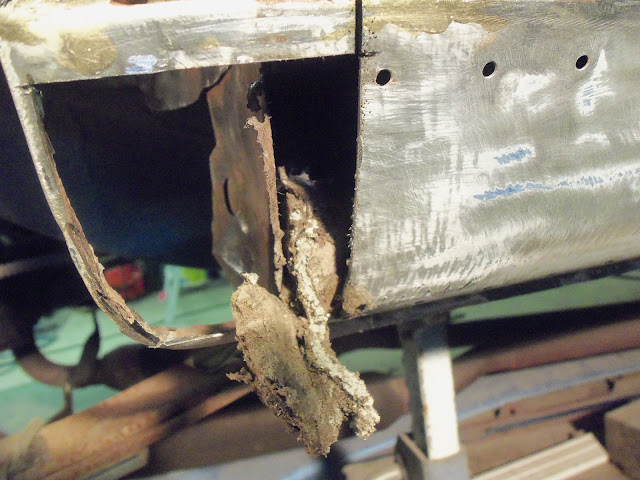
Oh, what's that inside the rocker?? A giant Turd??

106_1874.JPG


nope - seam caulking to stop up a hole....

106_1875.JPG


Wait, there's more - what's this? (Check out my "Rocker Panel Cam")

106_1878.JPG


Mouse nesting materials....

106_1877.JPG


Send in the vacuum hose:

106_1882.JPG


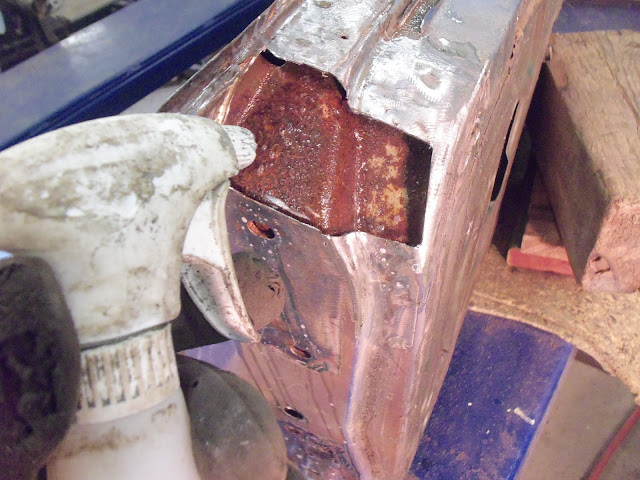
Once I get it as clean as possible I'll spray Eastwood's Rocker Anti-Rust in there. It's an oil/wax substance in a can with a 2 foot spray hose and conical spray tip:

p39175.jpg


http://www.garagejournal.com/forum/showthread.php?t=74725&page=42

But first, there's a little more to cut:

106_1888.JPG


...and here's where the cutting ended:

106_1890.JPG


106_1889.JPG


Forming the metal replacement pieces - from the inside out:

106_1899.JPG


Rough cutting rocker patch:

106_1903.JPG


Fitted and closer to welding:

106_1904.JPG


And that was about 4 hours worth of work. I also worked on the doors and quarters today, cleaning up welds and hammering out low spots.

I always study the tools other guys use, so I'll show mine in case anyone cares to do the same:

106_1905.JPG
 
To avoid these ads, REGISTER NOW!
Top Bottom