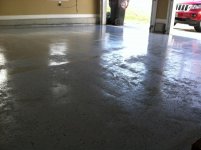
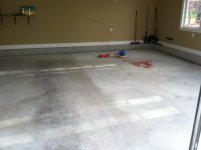
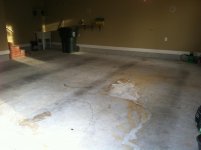
This is a very old thread, but one of the best I have seen on this subject, so I thought I would contribute what I learned during my first application of Epoxy-Coat. This will be long winded, but hopefully helpful - I know I prefer more detail in these maters.
Background - I have a three car garage (about 800sf) and an attached shop (350sf), and I am going to coat both floors, but started with the shop as a test run since fewer people would see the finished product.
The Key Things I learned:
-If at all possible, have a helper, as this would be much easier with two people
-If working alone, cover the floor in FEWER batches (maybe one big go), as the time you take to mix and pour will seriously complicate the important part: getting the stuff spread evenly across the floor and all the bubbles out
-Like any painting project it is ALWAYS better to do two thin coats rather than one thick one
-The materials you are using are expensive, and if you mess up it is hard to get it off, so invest in good tools: Buy measured mixing buckets (a few bucks each), a three gallon mixing bucket, a 22" squeegee that you can put on a long handle ($10), a heavy duty 18" roller frame ($16) and roller covers, a box of surgical gloves, and if you have the time some old school spiked golf shoes (I got a brand new pair off eBay for $20).
-Mix slowly, as air that gets mixed in will become bubbles on the floor
-back roll, back roll, back roll, then back roll again
-If you are a sweater, and it is hot out, wear a hat or headband, or you will be dripping sweat into the epoxy
-Cleanup: denatured alcohol will get this stuff off almost anything while it is still wet, or even tacky
How I learned this:
Since Epoxy-Coat implies that more is better, and does not imply that thick application is discouraged I decided to put down a full kit in my 350sf shop in one go. Since the product says self leveling, I was also hoping the thick coat would fix some imperfections in the floor. Before I started I gave the whole floor a light grinding, and a good washing. I got everything set up, and started mixing the first batch.
The first challenge is that the main bucket, in which they tell you to mix, is HUGE, and the amount you are mixing is small, so the mix is shallow. I was tilting the bucket to get some depth, and it worked fine. On the latter mixes, I found that if I stepped up the drill speed, I could get the stuff whipping like egg whites (big mistake). This is why I recommend you get a smaller bucket for the mixing process - it will make it easier to mix, and be more precise to pour.
I strapped on my spiked shoe things, and I poured the first section, cut it in as instructed, used my squeegee to pull it out (I had a 22" one lying around - I don't know how on earth you could effectively spread this stuff with the tiny squeegee that comes with the kit), and then took the supplied 9" roller to it. Went down well, so I moved onto the next section, which also went down well. By the time I was done, the first section had some bubbles, so I back rolled.
When I got to the third section, I was a bit rushed, as I could see bubbles in the first two and was worried about drying time. Threw down the third section, and then went back and re-rolled the first two as they both had bubbles. At this point, the first section was getting pretty tacky.
I did the final section, mixing furiously, then laying it down. Then I kept going back and back rolling. By this time the first section was so tacky that it kept pulling the roller off the frame. I was teetering around on those terrible spike plates, which dropped one or two bolts in the process even though I double tightened everything before starting, trying to keep the roller on the frame as I rolled through increasingly grabby epoxy. Since I had been mixing more aggressively on each successive round, each section had more bubbles than the one before.
Once it got too thick to roll, I pulled out a leaf blower and tried blowing, but it had minimal impact, so I just decided to let it dry and deal with it the next day.
The next morning there were bubbles in all the sections, but they were really bad in the third and fourth section. I let it dry for a few days, then took a random orbital sander and knocked down the bubbles, and roughed up the whole floor.
For my second round I re-tooled. I got a nice heavy duty double sided 18" roller frame at home depot. I bought a new big squeegee and put both on heavy duty extendable poles. I bought good measure and mixing receptacles and I got a pair of spiked golf shoes off ebay.
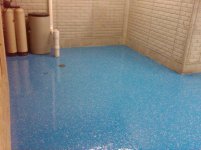
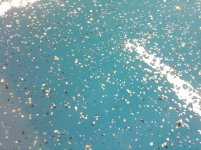
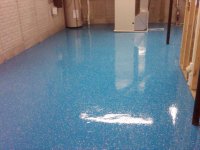
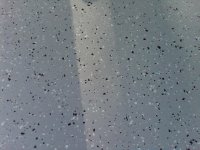
This time I mixed 3/4 of a kit all at once, being careful not to mix in too much air, poured it around the edge, and just took the big squeegee and spread everything around the shop so there was almost full coverage. I took a big brush (not the little chip brush in the kit) and pulled everything out to the edges, then took my roller and started working it back and forth, doing full passes of the shop. I let it sit for a few minutes, did another roll, re-brushed the edges (there is some discoloration when it first starts to set up) and left it for a while. Once I was confident there would be no bubbles, I broadcast my chips.
The bigger, stronger roller, increased mobility because of the golf shoes, and lower bubble count due to less air, not contaminants, and thinner application made a world of difference.
A note on broadcasting: even if you throw them in the air, you have to use SMALL amounts at a time, or you will get some clumping. You can also throw them horizontally at full pace and they spread, but I found it was actually best to grab a small handful and shake them at a reasonable height so a few sprinkled through my fingers at a time
The next morning everything looked great. That night I put down 3/4 of a kit of clear coat. It went well. I should have done one final roll, as this morning there were some small bubbles. In hind sight I actually would have done two very thin applications.
So, I will do the garage in a week or two. I plan to do two thin coats of epoxy, and two thin coats of clear coat. This stuff is thick, and DEFINITELY not self leveling, so on the very smooth garage floor I will be better off going thin coats. If anybody is interested, I will update with results.