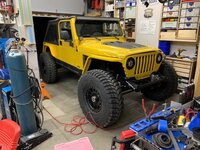
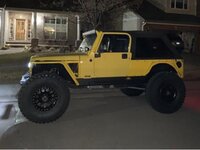
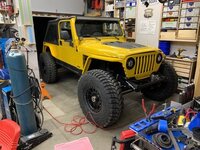
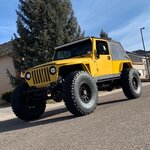
Mike - this is all I really need to be honest. Maybe I'll dial it back a notch and work through installing a more simple setup. How does the EO work? Is it something (like a pre-negotiation) that Robbie has with California which he makes available to his customers as part of the purchase process or is it something that anyone can get if they have a matching setup (matching to the specs)?
The EO is basically a certificate from the ARB (Air Research Board), in California it's known as CARB, that states this application has been approved and has been proven to pass the USEPA guidelines for use by the EPA. Things like air intakes, exhaust systems, etc from the aftermarket all have to go through this process in order to sell items that are CARB compliant.
Robbie went through the same process where he used certain parts and submitted them and a vehicle to the ARB for evaluation and ultimately, approval. I think it was made slightly easier due to the fact of using all OEM components which were already certified by GM at the time they were developing said vehicle(s). This is why using "hot rod" or custom wiring harnesses won't pass ARB certifications for use in anything other than hot rods or off-highway vehicles. Granted some states do not have such emissions laws so pretty much anything goes but those states are becoming few and far between. Plus I also wouldn't want to have a car that isn't legal to drive on the street unless it was race only.
When the Executive Order is approved it will be basically a certificate that states as long as all of these components, (X, Y and Z) are used it will be USEPA compliant and more importantly must be accepted by the county or state you are dealing with. It is not specific to a certain shop performing the work but specific to the components being used.
Ok, easy enough. Is it reasonable to assume that the swap could be done on the floor (without a lift)? I see most of the swaps actually lift the cab to get the motor and trans in. It's really this step (and programming) that has me apprehensive.
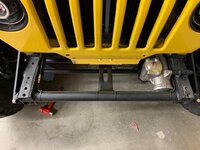
Yes, the swap can be performed without lifting the body, although a bit more time consuming and a few more clearances must be dealt with. If you were to use weld in motor mounts I don't know how possible it would be but if you use Robbie's bolt in motor mounts I can see there being enough clearance if you remove the front core support and if using the truck/SUV engines, remove the upper intake plenum.
350HP in town is really more than enough. I want to be able to set the cruise control at 80, pull the I-70 hill into the mountains, and have a little something something when I need to merge into traffic. Those are the real requirements. (silently I just wanna feed my up coming midlife crisis).
The L94 has nearly 350 lb/ft of torque just off idle and tops out on torque around 4k RPM. Coupled with the 6L80E transmission having a 4.02:1 first gear even my heavy JK @ 6k pounds leaves the light like a go-kart. As for cruising on the interstate on grades where my V6 would downshift and scream to around 5k-5500 RPM in second or third it now stays in 6th gear and with the cruise control on will hold within 1 MPH. On some grades however, if I'm slowed due to traffic or such it may downshift into 5th but that about it unless I am really slowing and then it is just getting into the optimum gear. The new generation of dual clutch GM transmission being torque sensing are always trying to get into and stay in high gear as quickly as possible for efficiency reason.
The difference between the LS and the newer LT engines will be the LT's have the ability to phase the cam continuously during the RPM range to maintain cylinder pressure whereas the LS engines with VVT will be in static position until around 3k RPM where they phase and shift the cam profile to retard the cam. It allows the cylinder pressure to be higher at lower RPM for torque but also why they require premium fuel. The LT may phase the cam slightly rather than a downshift for a slight addition of power whereas the LS may merely downshift to a lower gear. That's the biggest difference I've noted between driving the two. Again that may be a bit subjective but has been what I have experienced as far as power availability and driving impressions. Both engine generations have pro's and con's as far as I'm concerned. One uses more technology to improve performance (LT's) and one uses advancements but still based on the proven small block Chevy engine (LS's) but in the end both are a HUGE step up in performance.
Also on a side note, I really like the closed EVAP emissions system of the LS's and LT's vs. the ESIM (Evap System Integrity Monitor) of the Chrysler operating system which is pretty basic and primitive. It uses a spring loaded shuttle valve to shift between venting and/or purging whereas the GM system uses an actual FTP (Fuel Tank Pressure) sensor and a vent valve at the rear and the purge valve up on the engine to monitor and adjust the EVAP system continuously. NO more smelling fuel on the trail after an off-camber or steep climb like the OEM Chrysler system and much more precise.
I've had 2 atlas t-cases. 4:3:1 and 3.8:1. The 4.3 was horrible. Had to switch back to Hi-range between obstacles, just couldn't stand going 3 mph. The 3.8 was marginally better but I still felt like low was too low and used it less and less especially when wheel speed was needed...and in some cases, Hi was still too much making me want to be even higher. Think 3.0 will be a good choice.
Neither of my atlas' made noise but I suppose it's been a few years and it's possible that I've forgotten. Is this a common thing?
I've had gear driven NP205's as well as been around the Atlas TC's and have always noted a slight gear howl from them but with the heavier GL5 gear lubes the noise has been minimized. For shear strength and durability the gear driven TC's get the nod but still rely on the splash system for lubrication. However, for daily driving, especially in really cold weather, I prefer the chain transfer cases with their pressurized lube systems and ATF fluid. The chain TC's are still very durable and I like how smooth and quiet they are.
I also agree with your thoughts on the gearing. With my OEM 4:1 Rubicon case it was great for climbing off-road but it kind of needed it due to the 2.8:1 first gear of the 42RLE automatic Chrysler transmission. I didn't have enough power to run in 2HI between obstacles so I usually had no choice but to leave the car in 4LO pretty much any time I was off-road. Now with over 400 horses on tap and my 2.72:1 TC I have found that I usually reserve 4LO for the actual obstacles and much of the time shift back into 2HI once over an obstacle and run down the trail at low RPM, less sound, less heat and smoother all around.
If you look at the numbers alone, with my OEM V6 setup I had a first gear of 2.8:1 and coupled with the 4:1 transfer case had an overall first gear of just over 11:1 (11.2 actually). Now with my 6L80E having a 4.02:1 first gear and the non-Rubicon TC ration of 2.72:1 I have just under 11:1 (10.93 actual) but with twice the available power.
I've taken slack for giving up my 4:1 TC but even calculated out further to include final drive ration I'm not that far off of what I had from the OEM but much more power and definitely more actual usable power due to what it allows when off-road. My OEM setup with the Rubicon TC and my old 5.38:1 gears I was around 60:1 crawl ration whereas now with my GM powertrain and 4.56:1 gearing I still have around 50:1 crawl ratio, but again twice the available HP and torque available. I am still able to crawl easily over obstacles at barely over idle. I also like the 2.72:1 TC for the mountains of Colorado as well as sandy washes and snow wheeling, although snow wheeling isn't my favorite thing to do, but it allows for better wheel speed compared to the more restrictive 4:1 ratio.