To avoid these ads, REGISTER NOW!

Fastener Thread Pitch Gauge?

paulsomlo

Well-known member
Joined
Jul 16, 2013
Messages
3,871
Location
Northern Colorado
I've wanted to buy a checker, but cant justify the price

Leaf gauges used on ebay - a metric set and standard set, along with a caliper will take care of just about anything. And if you don't already have a caliper, it's usefulness goes far beyond checking fasteners.

I know that I'm just repeating what's been said by a prior poster, but I really think that anything other than calipers and leaf gauges is just dancing around a solution. Now, you may want an additional thread gauge to test small nuts, but I've never needed one.
 
To avoid these ads, REGISTER NOW!

BB Stacker

Active member
Joined
May 4, 2013
Messages
29
One of these might help if you can still find one...
 

Attachments

  • IMG_1608.jpg
    IMG_1608.jpg
    106.3 KB · Views: 72

turner66

Well-known member
Joined
Jan 29, 2016
Messages
122
Location
Texas
I just have these hanging on the shop wall so they don't take up any space

Dang, i didn't look at the date of this old thread...
 
OP
O

oldschoolcraft

Well-known member
Joined
Dec 31, 2017
Messages
1,829
Location
Bay Area, California
Funny my old thread got resurrected, I never wouldn't up buying one and started thinking about it again this week.

I didn't buy any because most of the options shown are big and take up a lot of space. Not if I had a house with a garage, but in a studio apartment where most of my tools are in offsite storage, then a 10" x 10" board with different bolts takes up more space than I want to dedicate to checking thread pitches once or twice a year.

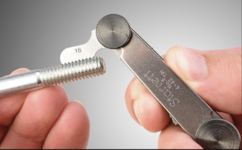
I think this was suggested and idk what I was thinking at the time, but it's really small and seems like a good fit for me. Unfortunately I've started an informal Starrett embargo since I dont know which of their tools are being made in China at the moment. I guess I can buy online from a retailer with good free returns (prepaid shipping label) and give it a shot.

starrett.png


Another idea I like, I dont know how good of an idea it is, but I really want to buy a tap and die set, and also a thread cleaner/repair set. I think I can use those as a thread gauge. Use the taps as a gauge for nuts, and use the dies as a gauge for bolts.

It might not be as efficient or pretty as other means, but I literally only find myself needing to do this once or twice per year and I do want both a tap/die and a thread repair set anyway for emergency purposes.
 

ChevyEFI

Well-known member
Joined
Sep 2, 2012
Messages
8,720
Location
Phoenix, AZ
want to buy a tap and die set, and also a thread cleaner/repair set. I think I can use those as a thread gauge.
I bought the grey box HF tap and die set and it included two fold out thread pitch gauges. Later, I added more for specialty larger thread sizes.

Laugh at the import factor but I have used many manny times the value of that set than it cost. And broke only one tap on block aluminum.

A fresh bolt functions as a thread gauge; a tap would be more precise in theory and complicate working with used fasteners at times.
 

darkzero

Well-known member
Joined
Oct 20, 2011
Messages
3,320
Location
SoCal
I wanted one of those thread checking boards that you see in hardware stores. But there were/are times when I can't bring whatever I need to identify to the board hanging on the wall or whatever. So instead I bought the cable type.

Just an FYI if you do get this style. Not sure who makes the original, mine says the original Thread Checker on it but I'm not so sure of that, doesn't matter to me anyway. But the one I first purchased (& returned) had labels for the thread sizes, I think it was named Thread Detective. The labels were thick & seemed heavy duty but I didn't trust them to stay on forever. Get the ones with the thread sizes engraved.
20191231_151810.jpg

It does come in handy from time to time but I still usually do it this way.
20240602_184338.jpg
 

dscheidt

Well-known member
Joined
Apr 26, 2017
Messages
2,888
I bought the grey box HF tap and die set and it included two fold out thread pitch gauges. Later, I added more for specialty larger thread sizes.

Laugh at the import factor but I have used many manny times the value of that set than it cost. And broke only one tap on block aluminum.

A fresh bolt functions as a thread gauge; a tap would be more precise in theory and complicate working with used fasteners at times.

While I'm sure we've all done the compare to a bolt method, a thread gauge is much more compact, and lets you measure things with weird thread pitches that you'd never have a bolt for. And let's you figure out dumb things like "Oh, it's got a 10mm head, but 1/4-24 threads?"

I've got a mitutoyo one, which is great, but for most people who don't work in a machine shop, a set of cheap ones will do perfectly well.
 
OP
O

oldschoolcraft

Well-known member
Joined
Dec 31, 2017
Messages
1,829
Location
Bay Area, California
You guys will laugh at me for this, because no professionals would ever want to buy this. But I had an idea to combine a thread pitch fold out gauge, with a feeler gauge.

Start with a feeler gauge but cut each gauge into a different thread pitch shape, and label the gauge as such. So a single tool can do both jobs. No pro would want this but I aspire to be a minimalist and it would be cool to have one (or even two less) tools to need to have, since there's so many feeler gauges you can probably have both metric and SAE thread pitch gauges cut into it.
 

darkzero

Well-known member
Joined
Oct 20, 2011
Messages
3,320
Location
SoCal
Maybe my eyes are tired right now but I'm not following, what are the feeler gauges for? If cutting the thread pitch into a feeler gauge (good luck with that), isn't that essentially just a leaf type thread pitch gauge?

Using thread pitch leafs, you'll still need a means for measuring major/nominal diameter.
 
OP
O

oldschoolcraft

Well-known member
Joined
Dec 31, 2017
Messages
1,829
Location
Bay Area, California
Maybe my eyes are tired right now but I'm not following, what are the feeler gauges for? If cutting the thread pitch into a feeler gauge (good luck with that), isn't that essentially just a leaf type thread pitch gauge?

Using thread pitch leafs, you'll still need a means for measuring major/nominal diameter.
Feeler gauges are a way to measure the distance between two objects when the objects are very close together. Totally separate tool from the pitch gauges.

But they look similar, you have a series of gauges on a ring that you can fan out.

feeler gauge.png

It's a ridiculous fantasy tool but just imagine that had each of the gauges shaped into a thread pitch gauge, and then stamped on each one was the thread pitch and also the thickness of the particular leaf/gauge. So you could use one tool for either thing. No one else would want this but me, probably. Everyone else has 1000 sq foot garages with dozens of drawers to keep their tools :p
 
To avoid these ads, REGISTER NOW!

ChevyEFI

Well-known member
Joined
Sep 2, 2012
Messages
8,720
Location
Phoenix, AZ
If you've bent a feeler leaf, you've junked two tools. Also, length of leaves are purposefully different. I like minimalism, but in this case, use a new rivet or nut/bolt and collect your feeler range and pitch leaves in one holder and call it good.
 
Last edited:
OP
O

oldschoolcraft

Well-known member
Joined
Dec 31, 2017
Messages
1,829
Location
Bay Area, California
If you've bent a feeler leaf, you've junked two tools. Also, length of leaves are purposefully different. I like minimalism, but in this case, use a new rivet or nut/bolt and collect your feeler range and pitch leaves in on holder and call it good.
They are different? I only ever owned one feeler gauge set, and I thought they were all identical except the thickness. Can you speak more as to them being purposely different length in what way?
 

darkzero

Well-known member
Joined
Oct 20, 2011
Messages
3,320
Location
SoCal
Feeler gauges are a way to measure the distance between two objects when the objects are very close together. Totally separate tool from the pitch gauges.

But they look similar, you have a series of gauges on a ring that you can fan out.

feeler gauge.png

It's a ridiculous fantasy tool but just imagine that had each of the gauges shaped into a thread pitch gauge, and then stamped on each one was the thread pitch and also the thickness of the particular leaf/gauge. So you could use one tool for either thing. No one else would want this but me, probably. Everyone else has 1000 sq foot garages with dozens of drawers to keep their tools :p
Yeah I know what feeler gauges are, I've done my fair share of valve adjustments & I use them as a hobby machinist.

I just couldn't understand what you would use feeler gauges for in relation to measuring thread sizes.

If I'm understanding it now, it seems like your idea is to combine the two but still serve as what each tool is intended for? Combination feeler gauges & thread pitch in one tool? But again, still need another tool to measure diameter.

Yeah, I for one wouldn't have a use for that or would want one. My thread pitch gauges I use often. My feeler gauges rarely see light of day anymore since I stopped working on cars for a living (repairs that is). But that's just me.
 

darkzero

Well-known member
Joined
Oct 20, 2011
Messages
3,320
Location
SoCal
They are different? I only ever owned one feeler gauge set, and I thought they were all identical except the thickness. Can you speak more as to them being purposely different length in what way?
For a particular "set" yes. But they come in bent, flat, standard/short, & extended length.

Trying to DIY cut thread pitches on feeler gauges (usually spring steel) won't be pretty. I wouldn't even know where to begin/what to use to try & do so. Some thread pitches are so fine I can barely see them anymore without magnification. And they need to be really accurate (if if matters to you) as a number of imperial & metric thread pitches are pretty close to each other.
 
OP
O

oldschoolcraft

Well-known member
Joined
Dec 31, 2017
Messages
1,829
Location
Bay Area, California
For a particular "set" yes. But they come in bent, flat, standard/short, & extended length.

Trying to DIY cut thread pitches on feeler gauges (usually spring steel) won't be pretty. I wouldn't even know where to begin/what to use to try & do so. Some thread pitches are so fine I can barely see them anymore without magnification. And they need to be really accurate (if if matters to you) as a number of imperial & metric thread pitches are pretty close to each other.
Oh no way I won't try to DIY that, just opining that if such a tool existed it would be interesting, though I concede no one but me would want to buy it.
 

nadogail

Well-known member
Joined
Jan 23, 2009
Messages
31,940
Location
Coronado, CA
After a few years of paying attention you acquire an ability to spot the common sizes you work with.

Until you reach that point, any or all of the ways mentioned in the responses posted will work.
 

mikegt4

Well-known member
Joined
Sep 12, 2005
Messages
3,266
Location
sw ohio
After a few years of paying attention you acquire an ability to spot the common sizes you work with.

Until you reach that point, any or all of the ways mentioned in the responses posted will work.
Pre retirement I was in charge of the bolt bins (about a dozen Vidmar cabinets) for several years at a large R&D facility, no one else wanted the job as it wasn't a career builder. I got to where I could ID a bolt diameter, thread and length from several feet away. Sadly old age has caught up with me and I am down to holding the bolt and squinting heavily. I use my thread gauges a lot now.
 

nadogail

Well-known member
Joined
Jan 23, 2009
Messages
31,940
Location
Coronado, CA
Pre retirement I was in charge of the bolt bins (about a dozen Vidmar cabinets) for several years at a large R&D facility, no one else wanted the job as it wasn't a career builder. I got to where I could ID a bolt diameter, thread and length from several feet away. Sadly old age has caught up with me and I am down to holding the bolt and squinting heavily. I use my thread gauges a lot now.
Time changes a lot of things.
 
OP
O

oldschoolcraft

Well-known member
Joined
Dec 31, 2017
Messages
1,829
Location
Bay Area, California
Do pitch gauges also apply to screws? Or is it just to bolts? Screws seem like they might be weird to gauge because they taper to a point.

The question arises "what would the purpose of this be?" and it's that if you are missing a screw, and have one of the similar screws, you could gauge it, measure it, and order up matching screws. I'm missing a screw from the interior of my car now, dont want to put in the effort to go to a junkyard, don't want to pay the $10 that people are asking on eBay for should be a $1 screw, the dealership ordered the wrong one last time I went and dont want to waste time with that. If I could measure and gauge it, I can go to McMaster Car and get them cheap.
 

pizza

Well-known member
Joined
Dec 4, 2019
Messages
1,739
Location
Midwest, USA
Do pitch gauges also apply to screws? Or is it just to bolts?

screw vs bolt is ultimately determined by how the fastener is used. many fasteners can be used bolts or screws.

Screws seem like they might be weird to gauge because they taper to a point.

most fasteners designed to go into threaded holes don't taper to a point.
 

pizza

Well-known member
Joined
Dec 4, 2019
Messages
1,739
Location
Midwest, USA
and if it does taper to a point, that part isn't interacting with the threaded hole/nut anyways, so it's irrelevant. just measure the normal part of the fastener.
 

pizza

Well-known member
Joined
Dec 4, 2019
Messages
1,739
Location
Midwest, USA
I'm missing a screw from the interior of my car now, dont want to put in the effort to go to a junkyard, don't want to pay the $10 that people are asking on eBay for should be a $1 screw

are you talking about plastic screws? is it actually critical to match the pitch? i would think if you get one that's the right diameter, it can just cut new threads if the pitch is different. or is that not true?
 
OP
O

oldschoolcraft

Well-known member
Joined
Dec 31, 2017
Messages
1,829
Location
Bay Area, California
are you talking about plastic screws? is it actually critical to match the pitch? i would think if you get one that's the right diameter, it can just cut new threads if the pitch is different. or is that not true?
No, there's a screw in my car that goes into a piece of sheet metal, and I assume I only need to have the right diameter. That's why I was asking if there's such a thing as a pitch gauge for screws, I dont think so, because it's not like bolts and nuts where you have a male and a female and they have to match perfectly. With this screw situation, it just has to fit into a hole in sheet metal, so I dont think the exact thread pitch should matter.
 

mikegt4

Well-known member
Joined
Sep 12, 2005
Messages
3,266
Location
sw ohio
Sheet metal screws are sized by wire diameter, the size wire that they are made from. Threads vary by intended use, screwed into metal, plastic, self tapping etc. And of course there are a zillion types of heads for each type of screw. Far more variety of screws than bolts.

for an aray of size charts google: Images for sheet metal screw size chart
 

danielbuck

Well-known member
Joined
Apr 15, 2014
Messages
919
I wanted one of those thread checking boards that you see in hardware stores. But there were/are times when I can't bring whatever I need to identify to the board hanging on the wall or whatever. So instead I bought the cable type.

Just an FYI if you do get this style. Not sure who makes the original, mine says the original Thread Checker on it but I'm not so sure of that, doesn't matter to me anyway. But the one I first purchased (& returned) had labels for the thread sizes, I think it was named Thread Detective. The labels were thick & seemed heavy duty but I didn't trust them to stay on forever. Get the ones with the thread sizes engraved.
20191231_151810.jpg

It does come in handy from time to time but I still usually do it this way.
on the cable type, buy a second one and remove all of the threaded checkers. Thread those removed ones into the back of the first set that is still on their cable. Now you have a set of thread checkers that can also be easily removed to check a thread down in an engine bay or something without having the whole snake of thread checkers in there.
 
To avoid these ads, REGISTER NOW!
Top Bottom