pcmeiners
Well-known member
No I do not mean Halon alone, though I should have said halogen based gases.I believe you mean Halon...


No I do not mean Halon alone, though I should have said halogen based gases.I believe you mean Halon...
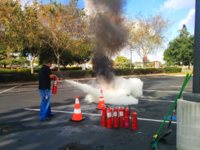
I did someone like this with my family. We had several extinguishers expire so I set up an outdoor fire and had everyone take a turn using the extinguishers to put out the fire. Actually doing it is much different that thinking about it.If you have a chance to take ERT or CERT team training, this often includes first aid and fire extinguisher use, among other things. The fire bit is fun, and you get to be familiar w/ a piece of equipment lots of people own and few people have ever used. Here's a photo of the instructor dowsing a gasoline (in a tray) fire out in the parking lot at my previous job in CA. There are a bunch of extinguishers ready for our class to use. The difference in results when aiming at the flames vs aiming at the base of the fire is very obvious (someone always aims at the flames).
Do not shake or hit your dry chemical extinguishers! This is an ancient and outdated practice that needs to die.My last job was physical plant maintenance at a university, and in addition to HVAC maintenance, etc., I did monthly checks of all the fire extinguishers in the buildings that I was responsible for. We checked that the extinguishers were actually where they belonged and not blocked by something, and then checked the pressure on the dry chemical ones, and took them out and made sure we felt and heard the powder moving inside and gave them a couple of whallops on the bottom with a rubber mallet also. CO2 got weighed annually. All of them were taken in for servicing on the appropriate dates. I would typically find one or two dry chem units that lost pressure every year (out of maybe 100 to 120). I notice that often homeowners don't do anything with their extinguishers until they need it, and often they have lost pressure or the powder has hardened inside and nothing comes out when the extinguisher is use.
I have a couple ABC extinguishers around the house and garage, and a 5 pound CO2 by each door in the garage and shop.
Outside of a grease fire in a kitchen, fire blankets are best for putting out a fire on a person. Stop, drop and roll works, but when you're covered in something that's burning, the blanket will make the roll part work a whole lot better. This thread reminded me that I could use a fire blanket around. Just bought two for $8....Fire blankets have their uses, but I’ve never figured out how your going to open the hood of a vehicle that has its engine on fire.
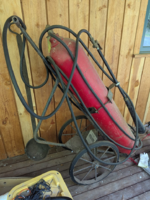
Be careful with that thing in a "confined space". Discharge too much of it and you may find yourself on the floor taking a long nap. CO2 displaces the oxygen to extinguish the fire. You know what else besides the fire needs Oxygen ?I have a old 110 lb CO2 extinguisher on wheels someone gave me; it's charged and going into the shop. Dates from the 1970s. A bit more practical are the 10 lb ABC extinguishers (Kidee/First Alert/...) often available at Costco; remember to rotate them and feel the powder moving once a year to prevent powder from packing solid
Good info I did not know this!Do not shake or hit your dry chemical extinguishers! This is an ancient and outdated practice that needs to die.
Back in the day (like 50+ years ago) when pressurized dry chemical extinguishers were a new idea, and were still charged with air, and filled with baking soda, the powder might cake. Nowadays, the siphon is going to be plastic, and the charge is going to be dry nitrogen. The powder does not cake up, and impact can separate the siphon from the valve. If the siphon breaks on the inside, no powder is going to come out!
What you do need to do in your monthly inspection of dry chem extinguishers is tap on the gauge. I've seen extinguishers with sticky gauges where the needle drops only after it's been flicked. So the gauge is showing green until you tap on it and realize that it's actually leaked. This is exactly why you need to inspect extinguishers monthly.
Outside of a grease fire in a kitchen, fire blankets are best for putting out a fire on a person. Stop, drop and roll works, but when you're covered in something that's burning, the blanket will make the roll part work a whole lot better. This thread reminded me that I could use a fire blanket around. Just bought two for $8.
10 lb in the cab.Good source ? Like I mentioned above, look local for ones that can be serviced...used to be a Yellow Pages search, now Google.
As far as mounting in the cab, are you talking a 10lber in there or a small like required for DOT ?

Yep. I'm guessing there was probably some old tube/knob in that area.Fire between floor joists is generally an indication of electrical fire as there is nothing else in the area. This time of year with cold snaps, people use electric heaters along with everything else lon the circuit normally plugged in. The heater is enough to overload the circuit...melt 14 ga wire, especially older cloth NM or knob/tube.
10lber probably too big for a cab
I’ve never seen this done with gasoline, only diesel fuel.If you have a chance to take ERT or CERT team training, this often includes first aid and fire extinguisher use, among other things. The fire bit is fun, and you get to be familiar w/ a piece of equipment lots of people own and few people have ever used. Here's a photo of the instructor dowsing a gasoline (in a tray) fire out in the parking lot at my previous job in CA. There are a bunch of extinguishers ready for our class to use. The difference in results when aiming at the flames vs aiming at the base of the fire is very obvious (someone always aims at the flames).
Monoammonium phosphate is one component of a pH down buffering fertilizer I use in my hydroponic setups (in combination with monopotassium phosphate), but I think you'd be better off spreading boric acid powder than MAP.As to dry powder, once they start losing pressure I take them up to my unused attic and discharge them, nothing like an extra fire retardant up there.
but I think you'd be better off spreading boric acid powder than MAP.
Since there were perhaps twelve of us who needed to take the training, I'm sure they used gasoline for speed of relighting the fire each time.... here's an photo of the fire prior to extinguishing it. It was actually quite fun. The benefit of aiming at the base of the fire is marked, which I guess is one of the main points of the training.I’ve never seen this done with gasoline, only diesel fuel.


Neither of those will do anything to a smoldering pile of sawdust. CO2 (in any size) carries a zero "A" rating, and halotron only carries an A rating in larger sizes. I can't keep a can of water in my unheated shop, so I have ABC dry chem extinguishers.I am open to critique. I have a 15 lb. CO2 and a 5 lb. Halotron. My shop has a woodworking shop and an autoshop (not in the same room). Do I need anything different?
I've read but not tested that some RV antifreeze (propylene glycol) helps out. High concentrations it is flammable. If you have an outlet near it, get a cheap stickyback heating pad for it that draws a few watts.Neither of those will do anything to a smoldering pile of sawdust. CO2 (in any size) carries a zero "A" rating, and halotron only carries an A rating in larger sizes. I can't keep a can of water in my unheated shop, so I have ABC dry chem extinguishers.
Amerex 506b is a non-glycol based antifreeze for water based fire extinguishers that's a much better idea, and is good down to -40F. Also, lots of RV antifreeze has alcohol in it.I've read but not tested that some RV antifreeze (propylene glycol) helps out. High concentrations it is flammable. If you have an outlet near it, get a cheap stickyback heating pad for it that draws a few watts.
Given recent events, I'm looking to buy about 10 ea. 10 lb. Fire extinguishers
Does anybody have a good source?
Any recommendations for mounting one in the cab of the 2016 Super Duty F250 Crew Cab short bed?