To avoid these ads, REGISTER NOW!

First time lathe owner

jones988

Well-known member
Joined
Dec 11, 2019
Messages
125
Location
Indiana
So my impulse buy of the weekend was this Grizzly G0602 10"x22" benchtop lathe. It came with all the original parts from when it was new and a bunch of tooling parts. This is my first lathe and I am looking for some all around tips or suggestions for first timers. I have virtually no experience in any type of machining or tooling. My father in law was a tool and die maker for 20 something years, so I will hopefully be learning a lot from him. But I would still like to do some learning on my own as far as what I can even do on a lathe, what parts and pieces are called, and what I might need.
My first step is getting a stand bought or built to get this thing secured on properly. I am open to any tips or suggestions please!
 

Attachments

  • IMG_1556.jpg
    IMG_1556.jpg
    432.8 KB · Views: 197
To avoid these ads, REGISTER NOW!

rslaback

Well-known member
Joined
Jul 24, 2010
Messages
4,062
Location
Westcentral Wisconsin
The number 1 commandment in lathe work (and all metalwork really) is rigidity. There is no way to get a good finish and not break tooling unless your setups are solid.
 

ItsNemo

Well-known member
Joined
Mar 5, 2016
Messages
4,805
Location
Canada
For a stand, check out my thread here:

Then head over to youtube and watch all of the big machinist channels backlog of videos and you'll have a good start.
 

Aaron_W

Well-known member
Joined
Feb 6, 2018
Messages
2,894
Location
Northern California
Blondihacks on YouTube has some very good beginner machinist videos, she starts at a very basic level. Mr Pete 222 is a retired metal shop teacher who also has some very good basic level videos,.

There are a lot of other machinist videos on YouTube, but many are focused on more advanced work.

Blondihacks has a different brand but similar size lathe so you can see what you can expect from your lathe.
 

RoninB4

Well-known member
Joined
Jul 22, 2020
Messages
3,491
Location
Under My House
First off, congratulations on your first machinery purchase. Hate to sound this way but my first suggestion is to learn how to be safe with this. Lathe safety may seem to be obvious but it's not. A lathe is regarded by many as one of the potentially dangerous machines in the shop. Making the workpiece secured in the chuck, getting clothing caught in the rotating chuck, chips curled around your fingers are razor blades, a chip thrown into your eye, the workpiece getting hurled from the chuck while cutting it, etc. The list of potential hazards is long and it happens very fast. I've been a machinist for over 40 years and seen a lot of industrial accidents, they were all ****** and often life changing. I don't know of anybody that hasn't had an incident. It's not a matter of "if" it's a matter of "when" and the severity of the accident. Learn safe habits, like not standing in the line of rotation of the chuck, not grabbing chip curls with your fingers, NOT wearing gloves or long sleeves while operating the lathe, etc. Learn to look for the danger before you even turn the lathe on.

Ok, that's been said (and should be repeated) What do you have in mind to do with the lathe? Your work will often dictate what tooling you'll want/need. Show some photos of what you do have. Do you have any measuring instruments? You'll want/need some. The stand you want to build is a good idea but special care must be considered. If the mounting surface is not flat/planer then it will twist the bed of the lathe and can/will greatly affect the accuracy, especially with longer work like making a shaft. Locate the nearest scrap metal yard that will sell to the public. Very often you'll be doing projects where NEW metal isn't important enough to spend the money that could be better used for tooling and instruments. Besides, it's all new material underneath the rust anyway. There will be some differing opinions about cutting tools but I'd suggest resisting the urge to use carbide. Carbide cutting tools are brittle, chip/shatter in many applications, and cannot be sharpened without special grinding wheels. I'd favor high speed steel (HSS) that can be easily sharpened, not prone to chip/shatter, and can be ground to whatever shape/geometry you wish. Carbide is mostly for production where speed is the target, you're more interested in good results than how long it took. Buy good quality drills made from HSS, cheaply made cutting tools will disappoint.

Cutting speed is critical to whatever you'll be doing and the type of material as well as size dictates what speed/feed to operate at. There are hundreds of other tips/practices to learn, I suggest finding all the videos you can and keeping a small notebook to write things down in you can easily refer to. There's too much to remember in the beginning. Post up questions here, there are several members here with long experience. Your FIL will be a good source for info if he's willing. Good luck.
 
OP
J

jones988

Well-known member
Joined
Dec 11, 2019
Messages
125
Location
Indiana
For a stand, check out my thread here:

Then head over to youtube and watch all of the big machinist channels backlog of videos and you'll have a good start.
That is exactly what I was thinking stand wise, something with drawers for storage! Would you recommend all steel construction or wood base with a metal plate on top?

Any suggestions for machinist youtubers?
 
OP
J

jones988

Well-known member
Joined
Dec 11, 2019
Messages
125
Location
Indiana
First off, congratulations on your first machinery purchase. Hate to sound this way but my first suggestion is to learn how to be safe with this. Lathe safety may seem to be obvious but it's not. A lathe is regarded by many as one of the potentially dangerous machines in the shop. Making the workpiece secured in the chuck, getting clothing caught in the rotating chuck, chips curled around your fingers are razor blades, a chip thrown into your eye, the workpiece getting hurled from the chuck while cutting it, etc. The list of potential hazards is long and it happens very fast. I've been a machinist for over 40 years and seen a lot of industrial accidents, they were all ****** and often life changing. I don't know of anybody that hasn't had an incident. It's not a matter of "if" it's a matter of "when" and the severity of the accident. Learn safe habits, like not standing in the line of rotation of the chuck, not grabbing chip curls with your fingers, NOT wearing gloves or long sleeves while operating the lathe, etc. Learn to look for the danger before you even turn the lathe on.

Ok, that's been said (and should be repeated) What do you have in mind to do with the lathe? Your work will often dictate what tooling you'll want/need. Show some photos of what you do have. Do you have any measuring instruments? You'll want/need some. The stand you want to build is a good idea but special care must be considered. If the mounting surface is not flat/planer then it will twist the bed of the lathe and can/will greatly affect the accuracy, especially with longer work like making a shaft. Locate the nearest scrap metal yard that will sell to the public. Very often you'll be doing projects where NEW metal isn't important enough to spend the money that could be better used for tooling and instruments. Besides, it's all new material underneath the rust anyway. There will be some differing opinions about cutting tools but I'd suggest resisting the urge to use carbide. Carbide cutting tools are brittle, chip/shatter in many applications, and cannot be sharpened without special grinding wheels. I'd favor high speed steel (HSS) that can be easily sharpened, not prone to chip/shatter, and can be ground to whatever shape/geometry you wish. Carbide is mostly for production where speed is the target, you're more interested in good results than how long it took. Buy good quality drills made from HSS, cheaply made cutting tools will disappoint.

Cutting speed is critical to whatever you'll be doing and the type of material as well as size dictates what speed/feed to operate at. There are hundreds of other tips/practices to learn, I suggest finding all the videos you can and keeping a small notebook to write things down in you can easily refer to. There's too much to remember in the beginning. Post up questions here, there are several members here with long experience. Your FIL will be a good source for info if he's willing. Good luck.
I honestly don't have any ideas of what I want to do/make with it. That is where I feel like I could benefit the most, is learning what you can even do with one of these things. I have basic "fabricator" tools, welder, torch, etc. I have a pair calibers I use for reloading ammo, but it sounds like I will need a few measuring tools.
My father in law has already mentioned all you have said about carbide tools vs high speed steel. But unfortunately he sold all of his tools when he got out of the trade 10 years ago. It came with a bunch of stuff, but I need to sit down with him and go though it to see all what I have.
 

ItsNemo

Well-known member
Joined
Mar 5, 2016
Messages
4,805
Location
Canada
That is exactly what I was thinking stand wise, something with drawers for storage! Would you recommend all steel construction or wood base with a metal plate on top?

Any suggestions for machinist youtubers?

All steel, weight and rigidity is your friend. Wood is far too flexible and light for a lathe, even ones as small as ours.

This Old Tony is the one I have watched the most, you'll hear that recommendation everywhere. There's others I occasionally watch (AvE, Abom, etc.) but not ones I'm subscribed to. I also participate on a couple machinist forums, reddit, and such.
 

nadogail

Well-known member
Joined
Jan 23, 2009
Messages
31,928
Location
Coronado, CA
When I was still a teenager, I bought a copy of "How to run a lathe" by South Bend Lathes. It may no longer be in print, but I am sure it can be found using the Internet.
 
OP
J

jones988

Well-known member
Joined
Dec 11, 2019
Messages
125
Location
Indiana

csp

Well-known member
Joined
Mar 23, 2010
Messages
5,719
Location
Franktown, CO
That how to run a lathe book, and the others published by other brands like Atlas, can be found in free downloadable form all over the web, including facebook groups.
 

RoninB4

Well-known member
Joined
Jul 22, 2020
Messages
3,491
Location
Under My House
I honestly don't have any ideas of what I want to do/make with it. That is where I feel like I could benefit the most, is learning what you can even do with one of these things. I have basic "fabricator" tools, welder, torch, etc. I have a pair calibers I use for reloading ammo, but it sounds like I will need a few measuring tools.
My father in law has already mentioned all you have said about carbide tools vs high speed steel. But unfortunately he sold all of his tools when he got out of the trade 10 years ago. It came with a bunch of stuff, but I need to sit down with him and go though it to see all what I have.

-Well you do have a start in fabricating skills and that's better than no skills at all. Agree with the poster suggestion for an all metal stand or even sinking the feet into a poured epoxy-granite on top of the stand is possible. You'll want to test the lathe for accuracy first.

As for what you'll do with it.....start looking around the garage/shop/auto/motorcycle for things that need improvement/replacement and keep a list. Shafts, bushings, pins, are all candidates. Even just cleaning up a round surface with surface rust is a good place to get familiar with the controls and using the machine. It's a tad daunting to consider all the knowledge/skills you'll want to know but we all faced this and we all sucked in the beginning. You have the rest of your life to learn so take your time and enjoy the journey. Post here often, I'll read it.
 

DuluthMachineWorks

Well-known member
Joined
Mar 7, 2019
Messages
152
Location
Duluth, GA
I agree with what everyone else has said about metal and heavy, but one thing that hasn’t come up is vibration. Steel tube, angle, beams, etc. can ring like a bell once a lathe gets vibrating. This can make chatter worse and make a lot of really annoying noises if everything isn’t balanced.

I used to have a mini lathe on a heavy wooden bench, and it worked out well. I was limited much more by the fit and finish of the machine and my own I experience rather than the bench. You may be better served with building a heavy wood bench out of 2x4s on end, bolted together. Not that lumber prices are much better than steel prices, but it may be easier. Heavy steel and epoxy granite would go a long way toward squeezing every bit of accuracy out of the lathe, but you could always cross that bridge if you come to it. If I were in your position, I’d slap it on whatever heavy bench you can find and get turning!

As far as tooling (carbide vs. HSS), I started out with a cheap set of insert turning tools from KBC. It was nice to have consistent tool geometry and eliminate a variable when getting over the initial lathe learning curve, but I quickly switched over to HSS as I got more proficient and the cost of tooling went up. HSS is definitely the way to go for a home shop where you have to buy your own tooling.
 
OP
J

jones988

Well-known member
Joined
Dec 11, 2019
Messages
125
Location
Indiana
-Well you do have a start in fabricating skills and that's better than no skills at all. Agree with the poster suggestion for an all metal stand or even sinking the feet into a poured epoxy-granite on top of the stand is possible. You'll want to test the lathe for accuracy first.

As for what you'll do with it.....start looking around the garage/shop/auto/motorcycle for things that need improvement/replacement and keep a list. Shafts, bushings, pins, are all candidates. Even just cleaning up a round surface with surface rust is a good place to get familiar with the controls and using the machine. It's a tad daunting to consider all the knowledge/skills you'll want to know but we all faced this and we all sucked in the beginning. You have the rest of your life to learn so take your time and enjoy the journey. Post here often, I'll read it.
Me being somewhat young was one of my factors for buying it considering I didn't have much of any ideas of what to use it for. I am only 27, so I figured if I bought it now, surely I will be able to get plenty of use throughout my life, and have plenty of time to learn. Might not make sense to some, but I was able to convince myself to actually buy it! Also considering I had the father in laws support, means the wife couldn't be upset either! lol
 
OP
J

jones988

Well-known member
Joined
Dec 11, 2019
Messages
125
Location
Indiana
I agree with what everyone else has said about metal and heavy, but one thing that hasn’t come up is vibration. Steel tube, angle, beams, etc. can ring like a bell once a lathe gets vibrating. This can make chatter worse and make a lot of really annoying noises if everything isn’t balanced.

I used to have a mini lathe on a heavy wooden bench, and it worked out well. I was limited much more by the fit and finish of the machine and my own I experience rather than the bench. You may be better served with building a heavy wood bench out of 2x4s on end, bolted together. Not that lumber prices are much better than steel prices, but it may be easier. Heavy steel and epoxy granite would go a long way toward squeezing every bit of accuracy out of the lathe, but you could always cross that bridge if you come to it. If I were in your position, I’d slap it on whatever heavy bench you can find and get turning!

As far as tooling (carbide vs. HSS), I started out with a cheap set of insert turning tools from KBC. It was nice to have consistent tool geometry and eliminate a variable when getting over the initial lathe learning curve, but I quickly switched over to HSS as I got more proficient and the cost of tooling went up. HSS is definitely the way to go for a home shop where you have to buy your own tooling.
I have been thinking about a stand situation, seems to be about a 50/50 split on people who say it has to be the sturdiest all steel stand you can possibly make, and others will sit in on an old desk and call it good. I was originally thinking of making the bottom part of the stand from 2x4s and 4x4s and get a steel plate for the top where the lathe will sit. My father in law has brought up vibration to me as well, he suggested maybe trying to mount whatever stand I come up with to the wall if possible, not sure if this is a good idea or not.

I am sure for at least quite awhile, I will be the weakest link in the accuracy chain for this lathe, I don't want to go too over the top at the start. Especially considering I don't have any experience at all, I'd hate to have to make serious changes to something down the road because I didn't even know what I wanted in the beginning.
 

DuluthMachineWorks

Well-known member
Joined
Mar 7, 2019
Messages
152
Location
Duluth, GA
Steel on top is a good idea, that way you have a solid surface to shim the lathe in to level. I’d at least put it over a couple of layers of 3/4” plywood and screw it down well to help absorb some vibration. There’s a good video posted by Blondihacks on leveling and alignment of a similar size and make of lathe as yours.

Also, you could make a big chip pan out of a restaurant sized sheet pan, and put it under the lathe. Even small lathes will make a heck of a mess and you’ll need something to catch the chips and cutting oil.
 
OP
J

jones988

Well-known member
Joined
Dec 11, 2019
Messages
125
Location
Indiana
Steel on top is a good idea, that way you have a solid surface to shim the lathe in to level. I’d at least put it over a couple of layers of 3/4” plywood and screw it down well to help absorb some vibration. There’s a good video posted by Blondihacks on leveling and alignment of a similar size and make of lathe as yours.

Also, you could make a big chip pan out of a restaurant sized sheet pan, and put it under the lathe. Even small lathes will make a heck of a mess and you’ll need something to catch the chips and cutting oil.
I like that idea with the layers of 3/4" plywood with a steel top. And my lathe actually came with the original chip pan so I will be able to use it. I have been checking out Blondihacks as well!
 
To avoid these ads, REGISTER NOW!

Crag

New member
Joined
Mar 10, 2016
Messages
3
That how to run a lathe book, and the others published by other brands like Atlas, can be found in free downloadable form all over the web, including facebook groups.
This
The Atlas Lathe Operations book is a pretty decent book for a beginner. Its how I learned to use a metal lathe.

The VintageMachinery website has the PDF uploaded, but there may be a better copy somewhere else.
 
OP
J

jones988

Well-known member
Joined
Dec 11, 2019
Messages
125
Location
Indiana
This
The Atlas Lathe Operations book is a pretty decent book for a beginner. Its how I learned to use a metal lathe.

The VintageMachinery website has the PDF uploaded, but there may be a better copy somewhere else.
Thanks for the suggestions on books! And I know this is going to sound bad considering that PDF is free, but I would almost rather purchase the book copy of it not only so I can easily reference it in the garage, but I look at a computer screen for most of my day, so it would be nice to actually read a physical book vs staring at a screen in my downtime.
 

Aaron_W

Well-known member
Joined
Feb 6, 2018
Messages
2,894
Location
Northern California
I like that idea with the layers of 3/4" plywood with a steel top. And my lathe actually came with the original chip pan so I will be able to use it. I have been checking out Blondihacks as well!

There are a lot of people who will say that a wooden stand is unacceptable, but I will point out that a lot of old school lathe makers offered wood stands for their smaller lathes, even some of the very high end tool room lathes like Hardinge could be purchased with wood or metal and wood stands. Cast iron legs with a wood top was particularly common.

For a large lathe metal is the way to go, but a solid wood or wood / metal stand should be fine for your Grizzly. The issue people have with wood is it can move with changes in the environment so think about your materials and how the lathe is mounted to reduce the possibility of twisting.
 

RoninB4

Well-known member
Joined
Jul 22, 2020
Messages
3,491
Location
Under My House
Don't buy any tooling beyond cutting tools until you know what you want to do with it. Tooling and measuring instruments is too expensive to just sit on the shelf. If you buy cheap tooling it will disappoint.

To the OP: Your FIL can offer solid advice on what to buy, what to wait on, and what level of quality is appropriate for your work.
 
OP
J

jones988

Well-known member
Joined
Dec 11, 2019
Messages
125
Location
Indiana
Don't buy any tooling beyond cutting tools until you know what you want to do with it. Tooling and measuring instruments is too expensive to just sit on the shelf. If you buy cheap tooling it will disappoint.

To the OP: Your FIL can offer solid advice on what to buy, what to wait on, and what level of quality is appropriate for your work.
I still don't know what exactly all of them do, but the lathe came with maybe 20 something different types of cutting tools so hopefully these will get me by for a bit as I focus on getting some measuring instruments as all I have are calipers. I'd imagine the next two instruments would be a micrometer and dial indicator?
 

RoninB4

Well-known member
Joined
Jul 22, 2020
Messages
3,491
Location
Under My House
I still don't know what exactly all of them do, but the lathe came with maybe 20 something different types of cutting tools so hopefully these will get me by for a bit as I focus on getting some measuring instruments as all I have are calipers. I'd imagine the next two instruments would be a micrometer and dial indicator?

-Photos of what you have would help. Your caliper is likely just fine for now but a micrometer and dial test indicator are going to be in your future. There a lot of cheap crappy instruments out there and rather expensive instruments out there (including fake ones) so be careful what you buy. Cheap instruments are almost always a waste of money, so are expensive instruments where critical accuracy isn't really needed. If you were making a living in machining I'd advise good quality tooling and instruments. If not then it's a bit harder to suggest what you need.

Plenty of good, name brand, used instruments can be had on E(vil)-Bay for a fraction of new prices. That's what I'd suggest provided it looks like new and doesn't show signs of abuse. A decent 0-1 micrometer by a good name brand can often be had for under $30 if you look. Chinese made instruments that show up in the U.S. are almost always **** that does work when new but I suspect will wear out in a few years due to inferior materials. There are also Polish, German, and Japanese brands I feel are good buys. I don't like digital but that's just my preference, batteries go flat at inconvenient moments.

An indicator will be important when you have to have a surface concentric with another like a bushing in a vehicle. Your calipers will likely be good enough until you have a critical fit of +/- .002 or your fitting a shaft to a bushing or measuring camshaft shims or something similar where accuracy is critical. Plenty of time for important projects to appear on your horizon, make do with what you have for now.
 

RoninB4

Well-known member
Joined
Jul 22, 2020
Messages
3,491
Location
Under My House
You can also post up project you want to attempt before starting them. You'll get plenty of good advice for members here on critical fits, materials, and results you should expect. You don't know what you don't know so why not ask here after doing some research on what you've read? We ALL had to start somewhere and asked a lot of questions. I still ask questions about things I don't know, that's why I joined this board.
 

ItsNemo

Well-known member
Joined
Mar 5, 2016
Messages
4,805
Location
Canada
You can also post up project you want to attempt before starting them. You'll get plenty of good advice for members here on critical fits, materials, and results you should expect. You don't know what you don't know so why not ask here after doing some research on what you've read? We ALL had to start somewhere and asked a lot of questions. I still ask questions about things I don't know, that's why I joined this board.
Also good to find a copy of the Machinery's Handbook so you can actually look up what those critical fits need to be or how that material will behave or what the dimensions you need for the thread is and so on.
 

RoninB4

Well-known member
Joined
Jul 22, 2020
Messages
3,491
Location
Under My House
Also good to find a copy of the Machinery's Handbook so you can actually look up what those critical fits need to be or how that material will behave or what the dimensions you need for the thread is and so on.

Good point to make but the reading will likely swamp him with information and bore him to sleep. It's also a tad expensive unless it's a well used version like mine from 1978, greasy thumbprints are optional. I spent hours reading it on the train home to learn things but I don't recommend that for everybody.
 

ItsNemo

Well-known member
Joined
Mar 5, 2016
Messages
4,805
Location
Canada
Good point to make but the reading will likely swamp him with information and bore him to sleep. It's also a tad expensive unless it's a well used version like mine from 1978, greasy thumbprints are optional. I spent hours reading it on the train home to learn things but I don't recommend that for everybody.

It's not reading material, it's reference. If I need to figure out what tolerance or dimensions I need or how strong something is or whatever...I look it up in "the bible".

I do agree though, it's expensive but it's a must have for machinists.
 
OP
J

jones988

Well-known member
Joined
Dec 11, 2019
Messages
125
Location
Indiana
-Photos of what you have would help. Your caliper is likely just fine for now but a micrometer and dial test indicator are going to be in your future. There a lot of cheap crappy instruments out there and rather expensive instruments out there (including fake ones) so be careful what you buy. Cheap instruments are almost always a waste of money, so are expensive instruments where critical accuracy isn't really needed. If you were making a living in machining I'd advise good quality tooling and instruments. If not then it's a bit harder to suggest what you need.

Plenty of good, name brand, used instruments can be had on E(vil)-Bay for a fraction of new prices. That's what I'd suggest provided it looks like new and doesn't show signs of abuse. A decent 0-1 micrometer by a good name brand can often be had for under $30 if you look. Chinese made instruments that show up in the U.S. are almost always **** that does work when new but I suspect will wear out in a few years due to inferior materials. There are also Polish, German, and Japanese brands I feel are good buys. I don't like digital but that's just my preference, batteries go flat at inconvenient moments.

An indicator will be important when you have to have a surface concentric with another like a bushing in a vehicle. Your calipers will likely be good enough until you have a critical fit of +/- .002 or your fitting a shaft to a bushing or measuring camshaft shims or something similar where accuracy is critical. Plenty of time for important projects to appear on your horizon, make do with what you have for now.
Thanks for the suggestions on measuring instruments. There is actually a Starret micrometer being sold by a member here in the classifieds I was looking at, but I've never used one so honestly not sure what to look for.
I will try to get some photos of what it came with to show here!
 

RoninB4

Well-known member
Joined
Jul 22, 2020
Messages
3,491
Location
Under My House
Thanks for the suggestions on measuring instruments. There is actually a Starret micrometer being sold by a member here in the classifieds I was looking at, but I've never used one so honestly not sure what to look for.
I will try to get some photos of what it came with to show here!

-Looked in classifieds, didn't see it.
 

RoninB4

Well-known member
Joined
Jul 22, 2020
Messages
3,491
Location
Under My House
Not a great buy but looks ok. It's one of the lowest priced models made by Starrett. If it hasn't been abused then it should do ok for what you need. Check e-bay as well for more current prices. I've not been shopping for mic's in a long time, don't need more of them.
 

Monza Harry

Well-known member
Joined
Dec 29, 2018
Messages
1,433
Location
Windsor ON
RoninB4 hit lots of good points. But I would like to add that if you are truly interested in making things and this "lights your fire" (does this sound familiar in the mirror) measuring tools will not be a waste. If you're not doing this for a living used is a perfectly acceptable approach you don't have to keep those ones forever, you can always upgrade as your skills/needs grow. As for cheap tools you get what you pay for, and they break as well as the name brand new ones when you make a mistake, and as pointed out above, mistakes will happen and there will be casualties. When I started out I had to buy too many tools twice one to replace the other guys that I broke and one for me as borrowing that new one was going to be difficult! And there isn't any new steel it's fresh out of the steel mill or not so much, it is all about 4-5 billion years old. LOL! Yes it is all pretty much similar under the history ( uhm... surface). The CD version of the "Bible" is cheaper but there aren't many changes version (edition maybe a better word) to version. So used is also a good choice. My tooling collection is a ~50ish year journey far, it doesn't have to happen all at once. Same advice goes for the bench steel would be my choice but my first bench was wood and for a loooong time. Build what you can afford, and upgrade when/if you want. Harry
 
OP
J

jones988

Well-known member
Joined
Dec 11, 2019
Messages
125
Location
Indiana
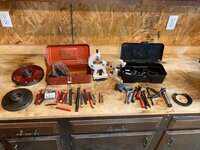
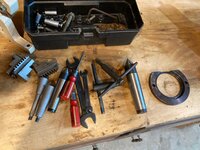
This is all what came with the lathe. Not sure what the two big round things are on the left. And I believe the two white pieces in the middle are some kind of holders maybe for longer pieces? Looks like enough stuff to get started and play around a bit. I've been working on a stand for it a little. Decided to go with a wooden bench with 3/4" plywood top and a 3/16" steel plate on top of that. I'll hopefully get it mostly finished this weekend as my steel top will be ready this Monday.
 

Attachments

  • IMG_1585.jpg
    IMG_1585.jpg
    412.3 KB · Views: 84
  • IMG_1586.jpg
    IMG_1586.jpg
    393 KB · Views: 84
  • IMG_1587.jpg
    IMG_1587.jpg
    371.5 KB · Views: 100

Aaron_W

Well-known member
Joined
Feb 6, 2018
Messages
2,894
Location
Northern California
The big round things are a face plate (red), and I think the other is a backplate for a chuck. The white things are a steady rest (3 fingers) which helps with long parts, the other is a follow rest which helps with flexi parts by backing up behind the lathe tool. The really long cutters are boring bars for enlarging holes.

Looks like a decent starting point.
 
To avoid these ads, REGISTER NOW!
Top Bottom