
dr_clyde
Well-known member
There has been interest expressed in my making a thread about flame straightening. SO. Without further ado...
What the hell is flame straightening, anyway? Well, flame straightening is the precise application of heat to metals to correct warp or to induce warp. Typically this is used as corrective action after welding.
So, what metals can be flame straightened? Typically, mild steel, stainless steel and aluminum are fairly easily straightened. It should go without saying, but I'll say it anyway, don't put a torch on heat treated steels, or metals that will be damaged by reaching temperatures of 2000°. Air hardening tool steels come to mind.
The thermal conductivity of the metal affects how effective the flame is, and how much heat is needed to make a measurable change. Therefore, using the given three metals in our example, stainless will straighten with relatively little heating, mild with a normal amount, and aluminum will take roughly twice the heat of mild.
When metal is heated, it expands. When localized heat is applied to a piece of metal, it expands differently than if it was heated in an oven. The surrounding cool metal prevents the hot metal from expanding evenly with the rest of the piece. It instead pushes outward into the air, creating a small upset in the surface of the metal.
When allowed to cool, the changed geometry of the base metal pulls inward because the displaced metal from small upset is no longer there to resist the inward shrinking of the outer metal. It warps. But it warps predictably, and when we apply this technique opposite the distortion caused by welding, we can correct that distortion to a really accurate degree.
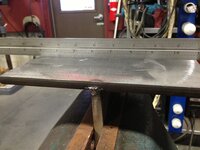
Here is our test victim, 3/8" thick A36 Hot rolled steel plate. I sawed off a couple pieces and ground off the mill scale. Fillet welds distort more than other joint geometries, so we'll do a 2F weld for our demo.

As you can see, we're looking nice and flat, as you'd expect from an unwelded joint.
I ran one stringer of 7018 on each side of the plate, and let the plate cool.
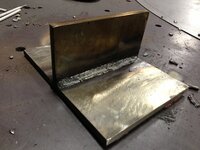
Well, it warped. More than I expected actually. In actual real word welding, the plate would be clamped to the table to minimize the amount of distortion.

My first order of business was to mark my line to follow. This is not strictly necessary, it just helps to keep me from wandering off course. The paint marker stays visible until the metal is darn near molten, so it works great for this.

In most welding shop flame straightening, we use a cutting head on an oxyacetylene torch. Propane torches don't have the intense localized heat needed to do an accurate job. A rosebud or heating attachment is too broad. We want a very focused heating. Like welding, but without filler.
I like to set my acetylene so the flame is just jumping off the tip of the torch, any less, and I'm not maximizing my heat output for my tip size. Then I adjust for a neutral flame.

I run the first pass directly down the center, this helps get an even pull on both sides as a baseline.

I make small circles with the torch, getting it to a nice, bright orange, but not melting. It's difficult to photograph, but the orange circle is slightly larger and more intense than this.


I choose to cool the heats quickly, typically using wet rags on small jobs. If I can, I'll do it outside on the forklift forks, with a hose. For this small job I just slowly dunk it in a bucket. Since we're not quenching during in the upper critical temperature, we're not doing any hardening, and steels that are flame straightened aren't heat treated anyway. You can air cool your shrinks, but it just takes forever on multiple shrink jobs.

As you can see, some progress was made, but more is needed.

I lay out the next two shrinks symmetrically, so the straightening is even. I do these right at the toes of the welds, so I'm pulling on fresh, un-distorted steel. You can only upset steel so much, then you must work undisturbed steel right next to the previous shrink if more is needed.

One shrink finished. Cool between each shrink so the corresponding shrink on the other side pulls the same amount and isn't affected by the preheat of the first shrink.

Both done.

Just enough. Dead nuts straight.
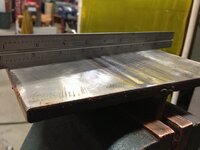
Here I dusted the crowns of the upsets with a grinder so you can see how much they rise up out of the base.

And that's flame straightening in a nutshell. Any questions please ask.
What the hell is flame straightening, anyway? Well, flame straightening is the precise application of heat to metals to correct warp or to induce warp. Typically this is used as corrective action after welding.
So, what metals can be flame straightened? Typically, mild steel, stainless steel and aluminum are fairly easily straightened. It should go without saying, but I'll say it anyway, don't put a torch on heat treated steels, or metals that will be damaged by reaching temperatures of 2000°. Air hardening tool steels come to mind.
The thermal conductivity of the metal affects how effective the flame is, and how much heat is needed to make a measurable change. Therefore, using the given three metals in our example, stainless will straighten with relatively little heating, mild with a normal amount, and aluminum will take roughly twice the heat of mild.
When metal is heated, it expands. When localized heat is applied to a piece of metal, it expands differently than if it was heated in an oven. The surrounding cool metal prevents the hot metal from expanding evenly with the rest of the piece. It instead pushes outward into the air, creating a small upset in the surface of the metal.
When allowed to cool, the changed geometry of the base metal pulls inward because the displaced metal from small upset is no longer there to resist the inward shrinking of the outer metal. It warps. But it warps predictably, and when we apply this technique opposite the distortion caused by welding, we can correct that distortion to a really accurate degree.
Here is our test victim, 3/8" thick A36 Hot rolled steel plate. I sawed off a couple pieces and ground off the mill scale. Fillet welds distort more than other joint geometries, so we'll do a 2F weld for our demo.
As you can see, we're looking nice and flat, as you'd expect from an unwelded joint.
I ran one stringer of 7018 on each side of the plate, and let the plate cool.
Well, it warped. More than I expected actually. In actual real word welding, the plate would be clamped to the table to minimize the amount of distortion.
My first order of business was to mark my line to follow. This is not strictly necessary, it just helps to keep me from wandering off course. The paint marker stays visible until the metal is darn near molten, so it works great for this.
In most welding shop flame straightening, we use a cutting head on an oxyacetylene torch. Propane torches don't have the intense localized heat needed to do an accurate job. A rosebud or heating attachment is too broad. We want a very focused heating. Like welding, but without filler.
I like to set my acetylene so the flame is just jumping off the tip of the torch, any less, and I'm not maximizing my heat output for my tip size. Then I adjust for a neutral flame.
I run the first pass directly down the center, this helps get an even pull on both sides as a baseline.
I make small circles with the torch, getting it to a nice, bright orange, but not melting. It's difficult to photograph, but the orange circle is slightly larger and more intense than this.
I choose to cool the heats quickly, typically using wet rags on small jobs. If I can, I'll do it outside on the forklift forks, with a hose. For this small job I just slowly dunk it in a bucket. Since we're not quenching during in the upper critical temperature, we're not doing any hardening, and steels that are flame straightened aren't heat treated anyway. You can air cool your shrinks, but it just takes forever on multiple shrink jobs.
As you can see, some progress was made, but more is needed.
I lay out the next two shrinks symmetrically, so the straightening is even. I do these right at the toes of the welds, so I'm pulling on fresh, un-distorted steel. You can only upset steel so much, then you must work undisturbed steel right next to the previous shrink if more is needed.
One shrink finished. Cool between each shrink so the corresponding shrink on the other side pulls the same amount and isn't affected by the preheat of the first shrink.
Both done.
Just enough. Dead nuts straight.
Here I dusted the crowns of the upsets with a grinder so you can see how much they rise up out of the base.
And that's flame straightening in a nutshell. Any questions please ask.


 ]
]