To avoid these ads, REGISTER NOW!

Flame Straightening 101: The Basics

dr_clyde

Well-known member
Joined
Jan 7, 2009
Messages
6,438
Location
Holland, MI
There has been interest expressed in my making a thread about flame straightening. SO. Without further ado...

What the hell is flame straightening, anyway? Well, flame straightening is the precise application of heat to metals to correct warp or to induce warp. Typically this is used as corrective action after welding.

So, what metals can be flame straightened? Typically, mild steel, stainless steel and aluminum are fairly easily straightened. It should go without saying, but I'll say it anyway, don't put a torch on heat treated steels, or metals that will be damaged by reaching temperatures of 2000°. Air hardening tool steels come to mind.

The thermal conductivity of the metal affects how effective the flame is, and how much heat is needed to make a measurable change. Therefore, using the given three metals in our example, stainless will straighten with relatively little heating, mild with a normal amount, and aluminum will take roughly twice the heat of mild.

When metal is heated, it expands. When localized heat is applied to a piece of metal, it expands differently than if it was heated in an oven. The surrounding cool metal prevents the hot metal from expanding evenly with the rest of the piece. It instead pushes outward into the air, creating a small upset in the surface of the metal.

When allowed to cool, the changed geometry of the base metal pulls inward because the displaced metal from small upset is no longer there to resist the inward shrinking of the outer metal. It warps. But it warps predictably, and when we apply this technique opposite the distortion caused by welding, we can correct that distortion to a really accurate degree.

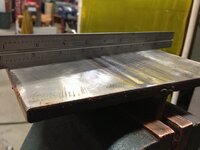
Here is our test victim, 3/8" thick A36 Hot rolled steel plate. I sawed off a couple pieces and ground off the mill scale. Fillet welds distort more than other joint geometries, so we'll do a 2F weld for our demo.

15580591343_3166abccd7.jpg

As you can see, we're looking nice and flat, as you'd expect from an unwelded joint.
16014604747_d7c1befbbc.jpg

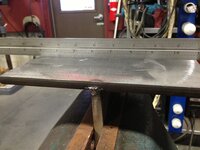
I ran one stringer of 7018 on each side of the plate, and let the plate cool.
16013059520_9a52caaf92.jpg

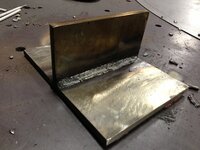
Well, it warped. More than I expected actually. In actual real word welding, the plate would be clamped to the table to minimize the amount of distortion.

15580577703_814ca94367.jpg

My first order of business was to mark my line to follow. This is not strictly necessary, it just helps to keep me from wandering off course. The paint marker stays visible until the metal is darn near molten, so it works great for this.

16014583297_32447bebb1.jpg
In most welding shop flame straightening, we use a cutting head on an oxyacetylene torch. Propane torches don't have the intense localized heat needed to do an accurate job. A rosebud or heating attachment is too broad. We want a very focused heating. Like welding, but without filler.

I like to set my acetylene so the flame is just jumping off the tip of the torch, any less, and I'm not maximizing my heat output for my tip size. Then I adjust for a neutral flame.

16014579787_9ba15218f3.jpg

I run the first pass directly down the center, this helps get an even pull on both sides as a baseline.

15577979684_674d9b2446.jpg

I make small circles with the torch, getting it to a nice, bright orange, but not melting. It's difficult to photograph, but the orange circle is slightly larger and more intense than this.

16200380915_78bae67e30.jpg

15577974014_6e2c3e4102.jpg

I choose to cool the heats quickly, typically using wet rags on small jobs. If I can, I'll do it outside on the forklift forks, with a hose. For this small job I just slowly dunk it in a bucket. Since we're not quenching during in the upper critical temperature, we're not doing any hardening, and steels that are flame straightened aren't heat treated anyway. You can air cool your shrinks, but it just takes forever on multiple shrink jobs.

16198500601_5102a7743f.jpg

As you can see, some progress was made, but more is needed.

16174522296_4952abcff6.jpg

I lay out the next two shrinks symmetrically, so the straightening is even. I do these right at the toes of the welds, so I'm pulling on fresh, un-distorted steel. You can only upset steel so much, then you must work undisturbed steel right next to the previous shrink if more is needed.

16198494041_3856abb78e.jpg

One shrink finished. Cool between each shrink so the corresponding shrink on the other side pulls the same amount and isn't affected by the preheat of the first shrink.

16199548102_742a1153c1.jpg

Both done.

16014553737_488612be03.jpg

Just enough. Dead nuts straight.

16014622527_fe6789bf21.jpg

Here I dusted the crowns of the upsets with a grinder so you can see how much they rise up out of the base.

15580619193_ab06b630eb.jpg
And that's flame straightening in a nutshell. Any questions please ask.
 
To avoid these ads, REGISTER NOW!

LXCam

ALLIANCE MEMBER
Joined
Apr 23, 2013
Messages
19,109
Location
AZ
Well I've never asked you to do that but.........thanks a ton bud!!. I've become so accustomed to clamping everything and letting it cool that I rarely have issues anymore but using this technic to message assemblies will be something I never forget. Thanks again!. :bowdown:
 
OP
D

dr_clyde

Well-known member
Joined
Jan 7, 2009
Messages
6,438
Location
Holland, MI
Is there a reason why it's cherry red?

I was told just to get it hot enough so there is "Blueing" from the flame.

Blue is roughly 640 degrees. That's not hot enough to cause the upset needed to counteract welding. There isn't any melting, so there isn't any damage caused. Like I mentioned, don't do this on heat treated steels, or things that are high temperature sensitive.
 

srmofo

Well-known member
Joined
Oct 15, 2009
Messages
6,161
Location
SW ohio
Now is it possible to do this on a square frame that was welded square but then twisted so one corner rose up? roughly30"x60"

Not having an adequate table to clamp to makes welding up an adequate square table to weld on difficult.

Im probably going to end up cutting the frame apart, making it a little smaller and trying again
 

zkling

Well-known member
Joined
Jan 23, 2007
Messages
16,939
Yes, the way to think about it is to add heat to the opposite side of the weld or 'pull'. Dr. Clydes example is the most fundamental of the process. For a frame you have to put a reference on which side is being pulled together like in stringing a bow. For more complex structures such as frames it helps to have tie downs, jacks or other types of constraints to encourage the metal to go in the direction you want. Alot of semi predictable stresses can form in a complex welded structure.

Agree with APmech, that is by far the best practical writing on the process.
 
Last edited:

BJ42LX

Well-known member
Joined
Dec 29, 2010
Messages
2,811
Location
WNY
Excellent write-up. Thank you.

Where did you get the copper jaws for the Wilton?

[You did say "any questions". :lol:]
 

airrj

Well-known member
Joined
Apr 4, 2008
Messages
137
Location
Wide Wonderful Wyoming
Very nice writeup on a useful subject. I just wanted to note that you can do this on many different shapes as well. The only time I have used flame straightening is on axle tubes for vehicles. On 45 year old axle housings they get bent from time to time. And on stock car axles you can use this technique to add camber to a rear axle housing. Multiple little shrinks can move a 3 1/2" diameter tube nicely.

Well done and thanks.
 
To avoid these ads, REGISTER NOW!

Fyrme

Well-known member
Joined
Nov 28, 2012
Messages
2,231
Location
Green country, Oklahoma
Thanks Doc. That's just want I anticipated seeing. The PDF is some great info, but for a ADD stricken dummy like me a simple down and dirty write up gets my brain tuned in to the task at hand much easier. Again, Great job
 

Boiler

Well-known member
Joined
Nov 20, 2009
Messages
1,967
Location
Indiana
So, what metals can be flame straightened? Typically, mild steel, stainless steel and aluminum are fairly easily straightened. It should go without saying, but I'll say it anyway, don't put a torch on heat treated steels, or metals that will be damaged by reaching temperatures of 2000°. Air hardening tool steels come to mind.

The thermal conductivity of the metal affects how effective the flame is, and how much heat is needed to make a measurable change. Therefore, using the given three metals in our example, stainless will straighten with relatively little heating, mild with a normal amount, and aluminum will take roughly twice the heat of mild.

Just curious, what is your process for aluminum? I've never personally heated it (I'm a design engineer) but I've dealt with specifying the material very often. I've had guys in the shop try to anneal it for bending with a torch and they will often damage the material by overheating it. I believe it melts around 1200F. We've changed to "over-aging" it in the oven for bending, or selecting a different alloy / temper, so I rarely see anyone try to hand heat it anymore.
 

Ed ke6bnl

Well-known member
Joined
Aug 1, 2005
Messages
495
Location
Agua Dulce, Calif.
QUESTION? When I was watching a video on straightening a small shaft while on a lathe with an indicator for checking distortion. what I recalled was if the bend was toward the operator of the lathe he heated in on that side with the bend toward operator and it moved away. Was this correct in your opinion.?
 

404

Well-known member
Joined
Aug 23, 2014
Messages
3,463
Location
Mass
Great write up. Imagine how much force one would need to apply with a press to get the big plate to bend that much. Shrink forces from welding are enormous.
 

kerrynzl

Well-known member
Joined
Nov 8, 2013
Messages
5,054
Location
Tauranga, New Zealand
Great write up. Imagine how much force one would need to apply with a press to get the big plate to bend that much. Shrink forces from welding are enormous.

The weld tries to "pinch" the steel when it cools , which is why there is a slight rise on the other side after it is flame straightened.

Hammering the weld [if possible] while it is cooling will reduce shrinkage.
pre-heating the steel ,so it all shrinks equally also works [but takes an enormous amount of energy compared to flame straightening]

I've had a lot of success "cold shrinking" galvanised Angle steel using a soft hammer against a hard object [ basically swapping heat energy for physical energy]
Heat ruins the galv.
 

MP&C

Well-known member
Joined
Oct 21, 2009
Messages
4,401
Location
Leonardtown, MD
QUESTION? When I was watching a video on straightening a small shaft while on a lathe with an indicator for checking distortion. what I recalled was if the bend was toward the operator of the lathe he heated in on that side with the bend toward operator and it moved away. Was this correct in your opinion.?

That would be correct. Just as shown in the pictures on the first page, the high spot(s) are heated.
 

BJ42LX

Well-known member
Joined
Dec 29, 2010
Messages
2,811
Location
WNY
The Federal Highway Administration "Guide for Heat Straightening of Damaged Steel Bridge Members" is the best publication available on the subject, so far as I'm aware:

http://www.fhwa.dot.gov/bridge/steel/

I read the first couple chapters of this on my lunch hour. Fascinating stuff.

Then I found this YouTube. Same application as in the paper. The guy uses the same terminology. It's amazing how much damage is pulled out of this bridge element with the application of heat.

I want to go try this on a vise handle or something.


Kevin54

MEMBER EMERITUS
Joined
Jan 12, 2005
Messages
29,341
Location
Urbana, Ohio
Not to hijack the thread, but to add to it a little.......when flycutting a piece of aluminum, or taking a cut off of one side in one complete pass, the material will bow because it "relieves" the material. So to make a piece of aluminum flat, say for instance a 6" x 12" piece of aluminum plate, you want to take an equal amount off of each side. For instance, if you want to take a piece of 5/8" thick aluminum down to 1/2", you want to remove 1/16" off of each side, but you don't want to take it off all at once. You want to take something like .050 off of one side, flip it over, then take .050 off of the other side. Loosen the vise and reclamp your piece, take your other .012 off of the one side, then flip it over and remove enough to bring your part down to .500.

Jut like welding material, cutting it will heat it up and do the same thing. The only thing is that welding the material will warp it way more than cutting it due to the amount of heat and the amount of expansion.

I tell a lot of people.....become one with the material, and become one with the machine. Learn how material acts and compensate for that. Most people have heard of bi-metal, like they use in certain switches and thermostats? One metal will heat up more than the other then it will start bending.

Heat can be your friend, or heat can really be your enemy. Become one with the material and learn what it does. Once you do that, a lot of your problems will be solved..

Sorry to hijack, I just wanted to add a little to it as to why metal does what it does.
 

Engine

Well-known member
Joined
Jan 9, 2014
Messages
646
Location
Kentucky
Another thanks for taking the time to show how it's done. I'm going to try this out soon and see what kind of results I get. I can think of a few uses for this already. It doesn't look too difficult to learn; just like welding, it will just take some practice and trial & error.
 

Engine

Well-known member
Joined
Jan 9, 2014
Messages
646
Location
Kentucky
Doc,
As I mentioned above, I followed your example as close as possible and got good results. Since I'm using oxy/propane, I had to make one additional pass more than you did on each side of the centerline to get the necessary straightening. As you said, the o/p torch produces a more diffuse area of heat than the o/a torch. It still works but it is a slow process with the 3/8" plate.

I've got enough material left for one more test so I think I'll try it this time with a larger size tip and try to get more heat into it faster. I was using a 00 size and that cuts 3/8 just fine, but I'll step up two sizes to the 1 size tip and see if that speeds things up any.

Again, thanks for showing how to do the process. It will be useful to know in the future when things get "warped out of shape."
 

Macrosloth

Well-known member
Joined
Apr 27, 2012
Messages
86
Location
Van
Thanks for the howto..

For those of us with out oxy setups, is it possible to do this with a tig torch, or is the heat too localized?
 
OP
D

dr_clyde

Well-known member
Joined
Jan 7, 2009
Messages
6,438
Location
Holland, MI
Just curious, what is your process for aluminum? I've never personally heated it (I'm a design engineer) but I've dealt with specifying the material very often. I've had guys in the shop try to anneal it for bending with a torch and they will often damage the material by overheating it. I believe it melts around 1200F. We've changed to "over-aging" it in the oven for bending, or selecting a different alloy / temper, so I rarely see anyone try to hand heat it anymore.

Aluminum is trickier, mostly because of the lack of color change with heat. I try not to heat areas that haven't already been metallurgically changed by welding. Getting to these temperatures, you are going to change the base metal. No way around it. I use temperature indicating crayons to get a rough idea of temp. My infrared thermometer doesn't like aluminum for some reason. Probably the reflectivity. Otherwise the process is the same, except for it takes more heat to do any work.
 
OP
D

dr_clyde

Well-known member
Joined
Jan 7, 2009
Messages
6,438
Location
Holland, MI
Thanks for the howto..

For those of us with out oxy setups, is it possible to do this with a tig torch, or is the heat too localized?

I've done it with a tig torch. Its harder though, because it is difficult to see the color change, and really easy to overheat and melt the base. Keeping these things in mind, I've used the tig several times for small parts with success.
 

Surreal001

Well-known member
Joined
Feb 25, 2014
Messages
105
Thanks Doc! I'm trying to teach myself to stick weld and am sure this little lesson will come in handy!
 

rdn2blazer

Well-known member
Joined
Jan 7, 2009
Messages
166
Location
So Cal/South Bay area, Calif.
Although I have never tried the concept I though of, I have always wanted to try it. I just forget to do it at the moment I'm welding something up. I assume you can, for lack of a better term "Down flex" the flat plate with a narrow shim under the center thats say about 1/8 thick and equal length of the flat plate. And running the same direction as the vertical top plate.

You clamp it down effectively flexing the flat plate, all four corners, or both sides in the oppisite direction. Then once welded and let air cool. Once clamps are removed, you should have far less warpage. Different material thickness will require different thickness shim. Knowing what shim to use comes with trying this concept on different thickness of material so you find out how much different thickness warps on average. There are variables of course. Welder amp setting is one variable. Outside temp is another, and there are others. Just my .02 cents.
 

Goat Driver

Member
Joined
Jan 7, 2015
Messages
16
Thanks for the write up and great images dr_clyde!
Interesting and very helpful information. Thanks again.
 
To avoid these ads, REGISTER NOW!
Top Bottom