RTM
Well-known member
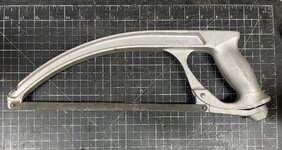
Streamlined for speed while sawing.Here's an interesting looking Stanley
I picked it up at the Flea Market from a real nice seller.....I have more than plenty hacksaws, but I just had to buy something from him

Streamlined for speed while sawing.Here's an interesting looking Stanley
I picked it up at the Flea Market from a real nice seller.....I have more than plenty hacksaws, but I just had to buy something from him
It also gives a little more clearance, reduces weight and is a strong design.Streamlined for speed while sawing.
I've been walking away from one just like that at a local junque shoppe for a year now. I could probably get it cheap, but I have a half-dozen hacksaws and that's enough for me.Here's an interesting looking Stanley
I picked it up at the Flea Market from a real nice seller.....I have more than plenty hacksaws, but I just had to buy something from him
Yeah..........I could probably get it cheap, but I have a half-dozen hacksaws and that's enough for me.

Slacker.I could probably get it cheap, but I have a half-dozen hacksaws and that's enough for me.
 I have a half dozen users, and at least 4 others that are just for looks, cuz they were cheap.
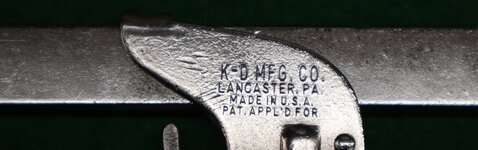
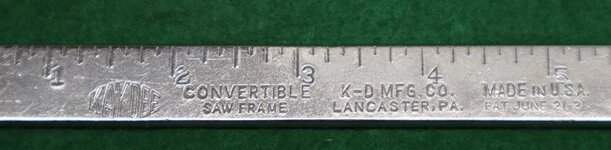
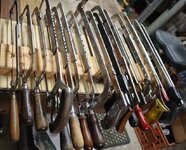
You guys aren't serious collectors. Here is a picture of a group I'm researching. They all have adjustable frames for different blade lengths. No two are alike. The one on the far left is a 1884 H.L. Pratt (patent 292176). The next two are Starrett's. The next four all have index holes in the frame, Quality Saw & Tool Works, The S&I Co, HG Thompson & Son Co, Union Hardware Co.. Then there is a Goodell-Pratt Co. design later used by Millers-Falls, KD convertible, Clemson Victor, Millers-Falls No. 1100, a bronze one made by patternmaker, Fulton, Unknown, Forsberg No 80 Whale, De. E. Priest 1936 patent electricians, Hudson Forge, Olympia (made in China). Have more coming. Another M-F's and KD too.Slacker.
Oh most definitely not. I am more of an accumulator of most things.You guys aren't serious collectors
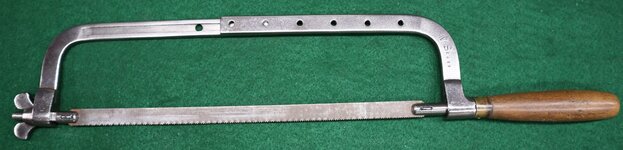
More info on 1st saw (far left). It is marked W. Scott on the left side frame by the handle. It is marked W S on the other end frame. It is marked three places on handle with W Scott. No other markings. However, it matches the Henry L. Pratt patent 292176 (Jan 22, 1884) with the same frame adjustment and the same blade retention pins shaped like a "U". The only thing not the same is the shape of the handle. Searching has found no connection with anybody named Scott along with Pratt. H.L. Pratt was president of Millers-Falls at the time. He did not assign this patent to them. Also, no connection to Clemson Saw, which M-F's had make saws and saw blades for them.You guys aren't serious collectors. Here is a picture of a group I'm researching. They all have adjustable frames for different blade lengths. No two are alike. The one on the far left is a 1884 H.L. Pratt (patent 292176). The next two are Starrett's. The next four all have index holes in the frame, Quality Saw & Tool Works, The S&I Co, HG Thompson & Son Co, Union Hardware Co.. Then there is a Goodell-Pratt Co. design later used by Millers-Falls, KD convertible, Clemson Victor, Millers-Falls No. 1100, a bronze one made by patternmaker, Fulton, Unknown, Forsberg No 80 Whale, De. E. Priest 1936 patent electricians, Hudson Forge, Olympia (made in China). Have more coming. Another M-F's and KD too.

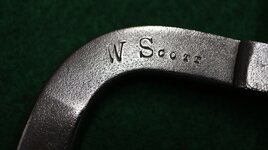
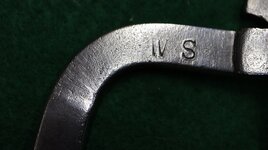
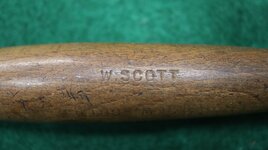
More info on 1st saw (far left). It is marked W. Scott on the left side frame by the handle. It is marked W S on the other end frame. It is marked three places on handle with W Scott. No other markings. However, it matches the Henry L. Pratt patent 292176 (Jan 22, 1884) with the same frame adjustment and the same blade retention pins shaped like a "U". The only thing not the same is the shape of the handle. Searching has found no connection with anybody named Scott along with Pratt. H.L. Pratt was president of Millers-Falls at the time. He did not assign this patent to them. Also, no connection to Clemson Saw, which M-F's had make saws and saw blades for them.
The shape of the handle is unusual too. Usually there is a swell for your thumb to push against. This handle looks more like a chisel or coping saw handle. Not sure but the wood may be beech.
More info on 1st saw (far left). It is marked W. Scott on the left side frame by the handle. It is marked W S on the other end frame. It is marked three places on handle with W Scott. No other markings. However, it matches the Henry L. Pratt patent 292176 (Jan 22, 1884) with the same frame adjustment and the same blade retention pins shaped like a "U". The only thing not the same is the shape of the handle. Searching has found no connection with anybody named Scott along with Pratt. H.L. Pratt was president of Millers-Falls at the time. He did not assign this patent to them. Also, no connection to Clemson Saw, which M-F's had make saws and saw blades for them.
The shape of the handle is unusual too. Usually there is a swell for your thumb to push against. This handle looks more like a chisel or coping saw handle. Not sure but the wood may be beech.
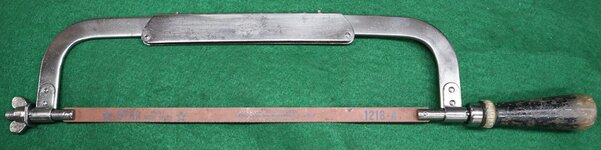
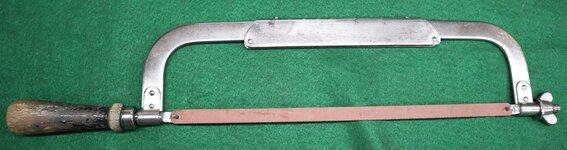
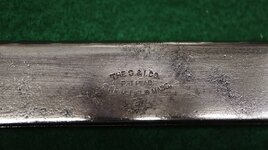


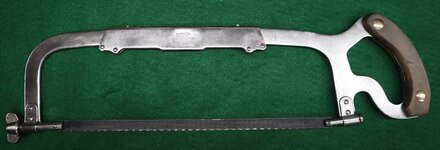
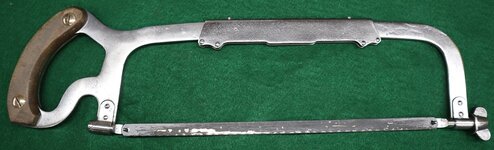
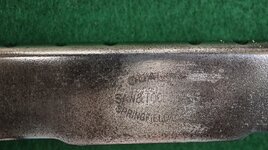
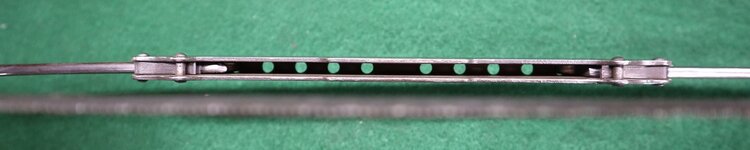

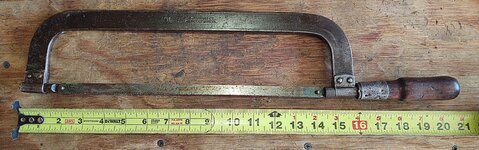
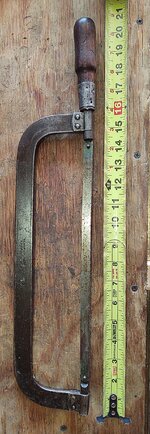
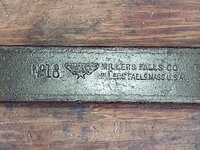
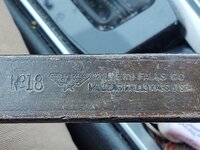
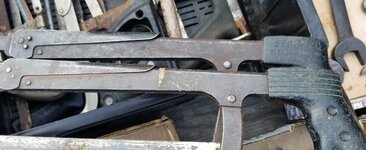
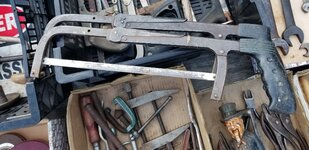
Millers Falls catalog #35 page 110 has it listed. Year 1915. May have been made before this.This one is interesting. I found this Millers Falls hacksaw for $7. It got my attention because I noticed it is not adjustable like almost every other hacksaw I've seen. Overall it's 20-1/2 long & has a 12" blade. I haven't done much research yet, but a quick look at Google books I didn't see anything on a no. 18 Millers Falls hacksaw. Not finding much on Google yet either. The other thing that shocked me was how heavy it is. I'm curious to find out if this dates to before 1900?
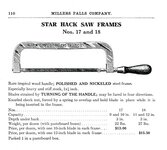
Thanks for the ad. Wow! It says "rare tropical wood handle." It will be interesting to see if the #18 goes back further than 1915.Millers Falls catalog #35 page 110 has it listed. Year 1915. May have been made before this.




I'm reading that to mean it's only a subset of your total collection, right, Eric? I've been following all your previous posts, including a few group shots, and now this one, but I don't recall seeing a total collection photo, which might defy all wide-angle lenses except the special panoramic effect.Here is a picture of a group I'm researching.
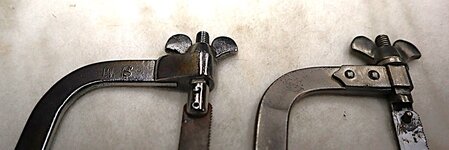
At a glance the first one looks like a Starrett. #47 except for the wood handle. It looks like the blade holders were swapped end-to-end and a wingnut added. Then the wood handle added. Scrape the side to maybe see the maker.At the risk of my Membership Card being revoked, I started being much more selective at fleas last year, even for $1 Table items (every $1 adds up eventually, space is limited, and my days of consignment shopping for other collectors are also well behind me), but I do have a couple hacksaws in my LEFT-BEHIND folders.
The branding is not legible on the first, but I am sure Eric or someone else may recognize it. On the spot, I was not familiar with the combination of the (broken) wood saw type handle and that particular mechanism, and I never researched the model number.
For the second, I see a lot of STAR (Clemson Bros brand) blades, and usually grab them if they look vintage, because the WWII GMTK was issued an adjustable (8"-12") hacksaw (straight wood handle, thumb-nut tension style until 1945, when plastic pistol grip took over) with a dozen blades (Type A, 1/2" or 9/16", 24 ppi), but in all my years of collecting tools for assembling GMTK's (5 and counting), I have never provisioned one with a Clemson Bros hacksaw (only Union and Atkins) and don't recall ever seeing one that met the adjustable requirement before. As I recall, I only snapped this photo for that marking on the handle of the one in back, which I didn't remember seeing before. Given the recent discussion, probably should've grabbed it.
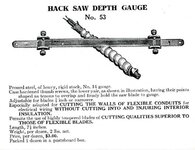
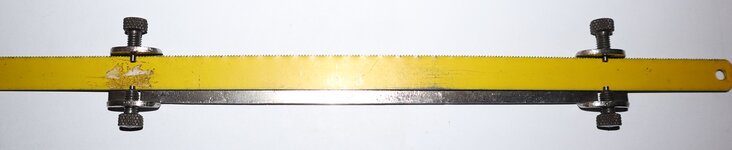
Thank you. It would be almost impossible to take a picture of my whole collection. It's hard enough to just get a small group together. My collecting isn't restricted by any one type of tool. I have an almost insatiable curiosity about mechanical things. With hacksaws lately it's a focus on adjustable frames. An earlier post showed a bunch of my fixed frames. So frame material, blade holding design, handle attachment, I find interesting. I try to follow the thinking behind "improvements. A good example is the hacksaw depth gauge. When I saw it, I bought it. Didn't exactly know what it was or how it worked. At first I was thinking tension, but it didn't make sense. After researching I found the catalog page that said what it was. Then it made sense. My tool collecting may seem more woodworking related, but I have a large group of plier and wrench type tools. (Nothing close to what Alloy Artifacts has). While collecting expansive bits, I found a bunch named "Fulton". Research didn't find a tool company with that name. Most of them were made for Sears and Sears used Fulton before they came out with Craftsman. So digging deeper I found that the Fulton name was being used to honor Robert Fulton, inventor of the first practical steamboat. So now I have a Robert Fulton Tribute Collection. It has more than tools in it. About a 100 books from 1817 to present about him. (Trivia: The first animated cartoon Walt Disney put out with sound was Steamboat Willie.)I'm reading that to mean it's only a subset of your total collection, right, Eric? I've been following all your previous posts, including a few group shots, and now this one, but I don't recall seeing a total collection photo, which might defy all wide-angle lenses except the special panoramic effect.
(I've said it before to you, but I admire the topical focus. Niche collections are fun. @3baygarage has a spectacular collection of swivel speeders, as a good example. I have been drawn for whatever reason to some goofy things - utility knives and half-moon wrenches. Many guys have been bitten by the 4" adjustables. Hacksaws is a nifty one and your research to match is appreciated. I realize you're into other, more traditional first wave collectibles from the sawdust-making set, e.g., auger bits, breast drills, etc, but the hacksaws cross over nicely into mechanical.)
But I'm very curious for a total number. Hacksaws, bonesaws, padsaws, and the like, with accessories.
Also, I like the temporary holding method of this 'being researched' group. Tidy, compact, and yet also an "in use" view, that does not obscure any of the mechanisms or markings. Do you use a similar method for long-term storage/display? Or do you lay them on their sides as in some of your felt background shots? I don't have enough - maybe 12 or so, for it to be a need, especially because most of them are stored somewhere else, by brand. I'm just curious.
Good to know! If you ever feel like sharing, check out the A-Z Index of Threads in the Sticky at the top of the page. By type, and by brand. It defeats the descending chronology format of the forum.My tool collecting may seem more woodworking related, but I have a large group of plier and wrench type tools.
I know the feeling!Didn't exactly know what it was or how it worked.
Very cool. I have little dedicated shelves or "wings" like that in "the Lugzsonian" (i.e., my basement hangout) where the tools are accessorized with related paraphernalia. It's a common symptom.So now I have a Robert Fulton Tribute Collection.
Thanks, but I've actually been in serious thinning the herd mode.See something you like, let me know.
The branding is not legible on the first, but I am sure Eric or someone else may recognize it. On the spot, I was not familiar with the combination of the (broken) wood saw type handle and that particular mechanism, and I never researched the model number.
I’m gonna guess Starrett 489At a glance the first one looks like a Starrett. #47 except for the wood handle. It looks like the blade holders were swapped end-to-end and a wingnut added. Then the wood handle added. Scrape the side to maybe see the maker.

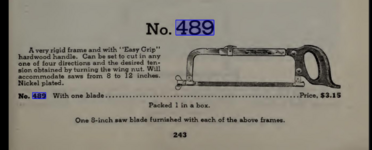
I have to agree with RTM. I was on the right track, just didn't dig deeper. Sorry.I’m gonna guess Starrett 489
Starrett Precision Tools : Catalog 26 : L. S. Starrett Co. : Free Download, Borrow, and Streaming : Internet Archive
292 p., illus., 17.4 cm, trade catalogarchive.org

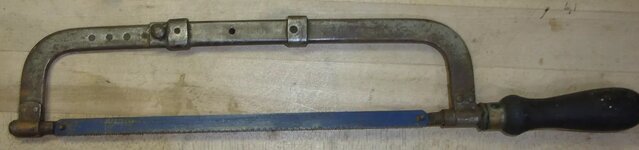
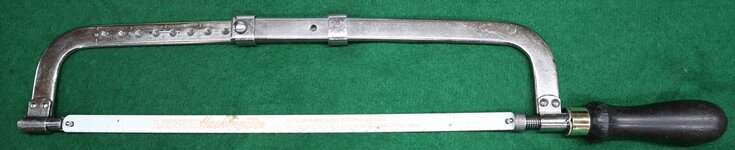
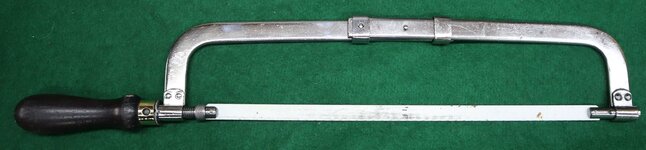

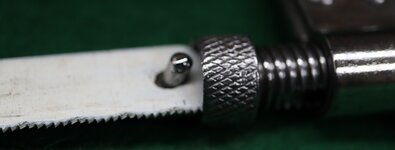

Yes, but the basic idea behind it is the same. I've looked some more to try and find info on W. Scott, but no luck so far. My guess is he either worked for Clemson Brothers or Millers-Falls in the "development dept.".^ Really quite a difference in construction there.
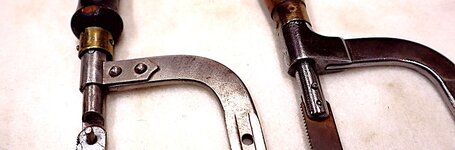
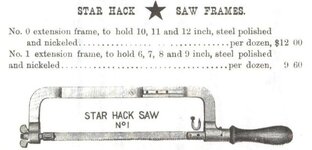
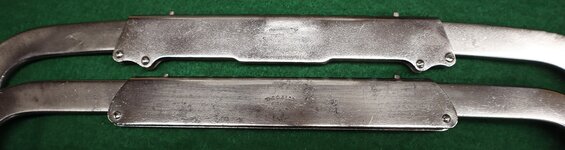
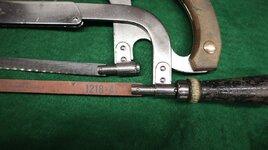
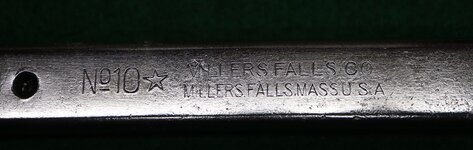
Just got another Millers-Falls hacksaw No 1. My earlier example was only marked with "W. Scott". This saw is actually marked "No 1", a Star, "MFD By Millers-Falls Co.", Millers-Falls Mass", "AT&T Co.". (The Scott is the upper one in pictures). The main frames look alike except for the ends where the blade holders go. On the Scott they are cast steel, on the M-F they are stamped steel. The handles are different. The Scott uses the H.L Pratt patent "U" shaped retainers, where the M-F uses angled pins. This suggests that the Scott is earlier, possibly a prototype. The M-F is also stamped with AT&T, which was formed in 1885 a year after the 1884 Pratt patent, so it's in the right time period. Both these saw have the wrong blades in them, they are extended too far. Should have 6,7,8,9 inch blades instead. Will correct.
Thanks RTM. Quite a puzzle, isn't it? I seem able to find the odd stuff. I don't agree that 440174 is that similar. It uses a hollow top rail and then the other part of the frame slides inside it. The Pratt design is a simple overlap.DATAMP search on the G.N. Clemson name does not show a Scott as a witness anywhere.
Looking into USPTO, the search of the OCR fields for Hacksaw and Scott drew nothing.
Looking thru anything in OCR with Hacksaw, and ogling frame pix gave me some notes below
Looking at 440174, it seems to have your top rail design, but with pins not screws in the description. This also has an intermediate channel to straddle both ends
The blade attachment is very wrong, but the tension screw has the right wingnut shape.
No Scott on the witness list, or producer, etc.
DATAMP has it as Not Known to have Been Produced
this one 499227 has 2 lapped pieces, no center channel, but uses pins and keyholes, no Scott again. Mfgr is Thompson
This one 510774 has two lapped frames, secured by a pin, but held captive on a spring it appears
Supposedly excludes anything covered by 440174 per DATAMP, but also Not known to have been produced.
776602 has a two piece lapped frame, help by a pin or bolt (e), and a clamp of some nature (f), which yours does not have. If you look at this pin only, this looks credible. Nothing else seems to fit. Listed as assigned to the Oozer Manufacturing company of Jersey City, NJ. He was an incorporator, they were in biz 1904 -1916 or so
This patent is not in DATAMP
Another one from the same inventor, the clamp is much thinner, pins still seem in play. ANchoring of the frame to the handle is getting closer to matching. Not listed as assigned to anyone
Again, this patent is not in DATAMP
Well ****, my patent window just died, giving up for now. More later, I'm about to start 1910.
Eric, thank you for your post! That is interesting. I had learned somewhere that butcher saw blade was bought in bulk on a roll, but had never seen the appropriate punching tools for the task.Hacksaw Hole Punches. In the early days of hacksaws, it seems they had issues with tempering blades. Cost of steel was also a consideration. So the saw makers made frames for different lengths of blades. Most common were 8", 10" and 12". According to blade makers, there were lots of blades breaking. But, if you look at the frames, many were designed to handle blades in 1/2" increments. Why? I believe that the so-called butcher saw hole punches were used not only for butcher blades, but hacksaw blades as well. So to test my theory, I bought some hole punches and used them on a hacksaw blade. Here is what I found. I have two butcher saws. The pin sizes are .156" and .167". The hole sizes in the blades are .167" and .196". An older hacksaw blade had a hole size of .153" (5/32").....
Never know when I post something if anyone will like it or not. Your welcome and thank you.Eric, thank you for your post! That is interesting. I had learned somewhere that butcher saw blade was bought in bulk on a roll, but had never seen the appropriate punching tools for the task.
I am always hesitant to punch anything harder than mild steel with my Roper for fear of chewing up the punch/ die. I'll have to do more reading to learn what their full capabilities are. Thanks again!


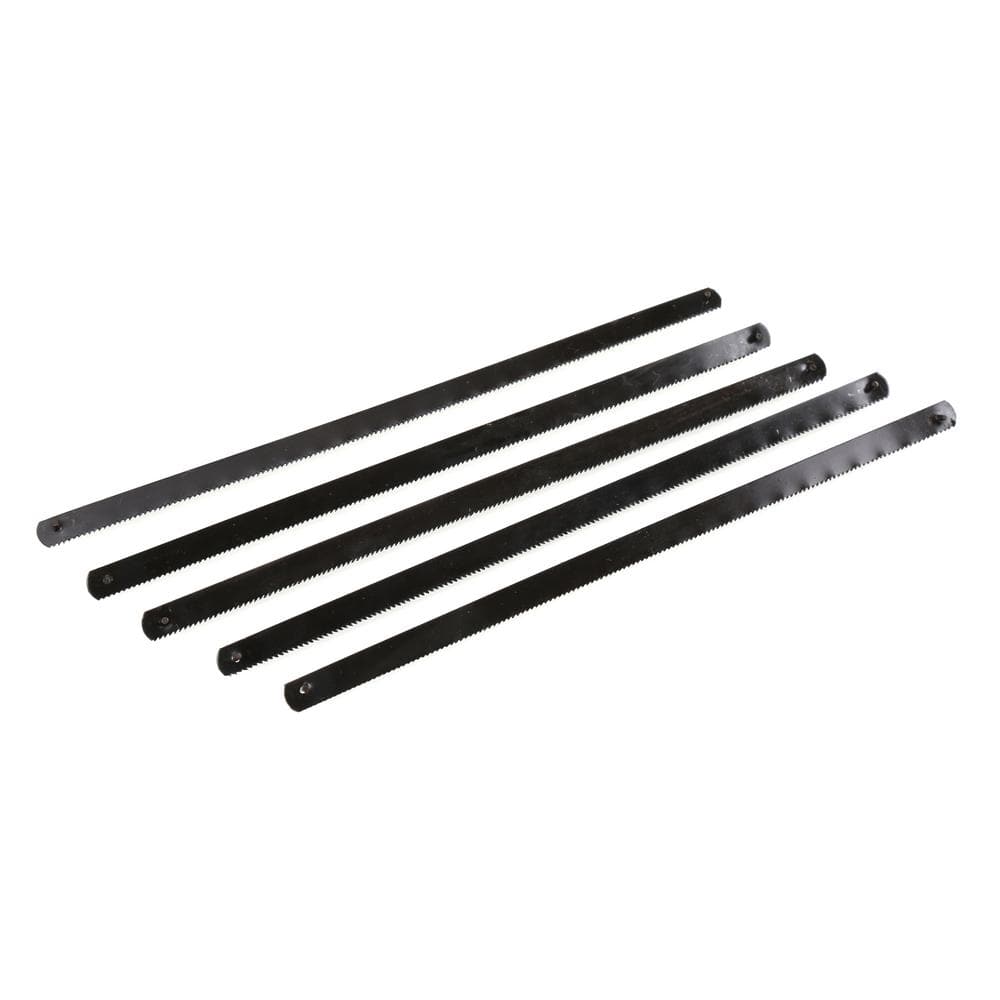
Genuine 'Eclipse' junior hacksaw blades work well for me:I have this “junior” or “close quarter” hacksaw in need of new blades. Model BC T114 409 is stamped on the handle. Any idea what brand this is? Looks fairly cheaply made.
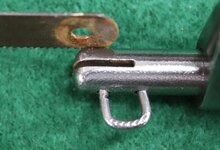
The blade needs to have pins built in, not holes for pins.
What do you recommend? Are there wood vs metal blade differences? Home Depot, HF or Amazon are easiest for me to buy from. I know there are more specialty tool shops online, but most charge for shipping.
Thanks for any tips.

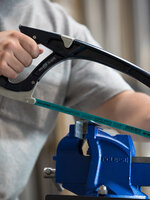


Genuine 'Eclipse' junior hacksaw blades work well for me:
Eclipse Professional Tools
The company was founded in the City of Sheffield, England. Famous for producing steel, cutlery and hand tools; and continues to be our home over 100 years later.
Initially manufacturing steel, he moved onto manufacture machine knives, woodworking tools and the hacksaw blades and frames for which the Eclipse brand is known today the world over.
Hacksaws, Fret Saws and Coping Saws
Eclipse Professional Tools are the 'TOOLS TO TRUST'
Hacksaw blades are manufactured to the highest quality standards and show unparalleled cutting performance.
A comprehensive range of saw frames compliment the hacksaw blades to offer the professional a complete metal cutting solution.

I've never seen these Jr Hacksaw blades before, they might be your answer. Maybe on a bigger screen, you can see if those are pins or holes in the pix. I'd poke around to find a store that claims they have them in stock. Website claims Stanley sells Jr as well .I’d love to know about any other brands/products that won’t require modification. The next easiest thing I guess is to take my used saw blades to HD and compare them.