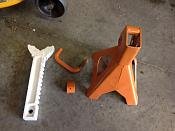
Guys, let's not screw around with this one. This is the time for us to come together and say something important to those who may be reading along and our fellow members:
Placing a wheel under a vehicle to "catch its fall" may not be sufficient to avoid injury. This depends on how the car is jacked, and where you are working. But given the fact that many rims are no higher than the size our our skulls......this is not a safe solution.
Injuries to due jack failures (including unspecified improper procedures) are not uncommon:
http://www-nrd.nhtsa.dot.gov/Pubs/98.040.PDF
NHTSA estimates nearly 5000 accidents each year, 5% of them are amputations.
I'm not sure where this came from, but it has some good basic advice:
https://classnet.wcdsb.ca/sec/RCS/G...d Documents/06 Jack Stands/01 Jack Stands.pdf
As to which stands are safe and which are not, I would apply the same rules used for aircraft design: No single point failure should create the potential for injury. With the average hydraulic trolley jack or bottle jack, the seals are all single points of failure. Therefore, these should never be used to support a vehicle being worked under.
Both the ratchet style and pinned tube style stands have (obviously) single point failure modes.
These jacks offer a fail safe pin design:
http://www.northerntool.com/shop/tools/product_200305227_200305227
But even with this design, there is so much that can go wrong.
Many manufacturers suggest the outer pinch weld be used as a jacking point. But depending on the jack, the stand, and the condition of the seam, this could just as easily cause problems as prevent them. The pinch welds seem to be designed to work with the emergency jack, which typically uses the seam to keep the car from slipping off the jack's saddle. The seam itself doesn't typically bear any weight. These seams are typically used by the hydraulic lifts in an auto shop, but the forks sit flat on the seam and apply no side or point loads.
I have a few opinions and words of advice, but I'll be interested in others':
1) Jack stands that feature single point failure designs (ratchet or single pin) depend on the quality of construction and materials for their reliability/safety. If you choose this sort of stand, choose one from a company you believe is dedicated to your safety, or has a healthy fear of lawsuits. That's not just US made, but in my mind, it realistically leaves out Taiwan, China, and third world nations.
2) How you jack and support the car, on what surface, where on the car you jack, is as important as the stands you choose. Learn how to do it safely.
3) Additional stands increase you rsafety. In aircraft, redundancy is an acceptable risk mitigator. Wanna use Harbor freight stands? Use 4 on one end of the vehicle.
4) If you are unsure, aren't comfortable, haven't chocked the wheels, don't get under the vehicle.
(Maybe we can snip this out put it into a new thread and make it sticky? Of all the tools we talk about, none I can thick of require such important safety considerations).