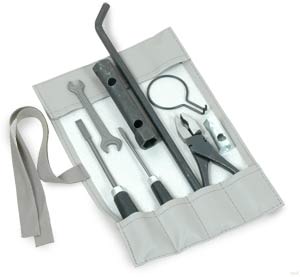
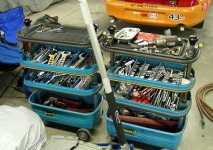
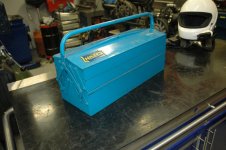
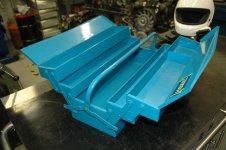
Oh, man! Thanks for the pics! That ratcheting mechanism on the Hazet looks identical to early Snap-On ratchets; I always wonder, if companies use each others designs under license.... So, what is your overall feeling about Hazet tools and what is the ratchet like compared to the Snap-On?
No problem. I'm glad I can sometimes contribute something interesting here. You guys know way more about tools than me...
I can't really say anything about Hazet in general. I picked up this ratchet 15 years ago b/c my one ultra cheapy broke. I bought it in Switzerland and I think it cost around $20. I was an undergrad at the time so I'm positive it didn't cost more

The ratchet feels really solid and strong. It has 32 teeth, so it's not all that smooth but quite passable. Compared to the F80, it's coarse, though (well, no surprise here...). The plastic of the handle has held up well but I do prefer either a round metal handle or a real grip. The plastic on the Hazet helps when things get slippery, though... However, I haven't used it much since I got my SO ratchets. That probably sums it up best...
We all have heard that the German tool industry seems to have a different philosophy when it comes to warranting tools; it seems that once something is worn out, you are supposed to buy another one! You have made your money with the tool, it has served its purpose and now it is time to "buy another one". This is different then the "satisfaction warranty", that traditionally was part of the USA sense of a warranty on tools. Can you clarify this and is this true? Can you also comment on German design, fit/finish of their tools? My sense is, compared to say Snap-On (which finishes their tools to a high chrome luster and almost blinding mirror finish); the German tool finish is generally a matt, under stated "spartan", more utilitarian, and simple design/esthetic. I think this is a design philosophy that pervades German products from their automobiles, furniture, appliances, knives and just about anything made there; these design principles are part of influences of the Bauhaus school of design and the "International Modern Style", "form follows function" and "less is more" sensibility (Minimalism); would you agree and comment on this?
Sorry that I can't say anything about the German tool industry. I only built model planes and boats when I was living in Europe and made do with mostly cheap tools.
I do agree with you on the form-follows-function design approach. When most Germans (well, teenagers excluded ;-) buy something, substance matters more than bling. A matt finish works just as well. If a professional tool would be offered in both matt and, for $5 more, in fully polished and chromed, 90% of the sales would come from the matt finished, cheaper version. "Understatement" is quite a big thing in Germany. Bling is not... Or I should say "was not", it seems to me that thing are changing...
As for good, utilitarian design, here's a small example I saw in Karlsruhe last year:
It's the sign on an emergency staircase. I imagine it probably cost $500 for designing, making, and installing it. And people in Germany wonder why the local industry has a hard time competing on the global market... It is perfect, though
Your pics are awesome, what camera are you using.... you aren't using a Leica are you (another great German product!)?
Dangerous territory here...
Photography has always been a hobby of mine, I even freelanced on the side for a while... The pics were taken with a Canon G9, which is about as close as you're going to get to a Leica M8 without robbing a bank. Nice little camera (it's smaller than the smallest lens I have in my pro gear arsenal ;-)
I now remember seeing a cart like that in Germany. Quite neat!
BTW, I own a set of Mies v.d. Rohe chairs ("inherited" from my parents

)