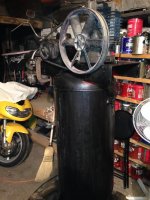
I tried posting this on my compressor thread, but no response so hopefully I can get some help here. I'm renting currently, but I can install a new service in the garage from the sub panel.
I am confused by your terminology. Do you mean that you plan to install a new sub-panel which would be fed from an existing sub-panel (which would in terun be fed from the home's main service panel)? If so, what are the locations of these panels, and what is the size of the service feeding the existing sub-panel? For that matter, where is the Main panel, and what size service is feeding it?
I'm not an electrician by any means, but I can do a bit here and there. Just like guidance from more experienced folks so I don't fry anything.
I'm going to need to wire both the machine, and put a new breaker in the box. I'm looking for advice on both.
This, OTOH, implies that you're talking about installing a new individual branch circuit, as opposed to a new sub-panel.
The service to the garage is only 50 amp. I have a fridge, deep freezer and lights in there. Otherwise, any other equipment I use is one at a time. I'm hoping to be able to install a circuit that I can use for both my welder, and this compressor, although not at the same time.
Depending on the specific compressor and welder in question, that MAY be possible. But it is usually not a good idea.
According to the manufacturer's web page, that model calls for 25A @ 230V. Hold that thought.
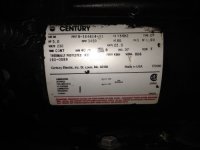
(multi voltage) that I currently just run on 110v and that is okay, but since I'll be installing a larger service, being able to use it on that too would be great. If I can't, oh well, save that for another day or another house. I've attached a picture of the spec sheet on the motor, as well as the pressure switch, and I'm hoping someone can either help direct me, or point me towards somewhere that can.
According to the data plate on that motor, it is rated at 5HP. That means you'll need
at least AWG 10 wire (possibly AWG 8, depending on the wire type), and a 35A breaker.
Welders have "special case" exceptions to the usual rules regarding wire/breaker sizes; but in this case, you can (and probably should) ignore those. The AWG 8/10 and 35A breaker mentioned above for the compressor will also be adequate for the welder.
HOWEVER... The problem with this is two-fold: First, AFAIK, branch circuits rated for more than 30A are restricted to powering a single device. Second, per the commonly-cited wisdom, receptacles/plugs rated at more than 3HP are rare as hens teeth -- and considerably pricier (but see below for more on that).
All in all, you would near-certainly be better off installing separate branch circuits for your welder and your compressor.
This question gets asked here a couple of times a week. Do a search and read the answers.
True, that.
A compressor this size is usually direct wired to avoid having a plug and socket. Plugs have a horsepower rating.
Indeed.
I've actually been searching to and not finding too much - my problem is I want to wire for a FUTURE compressor (& welder) - I don't have either right now. I just need to know how big of wire to pull!
You are putting the cart squarely before the horse. Until you know what compressor and what welder you're going to get, you CANNOT know what their electrical requirements will be. And until you know that, you CANNOT make an intelligent decision about what size wires, breakers, etc., you will need.
If the compressor/welder purchase is imminent, then do your homework, figure out what makes/models you prefer, and go from there.
If OTOH you DON'T plan to get the compressor and/or welder "Real Soon Now", then the better question might be: Why bother to install special-purpose wiring for equipment you don't have?
Near-certainly NOT true.
there's no "size effect" when it comes to electricity, it's all linear.
What on Earth do you mean by "size effect"? Or even "linear", in this context?
Another word, if your TV with 5A (110v) is using a plug, then it's ok if a 35A motor (7.5hp) to use a plug and socket.
That's not only wrong, it's silly.
Just pay attention to the current capacity and voltage rating of the socket/plug.
Which are NOT the only variables. Plugs & receptacles ALSO carry "Max. HP" ratings -- and they are generally a LOT lower than you might think.
electric water heaters were typically hardwired but it's typical now to see plug and socket now and those are on 30A 220V breaker rating. Those plug and socket are affordable these day are maybe reason why.
First, I would seriously question how "typical" it would be to see a domestic water heater installed via a plug & receptacle. Personally, I've NEVER seen such, save for very small "under-sink" models designed to run off 120V. It also would make no sense to do so -- just how "portable" do you think that plumbed-in water is, anyway?
Second, and far more importantly in this context, water heaters (or any other form of electric-resistance heat, for that matter) are
NOT motors, or motor-driven. That makes all the difference.
Some of the MIG 200A with pulse pulls up to 40A. If so, you'll need #8AWG copper.
I seriously doubt that. Even for some other "more normal" sort of load, AWG 8 would only be needed if (for whatever reason) we were forced to use the 60°C column in the applicable NEC table. Further, it is perfectly "legal" to use somewhat "undersized" wiring on dedicated welder circuits, due to their typically low duty cycles. They do, however, often need OVERsized breakers. Others can probably chime in with the pertinent chapter & verse from the NEC; but that's the gist of it.
5HP compressor motors are run on 30A breaker with #10AWG (smaller wire) and that's pretty standard.
The AWG 10 is near-certainly OK (again, depending on the specific type & temperature rating of the wire); but per code, the breaker should be at least 35A.
And that's what I run my 5HP on.
And I'll therefore wager that your installation does NOT meet code.
I don't like to oversize for something I might not get, therefore #10AWG is what I would get for your compressor and future welder.
So you would prefer that he find himself saddled with what might turn out to be an UNDER-sized circuit, which would therefore require replacement before his shiny new toy could be used, thus rendering the original installation a COMPLETE waste of time & money?
You probably should consult an electrician.
Probably so.
That page is VERY interesting. According to it, there are indeed several plug/receptacle combinations (NEMA 7-50, L8-30, 11-50, 15-50, L16-20, etc.) which would be code-legal for 5HP or larger motors, some as high as 10HP. That comes as rather surprising news to me.