To avoid these ads, REGISTER NOW!

Help wiring compressor

jtyson

Active member
Joined
Jan 6, 2014
Messages
29
Location
Albuquerque, NM
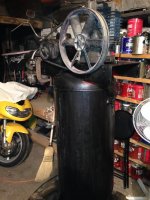
I tried posting this on my compressor thread, but no response so hopefully I can get some help here. I'm renting currently, but I can install a new service in the garage from the sub panel. I'm not an electrician by any means, but I can do a bit here and there. Just like guidance from more experienced folks so I don't fry anything.

I'm going to need to wire both the machine, and put a new breaker in the box. I'm looking for advice on both.

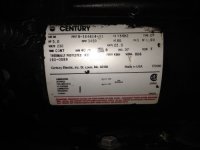
The service to the garage is only 50 amp. I have a fridge, deep freezer and lights in there. Otherwise, any other equipment I use is one at a time. I'm hoping to be able to install a circuit that I can use for both my welder, and this compressor, although not at the same time. Welder is a Miller 211 (multi voltage) that I currently just run on 110v and that is okay, but since I'll be installing a larger service, being able to use it on that too would be great. If I can't, oh well, save that for another day or another house. I've attached a picture of the spec sheet on the motor, as well as the pressure switch, and I'm hoping someone can either help direct me, or point me towards somewhere that can.

I appreciate any information anyone has. Although, if you are going to advise that I hire an electrician, I would love to trust me, I hate dealing with electrical, but it just isn't in the budget.

Thanks!
 

Attachments

  • compressor.jpg
    compressor.jpg
    127.3 KB · Views: 117
  • compressor motor.jpg
    compressor motor.jpg
    93.3 KB · Views: 174
  • compressor pressure switch.jpg
    compressor pressure switch.jpg
    129.3 KB · Views: 109
  • compressor pressure switch 2.jpg
    compressor pressure switch 2.jpg
    134 KB · Views: 96
To avoid these ads, REGISTER NOW!

Gary S

Well-known member
Joined
Dec 27, 2008
Messages
2,972
Location
Bismarck, ND
This question gets asked here a couple of times a week. Do a search and read the answers.

A compressor this size is usually direct wired to avoid having a plug and socket. Plugs have a horsepower rating.
 

TJG

Active member
Joined
May 8, 2013
Messages
38
I've actually been searching to and not finding too much - my problem is I want to wire for a FUTURE compressor (& welder) - I don't have either right now. I just need to know how big of wire to pull!
 

Trey T

Well-known member
Joined
Aug 3, 2011
Messages
3,749
Location
Houston, TX
Plug and socket is fine, there's no "size effect" when it comes to electricity, it's all linear. Another word, if your TV with 5A (110v) is using a plug, then it's ok if a 35A motor (7.5hp) to use a plug and socket. Just pay attention to the current capacity and voltage rating of the socket/plug.

electric water heaters were typically hardwired but it's typical now to see plug and socket now and those are on 30A 220V breaker rating. Those plug and socket are affordable these day are maybe reason why.
This question gets asked here a couple of times a week. Do a search and read the answers.

A compressor this size is usually direct wired to avoid having a plug and socket. Plugs have a horsepower rating.
 

Trey T

Well-known member
Joined
Aug 3, 2011
Messages
3,749
Location
Houston, TX
Some of the MIG 200A with pulse pulls up to 40A. If so, you'll need #8AWG copper.

5HP compressor motors are run on 30A breaker with #10AWG (smaller wire) and that's pretty standard. And that's what I run my 5HP on.

I don't like to oversize for something I might not get, therefore #10AWG is what I would get for your compressor and future welder.
I've actually been searching to and not finding too much - my problem is I want to wire for a FUTURE compressor (& welder) - I don't have either right now. I just need to know how big of wire to pull!
 

Gary S

Well-known member
Joined
Dec 27, 2008
Messages
2,972
Location
Bismarck, ND
Plug and socket is fine, there's no "size effect" when it comes to electricity, it's all linear. Another word, if your TV with 5A (110v) is using a plug, then it's ok if a 35A motor (7.5hp) to use a plug and socket. Just pay attention to the current capacity and voltage rating of the socket/plug.
.


You probably should consult an electrician.
http://garagejournal.com/forum/showthread.php?t=232403
http://garagejournal.com/forum/showthread.php?t=226177&highlight=compressor+wiring
http://www.garagejournal.com/forum/showthread.php?t=125053

And, page R10 shows some HP ratings for plugs
http://www.cooperindustries.com/content/dam/public/wiringdevices/BuyersGuides/AHBG/R/AHBG-R-Sec.pdf
 
Last edited:

2ManyProjects

Well-known member
Joined
Jul 18, 2013
Messages
757
I tried posting this on my compressor thread, but no response so hopefully I can get some help here. I'm renting currently, but I can install a new service in the garage from the sub panel.

I am confused by your terminology. Do you mean that you plan to install a new sub-panel which would be fed from an existing sub-panel (which would in terun be fed from the home's main service panel)? If so, what are the locations of these panels, and what is the size of the service feeding the existing sub-panel? For that matter, where is the Main panel, and what size service is feeding it?

I'm not an electrician by any means, but I can do a bit here and there. Just like guidance from more experienced folks so I don't fry anything.

I'm going to need to wire both the machine, and put a new breaker in the box. I'm looking for advice on both.

This, OTOH, implies that you're talking about installing a new individual branch circuit, as opposed to a new sub-panel.

The service to the garage is only 50 amp. I have a fridge, deep freezer and lights in there. Otherwise, any other equipment I use is one at a time. I'm hoping to be able to install a circuit that I can use for both my welder, and this compressor, although not at the same time.

Depending on the specific compressor and welder in question, that MAY be possible. But it is usually not a good idea.

Welder is a Miller 211

According to the manufacturer's web page, that model calls for 25A @ 230V. Hold that thought.

(multi voltage) that I currently just run on 110v and that is okay, but since I'll be installing a larger service, being able to use it on that too would be great. If I can't, oh well, save that for another day or another house. I've attached a picture of the spec sheet on the motor, as well as the pressure switch, and I'm hoping someone can either help direct me, or point me towards somewhere that can.

According to the data plate on that motor, it is rated at 5HP. That means you'll need at least AWG 10 wire (possibly AWG 8, depending on the wire type), and a 35A breaker.

Welders have "special case" exceptions to the usual rules regarding wire/breaker sizes; but in this case, you can (and probably should) ignore those. The AWG 8/10 and 35A breaker mentioned above for the compressor will also be adequate for the welder.

HOWEVER... The problem with this is two-fold: First, AFAIK, branch circuits rated for more than 30A are restricted to powering a single device. Second, per the commonly-cited wisdom, receptacles/plugs rated at more than 3HP are rare as hens teeth -- and considerably pricier (but see below for more on that).

All in all, you would near-certainly be better off installing separate branch circuits for your welder and your compressor.


This question gets asked here a couple of times a week. Do a search and read the answers.

True, that.

A compressor this size is usually direct wired to avoid having a plug and socket. Plugs have a horsepower rating.

Indeed.


I've actually been searching to and not finding too much - my problem is I want to wire for a FUTURE compressor (& welder) - I don't have either right now. I just need to know how big of wire to pull!

You are putting the cart squarely before the horse. Until you know what compressor and what welder you're going to get, you CANNOT know what their electrical requirements will be. And until you know that, you CANNOT make an intelligent decision about what size wires, breakers, etc., you will need.

If the compressor/welder purchase is imminent, then do your homework, figure out what makes/models you prefer, and go from there.

If OTOH you DON'T plan to get the compressor and/or welder "Real Soon Now", then the better question might be: Why bother to install special-purpose wiring for equipment you don't have?


Plug and socket is fine,

Near-certainly NOT true.

there's no "size effect" when it comes to electricity, it's all linear.

What on Earth do you mean by "size effect"? Or even "linear", in this context?

Another word, if your TV with 5A (110v) is using a plug, then it's ok if a 35A motor (7.5hp) to use a plug and socket.

That's not only wrong, it's silly.

Just pay attention to the current capacity and voltage rating of the socket/plug.

Which are NOT the only variables. Plugs & receptacles ALSO carry "Max. HP" ratings -- and they are generally a LOT lower than you might think.

electric water heaters were typically hardwired but it's typical now to see plug and socket now and those are on 30A 220V breaker rating. Those plug and socket are affordable these day are maybe reason why.

First, I would seriously question how "typical" it would be to see a domestic water heater installed via a plug & receptacle. Personally, I've NEVER seen such, save for very small "under-sink" models designed to run off 120V. It also would make no sense to do so -- just how "portable" do you think that plumbed-in water is, anyway?

Second, and far more importantly in this context, water heaters (or any other form of electric-resistance heat, for that matter) are NOT motors, or motor-driven. That makes all the difference.

Some of the MIG 200A with pulse pulls up to 40A. If so, you'll need #8AWG copper.

I seriously doubt that. Even for some other "more normal" sort of load, AWG 8 would only be needed if (for whatever reason) we were forced to use the 60°C column in the applicable NEC table. Further, it is perfectly "legal" to use somewhat "undersized" wiring on dedicated welder circuits, due to their typically low duty cycles. They do, however, often need OVERsized breakers. Others can probably chime in with the pertinent chapter & verse from the NEC; but that's the gist of it.

5HP compressor motors are run on 30A breaker with #10AWG (smaller wire) and that's pretty standard.

The AWG 10 is near-certainly OK (again, depending on the specific type & temperature rating of the wire); but per code, the breaker should be at least 35A.

And that's what I run my 5HP on.

And I'll therefore wager that your installation does NOT meet code.

I don't like to oversize for something I might not get, therefore #10AWG is what I would get for your compressor and future welder.

So you would prefer that he find himself saddled with what might turn out to be an UNDER-sized circuit, which would therefore require replacement before his shiny new toy could be used, thus rendering the original installation a COMPLETE waste of time & money?

You probably should consult an electrician.

Probably so.


That page is VERY interesting. According to it, there are indeed several plug/receptacle combinations (NEMA 7-50, L8-30, 11-50, 15-50, L16-20, etc.) which would be code-legal for 5HP or larger motors, some as high as 10HP. That comes as rather surprising news to me.

 

Trey T

Well-known member
Joined
Aug 3, 2011
Messages
3,749
Location
Houston, TX
^^I don't know what you pointed to but electricity is electricity. Theoretically, you can have a motor that pulls 100A (@ 2% efficiency) and produce 5hp and you can have a motor that pulls 20A (@80% efficiency) and produce the same 5HP.

I'm not disputing if there's HP value to plugs or not. As a matter of fact, each motor is designed slight differently with loading characteristic (amp, torque, etc...). Again, you can have one 5HP that pulls different amp base on its efficiency rating. Therefore "HP" rating is not the true value for termination and wiring requirement. It just so happen that motors have an HP value, and people use the term "HP" for ease of conversation/understanding.

Electricity is electricity, termination is termination, wiring size is wiring size. Those three does not discriminates whether if it's a motor can be used or not with plugs. When you terminate the wires (hardwire or plugs) those two clamping forces better be rated at that current it advertised and that whats matter. If you're afraid the clamping force of plugs losing its strength over the time after usage (plug and unplug), then you can question all of the other 110V compressor out there.
 
Last edited:

sberry

Banned
Joined
Jun 18, 2005
Messages
35,747
Location
Brethren, Michigan
In a home brew garage its likely to get a 10 wire a 30 breaker and a 50 welder plug,,, not saying I would do it if I held a license but the real draw isn't far from 3 hp and the duty cycle is low and you can run a compact mig from it. If a guy had to could breaker change,,, if it ever became an issue. I got a couple of my own, a couple buds got those comps and never tripped a 30
 
OP
J

jtyson

Active member
Joined
Jan 6, 2014
Messages
29
Location
Albuquerque, NM
Wow tons of information given. Mind blown. Info overload. My intention is to wire a branch circuit off of the sub panel already located in the garage. When this panel was installed, it was done so for light duty use with only 50 amp service. I know I am limited with that, but I don't care to run another 100ft 100 amp service since this isn't my permanent place of living.

I was hoping to be able to wire a single plug that I could use for either compressor or welder. Not both simultaneously. However, it seems based on the discussion here that safety wise as well as cost, hard wiring the compressor would be the best bet. I can continue to run my welder off 110v, as I don't do any real heavy gauge welding at home that can't be done multi-pass.

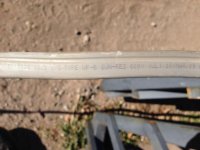
As for supplies...35 amp breaker for code even though motor states 22 amps? And I happen to have about 50-60' of 10/3 that was given to me by a friend off a construction site that they left behind. How do I know if the wire is adequate? I've attached a picture of what it says on the wire that I have - sorry it isn't ultra clear. Tough to make the iphone focus that close up.
 

Attachments

  • wire.jpg
    wire.jpg
    65.8 KB · Views: 63

Trey T

Well-known member
Joined
Aug 3, 2011
Messages
3,749
Location
Houston, TX
^welcome to GJ. You'll find different minded people with different background; some will act like robot and give you answer what they heard and some will provide you a direct answer.

That ROMEX wire #10AWG is proper for your Century 5HP motor.
 

sberry

Banned
Joined
Jun 18, 2005
Messages
35,747
Location
Brethren, Michigan
While the 211 will run from 120V its really a 240 machine, 030 solid wire. That is why I say use a welder plug, it matches, you can use a 40A breaker with the 10 wire if you want but, could use a 50, you do not need a 35, you aint that "special" but you deprive yourself with the welder not running it on the high voltage. It will output 2x.

Instead of wring its guts out to get 50% output from of overloaded poor circuit will run wide open on a circuit 50% better than it needs from a 10 wire
 
Last edited:
OP
J

jtyson

Active member
Joined
Jan 6, 2014
Messages
29
Location
Albuquerque, NM
I appreciate all the responses. Better to have multiple points of view anyway. Plus, the robotic folks are typically those who are most familiar with the subject. Unless of course they are just regurgitating what they have read on the board or other places online.

By chance, would that Romex also be adequate for my welder in the future? I have 50-60' available and think it will only take me 20' or so to do my compressor, so I should have some left over.
 

sberry

Banned
Joined
Jun 18, 2005
Messages
35,747
Location
Brethren, Michigan
It depends on the machine connected to it. For the 211 its better than it needs, for a 50A buzzer its just what it needs and for a 250 class feeder running wide open with spray its one size too light. In the existing app the op only has 50 available, cant draw anymore anyway from a welder.
Run 2 circuits if you want, one for the comp and one for the welder, but,,, this is all fairly temp and lightly loaded, plug one machine in at a time.
 
Last edited:
OP
J

jtyson

Active member
Joined
Jan 6, 2014
Messages
29
Location
Albuquerque, NM
While the 211 will run from 120V its really a 240 machine, 030 solid wire. That is why I say use a welder plug, it matches, you can use a 40A breaker with the 10 wire if you want but, could use a 50, you do not need a 35, you aint that "special" but you deprive yourself with the welder not running it on the high voltage. It will output 2x.

Instead of wring its guts out to get 50% output from of overloaded poor circuit will run wide open on a circuit 50% better than it needs from a 10 wire

Yeah I know it was designed to be a more flexible machine if need be, but obviously running it on a bigger circuit will increase it's potential.

I don't follow what you mean "That is why I say use a welder plug, it matches, you can use a 40A breaker with the 10 wire if you want but, could use a 50, you do not need a 35, you aint that 'special' " - Are you implying that I install a 40 amp breaker and wire in a plug for the compressor that matches my welder's plug? That is what I was originally looking for, but if in fact the HP rating is an issue on plugs and I'll have to pay out the ears for plugs that are adequate, I'd rather hard wire the compressor and possibly run a separate line for my welder at a later date.

The only MIG I'll be running here is my 211. I am in the market for another a/c tig, and I'm considering the power available to me while looking. I'd like to get a syncrowave or dynasty. I sold off my Hobart because it was too much draw for the panel I have
 
Last edited:

sberry

Banned
Joined
Jun 18, 2005
Messages
35,747
Location
Brethren, Michigan
A synch isn't designed to run from 50A service. Not that you couldn't get it to maker a spark but its a greedy ****** and would ideally be fed from 100A panel. Yes, the welder outlet is marginal by the letter of the code so I am not totally advocating this but if it was mine wouldn't lose sleep over it. The real load is over by near 1/2 hp but how many cycles you figure you are going to hit in this home garage?

I assume at 3 hp the recept is good indefinate or in the millions of cycles? I don't know, most of it is by minds greater than my own as are those who write the code. This would be pretty low on the violation risk/danger ratio though, probably several times as likely to be killed driving for the parts as to die or have an issue from the plug, certainly not as high as not wearing a seatbelt.

With a comp 2 sizes bigger the issue would come a lot faster in a true mechanical sense
 

sberry

Banned
Joined
Jun 18, 2005
Messages
35,747
Location
Brethren, Michigan
Also once you unplug a machine it doesn't matter, the 99% of the time in life its off it doesn't know what size is on it,,, hahahaha My neighbor, a licensed master has a 10/2 with 50A fuses in a range side for 30 yrs for his welder, uses it on occasion to burn a rod, rest of the time its unused.

Once the circuit is off it only needs to have a wire large enough to provide short circuit to 50A ocpd.

We see some worry about 20A branch circuits and voltage drop, while its true its a 12 wire and "can" carry 20A 99.9% of the loads are 13A or less. Same with a 50A circuit with AC225 hooked to it, real load about 40 with 1/8 electrodes nice and toasty, another amp or so on poor service but zippy modern 240+ probably below 40, little DC versions a couple less,,, right around 38 or so.

The load may be "calculated at 50" same way the 20A circuit is but its not actual applied which is substantially less. .
 

sberry

Banned
Joined
Jun 18, 2005
Messages
35,747
Location
Brethren, Michigan
I remember one time I was running a project and we had replaced a bunch of sheet to this machine and had sized all the wire etc and ended up in a mental ************ over fuse size for it, I was probably the only guy on the job that didn't have a license or degree, I finally went and bought 3 fuses, told them I called the fuse people or something and put them in, as I recall there was some trouble comprehending that it wasn't going to all start at once and the largest motor was to run before the rest of it came on or something, this is 20 yrs ago.

The worst that can happen with a 30 is it trips, both appliances have their own thermal and the wire is good to 60 for short circuit, a 40 is a compromise to avoid a hassle. The Miller is limited to 50A circuits,,, its real draw is 22 to 23 wide open but most amateurs cant figure out how to dial it up that high.
 
Last edited:

MrMark

Well-known member
Joined
Jan 25, 2010
Messages
4,626
Location
Southern Cal.
^welcome to GJ. You'll find different minded people with different background; some will act like robot and give you answer what they heard and some will provide you a direct answer.

That ROMEX wire #10AWG is proper for your Century 5HP motor.

You are wrong about that. NMB 10 awg is limited to the 60 degree column and limited to a 30 amp breaker. Contrary to what you may think, the NEC goes by HP ratings as stated on the rating plate to size branch circuits, regardless of efficiency. The NEC wants wiring sized based on HP regardless of actual specific motor amps because the equipment may change and have different running amps, but a 5 HP installation will handle any 5 HP motor.

A 5 HP motor needs 35 amp wire, which is either 10 THWN in pipe or 8/2 nmb, bottom line. And, a 40 breaker to start off with (is there a 35 breaker?). The breaker may be increased according to the rules if tripping on start up is an issue.
 
Last edited:

Charles (in GA)

Well-known member
Joined
Jan 11, 2006
Messages
12,489
Location
50 mi south of Atlanta
^^I don't know what you pointed to but electricity is electricity. Theoretically, you can have a motor that pulls 100A (@ 2% efficiency) and produce 5hp and you can have a motor that pulls 20A (@80% efficiency) and produce the same 5HP.

I'm not disputing if there's HP value to plugs or not. As a matter of fact, each motor is designed slight differently with loading characteristic (amp, torque, etc...). Again, you can have one 5HP that pulls different amp base on its efficiency rating. Therefore "HP" rating is not the true value for termination and wiring requirement. It just so happen that motors have an HP value, and people use the term "HP" for ease of conversation/understanding.

Electricity is electricity, termination is termination, wiring size is wiring size. Those three does not discriminates whether if it's a motor can be used or not with plugs. When you terminate the wires (hardwire or plugs) those two clamping forces better be rated at that current it advertised and that whats matter. If you're afraid the clamping force of plugs losing its strength over the time after usage (plug and unplug), then you can question all of the other 110V compressor out there.

Plugs and receptacles DO have motor ratings, and its for a reason. If you don't understand, please don't give someone advise that they can use a plug and cord, when they are not allowed to by the requirements of the code and the ratings of devices. I don't think you will find a blade type plug and receptacle that has a hp rating in excess of 3 hp. To get any more, you need to go to very expensive pin and sleeve type connectors. A 50 amp plug and receptacle is rated by the manufacturers at 3 hp. A 5 hp electric motor clearly exceeds that...................... Motors impose huge starting loads that resistance circuits such as heaters and lighting do not. My 7.5hp compressor (a true 7.5 hp) draws at least 190 amps on startup, that is why the plugs and receptacles are hp rated.

Not all screw clamp connectors on pressure switches, water heaters, etc are designed for the fine stranded wire used in cords (cannot recall the class ratings at the moment) and so on those installations, you are not supposed to use typical fine stranded cord on those connections.

Try reading some of the thread links given by Gary S where this is discussed.

Charles
 
To avoid these ads, REGISTER NOW!

MrMark

Well-known member
Joined
Jan 25, 2010
Messages
4,626
Location
Southern Cal.
Bottom line as the posters have stated is that to be code legal that compressor needs to be hard wired.

Rating Plate States 5 HP. Then you need 10 THHN in conduit, or #8 nm cable and 35 amp breaker or 40 amp breaker AND hard wired. Pretty simple.
 
OP
J

jtyson

Active member
Joined
Jan 6, 2014
Messages
29
Location
Albuquerque, NM
Alright, so many conflicting opinions here.

Simple question. Is the wire I have adequate for running the compressor? Or do I need to run #8? The plate on the motor says 22 amps, but I don't know if that is running amps, startup surge, etc. Nor can I find out searching online. To me, if #10 is rated for 30 amps, then a 30 amp breaker with my #10 wire would be fine. But I have next to no idea what I am talking about so I could be entirely wrong.

Second question - Is the wire I have adequate for running my Miller 211? According to the manual at 230v it is going to pull 25 amps max.
 
OP
J

jtyson

Active member
Joined
Jan 6, 2014
Messages
29
Location
Albuquerque, NM
Bottom line as the posters have stated is that to be code legal that compressor needs to be hard wired.

Rating Plate States 5 HP. Then you need 10 THHN in conduit, or #8 nm cable and 35 amp breaker or 40 amp breaker AND hard wired. Pretty simple.

Seems I was replying as you were typing. I will be hard wiring it that is settled. Now I'm just trying to figure out what I need to pick up to do so. I'm not saying you are wrong, but I am curious why it says 22 amps on the name plate if a 5hp compressor requires 35?
 

MrMark

Well-known member
Joined
Jan 25, 2010
Messages
4,626
Location
Southern Cal.
You need a short whip of fmc (flex) or nonmetalic flex conduit (sealtite?). You need a 4S box with a cover to house your connections. You need Red, Black and Green, 10 AWG THHN for the whip to the box. You need appropriate connectors, i.e., flex connectors.

The 22 amps is running amps (EDIT: used for overloads ONLY). Motor inrush current on startup is probably over 100 amps for that motor, maybe more for milliseconds. I imagine if you put it on a scope with enough resolution that the inrush would be off the charts in the initial few milliseconds.

Like I posted earlier, the NEC sizes wiring conductors based on HP to accommodate the varying running amps that true 5 hp motors draw and to provide a margin of safety. The next compressor with 5 HP motor to use that installation may have 28 amps running. But, the installation will handle it.
 
Last edited:

Trey T

Well-known member
Joined
Aug 3, 2011
Messages
3,749
Location
Houston, TX
Sorry for all of the antics. Let's get back to productivity on this subject.

if the Full Load Amp rating is 22A, then a 30A capacity wire will be proper (120% is right under 30A). The proper breaker for the #10 wire is 30A or less. Note that circuit breaker or any fuses is intended to primarily protect the wiring, not the equipment.

Miller 211: according to their brochure for 230V, it has amp rating "up to" 24.3A. Therefore, your 30A wiring will handle it.

thread\
Alright, so many conflicting opinions here.

Simple question. Is the wire I have adequate for running the compressor? Or do I need to run #8? The plate on the motor says 22 amps, but I don't know if that is running amps, startup surge, etc. Nor can I find out searching online. To me, if #10 is rated for 30 amps, then a 30 amp breaker with my #10 wire would be fine. But I have next to no idea what I am talking about so I could be entirely wrong.

Second question - Is the wire I have adequate for running my Miller 211? According to the manual at 230v it is going to pull 25 amps max.
 

RickP

Well-known member
Joined
Jan 15, 2013
Messages
1,548
Location
Annapolis, MD
Trey - sorry to disagree, but you have that wrong. (I made the same mistake and the GJ experts helped me figure it out.) This was discussed in several posts a few months ago. I have the exact same motor, so I did the research. The key is that NEC motor circuits are sized by HP, not by the amp rating on the nameplate. So that motor needs wire rated for 35 amps, with a 40 amp breaker (minimum) - as posted by MrMark.
 
Last edited:

RickP

Well-known member
Joined
Jan 15, 2013
Messages
1,548
Location
Annapolis, MD
jtyson - you can install a surface mount junction box and use a pre-made whip from there to the compressor:
Southwire 1/2 in. x 6 ft. Liquidtite A/C Whip ($11 at Home Depot)

For the feed from the subpanel, you can use either 10AWG wire in conduit, or 8AWG cable (romex).
 

Trey T

Well-known member
Joined
Aug 3, 2011
Messages
3,749
Location
Houston, TX
This is very silly! It's even sillier when y'all say I'm wrong, you don't dare to reference the code. Who are the GJ experts that explain to y'all of this? When reading codes, it's important to NOT take it as face-value but analyze it and then interpret it. It happens all the time in my work line.

AGAIN, I'm not disputing the power (HP) value that one motor make when it comes to wire sizing. #10 wire size may not work for other 5HP based on specific motor design. I'm sure NEC will provide some general current value based a "typical" 5HP motor design but that's general - that's code guys, it's conservative! If I was to provide a turn-key installation for any 5HP motor out there to run on the feed line, I would size it up to #8. Again, this is not a job, it's for his specific motor he provided.

Like I said before, HP is relative (NOT DIRECT) to FLA, and I highly doubt NEC will advise using "HP" to size wire w/o specifing a general statement regarding the NEMA design characteristic (torque, speed, etc...) of modern AC motor. Not all motor will have the "normal speed" of 1700rpm or 3400rpm; it's all different from brand to brand. Also, not all motor ppl use are NEMA design specs!!!

Go ahead and quote what NEC says about HP and wire size. Like all codes, it will state very general but enough for accurate interpretation.
 
Last edited:

TJG

Active member
Joined
May 8, 2013
Messages
38
Some of the MIG 200A with pulse pulls up to 40A. If so, you'll need #8AWG copper.

5HP compressor motors are run on 30A breaker with #10AWG (smaller wire) and that's pretty standard. And that's what I run my 5HP on.

I don't like to oversize for something I might not get, therefore #10AWG is what I would get for your compressor and future welder.

FYI:

After speaking with my electrician, he suggested pulling 10-3 for a compressor and 8-3 for a welder. He did suggest keeping the 8-3 run as short as possible.


You are putting the cart squarely before the horse. Until you know what compressor and what welder you're going to get, you CANNOT know what their electrical requirements will be. And until you know that, you CANNOT make an intelligent decision about what size wires, breakers, etc., you will need.

If the compressor/welder purchase is imminent, then do your homework, figure out what makes/models you prefer, and go from there.

If OTOH you DON'T plan to get the compressor and/or welder "Real Soon Now", then the better question might be: Why bother to install special-purpose wiring for equipment you don't have?


A purchase of either is not imminent, heck, maybe not ever. But maybe the next guy who lives in my house will want them? With the walls open, it's much easier for me to do it now and 'future proof' it the best I can.
 

MrMark

Well-known member
Joined
Jan 25, 2010
Messages
4,626
Location
Southern Cal.
No need for 8/3 or 10/3. A compressor circuit is not dual voltage it is straight 240v. 10/3 would be for a dual voltage device 240/120 like a range or dryer. Any electrician should know something that basic. I would question anything else the guy said.
 

89GLH

Well-known member
Joined
Mar 24, 2011
Messages
1,057
Location
Westminster, MD
Why not run a break out box to the garage on a 100A service, and have multiple breakers out there? Rather than running barely enough to the garage. Im asking, feel free to shoot my comment all to isht if it's off...

I have friends with detached garages that do this, and they passed all MD inspections. Seems logical here, unless you can't have a second box in the garage feeding from the heavy up.
 

MrMark

Well-known member
Joined
Jan 25, 2010
Messages
4,626
Location
Southern Cal.
In case interested, this article provides the cites that you must use the NEC table values to determine ampacity of motor circuits based on HP ratings. The tables give FLC (full load current) based on nameplate horsepower. This table value FLC must then by multiplied by 1.25 to arrive at the required minimum wire ampacity.

The FLA (full load amps) listed, here 22, is used only for the overload (thermal protection on the motor itself).


http://www.ecmag.com/section/codes-standards/overcurrent-protection-motor-circuits
 
Last edited:

JoeFin

Well-known member
Joined
Sep 13, 2013
Messages
717
Location
NorCal - where the Rednecks Race
You are wrong about that. NMB 10 awg is limited to the 60 degree column and limited to a 30 amp breaker. Contrary to what you may think, the NEC goes by HP ratings as stated on the rating plate to size branch circuits, regardless of efficiency.

That's not entirely true

You are absolutely correct he has to use the 60 C deg column as UL and the NEC only require equipment 100 amps and above to be designed 70 C deg. Unless otherwise stated on the device you must assume it is 60 C deg

But as for Hp rates - No

The NEC is Very specific allowing you to wire dedicated circuit based off the Manufactures FLA/Current rating.

430-6 (a)(1) Exception 3 - Period End of Subject

Not to even take in account for motor efficiency but the motor design load has been sufficiently demonstrated to the Underwriter Laboratory to draw the rated amount of current.

No where in the NEC are you required to wire to what you suspect the motor MIGHT be changed out to
 

MrMark

Well-known member
Joined
Jan 25, 2010
Messages
4,626
Location
Southern Cal.
That's not entirely true

You are absolutely correct he has to use the 60 C deg column as UL and the NEC only require equipment 100 amps and above to be designed 70 C deg. Unless otherwise stated on the device you must assume it is 60 C deg

But as for Hp rates - No

The NEC is Very specific allowing you to wire dedicated circuit based off the Manufactures FLA/Current rating.

430-6 (a)(1) Exception 3 - Period End of Subject

Not to even take in account for motor efficiency but the motor design load has been sufficiently demonstrated to the Underwriter Laboratory to draw the rated amount of current.

No where in the NEC are you required to wire to what you suspect the motor MIGHT be changed out to

It's 75 degrees C. You can use the 75 degree column for ampacity for circuits under 100 amps i.e. 14-1 awg, if the terminations are so rated. NM cable is limited to 60 degree column. But with THHN, for example, we can use the 75 degree column if the terminations are 75 degrees.


As to the exception, where do you see FLC on that motor? Where do you see the UL listing for this "appliance"?
 
Last edited:

MrMark

Well-known member
Joined
Jan 25, 2010
Messages
4,626
Location
Southern Cal.
Moreover, it is MOST unclear that exception you refer to applies here. That the exception states specifically that it is for nameplates on the APPLIANCE, not the motor.

The very following section of the NEC, Section 430.6(A)(2), states, "Nameplate Values. Separate Motor Overload protection shall be based on the motor nameplate current rating."

The commentary that follows states:

"[the] ampacity of motor branch circuit conductors . . . are determined by the ampere values listed in Tables 430.247 through 430.250, not the ampere values listed on the motor nameplate. The ampere rating provided on the motor nameplate is used to size the overload protective devices . . . ."

Thus, we have a pretty nice explanation of what the motor plate amps are to be used for and motor nameplates are distinguished from appliance nameplates expressly.

But, I suppose you would argue that this section is just for bare motors that are not part of some appliance and an air compressor is an appliance and it can use the manf. stated current rating. I think the section is UNCLEAR at best. It is poorly drafted, no doubt.

I suppose if the compressor has a UL listing and a label on the compressor itself, apart from the motor plate, that we could use your exception. For me, it all comes down to whether the compressor is a "listed motor-driven appliance" with a UL listing and separate UL labeled specification plate, otherwise it gets treated like a motor.
 
Last edited:

Trey T

Well-known member
Joined
Aug 3, 2011
Messages
3,749
Location
Houston, TX
^NEC calls it full-load current and manufactures calls them full-load amp; they're the same. I have to SCREAM at y'all guys again: FLA is the SAME as FLC. When you narrate it, full-load "current" is a proper English. You don't use the unit in there like that when you write it formally.

FLC in NEC tables are more like theoretical values, based on a general motor design specification or characteristic - read the verbiage in table 430-248. manufacture's FLA are tested values. The table has a more conservative value that will cover all 5HP based on today's "general" motor design when you install that wire.

thread\
 

Attachments

  • NEC08.jpg
    NEC08.jpg
    80.8 KB · Views: 26

TJG

Active member
Joined
May 8, 2013
Messages
38
No need for 8/3 or 10/3. A compressor circuit is not dual voltage it is straight 240v. 10/3 would be for a dual voltage device 240/120 like a range or dryer. Any electrician should know something that basic. I would question anything else the guy said.

He said he likes to run an extra neutral wire on 'future' stuff - that way in the future I could run 120v out of it if necessay. I'm not sure if it's worth the $25 difference in wire cost to me, however.
 

RickP

Well-known member
Joined
Jan 15, 2013
Messages
1,548
Location
Annapolis, MD
Okay, let's leave the code arguments for another day and get back to the OP's original question:

I'm renting currently, but I can install a new service in the garage from the sub panel.
I'm going to need to wire both the machine, and put a new breaker in the box. I'm looking for advice on both.

For a temporary installation, surface mount conduit to the compressor is probably your best bet. In that case, 10AWG stranded wire is the way to go. If you decide to use the leftover 10/3 nm cable instead, then be aware that it "might" not meet code, depending on the interpretation of the NEC sections described above. For your welder, you could locate the outlet near the subpanel, and then use a short length of wire to the outlet. I think previous posts gave good advice about the wire size for the welder, but you could also follow whatever is listed in the owner's manual for it (as long as you mark the outlet for welder use only).
 

Trey T

Well-known member
Joined
Aug 3, 2011
Messages
3,749
Location
Houston, TX
That gray romex wire is proper w/ 30A breaker to run that 5HP, and many other 5HP out there.

Those gray romex are actually more expensive with better rating. Don't they have higher amp capacity than the typical romex?
 
OP
J

jtyson

Active member
Joined
Jan 6, 2014
Messages
29
Location
Albuquerque, NM
Against some advice, and following some others, I got the compressor wired in with the romex I had and a 30 amp breaker. It is running just fine. I will say, start up amperage is a surge. Lights in the garage dim pretty good for a fraction of a second.

I'll be using the same wire, a second 30 amp breaker and a 50 amp plug for the welder since that is what the Miller MVP line ships out with. Just have to flip the breaker for the compressor when I want to weld. A bit of a pain, but a lot cheaper than running a heavier wire to my sub panel.

Thanks everyone for the advice
 
To avoid these ads, REGISTER NOW!
Top Bottom