To avoid these ads, REGISTER NOW!

Help with CAT6 wire

theoldwizard1

Well-known member
Joined
Feb 22, 2011
Messages
43,114
Location
SE MI
Its 90m for horizontal cable and 10m for patch cords.
I don't know how you differentiate "cable" from "patch cords", but I ran dozens and dozens of 100' Cat 5 (not even Cat 5E) back in the early 2000s with no issues. Well, they were only running 100Mb back then.
 
To avoid these ads, REGISTER NOW!

theoldwizard1

Well-known member
Joined
Feb 22, 2011
Messages
43,114
Location
SE MI
Been doing this stuff for better than 35 years. Before Cat ** was Level **. TwinSx, coax, thicknet, thinnet, DecNet. Things are so simple these days...

Been there done that !

People have forgotten that Ethernt (a.k.a. ThickNET) was originally a tick coax (about as big as your thumb), usually orange or yellow. It used a "vampire tap" to an "Attachment Unit Interface" (AUI) cable to your equipment. AUI cables had a max distance of 50m, but that was added on to whatever on to the existing cable length.

Capture.jpg

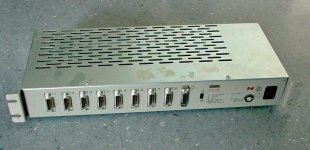
The "cheap way" into Ethernet was "Ethernet in a box" (an AUI multi port repeater - example Digital Equipment DELNI)

Capture2.jpg

Ethernet was attributed to Digital Equipment Corporation (DEC), Intel, and Xerox, although Xerox did all of the preliminary work. The original spec was for a "bus" technology (the one big fat cable) and not a "star" topology (what we have had since 10BaseT) because that was "too expensive".


Sigh ! The "good old days"


Segue - DECnet was a protocol (software) that ran on Ethernet along with TCP/IP and a couple of others. DECnet is not a physical spec.
 
Last edited:

theoldwizard1

Well-known member
Joined
Feb 22, 2011
Messages
43,114
Location
SE MI
Yes, although for standards based install ( world I live in) it would have to be punch down in/out connections. Very few applications where you can field install a mod end. Do it all the time but again, technically...
Never seen Ethernet into a punch down block.

Don't punch down blocks require solid (not stranded) wire ? Most Cat5E and Cat6 is stranded (easier to use).
 

theoldwizard1

Well-known member
Joined
Feb 22, 2011
Messages
43,114
Location
SE MI
The cable for POE microwave radios (excluding APs for wifi) are the only thing i will put a mod end on regardless of standard because they need shielded connectors and it would be a waste to buy a shielded patch panel for 1 or 2 devices.

Although I have pulled miles of Cat5 (prior to 1000BaseT) I have never used shielded. Maybe in the environment you mentioned (POE microwave radios) ...
 

gte718p

Well-known member
Joined
Mar 12, 2009
Messages
3,972
Dont need a pro for fiber these days.

One can order fiber at desired length with connectors already terminated on.

CAT3 will not work for ethernet wiring. Its not twisted pair.

Only thing CAT3 is good for is phone lines

You don't even need a pro to terminate fiber. Terminating and splicing fiber used to be a very high paying job. I think it still is if you are doing the undersea type cables. However, for normal building/patch fibers they make a little $15 kit with a jig to cut the fiber square and polish it up. Then you can terminate it or put another fiber in the jig and epoxy two together.
 

Bad Habit

Well-known member
Joined
Mar 19, 2014
Messages
1,984
Location
Chumstick WA
Never seen Ethernet into a punch down block.

Don't punch down blocks require solid (not stranded) wire ? Most Cat5E and Cat6 is stranded (easier to use).

All Cat ** cable for permanent installation (i.e. walls,ceilings, etc) is solid. Stranded is only used for cordage as the attenuation is greater. Yes, there may be some stranded cable that is rated for installation in walls and ceilings, but it is rarely if ever used in a commercial, industrial, or military environment. You are correct, you can't punch down stranded wire.

Punch blocks and modern jacks all use some form of insulation displacement, "punching down" forces the wire between contacts that cut through (displace) the insulation and make contact with the conductor. Stranded wire conductor will not maintain a consistent geometry to ensure a viable connection.


Down the rabbit hole...

The TIA/EIA 568 specification series (https://en.wikipedia.org/wiki/TIA/EIA-568) sets the standards that are used to define structured cabling. 100 meters is the max distance between devices (yes it can work longer, most of us have had to do that), with no more than 10 meters of stranded cordage (at the workstation and in the network closet). There are some system designs that use more cordage but the overall max distance is then shrunk.

Shielded cable isn't used that much here in the US, although being used more in video applications (HDBaseT). Still mainly shows up industrial environments to shield for electrical noise and in some cases for security, but that's usually now dealt with by using fiber.

6A gives little advantage to the typical user (>99.999%) in that unless you are running 10Gb to your desktop, everything can, and still does run on Cat5e. The downside of Cat5e is that it is not as PoE friendly, its 24ga vs. the 22ga of 6/6A. With newer standards for PoE being developed, projecting up to 100w per device, that can make a difference (along with not exceeding that 100mtr and minimizing the amount of cordage). Most enterprise companies (i.e. the big boys, AMZ, GOOG, etc) stick with Cat 6, some up until real recently stayed with 5e. Long term buildings, i.e. public entities (you know the ones that like to spend your money) opt for using 6A. Makes some sense as they are not refreshed nearly as often as commercial buildings and they get one shot at things to last for decades.

:shocking:
 

Joelfke

Well-known member
Joined
Mar 31, 2009
Messages
1,837
Location
Mt Holly, NJ
All Cat ** cable for permanent installation " " Makes some sense as they are not refreshed nearly as often as commercial buildings and they get one shot at things to last for decades.

:shocking:

Since you are quite knowledgeable. If wiring up a new garage does it make sense to just do Cat7? or is 6 good for a foreseeable future?
 

jeffmoss26

Well-known member
Joined
May 25, 2011
Messages
12,854
Location
Cleveland, Ohio
Cat 7 is not an actual ratifiedTIA/EIA standard. There is Cat 8 but it's all shielded stuff for short distances.
Cat5e or Cat 6 are more than adequate.
 

theoldwizard1

Well-known member
Joined
Feb 22, 2011
Messages
43,114
Location
SE MI
... but it (stranded) is rarely if ever used in a commercial, industrial, or military environment.
Everything I installed was in commercial, office environment. Much off it under raised floors, some inside walls and in ceilings.

The corporation paid for thousand of mile to be installed in the 90s/00s, all Cat5, stranded. (Two cables to each desk, plus a Cat3 for phone. Cat 3 has been abandoned for VOIP phones.) No punch down blocks. We were probably one of the first (non-computer) corporation to have Gbit fiber back bone, including between many buildings.

I know they started renting "dark" fiber from phone/cable companies over 10 years ago. Some of these runs go 10+ miles.
 

wyliesdiesels

Well-known member
Joined
Aug 14, 2012
Messages
19,994
Location
Modesto, CA
I don't know how you differentiate "cable" from "patch cords", but I ran dozens and dozens of 100' Cat 5 (not even Cat 5E) back in the early 2000s with no issues. Well, they were only running 100Mb back then.

cable that comes in such dispense methods as 1000' pull boxes is solid and has lower attenuation.

Patch cords are for connecting from the jacks to the host or from the patch panel jacks to the switches in the rack

Patch cords are more flexible than cable but have higher attenuation so not good for long runs.

Patch cords are not meant to be used as permanent wiring. Running patch cords inside the walls of buildings reeks of amature hack work.

Never seen Ethernet into a punch down block.

Don't punch down blocks require solid (not stranded) wire ? Most Cat5E and Cat6 is stranded (easier to use).

Youve never seen a patch panel with CAT5e or CAT6 ethernet wiring punched down to on a 110 block?

Most CAT5e and CAT6 is NOT stranded.

Ive never even seen a 1000' pull box of stranded cable at the supply house. Ive picked up 1000' boxes of cable by the pallet before too.

Where do you get your info?

Although I have pulled miles of Cat5 (prior to 1000BaseT) I have never used shielded. Maybe in the environment you mentioned (POE microwave radios) ...

I only use shielded CAT5e for radios that are susceptible to ESD and lightning outdoors as well as outdoor runs for cameras. The cameras dont need shielded cable but i dont want to stock multiple types of outdoor rated wire and the non shielded CMX stuff is often more expensive than Ubiquiti tough cable that i use.

You don't even need a pro to terminate fiber. Terminating and splicing fiber used to be a very high paying job. I think it still is if you are doing the undersea type cables. However, for normal building/patch fibers they make a little $15 kit with a jig to cut the fiber square and polish it up. Then you can terminate it or put another fiber in the jig and epoxy two together.

No not quite.

A clever costs hundreds of dollars. Mine Unicam clever costs $450 and the really fancy ones are close to a grand.

the "$15 kits" you're referring to are just the fiber connector kits and there is no "jig", whatever you think that may be. And they cost more than $15 each. I know because i just order some Leviton fast cams for a job (not my preferred brand; I like corning unicams). These kits do not include any such jig that would cleve/cut the fiber.

Also, nobody exposies and polishes fiber anymore. Its a waste of time and money.

The aforementioned connector kits come with pre-polished stubs of fiber epoxied into the connector. All one does is strip, clean, and insert the bare fiber strand into the connect and then release the holding tab or crimp the jacket depending on brand.

Not sure where you got your info but its not correct.

Everything I installed was in commercial, office environment. Much off it under raised floors, some inside walls and in ceilings.

The corporation paid for thousand of mile to be installed in the 90s/00s, all Cat5, stranded.
(Two cables to each desk, plus a Cat3 for phone. Cat 3 has been abandoned for VOIP phones.) No punch down blocks. We were probably one of the first (non-computer) corporation to have Gbit fiber back bone, including between many buildings.

I know they started renting "dark" fiber from phone/cable companies over 10 years ago. Some of these runs go 10+ miles.

So the company wasted money on patch cords that cost way more than building cable? Would've been cheaper to buy cable in a 1000' pull box than futz around with patch cords.

If you didnt use punch blocks and patch panels, how did you terminate any of it? Did you just run it out of the wall and into the computer or straight into a rack mounted switch?

Thats total absolute hack work if you did :wtf::confused::headscrat
 

gte718p

Well-known member
Joined
Mar 12, 2009
Messages
3,972
I only use shielded CAT5e for radios that are susceptible to ESD and lightning outdoors as well as outdoor runs for cameras. The cameras dont need shielded cable but i dont want to stock multiple types of outdoor rated wire and the non shielded CMX stuff is often more expensive than Ubiquiti tough cable that i use.


No not quite.

A clever costs hundreds of dollars. Mine Unicam clever costs $450 and the really fancy ones are close to a grand.

the "$15 kits" you're referring to are just the fiber connector kits and there is no "jig", whatever you think that may be. And they cost more than $15 each. I know because i just order some Leviton fast cams for a job (not my preferred brand; I like corning unicams). These kits do not include any such jig that would cleve/cut the fiber.

Also, nobody exposies and polishes fiber anymore. Its a waste of time and money.

The aforementioned connector kits come with pre-polished stubs of fiber epoxied into the connector. All one does is strip, clean, and insert the bare fiber strand into the connect and then release the holding tab or crimp the jacket depending on brand.

Not sure where you got your info but its not correct.

One a good cleaver cost a lot of money. A good cleaver is also not required.

Our kits looks something like this.
http://www.fiberopticshare.com/fiber-optic-splicing-basis.html

This is actually a mechanical splice, very similar to what we use. The ones we use are very similar bit it has a drop of epoxy you apply with a tiny tiny syringe. I have no idea if it is still common practice or not, but obviously someone does it as we have a box of 100 splice kits at work. They are very cheap, I'm sure there is plenty of lose. However it is not noticeable.
 
Last edited:
To avoid these ads, REGISTER NOW!

theoldwizard1

Well-known member
Joined
Feb 22, 2011
Messages
43,114
Location
SE MI
Would've been cheaper to buy cable in a 1000' pull box than futz around with patch cords.
I have a 1000' pull box of Cat5E. It is stranded.

If you didnt use punch blocks and patch panels, how did you terminate any of it? Did you just run it out of the wall and into the computer or straight into a rack mounted switch?
Long runs (over 100m) were fiber, installed by vendors. They went into a routers/switches which of course had RJ45 ports. Everything after that was stranded. Desks had a multi-port box with 2 or 3 strands going into it(two Cat5E, one Cat3).

In server rooms (mine was the size of about 3 tennis courts), we ran from the router/switch directly to the equipment with patch cord. Some of these runs were 100'.
 

wyliesdiesels

Well-known member
Joined
Aug 14, 2012
Messages
19,994
Location
Modesto, CA
One a good cleaver cost a lot of money. A good cleaver is also not required.

Our kits looks something like this.
http://www.fiberopticshare.com/fiber-optic-splicing-basis.html

This is actually a mechanical splice, very similar to what we use. The ones we use are very similar bit it has a drop of epoxy you apply with a tiny tiny syringe. I have no idea if it is still common practice or not, but obviously someone does it as we have a box of 100 splice kits at work. They are very cheap, I'm sure there is plenty of lose. However it is not noticeable.

yeah thats a mechanical splice which is different than what we were previously discussing which is terminating a connector. But fiber still does need to be cleved otherwise you will have a ragged end.

here is an instruction set that describes cleveing the fiber

https://beyondtech.us/blogs/beyond-blog/fiber-mechanical-splice

Nobody around here uses mechanical splices. too much line loss. They are meant as a temporary repair. Everyone does fusion splicing these and nobody messes with epoxy. It is old school.

I have a 1000' pull box of Cat5E. It is stranded.


Long runs (over 100m) were fiber, installed by vendors. They went into a routers/switches which of course had RJ45 ports. Everything after that was stranded. Desks had a multi-port box with 2 or 3 strands going into it(two Cat5E, one Cat3).

In server rooms (mine was the size of about 3 tennis courts), we ran from the router/switch directly to the equipment with patch cord. Some of these runs were 100'.

nobody stocks that around here. would be special order. Dont even know why one would use stranded. Everyone out here uses solid conductors and patch panels. Makes for a nice standardized clean install.
 
Last edited:

Bad Habit

Well-known member
Joined
Mar 19, 2014
Messages
1,984
Location
Chumstick WA
The last time I saw a stranded cable used for data was early 90s maybe (other than some minor signalling circuits and even then...). Back in the day...we would install 4 wire silver satin (think phone handset cable) out to workstations. These were connected at each end with modular plugs. They would run back to a "harmonica" in the ceiling somewhere. This was fed with a 25pr cable terminated with an amphenol connector. Had to use a butterfly tool to crimp it on. Good times trying to balance it on top of a ladder in a dark ceiling and also get the 25pr color code right and the wires into the combs. System was basically a simple RS232 connection running dumb terminals. Wohoo, 9600 baud!

This was before there were requirements for UL listed cable having to be used and fire/smoke ratings.
 

u3b3rg33k

Well-known member
Joined
Dec 18, 2017
Messages
4,047
Also, nobody exposies and polishes fiber anymore. Its a waste of time and money.

on that I will disagree. I can make a UPC connector superior (i.e. lower loss and lower reflection) to the pre-term stuff pretty easily. my former co-worker can do them faster than the average "pro" can slap on a cam-lock. once you've done a few thousand it's not that hard.

More places than you would expect demand as few points of failure as possible, wanting a single strand of fiber from one end to the other. that means glass to the end of the connector and fusion splices to extend length.

none of this is needed for a home install. I'd buy a pre-term single mode patch cord and vacuum it into buried conduit. media converters are cheap, and single mode has as much bandwidth as you can afford to spend on an SFP.

barring that i'd do PTP wireless. generally speaking it's the cheapest option.

if I was running copper between buildings, it would be cat6 direct bury unshielded, with gas block & diode/mosfet filters. if it works for Ma Bell, it'll work for you.

I've seen tens of thousands of dollars in fried equipment and spent too many hours handling outages caused by people who didn't know better not having installed surge arrestors on com wire entering buildings to let that stuff slide. plus it's code too.

as for cat 3, lol. not enough twist to maintain gigabit signal integrity to the end of a 100m run.
also if you're a chump and going to hand crimp connectors onto wire, do your darndest to keep the twist in as close as possible. a little bit of laziness is 4dB of headroom loss per connector, even if it "passes".
 
Last edited:

wyliesdiesels

Well-known member
Joined
Aug 14, 2012
Messages
19,994
Location
Modesto, CA
ok let me clarify, nobody around here does epoxy. Ive been on union and non union jobs. spec and non spec jobs. numerous different contractors. not a single one did epoxy and polish. Its either cam connectors or fusion splicing
 

jeffmoss26

Well-known member
Joined
May 25, 2011
Messages
12,854
Location
Cleveland, Ohio
To echo what was said above - stranded wire does exist in bulk, I guess if you wanted to make your own patch cords. It does NOT belong in walls, but of course you see just about everything in the field.
One of my favorites is a company here that uses PVC plumbing pipe as a sleeve for plenum wire.
 

Denwood

Well-known member
Joined
Sep 22, 2014
Messages
4,184
Location
Thunder Bay, Ontario, Canada
I actually still have a set of “thinnet” coax tools...ha. IBM token ring at my first gig...

I have never seen a jobber box of stranded cat5/e/6 or otherwise. 8 conductors with stain relief fibers, yes. Stranding would make conventional punch down or termination impossible. That said, the last 4K Lorex cams we installed shipped with stranded/terminated CAT5 cables likely 100ft each....

Btw; If you haven’t tried SlimRun patch you don’t know what you are missing :)
https://www.monoprice.com/product?p_id=13510
 

theoldwizard1

Well-known member
Joined
Feb 22, 2011
Messages
43,114
Location
SE MI
I actually still have a set of “thinnet” coax tools...ha.
Digital Equipment Corporation Thinnet used a different cable (and therefor different connectors) than standard RG58/BNC. I liked Thinnet, but it had a very short life.
 

ripperd

Well-known member
Joined
Jul 2, 2014
Messages
2,044
Location
Twin Cities, MN
I actually still have a set of “thinnet” coax tools...ha. IBM token ring at my first gig...

I have never seen a jobber box of stranded cat5/e/6 or otherwise. 8 conductors with stain relief fibers, yes. Stranding would make conventional punch down or termination impossible. That said, the last 4K Lorex cams we installed shipped with stranded/terminated CAT5 cables likely 100ft each....

Btw; If you haven’t tried SlimRun patch you don’t know what you are missing :)
https://www.monoprice.com/product?p_id=13510

How does that stuff work with POE? It is much smaller gauge.
 

jeffmoss26

Well-known member
Joined
May 25, 2011
Messages
12,854
Location
Cleveland, Ohio
I actually still have a set of “thinnet” coax tools...ha. IBM token ring at my first gig...

I have never seen a jobber box of stranded cat5/e/6 or otherwise. 8 conductors with stain relief fibers, yes. Stranding would make conventional punch down or termination impossible. That said, the last 4K Lorex cams we installed shipped with stranded/terminated CAT5 cables likely 100ft each....

Btw; If you haven’t tried SlimRun patch you don’t know what you are missing :)
https://www.monoprice.com/product?p_id=13510

our local computer store sells bulk stranded wire, for making patch cords.
https://www.microcenter.com/product/506438/inland-cat-5e-bulk-cable-1,000-ft---black

I really like those slimline cords, have some samples here.
monoprice also has bulk stranded wire, https://www.monoprice.com/product?p_id=888
 
Last edited:

Denwood

Well-known member
Joined
Sep 22, 2014
Messages
4,184
Location
Thunder Bay, Ontario, Canada
I have moved four sites to slimline patch...they are fine with the myriad of POE devices in use. We run the 48 port Ubiquiti POE switches at those sites.

Slim patch is monoprice sourced in about six different colors to denote the various services in use. Saves a lot of space on the patch panels.
 
Last edited:
To avoid these ads, REGISTER NOW!
Top Bottom