OP
boostedranger
Active member
- Joined
- Apr 7, 2007
- Messages
- 44
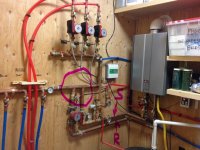
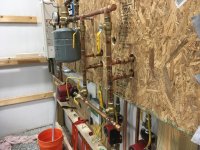
Ok, so I think I have a handle on this without the books(on the way), let me know what you think. I know this is far from some of your ideal setups, I am learning as I go and if I can get this to work for a year or 2 and then replaced the heater I will upgrade to a proper boiler.
I have numbers in the 1st post that are in the same ball park as what follows but they were much more complex equations that took into consideration room temps and insulation level of building, using some of the accepted normal rules of thumb still puts me in my original theoretical window and not at the low end.
Rule of thumb on flow rates in 1/2" *** seems to be .25 GPM for every 100 ft. So that means zone 1 with 300' loops is .75 gpm x 6 loops = 4 gpm. Zone 2 with 220' loops is .55 x 3 loops = 1.65 gpm.
Using the formula GPM=BTU/(490*^T) where 490 is a constant 8.01 x density x specific heat for 100% water
we end up with 44100 BTU for zone 1 and 16170 BTU for zone 2
If I run parallel primary loops and use balance valves to keep the inlet temp at each secondary loop the same and assume a ^T of 20 for the secondary loops
this gives me a total BTU of 60270 if both secondary are running simultaneously. Same formula for a ^T of 20 for the primary gives me a flow of 6.15 gpm. Looking at the north water heater head loss curve chartshows that at 6.15 gpm I would have 59ish ft of head. Most pumps I found had max head specs of well under 36. If we double the ^T of the primary loop we end up with 3.075 gym. At 3 rpm the head loss of the water heater is about 15, which brings us into normal pump circulation territory. I could run a grundfos 15-42F and this should work(need to research more pumps).
Thoughts? Again I know this isn't ideal, but for the $200 I will spend on the pump and fittings and the 2 hours to plumb it all together I may be able to make this work.
Thanks for all the input and suggestions
Jon
I have numbers in the 1st post that are in the same ball park as what follows but they were much more complex equations that took into consideration room temps and insulation level of building, using some of the accepted normal rules of thumb still puts me in my original theoretical window and not at the low end.
Rule of thumb on flow rates in 1/2" *** seems to be .25 GPM for every 100 ft. So that means zone 1 with 300' loops is .75 gpm x 6 loops = 4 gpm. Zone 2 with 220' loops is .55 x 3 loops = 1.65 gpm.
Using the formula GPM=BTU/(490*^T) where 490 is a constant 8.01 x density x specific heat for 100% water
we end up with 44100 BTU for zone 1 and 16170 BTU for zone 2
If I run parallel primary loops and use balance valves to keep the inlet temp at each secondary loop the same and assume a ^T of 20 for the secondary loops
this gives me a total BTU of 60270 if both secondary are running simultaneously. Same formula for a ^T of 20 for the primary gives me a flow of 6.15 gpm. Looking at the north water heater head loss curve chartshows that at 6.15 gpm I would have 59ish ft of head. Most pumps I found had max head specs of well under 36. If we double the ^T of the primary loop we end up with 3.075 gym. At 3 rpm the head loss of the water heater is about 15, which brings us into normal pump circulation territory. I could run a grundfos 15-42F and this should work(need to research more pumps).
Thoughts? Again I know this isn't ideal, but for the $200 I will spend on the pump and fittings and the 2 hours to plumb it all together I may be able to make this work.
Thanks for all the input and suggestions
Jon
Last edited: