To avoid these ads, REGISTER NOW!

Help with initial startup issues, radiant floor heat

OP
B

boostedranger

Active member
Joined
Apr 7, 2007
Messages
44
Ok, so I think I have a handle on this without the books(on the way), let me know what you think. I know this is far from some of your ideal setups, I am learning as I go and if I can get this to work for a year or 2 and then replaced the heater I will upgrade to a proper boiler.

I have numbers in the 1st post that are in the same ball park as what follows but they were much more complex equations that took into consideration room temps and insulation level of building, using some of the accepted normal rules of thumb still puts me in my original theoretical window and not at the low end.


Rule of thumb on flow rates in 1/2" *** seems to be .25 GPM for every 100 ft. So that means zone 1 with 300' loops is .75 gpm x 6 loops = 4 gpm. Zone 2 with 220' loops is .55 x 3 loops = 1.65 gpm.

Using the formula GPM=BTU/(490*^T) where 490 is a constant 8.01 x density x specific heat for 100% water

we end up with 44100 BTU for zone 1 and 16170 BTU for zone 2

If I run parallel primary loops and use balance valves to keep the inlet temp at each secondary loop the same and assume a ^T of 20 for the secondary loops

this gives me a total BTU of 60270 if both secondary are running simultaneously. Same formula for a ^T of 20 for the primary gives me a flow of 6.15 gpm. Looking at the north water heater head loss curve chartshows that at 6.15 gpm I would have 59ish ft of head. Most pumps I found had max head specs of well under 36. If we double the ^T of the primary loop we end up with 3.075 gym. At 3 rpm the head loss of the water heater is about 15, which brings us into normal pump circulation territory. I could run a grundfos 15-42F and this should work(need to research more pumps).

Thoughts? Again I know this isn't ideal, but for the $200 I will spend on the pump and fittings and the 2 hours to plumb it all together I may be able to make this work.

Thanks for all the input and suggestions
Jon
 
Last edited:
To avoid these ads, REGISTER NOW!

yeldogt

Well-known member
Joined
Jan 2, 2012
Messages
18,184
Why do you do that? The circulators job is just to deliver the btus to the radiation. Once you've done that, the circs are just wasting watts. Whats the rationale? Curious, not criticizing. All my systems use outdoor reset too. Eventually your temps hit your reset temp and it should shut off. Mine do. Circs only run when delivering btus.

With constant circulation -- you lower water temp. The whole point of ODR is to match the loss of the building in real time ... unless the circulator is running you are not delivering BTU's

This works great even with old cast iron radiator systems -- no more on and off.

Radiant really shines when with constant circulation and condensing
 

yeldogt

Well-known member
Joined
Jan 2, 2012
Messages
18,184
Ok, so I think I have a handle on this without the books(on the way), let me know what you think. I know this is far from some of your ideal setups, I am learning as I go and if I can get this to work for a year or 2 and then replaced the heater I will upgrade to a proper boiler.

I have numbers in the 1st post that are in the same ball park as what follows but they were much more complex equations that took into consideration room temps and insulation level of building, using some of the accepted normal rules of thumb still puts me in my original theoretical window and not at the low end.


Rule of thumb on flow rates in 1/2" *** seems to be .25 GPM for every 100 ft. So that means zone 1 with 300' loops is .75 gpm x 6 loops = 4 gpm. Zone 2 with 220' loops is .55 x 3 loops = 1.65 gpm.

Using the formula GPM=BTU/(490*^T) where 490 is a constant 8.01 x density x specific heat for 100% water

we end up with 44100 BTU for zone 1 and 16170 BTU for zone 2

If I run parallel primary loops and use balance valves to keep the inlet temp at each secondary loop the same and assume a ^T of 20 for the secondary loops

this gives me a total BTU of 60270 if both secondary are running simultaneously. Same formula for a ^T of 20 for the primary gives me a flow of 6.15 gpm. Looking at the north water heater head loss curve chartshows that at 6.15 gpm I would have 59ish ft of head. Most pumps I found had max head specs of well under 36. If we double the ^T of the primary loop we end up with 3.075 gym. At 3 rpm the head loss of the water heater is about 15, which brings us into normal pump circulation territory. I could run a grundfos 15-42F and this should work(need to research more pumps).

Thoughts? Again I know this isn't ideal, but for the $200 I will spend on the pump and fittings and the 2 hours to plumb it all together I may be able to make this work.

Thanks for all the input and suggestions
Jon

Why not make a primary / secondary ... get the three speed alpha 15-55.
 

PWC Repair

Well-known member
Joined
Dec 27, 2012
Messages
3,170
Location
Arkansas
I looked at the pump curve charts. The 15-42 will pump less head than the 15-48 that you currently have. It does seem like the heater has quite a bit of restriction. It looks like you need something more like the Taco 009 or Grundfos up15-100. Could you possibly rig up a bypass of the heater. Then you would know for sure if the restriction of the heater is too much for the pumps to overcome??

By the way, those look like the same manifolds as mine. Not that it matters at all.
 
Last edited:
OP
B

boostedranger

Active member
Joined
Apr 7, 2007
Messages
44
Why not make a primary / secondary ... get the three speed alpha 15-55.

Thats what I am describing, primary loop would use the third pump to circulate in the primary loop, both zones would be secondary loops that pull from the primary. See FIG 3

As for pumps I only spent a few minutes looking at curves. I will have to spend some more time looking at them to pick the proper pump.
 
OP
B

boostedranger

Active member
Joined
Apr 7, 2007
Messages
44
Tie one of the manifolds together as a temporary; turn off flow to the loops and see if the flow is enough to keep the heater running?

I am pretty confident this is the issue, All plumbing is 3/4 copper so doing anything means soldering, I have unions at the HWH and may make quick bypass for the HWH and see if my flow meters in my manifolds show flow without the HWH in the system if I can get out there today.
 

75gmck25

Well-known member
Joined
Jul 21, 2014
Messages
1,317
Location
Alexandria, VA
I have no experience other than my radiator hydronic system, but it seems like the problem is the water flow sensor shutting the system off too soon.

Can't the flow sensors be replaced (if faulty) and/or can't you use one with a different minimum flow rate? Or if they can't be replaced or adjusted, can't they be jumpered so that they keep the burner going manually until the system gets the slab up to the initial set temperature?

My other suggestion is to look at options on the controller for the boiler. My Buderus has various temp and damper sensors, but the digital controller also has settings. For example, I can set the minimum water temp to 100 degrees so the burner keeps it warm all the time and it will heat the radiators to operating temp (140 degrees max) faster, or I can let it drop back to ambient temp when it cycles off.

Bruce
 

yeldogt

Well-known member
Joined
Jan 2, 2012
Messages
18,184
Thats what I am describing, primary loop would use the third pump to circulate in the primary loop, both zones would be secondary loops that pull from the primary. See FIG 3

As for pumps I only spent a few minutes looking at curves. I will have to spend some more time looking at them to pick the proper pump.


The alpha (15-55) pump is more money but it has three speeds -- less power. 3 speeds gives you that ability to fine tune .. all systems need a little. Get the 15-58 3 speed pump (non Alpha) -- it's basically the same cost as the 15-42 ..... the 15-42 is a great little pump and has been around forever ... it's outdated. It's for replacement

Remember as flow and pressure increase -- that head curve changes. It's different vs static pressure.

Also -- I get that you have the pumps. Ideally with the pumps available today -- you can actually set them up with one pump in the system side -- because the pumps are smart. They increase speed to provide flow to zones opened and closed by zone valves.


For all new in a home w/ DHW. It's alpha for the boiler loop -- non alpha 3S for DHW and some type of smart pump for the output to radiation
 
Last edited:

brewchief

Well-known member
Joined
Sep 20, 2008
Messages
2,370
Location
Michigan
I have no experience other than my radiator hydronic system, but it seems like the problem is the water flow sensor shutting the system off too soon.


Can't the flow sensors be replaced (if faulty) and/or can't you use one with a different minimum flow rate? Or if they can't be replaced or adjusted, can't they be jumpered so that they keep the burner going manually until the system gets the slab up to the initial set temperature?


My other suggestion is to look at options on the controller for the boiler. My Buderus has various temp and damper sensors, but the digital controller also has settings. For example, I can set the minimum water temp to 100 degrees so the burner keeps it warm all the time and it will heat the radiators to operating temp (140 degrees max) faster, or I can let it drop back to ambient temp when it cycles off.


Bruce
The flow sensor is simply not seeing enough flow because the design of the water heater is too restrictive, 59 feet of head at 6 gpm is crazy compared to a real boiler. I looked up a lochinvar WHB085 in comparison and it's less then 1 foot of head at 8 gpm.

Primary/secondary piping works because you don't have to move the entire system flow through the boiler ( or in this case water heater).


Sent from my SM-G965U using Tapatalk
 

86turbodsl

Well-known member
Joined
Jul 1, 2005
Messages
6,554
Location
Michigan
With constant circulation -- you lower water temp. The whole point of ODR is to match the loss of the building in real time ... unless the circulator is running you are not delivering BTU's

This works great even with old cast iron radiator systems -- no more on and off.

Radiant really shines when with constant circulation and condensing

If you did your heat loss calculations and setup your system correctly, you should only need constant circulation at design temp. Mine has ODR and shuts off when thermostat is satisfied. Temps are always comfortable. Not saying your way won't work, just that you don't need 24/7 circs.
 

yeldogt

Well-known member
Joined
Jan 2, 2012
Messages
18,184
If you did your heat loss calculations and setup your system correctly, you should only need constant circulation at design temp. Mine has ODR and shuts off when thermostat is satisfied. Temps are always comfortable. Not saying your way won't work, just that you don't need 24/7 circs.

You can't have full ODR w/o constant circulation.

If the system turns off (yours) ... by that very fact you have provided too much heat. he goal of ODR is to exactly match the loss .. always be providing heat to perfectly match the house loss.

Your curve is too high ... the only reason for a thermostat is to manage heat gain from the sun ...

Since radiant can't respond quickly -- ORD with the proper curve can predict the future loss. It works the same with high temp radiators -- either retrofitted high mass or new style euro panel. In areas where they is high sun gain the system are managed with flow valves.

I'm sitting in a house with panels as well as tile and wood floor radiant ... there is no thermostat in the house. The boiler is thinking care of the rooms with 3x ODR curves.

When setting up any type of radiant -- it's really impossible to to match (design) the system to the heat load calculation room to room. What you do is make sure you can get the BTU's from the system in a given space. That's why -- more tubing (closer spacing) makes it easier to match throughout a house. That way at any given water temp you can tweek the flow to each loop.

After a system is put into service it can take same time to play with each zone -- or even each loop. But once set -- the system can just run off whatever the outside temp is.
 

david5253

Active member
Joined
Nov 26, 2013
Messages
35
Location
Cripple Creek, Colorado
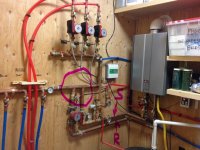
I would suggest you add 2 closely spaced tees as circled in the attached photo. Also add a pump that comes on whenever heat is called for. I have used the arrangement shown on the last 3 houses and shops we have built.

Have always used a direct open system with a Rinnai on demand water heater.
The one shown is 199,000 BTU's propane and heats 4400 square feet and supplies all the domestic hot water. Location is Colorado at 8200 feet above sea level. In floor tubing is 7/8" PEX rated for potable water and all pumps are stainless steel. No problems.

Closely spaced tees need to follow several rules: "It is VERY important that the closely spaced tees be no further apart than 4 times the diameter of whatever size pipe constitutes the primary/secondary loop, and it is equally important that the length of the straight pipes extending from the closely spaced tees be at least 6 times that same pipe diameter."

Hope you get your heat on soon!
 

Attachments

  • Closely Spaced Tees.jpg
    Closely Spaced Tees.jpg
    142.9 KB · Views: 56

fitter30

Well-known member
Joined
Jun 23, 2019
Messages
2,966
Location
Peace Valley,mo
1/ 2" pex loops are normally design at 20* temp difference. With boiler design temp 5-10* over thermostat setting. Your boiler lowest setting is 100*
6 loops 300'- 9' of head + 2' for piping 11'
3 loops 220' 6.6' + 2' for piping 8.6'
Figgering 30 btu's per foot 54,000 for 6 loops 19,800 for the 3 loop
The flows and head are for a primary secondary piping. Loop headers should be piped reverse return for a more even flow between loops meaning supply header 1-2-3
Return 3-2-1 first in last out.
 

SALIV8

Well-known member
Joined
Dec 11, 2008
Messages
2,114
Location
chicago and s/w michigan
If you did your heat loss calculations and setup your system correctly, you should only need constant circulation at design temp. Mine has ODR and shuts off when thermostat is satisfied. Temps are always comfortable. Not saying your way won't work, just that you don't need 24/7 circs.

I had a hw circ pump fail and thank god i was home to hear the loud banging in the basement. The old boiler i have has no flow sensor to shut it off.

After i replaced the circ pump i never wanted this to happen again so it is always on.

The constant on/off cycles hurt the longevity of equipment.
 

yeldogt

Well-known member
Joined
Jan 2, 2012
Messages
18,184
1/ 2" pex loops are normally design at 20* temp difference. With boiler design temp 5-10* over thermostat setting. Your boiler lowest setting is 100*
6 loops 300'- 9' of head + 2' for piping 11'
3 loops 220' 6.6' + 2' for piping 8.6'
Figgering 30 btu's per foot 54,000 for 6 loops 19,800 for the 3 loop
The flows and head are for a primary secondary piping. Loop headers should be piped reverse return for a more even flow between loops meaning supply header 1-2-3
Return 3-2-1 first in last out.

Output -- is based on pipe spacing and water temp. You can't just add up the loop lengths and factor a delta T of 20.. with greater heat loos and spaced or thick slab the water temp can easily go much higher. The delta will drop over time.
 

tricountytrail

Well-known member
Joined
Jan 26, 2015
Messages
212
Location
Pendelton, NY
Those white knobs on your return manifolds I believe are for individual control valves.
Make should there are fully loose I believe the default to fully closed and wont flow any water if you have them screwed down!
 
To avoid these ads, REGISTER NOW!

tricountytrail

Well-known member
Joined
Jan 26, 2015
Messages
212
Location
Pendelton, NY
Section 7
Filling and Purging the Manifold
To ensure the manifold provides enough water for superior performance,
fill and purge the system at the boiler or at the manifold.
If you choose to fill and purge at the manifold, see the
following instructions.
1. Connect a water hose from a faucet to the fill valve on the
supply manifold cap.
2. Connect a separate drain hose to the
cap on the return manifold and place
the other end into a large bucket or
into a drain.
3. Close all valves on the manifold
(both supply and return manifold),
as well as the Supply and Return
Ball Valve (A2631252) installed
on the supply and return lines.
4. Open the valves for the first loop
on the manifold.
open
https://www.garagejournal.com/forum/attachment.php?attachmentid=954370&stc=1&d=1575841110
 

Attachments

  • Untitled.jpg
    Untitled.jpg
    81.2 KB · Views: 26

redneckcharlie

Well-known member
Joined
Dec 26, 2009
Messages
125
I don’t usually do this but it needs to be said. You are over your head with your install plain and simple. You thought you were smarter then the professionals and wanted to save money. I get the money saving part. At this point your on this forum attempting to correct your issues. You undoubtably made your choices on what you installed in the same manner. Call a reputable radiant tech in your area and pay them the few hours itll cost to correct your system. Its money well spent. I cant tell you how often I get calls from diyers for situations similar to yours.


Well, Here I am, What can I do to make what I have work for the winter?

I apparently was led down a bad path and I should have realized that when I decided the manifolds they sent were overpriced and I ended up replacing them before I tried them.

I just spent an hour D***ing with it and after more flushing i was able to get it to run for 15 minutes straight, thought great, maybe it was air bound, then it shut down again. It didn't run long enough to even get a return temp above 45*.

Can i get another pump, plumb in a P/S loop and get heat for the winter?

I will order the books and learn, and I have learned a ton so far, but if I have to spend another $3-5K to replaced all the **** I already have the old lady is going to loose her ****.
 

86turbodsl

Well-known member
Joined
Jul 1, 2005
Messages
6,554
Location
Michigan
I had a hw circ pump fail and thank god i was home to hear the loud banging in the basement. The old boiler i have has no flow sensor to shut it off.

After i replaced the circ pump i never wanted this to happen again so it is always on.

The constant on/off cycles hurt the longevity of equipment.

I bet you pay for the new pump with the watts burned. Just saying.
 

86turbodsl

Well-known member
Joined
Jul 1, 2005
Messages
6,554
Location
Michigan
You can't have full ODR w/o constant circulation.

If the system turns off (yours) ... by that very fact you have provided too much heat. he goal of ODR is to exactly match the loss .. always be providing heat to perfectly match the house loss.

Your curve is too high ... the only reason for a thermostat is to manage heat gain from the sun ...

Semantics. Whatever, it works. How does your ODR curve respond when the wind is blowing at 30mph and house heat loss is increased? I'm glad you have yours tuned to the T, but i don't believe that zero thermostats would be the norm. I studied this subject extensively before i built my controller. I'm not a newb.
 

yeldogt

Well-known member
Joined
Jan 2, 2012
Messages
18,184
Semantics. Whatever, it works. How does your ODR curve respond when the wind is blowing at 30mph and house heat loss is increased? I'm glad you have yours tuned to the T, but i don't believe that zero thermostats would be the norm. I studied this subject extensively before i built my controller. I'm not a newb.

See ... now you are thinking !!!

Wind and stack effect ... can effect the curve. The need for adjustment is dependent on the building. That's why insulation and air sealing is so important.

The germans have been the leaders -- and they have been building tighter building ..forever. The german system do indeed have the option to have an internal sensor to adjust the curve if set temp is not maintained. One of my systems does have this -- but, it's for a room with a lot of glass facing south.

The circulation is still going 24/7

The germans also use a lot of panel radiators -- and they can have Danfoss thermo heads. That's a great way to go with an old house -- I have done that as well.
 

Jackfre

Well-known member
Joined
Dec 26, 2010
Messages
4,406
Location
N CA
Throwing a 009 or other large circ at a tankless is not going to achieve the desired high flow. That unit thinks it is a water heater and will throttle the flow based upon the delta T. The circ ends up fighting the units flow control and the flow control wins. It also wears out faster.
 

tricountytrail

Well-known member
Joined
Jan 26, 2015
Messages
212
Location
Pendelton, NY
Throwing a 009 or other large circ at a tankless is not going to achieve the desired high flow. That unit thinks it is a water heater and will throttle the flow based upon the delta T. The circ ends up fighting the units flow control and the flow control wins. It also wears out faster.

That's what is believe is going on but trying to work with what he has.
He might have a flow problem with the loops also. It's like he is only heating the primary heat loop. The installer should have had all figured out though.
 

yeldogt

Well-known member
Joined
Jan 2, 2012
Messages
18,184
Throwing a 009 or other large circ at a tankless is not going to achieve the desired high flow. That unit thinks it is a water heater and will throttle the flow based upon the delta T. The circ ends up fighting the units flow control and the flow control wins. It also wears out faster.


The only way I have seen these work is with a primary loop and high load -- I wonder if a LLH would be even better .... but, I have never see that setup as this is usually a low cost way of going. But, you can make a LLH out of pipe.

With a primary loop and high load -- the secondary is taking the heat away and the primary loop is allowing the burner to keep firing.

It sounds like the OP's system is overheating from low flow ... unfortunately -- we can't determine if he has properly purged the system or if he has all the valves open ... these have to be viewed as a given
 
OP
B

boostedranger

Active member
Joined
Apr 7, 2007
Messages
44
The only way I have seen these work is with a primary loop and high load -- I wonder if a LLH would be even better .... but, I have never see that setup as this is usually a low cost way of going. But, you can make a LLH out of pipe.

With a primary loop and high load -- the secondary is taking the heat away and the primary loop is allowing the burner to keep firing.

It sounds like the OP's system is overheating from low flow ... unfortunately -- we can't determine if he has properly purged the system or if he has all the valves open ... these have to be viewed as a given

All valves are open and system is purged, I don't believe I have an overheating problem, I have no error codes. Pump should be here tomorrow to create a primary/secondary setup and we will see if it works.
 
OP
B

boostedranger

Active member
Joined
Apr 7, 2007
Messages
44
Ok, I spent 6 hours reworking the system and I have to say that I have learned a TON. First, thank you for everyones input and suggestions, could not have figured this out without the help.

So I reworked the system to have a primary loop and 2 secondary loops in parallel. I used another 15-58 that runs the primary circuit.

I now have flow through both my secondary loops and its actually what its supped to be, .6 gym for the loops in zone 2 and .75 gym for loops in zone 1.

I figured out that the water heater will tell you flow through it and I am currently pushing 2.7 gym through the heater.

My manifold inlet temp on zone 1 is 100 and outlet is 60, zone 2 inlet is 70 and outlet is 50. These temps are with both zones on and after running for about 20 minutes with a slab temp of 42. I will check in the morn and see where we stand.

At this point I am super stoked that its up and running, I know its not perfect and I will have some tweaking to do, but at least its running.
 
OP
B

boostedranger

Active member
Joined
Apr 7, 2007
Messages
44
Came out this morn and slab temp was up to 55*. We had a low of 23 last night, so looks like its working, I will have to find time to get out here this afternoon and check all the temps.
 

86turbodsl

Well-known member
Joined
Jul 1, 2005
Messages
6,554
Location
Michigan
I might have swapped the loops on a low flow heat source, but it is working and that's what counts. Well done!
 
To avoid these ads, REGISTER NOW!
Top Bottom