If you need a really precise, clean, hole in wood, you should probably buy a WL Fuller brad point bit, in the correct size.
3/4 HSS BPD 6 X 1/2 - Brad Point Bits - Amazon.com
www.amazon.com
From whatI can tell, Fuller buys quality machinist, twist drills, and regrinds the tips using CNC equipment, to a sharp, spur, brad point design, which tests seem to show will produce about as clean a hole as you can get in wood with a drill bit.
The larger sizes will most likely be needed to be used in a drill press though.
The drills are High Speed Steel, so overheating the bits should not be a problem.
The bits don’t have a screw tip, so they don’t pull directly into the wood like an auger bit will.
The bits, especially in large sizes are fairly expensive.
Lee Valley sells very similar bits, which I believe Lee Valley regrinds in house, using a similar process to the Fuller bits.
It’s probably a toss up which are better.
Again, like the Fuller, reground from HSS machinist bits.
It should be pointed out that there are differences in the types of drill bits you should use depending on the drill, and the drilling angle.
End grain, or close in angle, and you are probably better off using a regular twist drill with a a typical twist drill pointed tip.
Parabolic, or more open fluted machinist twist drill bits are sometimes preferred, especially for end grain, to prevent the bits getting clogged with chips.
Most German and Austrian brad point bits use a different tip design that does not work as well as the above Fuller and Lee Valley bits. (The same may be true for other European brands, but I have not used them all).
There’s also Star-M and Wood Owl bits made in Japan.
I think both brands may be the same manufacturer.
They make a variety of bits, and are preferred by some woodworkers.
Pass completely through to the other side
www.starminfo.com
As far as “precise”, dowel fit, it really has to do with how and why the dowel fit needs to be precise.
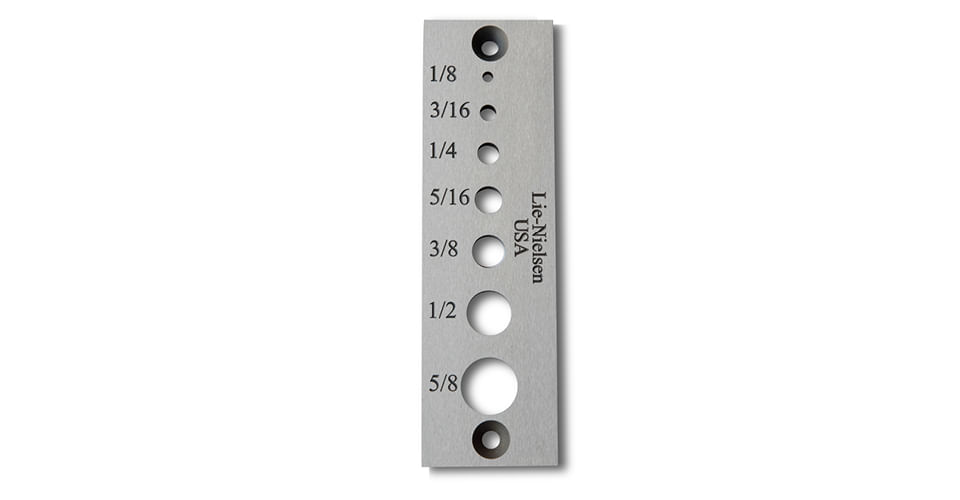
For making sure the dowel is the “proper” dimension, I would likely drive it thru a dowel plate, like the Lie-Nielsen type.
Use a Dowel Plate to easily make exact-sized dowels from any wood you choose. Also useful for making precise tenons on chair spindles. 51/8" long x 1½" wide x ¼" thick, made from surface ground A-2 Tool Steel, hardened to 60 Rc. Holes are machined with a 6° clearance taper on the underside....

www.lie-nielsen.com
If the dowel needed to be precise for “joint strength”, then I would try to drill a hole that was just undersized, or a dowel that was just oversized, and then make a “compression plate”. Basically a steel plate with a bevelled hole, drilled thru, that could be used to compress the wooden dowel down slightly, so that the dowel could be easily driven down into an undersized hole, with wood expansion later locking the dowel in place very tightly.
This could be sort of tricky depending on compression tolerances.