To avoid these ads, REGISTER NOW!

Hmmm ....

PugetDude

ALLIANCE MEMBER
Joined
Mar 13, 2013
Messages
22,401
Location
Superstition Mountains, AZ
I have three different thread pitches on different auger bits. My good RJ ones have a very fine threads. My coarse single spirals are much coarser. And some that seem in between might be double start, I’ve never counted them.

All with a tapered square tang for braces.
Did a big railroad tie retaining wall project many years ago, we were using 1/2" rebar to pin the ties together. Found a bunch of 1/2" square tang auger bits in a second hand store, I think they were about a dollar each so we cut the tangs off and chucked them in a big old D-handle B&D drill, one of those old geared monsters that would stop the earth's rotation if it stalled. Couple of licks with a triangular file on the cutting edge when they were dull until they got too worn to sharpen, which was about every third or fourth tie. I think we went through 25-30 auger bits on that job. Makes my back hurts just thinking about it now.
 
Last edited:
To avoid these ads, REGISTER NOW!

neophyte

Well-known member
Joined
Apr 23, 2012
Messages
9,679
Location
Pennsylvannia
If you need a really precise, clean, hole in wood, you should probably buy a WL Fuller brad point bit, in the correct size.


From whatI can tell, Fuller buys quality machinist, twist drills, and regrinds the tips using CNC equipment, to a sharp, spur, brad point design, which tests seem to show will produce about as clean a hole as you can get in wood with a drill bit.
The larger sizes will most likely be needed to be used in a drill press though.
The drills are High Speed Steel, so overheating the bits should not be a problem.
The bits don’t have a screw tip, so they don’t pull directly into the wood like an auger bit will.
The bits, especially in large sizes are fairly expensive.

Lee Valley sells very similar bits, which I believe Lee Valley regrinds in house, using a similar process to the Fuller bits.
It’s probably a toss up which are better.
Again, like the Fuller, reground from HSS machinist bits.

It should be pointed out that there are differences in the types of drill bits you should use depending on the drill, and the drilling angle.
End grain, or close in angle, and you are probably better off using a regular twist drill with a a typical twist drill pointed tip.
Parabolic, or more open fluted machinist twist drill bits are sometimes preferred, especially for end grain, to prevent the bits getting clogged with chips.
Most German and Austrian brad point bits use a different tip design that does not work as well as the above Fuller and Lee Valley bits. (The same may be true for other European brands, but I have not used them all).

There’s also Star-M and Wood Owl bits made in Japan.
I think both brands may be the same manufacturer.
They make a variety of bits, and are preferred by some woodworkers.

As far as “precise”, dowel fit, it really has to do with how and why the dowel fit needs to be precise.
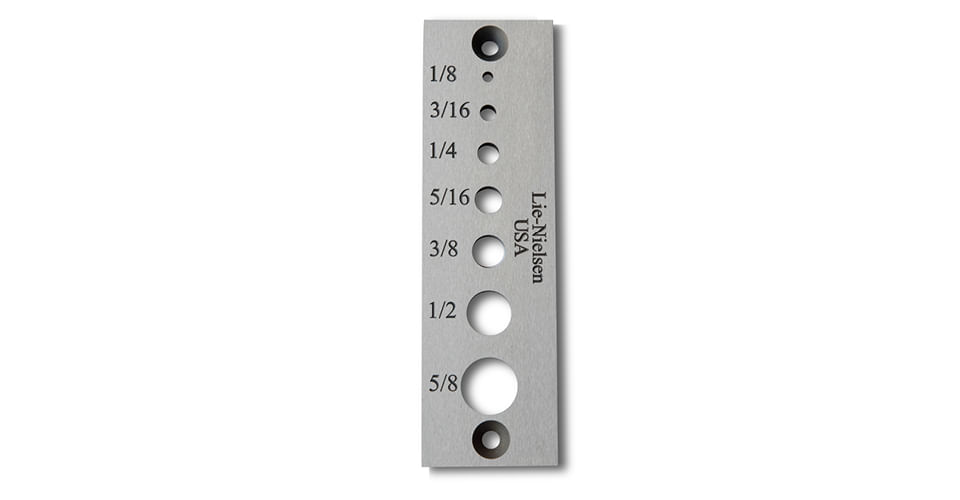
For making sure the dowel is the “proper” dimension, I would likely drive it thru a dowel plate, like the Lie-Nielsen type.
If the dowel needed to be precise for “joint strength”, then I would try to drill a hole that was just undersized, or a dowel that was just oversized, and then make a “compression plate”. Basically a steel plate with a bevelled hole, drilled thru, that could be used to compress the wooden dowel down slightly, so that the dowel could be easily driven down into an undersized hole, with wood expansion later locking the dowel in place very tightly.
This could be sort of tricky depending on compression tolerances.
 

Attachments

  • IMG_2371.png
    IMG_2371.png
    291.7 KB · Views: 2
  • IMG_2373.png
    IMG_2373.png
    351.7 KB · Views: 2
  • IMG_2374.png
    IMG_2374.png
    1,018.3 KB · Views: 2

ecotec

Well-known member
Joined
Oct 5, 2010
Messages
5,451
If you need a really precise, clean, hole in wood, you should probably buy a WL Fuller brad point bit, in the correct size.


From whatI can tell, Fuller buys quality machinist, twist drills, and regrinds the tips using CNC equipment, to a sharp, spur, brad point design, which tests seem to show will produce about as clean a hole as you can get in wood with a drill bit.
The larger sizes will most likely be needed to be used in a drill press though.
The drills are High Speed Steel, so overheating the bits should not be a problem.
The bits don’t have a screw tip, so they don’t pull directly into the wood like an auger bit will.
The bits, especially in large sizes are fairly expensive.

Lee Valley sells very similar bits, which I believe Lee Valley regrinds in house, using a similar process to the Fuller bits.
It’s probably a toss up which are better.
Again, like the Fuller, reground from HSS machinist bits.

It should be pointed out that there are differences in the types of drill bits you should use depending on the drill, and the drilling angle.
End grain, or close in angle, and you are probably better off using a regular twist drill with a a typical twist drill pointed tip.
Parabolic, or more open fluted machinist twist drill bits are sometimes preferred, especially for end grain, to prevent the bits getting clogged with chips.
Most German and Austrian brad point bits use a different tip design that does not work as well as the above Fuller and Lee Valley bits. (The same may be true for other European brands, but I have not used them all).

There’s also Star-M and Wood Owl bits made in Japan.
I think both brands may be the same manufacturer.
They make a variety of bits, and are preferred by some woodworkers.

As far as “precise”, dowel fit, it really has to do with how and why the dowel fit needs to be precise.
For making sure the dowel is the “proper” dimension, I would likely drive it thru a dowel plate, like the Lie-Nielsen type.
If the dowel needed to be precise for “joint strength”, then I would try to drill a hole that was just undersized, or a dowel that was just oversized, and then make a “compression plate”. Basically a steel plate with a bevelled hole, drilled thru, that could be used to compress the wooden dowel down slightly, so that the dowel could be easily driven down into an undersized hole, with wood expansion later locking the dowel in place very tightly.
This could be sort of tricky depending on compression tolerances.

Are the lipped bits for a cleaner hole on the front side or less tear out?
 
To avoid these ads, REGISTER NOW!

tarbellb

Well-known member
Joined
Apr 17, 2011
Messages
5,756
Location
Oregon
Auger bit= low accuracy holes

Brad point= better

Forstner bit= even better

but the real question is: @theoldwizard1 did you use a triple gear reduction drill, anything less would be uncivilized
 
To avoid these ads, REGISTER NOW!
Top Bottom