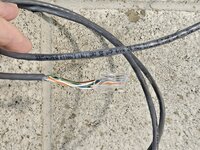
@djbmw Not surprised. That's what I get for using paid professionals, I could have screwed it up better myself! Thanks
It looks like this is a standard Home Depot installation with Klein & Southwire cable. Klein products aren't typically used for professional data work. I'd also bet there's a 50% chance they used an RJ45 connector rated for Cat6 on a Cat5e cable. Depending on the design, this could prevent the IDC terminals from properly engaging with the conductors. As someone else pointed out, totally wrong cable for this application. The cable you want is gel filled and will make you curse.
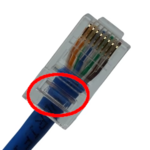
When crimping an RJ45 connector, the back of the connector should engage with the outer jacket of the twisted pair as a strain relief. I've seen similar crimps in industrial environments, usually done by non-data professionals. Over time, as the cable is subjected to vibration or handling, broken conductors can occur because there's nothing to prevent them from being strained or moved from the RJ45 connector. In one case, I encountered a bad crimp from 20 years ago that caused a building's HVAC system to fail. I had to repair it because the HVAC company didn't have the tools. They had been updating the building, which required unplugging and plugging that cable multiple times, something that had rarely happened since the initial installation, so bad crimps can last.
This situation also highlights actual data professionals almost never crimp twisted pair cables. IDC punch-downs are generally preferred for this reason. Achieving a proper, factory-quality crimp requires specific tools and expertise, which I rarely see executed correctly. The only tool I'd use is a specialized one from Panduit.
The jacket of the twisted pair cabling should be fully engaged in the box area where the strain relief crimp is performed.
Best advice I can give someone is to give is to try to crimp the cable yourself. Check out some tutorials and use a factory patch cable as a reference on how things should look. You'll find that for a non-critical home environment it's 100% do-able skill to do as a DIYer with good results and you'll probably be a lot better than whoever thought that was acceptable.