And @Astro_Pneumatic_ToolsThats a pretty bold assumption with members like @teagueo here...


You are using an out of date browser. It may not display this or other websites correctly.
You should upgrade or use an alternative browser.
You should upgrade or use an alternative browser.
Icon G2 Ratchets vs Snap On
- Thread starter milky2k
- Start date
1Bad55Chevy
Well-known member
- Joined
- Feb 20, 2025
- Messages
- 710
Thats a pretty bold assumption with members like @teagueo here...
Are they here in this thread bashing every quality of tool except for SO?
I don't know this for a fact but I would be willing to bet SO cares more about their software divisions then their hand tool division in 2026. To much competition in tools and once you buy your done... software updates and monthly subscription fees add up to much more money then a tool box and some sockets.
I simply asked a question.Remember nobody here has any experience working as a tool designer for any company. Nobody here has any experience assembling tools at a factory. Nobody here has taken apart thousands of ratchets to measure all the parts out to truly figure out the actual standard deviation. Everything here is based on assumptions.
The one thing I do know for certain in this life is you cant meet your heros because they will let you down. Whatever brand you support would be a massive let down to work there. The quality you think your delivering wouldn't actually be whats going on.
Never have faith in humanity. Its 2026 Everyone is working for the weekend and nobody gives a **** about the products they put out.
The brain trust here I believe is pretty expansive.
If no one wants to address it that’s fine as well.
1Bad55Chevy
Well-known member
- Joined
- Feb 20, 2025
- Messages
- 710
I wasn't putting you down.I simply asked a question.
The brain trust here I believe is pretty expansive.
If no one wants to address it that’s fine as well.
I am getting at the point that these threads are pointless. We got one guy who's profile picture is a meme that says "stop being poor and buy SO" thats like talking trucks with a guy who has a chevy tattoo on his calf....
The people who really know this type of information are not a self proclaimed tool connoisseur,
1Bad55Chevy
Well-known member
- Joined
- Feb 20, 2025
- Messages
- 710
Ok I measured out my 8 month old **** box G1 1/4 ratchet for anvil end play..... .008" at a ambient air temperature of 46* F...Excessive movement of the anvil relative to the faceplate is big deal. Think about what's happening in the head of a ratchet with excessive moment, it means the gears on the anvil and the pawl aren't meshing evenly and will eventually wear unevenly and induce potential skipping of the teeth since you don't have full gear engagement. I check that in every ratchet I purchase, new or used, and it's a dealbreaker if I deem it excessive.
1. Is this within spec for Icon manufacturing? How about SO manufacturing?
2. What's the SD of anvil endplay for Icon and SO ratchets?
3. Based on the metals used in my Icon ratchet how will the end play change during the summer months when ambient temperature exceeds 115*?
4. Based on testing how many ratchet cycles will my ratchet last assuming an average 90* arc swing and a constant 20lb of applied force with no maintenance?
5. Will areas of different climate change the life cycles of these ratchets?
mngundog
Well-known member
Are you exercising your ratchets between use?Ok I measured out my 8 month old **** box G1 1/4 ratchet for anvil end play..... .008" at a ambient air temperature of 46* F...
1. Is this within spec for Icon manufacturing? How about SO manufacturing?
2. What's the SD of anvil endplay for Icon and SO ratchets?
3. Based on the metals used in my Icon ratchet how will the end play change during the summer months when ambient temperature exceeds 115*?
4. Based on testing how many ratchet cycles will my ratchet last assuming an average 90* arc swing and a constant 20lb of applied force with no maintenance?
5. Will areas of different climate change the life cycles of these ratchets?
1Bad55Chevy
Well-known member
- Joined
- Feb 20, 2025
- Messages
- 710
Absolutely, but i refuse to stretch before or after! This might be why my end play is so tight?Are you exercising your ratchets between use?
When you put them away, do you leave them on or do you turn them off?Absolutely, but i refuse to stretch before or after! This might be why my end play is so tight?
1Bad55Chevy
Well-known member
- Joined
- Feb 20, 2025
- Messages
- 710
When you put them away, do you leave them on or do you turn them off?
Off 100% of the time but when I do turn them on I refuse to warm them up.
Every morning man, every morningAre you exercising your ratchets between use?
Sounds like you just don't care. Which is valid. But this isn't the same as saying "end play" or whatever we're calling it doesn't matter. It doesn't matter to you and maybe you can't imagine why it would matter to anyone. It matters to me, and I suspect many here.Ok I measured out my 8 month old **** box G1 1/4 ratchet for anvil end play..... .008" at a ambient air temperature of 46* F...
1. Is this within spec for Icon manufacturing? How about SO manufacturing?
2. What's the SD of anvil endplay for Icon and SO ratchets?
3. Based on the metals used in my Icon ratchet how will the end play change during the summer months when ambient temperature exceeds 115*?
4. Based on testing how many ratchet cycles will my ratchet last assuming an average 90* arc swing and a constant 20lb of applied force with no maintenance?
5. Will areas of different climate change the life cycles of these ratchets?
Here's where I am: I think the people reviewing ratchets (and other tools) professionally don't know what features to review. Their motivation is to attract eyeballs, which in turn makes them money. They couldn't give 2 craps whether the information they put out helps someone choose a tool they will love for the next 20yrs.
I picked up a ratchet in a store. I didn't use it. I just held it in my hand and gave my first impressions. I didn’t bash anything or anyone. And my first impressions are probably more valuable than all the strength testing videos we’ve all watched. And my sense for it, the criteria I used, has never been discussed here or anywhere I know about.
Feel free to disagree, but I think a quality ratchet shouldn’t feel like a rattly piece of junk. End play, or gear wobble, whatever we’re calling it, first impressions, felt excessive on the G2 ratchet. The selector switch felt ok. Doesn’t matter to you? Thanks for the news flash. Please don’t tell us my impressions don’t matter to anyone. That’s arrogant and small minded, neither of which fit my impressions of you and I’d like to keep it like that.
Suggest: When these subjects come up, and they’ll keep coming up, please think about what you like about your tools. Don’t trust professional youTube reviewers’ criteria. I suspect, for a bunch of reasons, tool strength is no longer the discriminator it once was. If you want to compare tools, we probably need look to other criteria.
When I select a tool, especially a ratchet, strength isn't high on my list of priorities. I'm sure my Koken Zeal ratchet would break before an Icon G2 if put on TTC's Pushy machine, but that plays ZERO factor in my selection decision. Fit/finish, smoothness, tight tolerances and overall quality are what's important to me as I don't abuse my tools to the point of failure. If you break a ratchet, you are using the wrong size and/or should be using a breaker bar.Sounds like you just don't care. Which is valid. But this isn't the same as saying "end play" or whatever we're calling it doesn't matter. It doesn't matter to you and maybe you can't imagine why it would matter to anyone. It matters to me, and I suspect many here.
Here's where I am: I think the people reviewing ratchets (and other tools) professionally don't know what features to review. Their motivation is to attract eyeballs, which in turn makes them money. They couldn't give 2 craps whether the information they put out helps someone choose a tool they will love for the next 20yrs.
I picked up a ratchet in a store. I didn't use it. I just held it in my hand and gave my first impressions. I didn’t bash anything or anyone. And my first impressions are probably more valuable than all the strength testing videos we’ve all watched. And my sense for it, the criteria I used, has never been discussed here or anywhere I know about.
Feel free to disagree, but I think a quality ratchet shouldn’t feel like a rattly piece of junk. End play, or gear wobble, whatever we’re calling it, first impressions, felt excessive on the G2 ratchet. The selector switch felt ok. Doesn’t matter to you? Thanks for the news flash. Please don’t tell us my impressions don’t matter to anyone. That’s arrogant and small minded, neither of which fit my impressions of you and I’d like to keep it like that.
Suggest: When these subjects come up, and they’ll keep coming up, please think about what you like about your tools. Don’t trust professional youTube reviewers’ criteria. I suspect, for a bunch of reasons, tool strength is no longer the discriminator it once was. If you want to compare tools, we probably need look to other criteria.
As I’ve written before, I generally have ratchets I use to remove stuff, and different ratchets when I’m reinstalling hardware/parts. If I’m working in severely restricted or uncomfortable places I choose special ratchets, maybe with smaller or flex heads.When I select a tool, especially a ratchet, strength isn't high on my list of priorities. I'm sure my Koken Zeal ratchet would break before an Icon G2 if put on TTC's Pushy machine, but that plays ZERO factor in my selection decision. Fit/finish, smoothness, tight tolerances and overall quality are what's important to me as I don't abuse my tools to the point of failure. If you break a ratchet, you are using the wrong size and/or should be using a breaker bar.
So for me “ratchet” is not one tool. There’s no one set of criteria I use to compare all ratchets. If we don’t talk about what features we think are the right ones to use to compare ratchets, I guarantee no one else will.
Edit: dual 80 was an amazing advancement in ratchets. It’s an excellent single design for a wide range of ratchets. But the attributes of dual 80 aren’t the best in every incarnation of ratchet.
Last edited:
Not all YouTube reviews are by professionals, either users or content creators. It's kinda the reason I put my stuff up on YouTube as a "regular guy" perspective.Sounds like you just don't care. Which is valid. But this isn't the same as saying "end play" or whatever we're calling it doesn't matter. It doesn't matter to you and maybe you can't imagine why it would matter to anyone. It matters to me, and I suspect many here.
Here's where I am: I think the people reviewing ratchets (and other tools) professionally don't know what features to review. Their motivation is to attract eyeballs, which in turn makes them money. They couldn't give 2 craps whether the information they put out helps someone choose a tool they will love for the next 20yrs.
I picked up a ratchet in a store. I didn't use it. I just held it in my hand and gave my first impressions. I didn’t bash anything or anyone. And my first impressions are probably more valuable than all the strength testing videos we’ve all watched. And my sense for it, the criteria I used, has never been discussed here or anywhere I know about.
Feel free to disagree, but I think a quality ratchet shouldn’t feel like a rattly piece of junk. End play, or gear wobble, whatever we’re calling it, first impressions, felt excessive on the G2 ratchet. The selector switch felt ok. Doesn’t matter to you? Thanks for the news flash. Please don’t tell us my impressions don’t matter to anyone. That’s arrogant and small minded, neither of which fit my impressions of you and I’d like to keep it like that.
Suggest: When these subjects come up, and they’ll keep coming up, please think about what you like about your tools. Don’t trust professional youTube reviewers’ criteria. I suspect, for a bunch of reasons, tool strength is no longer the discriminator it once was. If you want to compare tools, we probably need look to other criteria.
Owning and having used several Icon and Snap On ratchets side by side (I like to switch ratchets vs. swap sockets), my in-hand impressions are very good on both. I like my older SO ratchet (OG F80) better than my newer FH80. I got an SK LP90 and was very disappointed with backdrag and feel, and was then surprised when I ran it for a bit chucked in my drill and the both improved significantly. My Icons all feel generally pretty similar - it doesn't seem to matter how much I've used them. Zero of them have felt junky or rattly. They do have more play/wobble/whatever with a socket mounted than the SO, but I should probably test with both newer and older ratchets and sockets. I can't say I've ever noticed that making a difference in performance. The backdrag between SO and Icon seems pretty similar. None of them are as good as my Ko-ken - it has nearly zero play/wobble, no backdrag I can discern. It's too bad their handle isn't great.
1Bad55Chevy
Well-known member
- Joined
- Feb 20, 2025
- Messages
- 710
I literally have this set up in my vise and measured .008" of end play and somehow I dont care?Sounds like you just don't care. Which is valid. But this isn't the same as saying "end play" or whatever we're calling it doesn't matter. It doesn't matter to you and maybe you can't imagine why it would matter to anyone. It matters to me, and I suspect
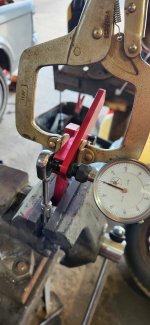
Literally everyone in here is talking about the "feel" of quality and I am the only one who is trying to actually measure something. If Icon is junk let's actually define what junk truly is. If I remember right your an engineer, I was also an engineer so I like things that are measurable and repeatable.
You are saying strength isn't a measure of quality so give me something to measure against.
Edit: Remember I went with end play measure because @CoThG and @AEAdam defined this as a measure of quality on the previous page. If @Astro_Pneumatic_Tools or @teagueo have better ways to measure the quality of hand tools please feel free to chime in. I think it would help everyone to establish a "junk" reference point for products to measured against.
Last edited:
You're asking too much out of someone who thinks his 2 minute opinion of holding, not even using, a ratchet is more valuable than any amount of testing or measuring there is.You are saying strength isn't a measure of quality so give me something to measure against.
Hey sorry, maybe I misread your post. I thought you were saying end play doesn't matter.I literally have this set up in my vise and measured .008" of end play and somehow I dont care?
Literally everyone in here is talking about the "feel" of quality and I am the only one who is trying to actually measure something. If Icon is junk let's actually define what junk truly is. If I remember right your an engineer, I was also an engineer so I like things that are measurable and repeatable.
You are saying strength isn't a measure of quality so give me something to measure against.
Edit: Remember I went with end play measure because @CoThG and @AEAdam defined this as a measure of quality on the previous page. If @Astro_Pneumatic_Tools or @teagueo have better ways to measure the quality of hand tools please feel free to chime in. I think it would help everyone to establish a "junk" reference point for products to measured against.
What you have there is super helpful as it tells us roughly how thick a washer we might need. Also an easy comparative measure.
To be clear, end play is maybe the cause, but not what I originally was referring to as a negative:
If you put a 6" extension on any given ratchet, the end of that extension will rattle within some sort of cone based on slop in the head (caused by end play+++) and also slop between the extension and the ratchet anvil. I want that cone to be as small as possible. I would fix that with a washer.
One thing that drove me to the snap on eco-system (as opposed to cherry picking a few individual tools) was reducing that cone. On one too many jobs, I found myself fishing a ratchet with a long extension and a socket past belts and hoses to get on a nut and the wobble made that difficult. Not a big deal, but for me, a micro frustration that I could fix with $$$.
It could be the case that an Icon eco-system has the exact same "wobble cone" as snap on. It could be that Icon is 10% BETTER. I just feel as tho, this is an attribute I personally care about.
Hopefully this makes sense.
EDIT: Willing to bet Koken cares about this.
Last edited:
Kurt4440
Well-known member
On one too many jobs, I found myself fishing a ratchet with a long extension and a socket past belts and hoses to get on a nut and the wobble made that difficult. Not a big deal, but for me, a micro frustration that I could fix with $$$.
Hopefully this makes sense.
The comedian in me sums up this dilemma as:
Your tool was dangling too much for you to insert it where you needed it to go.
The technical part of my brain agrees with you that the accumulated end play ("slop") is not ideal.
Interestingly, the tightest fitting ratchet/socket combination I had at the house was Toptul. I tested, Armstrong, Bahco, Craftsman, Gearwrench, SK, Snap-on, Williams, and Wright. I will check some more when I go over to my shop.
Brandon_Lutz
Well-known member
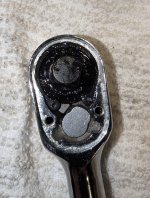
For those of you with G2 ratchets and having a complaint of too much play on the anvil side, do you have a snap ring in your ratchet? The one G2 that I have, has zero play and when I opened it up for the first time to lube it, I noticed the snap ring inside the head. All of the tear-down/promotional videos I watched on G2 ratchets prior to getting one myself featured no snap ring on the inside of the head holding the anvil firmly against the body.
Picture showing the snap ring setup in mine is below. I have the 20" 3/8 G2 ratchet and it has zero play on the head. It's still not as smooth as my F80 ratchets, but it's not far off either. (sorry for the pic quality, I had just re-lubed it and the flash reflected a lot back into the camera when I took the photo.)
Picture showing the snap ring setup in mine is below. I have the 20" 3/8 G2 ratchet and it has zero play on the head. It's still not as smooth as my F80 ratchets, but it's not far off either. (sorry for the pic quality, I had just re-lubed it and the flash reflected a lot back into the camera when I took the photo.)
Attachments
1Bad55Chevy
Well-known member
- Joined
- Feb 20, 2025
- Messages
- 710
Ok dont judge me on my set up here, I let a friend borrow my actual magnetic base and we both forget about it every time we go to each other's shop.Hey sorry, maybe I misread your post. I thought you were saying end play doesn't matter.
What you have there is super helpful as it tells us roughly how thick a washer we might need. Also an easy comparative measure.
To be clear, end play is maybe the cause, but not what I originally was referring to as a negative:
If you put a 6" extension on any given ratchet, the end of that extension will rattle within some sort of cone based on slop in the head (caused by end play+++) and also slop between the extension and the ratchet anvil. I want that cone to be as small as possible. I would fix that with a washer.
One thing that drove me to the snap on eco-system (as opposed to cherry picking a few individual tools) was reducing that cone. On one too many jobs, I found myself fishing a ratchet with a long extension and a socket past belts and hoses to get on a nut and the wobble made that difficult. Not a big deal, but for me, a micro frustration that I could fix with $$$.
It could be the case that an Icon eco-system has the exact same "wobble cone" as snap on. It could be that Icon is 10% BETTER. I just feel as tho, this is an attribute I personally care about.
Hopefully this makes sense.
EDIT: Willing to be Koken cares about this.

Measured At 7 inches from the ratchet head there is exactly. 25" of movement up and down (roughly 2 degrees of movement). If you apply a good amount of pressure to it you can squeeze out another 1/16". Remember this is a G1 Icon thats about 8 months old with a pretty good amount of abuse and zero maintenance.
Last edited:
1Bad55Chevy
Well-known member
- Joined
- Feb 20, 2025
- Messages
- 710
Picked up a G2 1/4 drive 12.5" extra long ratchet this morning for $44. The G2 has the same .008 end play but the anvil has a 3/16" (roughly 1.5 degrees) rock to it measured at 7" away from ratchet head.
If these are sloppy pieces of **** what are the SO ratchets measurements? The dual 80 extra long is $171 so I am expecting the quality/fit finish to be almost 4X....
If these are sloppy pieces of **** what are the SO ratchets measurements? The dual 80 extra long is $171 so I am expecting the quality/fit finish to be almost 4X....
Last edited:
The only ones that have that are the newer 3/8" anvils that go in the 1/4" heads.It would be interesting to see if the Snap-on ratchets had the scored anvil like the newer ones have to make an engineered breaking point so something more expensive doesn't break like the flex head joint. I have seen some new ones that have it and don't have it and some kits that have it and don't have it also.
Excessive is whatever I feel is excessive. I've declined purchasing numerous SO ratchets because they didn't "feel right". Dealer didn't care either way. He just put it back in circulation and said some Bubba tech, who's not a tool connoisseur like you are, will buy it.How much movement is considered excessive? How do you measure this in a store when ratchets are in some sort of package?
How many ratchet cycles will wear the teeth to a point of skipping? We talking hundreds, thousands, millions?
Has there been any testing that compares between brands on how many ratchet cycles before the gears are worn out? If we are talking a few hundred I would want the parts available under warranty to rebuild the ratchet, if we are talking thousands of uses i would rather have the wrench replaced with something shiny and new.
I do think thats a major plus of icon over the tool trucks. If I mess up a single screwdriver I get a new set, if I mess up a SO screwdriver I get a new bit in a worn out handle. Same with wrenches and sockets.
Just another reason I buy SO on the truck. I have a chance to go hands on before purchasing. Even with special orders, I've declined and the dealer sent it back to SO for another one.
1Bad55Chevy
Well-known member
- Joined
- Feb 20, 2025
- Messages
- 710
Hey sorry, maybe I misread your post. I thought you were saying end play doesn't matter.
What you have there is super helpful as it tells us roughly how thick a washer we might need. Also an easy comparative measure.
To be clear, end play is maybe the cause, but not what I originally was referring to as a negative:
If you put a 6" extension on any given ratchet, the end of that extension will rattle within some sort of cone based on slop in the head (caused by end play+++) and also slop between the extension and the ratchet anvil. I want that cone to be as small as possible. I would fix that with a washer.
One thing that drove me to the snap on eco-system (as opposed to cherry picking a few individual tools) was reducing that cone. On one too many jobs, I found myself fishing a ratchet with a long extension and a socket past belts and hoses to get on a nut and the wobble made that difficult. Not a big deal, but for me, a micro frustration that I could fix with $$$.
It could be the case that an Icon eco-system has the exact same "wobble cone" as snap on. It could be that Icon is 10% BETTER. I just feel as tho, this is an attribute I personally care about.
Hopefully this makes sense.
EDIT: Willing to be Koken cares about this.
Did you ever measure out your SO and Koken ratchets?
The cool thing is since they are publicly traded you can find out this information if you know how to search a 10K or 10QAre they here in this thread bashing every quality of tool except for SO?
I don't know this for a fact but I would be willing to bet SO cares more about their software divisions then their hand tool division in 2026. To much competition in tools and once you buy your done... software updates and monthly subscription fees add up to much more money then a tool box and some sockets.
(Not really related to the larger topic of Icon vs Snap on with AEAdam, I'm sure both ratchets are just fine personally)

1Bad55Chevy
Well-known member
- Joined
- Feb 20, 2025
- Messages
- 710
The cool thing is since they are publicly traded you can find out this information if you know how to search a 10K or 10Q
(Not really related to the larger topic of Icon vs Snap on with AEAdam, I'm sure both ratchets are just fine personally)
Is that just the Snap-on brand and not all the subsidiaries?
No I don't own any Koken. I'll try to do a similar test for the snappies I own.Did you ever measure out your SO and Koken ratchets?
All of them more or less.Is that just the Snap-on brand and not all the subsidiaries?

Somewhere there's a breakdown of corporate vs. truck (heavily corporate) and notes that their "soft" side contributes greatly to profit (which is expected). I don't think trucks are driving their business (no pun intendedThe cool thing is since they are publicly traded you can find out this information if you know how to search a 10K or 10Q
(Not really related to the larger topic of Icon vs Snap on with AEAdam, I'm sure both ratchets are just fine personally)
 ) and results in any meaningful way.
Wamsutta
Well-known member
There's no innovation when it comes to Harbor Freight ICON.What about competition breeds innovation/excellence?
Maybe the Icon stuff will light a fire under Snap On to up there game
All they do is wait for the patent to expire and then do their best to copy Snap-on.
Nobody-named-Olli
Well-known member
And here I am, still wishing we had something remotely similar to HF.
So, here, if you’re reading HF, bring some stores over here & disrupt this slow, boring & tiresome market!!!
Kind regards,
Olli
So, here, if you’re reading HF, bring some stores over here & disrupt this slow, boring & tiresome market!!!
Kind regards,
Olli
Sounds like Olli needs us to put together a care package from the US.And here I am, still wishing we had something remotely similar to HF.
So, here, if you’re reading HF, bring some stores over here & disrupt this slow, boring & tiresome market!!!
Kind regards,
Olli
Nobody-named-Olli
Well-known member
Sounds like Olli needs us to put together a care package from the US.
Appreciate the thought, but I’m good. Had they passed that free trade agreement years ago, it would probably be fun, but the way it is - it would be just one major hassle/headache.
But what I seriously would like to see in general, is a player like HF disrupting/moving the market over here.
Kind regards,
Olli
Maybe I'm wrong as well but even if someone scientifically proves one brands tool is the best one ever and better than every other brand. If i pick it up and don't like the feel I wouldn't want to use it.You're asking too much out of someone who thinks his 2 minute opinion of holding, not even using, a ratchet is more valuable than any amount of testing or measuring there is.
Its like “comfort” handles on ratchets, i don't like them i don't care how good the ratchet is, if it has a soft handle i don’t want to use it.