To avoid these ads, REGISTER NOW!

If you had it to do all over...

Ron_J

Well-known member
Joined
Jul 10, 2018
Messages
295
Location
Central PA
So I'm starting to get the wiring straight in my head for my new garage and I'm trying to think of all the possible needs. It will be a detached 30x50...with a welder, compressor (both 240), a car lift and wood working saws. 100A service.

I'm thinking 2 circuits for the wall outlets.
One for the ceiling.
One for the furnace.
One for the compressor.
One for a couple 240 outlets
one for the lift.

What am I missing? Looking to learn from those that have been there, done that. What would you do different?
 
To avoid these ads, REGISTER NOW!

kTHREE

Well-known member
Joined
Dec 30, 2016
Messages
222
Location
MN
This may sound silly, but I wish I alternated my 20 amp outlets around the shop on different circuits, at the very least by the workbench. I always tend to pop a breaker with my miter saw when it's cold and i'm also charging batteries.
 

pbon

Well-known member
Joined
May 14, 2017
Messages
3,498
Not sure 240 outlets should’ve on same circuit. I put each wall on a different 20A circuit to address the issue of blowing one — I can plug in elsewhere. But if you know you will have 2 heavy draw items located on the same wall then you should consider the alternating receptacle method.
 

OneOfEm

Well-known member
Joined
Dec 7, 2015
Messages
255
I ran two 20amp circuits down each wall and have one outlet on each circuit in each box. Probably overkill for a one man hobbyist shop, but it's a one time cost.
 

larry_g

Well-known member
Joined
Apr 28, 2007
Messages
16,888
Location
oregon
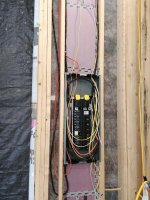
Think about adding circuits after the building is built. In my building I have the panel in the stud bay and that bay has a screw on panel that I can remove to access the top of the panel and the predrilled holes in the top plate to run wires into the ceiling for ease of work later. Think about where storage will be and where work is to be done. No use in a lot of outlets and lighting in the storage area.

lg
no neat sig line
 
OP
R

Ron_J

Well-known member
Joined
Jul 10, 2018
Messages
295
Location
Central PA
This may sound silly, but I wish I alternated my 20 amp outlets around the shop on different circuits, at the very least by the workbench. I always tend to pop a breaker with my miter saw when it's cold and i'm also charging batteries.

Great tip. Thanks.

As a one man operation, I can't imagine using 2 heavy draw items at once (probably why I didn't think to alternate circuits), but it is definitely worth planning for.
 

Jkcolo22

Well-known member
Joined
Nov 28, 2018
Messages
74
Location
Castle Rock, CO
I’d suggest you have way too few outlets planned. I followed the advice commonly repeated on this forum of outlets every 6’ and I’m happy I did. Mine are all at 50” to allow a piece of plywood to be layed against the wall without blocking the outlets. I did a few extra runs lower into handy boxes along my workbench wall to allow outlets to be stubbed out to the front of my workbench so as to avoid having to have chords on top of the workbench. I also ran some extra 240v outlets here and there to allow for future equipment and in case I need to weld on some equipment, I won’t have to run a long extension cord. Also have some 20a outlets planned for the ceiling towards the center for extension cords on reels.


Sent from my iPhone using Tapatalk
 

AntonLargiader

Well-known member
Joined
Nov 20, 2016
Messages
1,372
Location
Charlottesville, VA
Having a lot of receps isn't about plugging a lot of stuff in, it's about having a plug where you need it rather than pulling extension cords around. In my shop, battery chargers, floor fans, extra light, or plugiin power tools may need to be nearly anywhere. I don't plug all that much stuff in but I often don't have a recep close enough to where I want one.
 

Natty Bumppo

Well-known member
Joined
Dec 8, 2019
Messages
370
Location
Savoy, MA
I'm thinking 2 circuits for the wall outlets.
One for the ceiling.
One for the furnace.
One for the compressor.
One for a couple 240 outlets
one for the lift.

I just wired my garage this past summer and did everything you listed. In addition I added:

- hot ceiling outlets for drops...reeled work lights and power cords
- I did ceiling outlets on 3 different switches (same circuit) for lighting needs
- a switched ceiling fan outlet (12-3)...glad I did, as all of the heat from my Mr. Heater I am finding is at the ceiling. You need the third wire if the control switch allows you to reverse fan direction for summer/winter. You may need two fans.
- some switched outlets high on the wall for signs, lights, neon, etc...if you're into that kind of stuff.
- a hot outlet high on the wall for a clock
- on 3 of my walls I did a switched outlet about 8' so I can control a low hanging light over a work table or work station when needed.
 

u2slow

Well-known member
Joined
Nov 20, 2011
Messages
3,599
Location
BC
So I'm starting to get the wiring straight in my head for my new garage and I'm trying to think of all the possible needs. It will be a detached 30x50...with a welder, compressor (both 240), a car lift and wood working saws. 100A service.

I'm thinking 2 circuits for the wall outlets.
One for the ceiling.
One for the furnace.
One for the compressor.
One for a couple 240 outlets
one for the lift.

What am I missing? Looking to learn from those that have been there, done that. What would you do different?

I try to only run as many 240V circuits as I can use at one time... and for me that's a dedicated compressor circuit, and then another for 'general use' with multiple receptacles. (Odds are you aren't welding, running saws, and the lift at the exact same time.) Prefer 2 circuits for lights. Also at least 2 circuits for wall plugs (alternating). Wired as MWBCs where possible/permitted.

I don't like the exhaustive rough-in strategy that seems to be getting common with handy-folk in residential garages. Way more wiring than is needed, and still somehow there's omissions. Not easy to change when its all behind drywall.

I surface mounted my panel, and will convert my temporary wiring and cords to surface EMT after I have everything boarded (plywood), and a functional shop arrangement. Might not be for everybody, but it makes my head (and wallet) hurt the least.
 

sberry

Banned
Joined
Jun 18, 2005
Messages
35,747
Location
Brethren, Michigan
The more you can wire as you go the better. It gets it where needed and avoids a lot of wire stored in the walls. Convenient access to the panel is good, simple home run when you get something new vs trying to chain it on. As for 50 inches and leaning sheets,,,, I have 6400 sq ft and not a single place to lean a sheet against a wall. All full. It looks different before you move in, wiring an empty garage almost never gets it right.
 
Last edited:

b-boy

Well-known member
Joined
Oct 2, 2013
Messages
2,155
Location
Buffalo NY
I usually go a little overboard.

  • I put a 240 30A outlet on each wall for future A/C, compressor, table saw and other devices. I put an extra 240 40A as well for a welder.
  • I have outlets every 6 ft (50" up) along 3 walls, plus dedicated outlets for the furnace.
  • I added dedicated outlets for my 2 garage door openers, my refrigerator, and my freezer.
  • 2 ceiling fans are a must IMHO.
  • Lots of lights
  • Switched 20A outlets up high (~10 ft) for signage, neon, lights, etc...
 

gtae07

Well-known member
Joined
Mar 6, 2015
Messages
2,978
Location
Fayetteville, GA
More lights
Third exterior outlet on the back
Maybe a few quad outlets

That’s about all I’d change electrically.

Though, while I had the wall open in the garage to run the feeder to the shop, I should have run another circuit or two to the back patio and put in an outdoor outlet there.
 

MeentSS02

Well-known member
Joined
Aug 12, 2010
Messages
325
Location
Dayton, OH
My 3-car garage had 3 total duplex 15-amp outlets on 3 different walls. That was it.

I went back after the fact and added 4 20-amp circuits with lots and lots of convenience outlets. Most are either two or three gang boxes spread throughout the garage. Some are mounted higher to allow me to put sheet goods against the wall, and some are lower where they are needed. I've used them all at various times, and wouldn't have added any fewer than I did.

You just can't beat having an outlet right where you need it. In an ideal world, you'd use your garage exactly how you intend to use it, and see where you keep saying "damn, I wish there was an outlet there," and then put one in. Not super easy, but it's hard to plan for all contingencies. I was somewhat lucky that they didn't insulate any of my exterior walls for some strange reason...that made pulling wires super easy even though my walls were all finished (sheet rock).
 

Copymutt

Well-known member
Joined
Sep 3, 2016
Messages
3,392
Location
Colorado
I ended up adding power drops from the ceiling after the fact. It was too inconvenient to keep stringing ext. cords to the projects in the center of the garage.
 

Crazyjake8493

Well-known member
Joined
Sep 26, 2014
Messages
3,969
Location
Upstate NY
Biggest thing I would do different is to insulate and finish the walls, then surface mount my panel and all the wiring in EMT. I rushed to get everything run in the walls, and inevitably you'll always find new tools or sell old ones, or change the shop around. So I now have a 50/50 mix of romex in the walls and THHN in EMT on the wall surface. Fewer wall penetrations means fewer places to air seal and insulate as well.

Aside from that, a few of the things I'm really glad I did were:
- Separate lighting circuit (so I'm not in the dark if I trip a breaker)
- Outdoor welder receptacle on the front of the garage, for welding in the driveway
- Switch-controlled soffit receptacles for christmas lights
 

ard

Well-known member
Joined
Feb 16, 2015
Messages
4,391
Location
Sierra Foothills... California
I ran two circuits to each double gang box, so that each receptacle in the box is on a diffrent circuit. Each long wall has two circuits.

EMT for all of it, in the walls. Couple of 240V circuits for welder, planer, table saw, comp, dust collector. Can pull/add wires later if needed, extend with a surface mount. 12 years havent needed to.
 
Last edited:

nadogail

Well-known member
Joined
Jan 23, 2009
Messages
31,999
Location
Coronado, CA
Murphy's Electrical Service, says every job is "a work in progress".

Yogi Berra "It ain't over till it's over"
 
To avoid these ads, REGISTER NOW!

wes73

Well-known member
Joined
Nov 18, 2013
Messages
218
Location
South Central PA
Multiple ceiling fans, garage door(s) on separate circuit, separate circuit for heater, outlets 4 feet apart, separate circuit for outside lights/outlet. Run dedicated circuits fro any thing you think you may need/use/have in the future since it is easier and cheaper now.

I wish I would have alternated wall outlets on at least one wall.
 

pbon

Well-known member
Joined
May 14, 2017
Messages
3,498
After 2 years, I have my shop layout finalized. I spent a long time figuring it out as I was renovating and thought I knew exactly where everything would go. I was actually very close. I have made only a few changes, covering up only 2 outlets, one of which I salvaged by cutting out a hole in the back of a storage locker (to use for a battery charger since I store my Milwaukee tools in that locker). I may do the same with the other covered outlet since I just put a TV over the storage locker covering that outlet and could route a powerstrip up inside the cabinet to put the strip on top for the TV and cable box to plug into. But I also installed enough outlets so losing 2 would have been fine.

For occasional work, you could do fewer outlets and use ceiling or wall mounted for reels. Same goes for an air compressor. Simple way to get functional though less convenient power and air. Butting light fixtures and feeding 2 or 3 or 4 in a row is another way to be simple, and you could go in both directions from a 2 plug outlet or 4 directions from a 4 plug outlet. LED light draw is pretty low — the typical 4’ fixtures draw about 40W each.
 

William Payne

Well-known member
Joined
Mar 15, 2010
Messages
7,750
Location
Wanganui, New Zealand
I’m currently setting up my garage right now. I decided after experience in other shops that my best best to run all the wiring surface mount and install as needed. Shop layouts change and machinery can change. In a workshop setting everything should be easy to service.

To make it easy on myself my garage has its own panel which soon will have 415v going to it. That way I can add anything I want independent from the house.

I can only speak for myself. I know I will evolving as my shop progresses so for me the easier I can make it for myself the better.
 

yeldogt

Well-known member
Joined
Jan 2, 2012
Messages
18,184
I'm overstating the obvious here -- but it's so dependent on what type of work you do and how you have to use the space.

I have a couple stationary tools in my shop -- band saw/cabinet saw/planer .. they all have dedicated outlets and cords. Personally, I don't like all the outlets high up on the wall for the "plywood" that I never string around the shop. I have one place where it goes ..... outlets can get in the way.

My movable tools have longer cords --

I have wiremold at my benches ... put an outlet by every door. I put an outlet where I was planning my shop vac -- it's plugged in.

Some people never use ceiling outlets ..... others swear by them.

With all the cordless stuff -- I don't use the outlets I have. Some guys go crazy and most of them get covered ... plan a spot for charging.
 

tarmy

Well-known member
Joined
May 28, 2014
Messages
4,693
Location
Nor Cal
Ceiling hoist, air treatment blower, overhead drop cords...

Exterior power around shop/garage

Built in shop vac system, TV, generator...
 

Jeepster04

Well-known member
Joined
Jun 25, 2013
Messages
3,098
This may sound silly, but I wish I alternated my 20 amp outlets around the shop on different circuits, at the very least by the workbench. I always tend to pop a breaker with my miter saw when it's cold and i'm also charging batteries.

Excellent idea! I had never thought of this but will keep it in mind!
 

48windsor

Well-known member
Joined
Jan 24, 2013
Messages
407
Location
Olympia ,Wa.
I’m currently setting up my garage right now. I decided after experience in other shops that my best best to run all the wiring surface mount and install as needed. Shop layouts change and machinery can change. In a workshop setting everything should be easy to service.

To make it easy on myself my garage has its own panel which soon will have 415v going to it. That way I can add anything I want independent from the house.

I can only speak for myself. I know I will evolving as my shop progresses so for me the easier I can make it for myself the better.

I very much agree.
A good idea today isnt as good down the road .
yes if you buy a machine it would be easier to get to wiring if need be.
 

Wileel

Well-known member
Joined
May 19, 2016
Messages
132
Location
Panama City FL
I'll piggy back on several mentions here as well as what I did;
-I ran separate circuits for each wall, each 220 drop and one for the garage door openers on the front
-Add an outlet (or at least a box) on the ceiling for a drop light reel. I forget to do it an d now need to tap into my light circuit ;(
-Outlets along the walls about 6' apart, Looks like over kill and it might be but cheap insurance
-Installed an outlet up high for WIFI ****, router and clock/radio.
-Don't forget to run network cables and security wiring while its all open. Also, install a chase for the cables incase you need to change them in the future. Run extra for pre installed back-ups.
-Think about other little things as well as the big items, like maybe a battery tender you will have mounted.
-RV plugs are great to have as well as generator disconnects
-Don't get cheap GFCI's
 

MeentSS02

Well-known member
Joined
Aug 12, 2010
Messages
325
Location
Dayton, OH
I’m currently setting up my garage right now. I decided after experience in other shops that my best best to run all the wiring surface mount and install as needed. Shop layouts change and machinery can change. In a workshop setting everything should be easy to service.

To make it easy on myself my garage has its own panel which soon will have 415v going to it. That way I can add anything I want independent from the house.

I can only speak for myself. I know I will evolving as my shop progresses so for me the easier I can make it for myself the better.

This is a good idea, but just isn't feasible in my garage due to how tight things are. I already regularly hit one of my outlets when getting out of my truck every day...surface mount would be worse.

So if I had to do it all over again, the garage would be oversized so I wouldn't have to worry about any of that.
 

jimy

Well-known member
Joined
Mar 25, 2015
Messages
157
I would not use 2 gang boxes for my outlets. I have almost never had a need (in over 30 years) to plug more than 2 things in at once at the same location. Even at a work bench I'd prefer one at each end rather than sitting next to each other. It would have been much better to spread out the same number of outlets in single gang boxes (and easier to wire). Especially with all the cordless tools these days.

My walls are plywood and nailed in place except near the service panel where it was put on with screws. That should make it easier to add circuits with conduit.
 

124ci

Well-known member
Joined
Dec 23, 2018
Messages
59
Location
phoenix,az
Make sure and install a large 100 amp panel with more than enough breaker spacers. I installed a 12/24 panel, and when I was finished I used every spot. Before I put in drywall, I took that panel out and installed a 24/48 panel for anything that may arise. I already added more breakers. I put the lights on different circuits in case one trips out at night. I also added a 50 amp, 4 wire rv plug on the outside. They make so many different rv plug adapters, you can get 110, welder 220, or rv 220 50 amp, rv 30 amp fairly easy from that one plug.
 

jabelding

Well-known member
Joined
Feb 16, 2019
Messages
113
Location
Maine
I also ran a 10-3 30 amp to my attic on the back wall for a heat pump later for ac and some heat mid-season and 2 50amp 240v outlets in between each bay for future electric car chargers, I imagine one of my next cars will be electric. For the 3 exterior lights, they will be motion activated but I put a light switch higher up on the wall near each one to override.
My walls are 6in so used 2" foam to insulate the panel bay and will keep a screwed in cover panel above the load center for easy access to attic with extra holes.

My run down
200 amp 30 space 60 circuit panel, also plan on roof solar at some point. Also got whole panel surge protector. 26 spaces used from my 30 total!
120V
5 - 20amp one for each wall, front and side wall has exterior outlets stubbed off nearest interior box. Front wall outlet up high between bays for garage door openers. Attic circuit for a heater and possible cross flow ventilator.
4- 15amp ceiling lights, exterior lights, ceiling plugs for opener lights and ceiling fans, attic lights.
240v
4-50amp tractor shed subpanel, welder plug, 2 electric car charger /welder plugs
1-40amp Compressor
2-30amp heat pump and autolift hyd pump
 

Attachments

  • 20200101_105811.jpg
    20200101_105811.jpg
    115.2 KB · Views: 88
  • 20200126_151351_HDR.jpg
    20200126_151351_HDR.jpg
    150 KB · Views: 73
Last edited:

dcg9381

Well-known member
Joined
Jun 20, 2018
Messages
11,778
Location
Austin, TX
Basically, I built mine with 4x8 OSB wall panels and as the shop has a sub panel, I can re-wire to my desire.

I eventually ended up with sub-panels on both sides of the building.. That's what I would have done from the start.

I added Simens Talon sub panels on the outside of the building (RV capable) - these panels have 20A, 30A, and 50A outlets.. Pretty flexible.
 

slimpickins

Well-known member
Joined
Mar 27, 2011
Messages
2,404
Location
Canada
If you are doing woodworking or welding, then consider an air exchanger and/or exhaust fan circuit (depending on your climate), a ceiling mount air filter switched plugin, and wiring and piping for a whole shop vac system.

Also depending on your climate and the size of your garage, a circuit for a window air conditioner if you won't have a central air system. You'd be surprised how much difference one of these makes in your garage enjoyment.

If you have a floor drain, you may need a sump pump.

All outlets for electronics and computers should be home run to the panel with separate circuits and possibly have an isolated ground and/or budget for good. You don't want to trip a breaker and your computer powers goes too. Budget for good quality surge suppressors or UPS for all electronics. Also a good idea to install a whole house surge suppressor on your panel to protect electronics.

And the most important one, a separate circuit for the beer fridge! :beer:
 

Norcal

Well-known member
Joined
Mar 16, 2008
Messages
13,764
My small shop was built in 1993, in all those years added a couple of 120V receptacles, one between a couple of doors & the other double duplex for some neon beer & tobacco signs, plus a 60A pin and sleeve receptacle w/ in interlocked switch for a welder, with the exception of the welder all wiring is concealed in the walls, using either MC cable, or EMT, there is about 400' of PVC in the floor, most only have only 3 conductors in it. The ceiling is 2X6 T&G pine decking w/ exposed EMT for lighting.
 

u2slow

Well-known member
Joined
Nov 20, 2011
Messages
3,599
Location
BC
If you had it to do all over...


I'd have started with more money :pimpflash
 

Craig Balzer

Well-known member
Joined
Sep 21, 2005
Messages
867
Location
Colorado Springs
I just had my circuits wired and powered last week (last week of JAN2020), so I don't have any experience in my shop yet.
Details here: https://www.garagejournal.com/forum/showthread.php?t=432775
That said:

200 amp 30 space 60 circuit panel.
All circuits are GFIC and are 20 AMP circuit

Circuits in 48'x36' High Bay Main Floor (14' walls)
  1. Front LED Can Lights and Rear LED Can Lights in Soffits – 18x
  2. Door Sconces – 6x; motion activated
  3. 20-Amp Outlets – 9x Main Floor (every 4 feet on East Wall)
  4. 20-Amp Outlets – 12x Main Floor (every 4 feet on North and West Walls)
  5. 20-Amp Outlets – 12x 8'x20' Dirty Room (= secluded room with buffer, grinder, blast cabinet, etc)
  6. 20-Amp Outlets – 2x in future Bathroom (plus for Base Board Heater and ceiling light)
  7. 20-Amp Outlets – 5x Loft
  8. Ceiling Lights in Main Floor – 7x
  9. Ceiling Lights in Dirty Room – 2x
  10. Ceiling Lights in connecting passage-way between 2 rooms
  11. Ceiling – Garage Door Opener – 1x
  12. 220 in Loft – Air Compressor – 1x plus a 20-AMP outlet next to it for drop light
  13. 220 in Ceiling – Lift – 1x
  14. 220 in Dirty Room – Oven – 1x (for powder coating)
  15. 220 in Dirty Room – Welder – 1x

Circuits in Storage Room (24'x24' with 10 foot ceiling)
  1. 20-Amp Outlet Dedicated to Boiler for in-floor radiant heating
  2. 20-Amp Outlet Dedicated to Pump for in-floor radiant heating
  3. 20 Amp Outlets – 5x for refrigerator and tumblers/ultrasonic cleaner along North Wall
  4. 20 Amp Outlets – 11x along South and West walls
  5. Ceiling Lights in Main Floor – 4x
  6. Ceiling – Garage Door Opener
  7. 220 Amp – Welder near small garage door for outdoor welding

Exterior Outlets – 6x are stubbed off nearest interior outlet.

To help in my calculations and visualizing the power requirements, I listed for my GC/electrician every power tool / device and its amperage draw:

DeWalt Chargers (3 of 'em) = 6.0 Amps
Microwave (1500W) = 12.5 Amps
Coffee Maker (1500W) = 12.5 Amps
Ultrasonic Cleaner = 4.5 Amps
Eastwood Tumbler = 1.1 Amps
Baldor Grinder = 3.3 Amps
Eastwood Buffer = 3.36-6.30 Amps
Rockwell Drill Press = 7.0 Amps
Parts Washer = 0.5 Amps
Blast Cabinet Vacuum = 12 Amps
Lap Top Computer
Desk lap for above
Various lit wall art (clock, intersection signal light, etc)

Air Comp is a 220V device likely 30 AMPs
Lift is a 220V device likely 30 AMPs
Oven is a 220V device likely 30 AMPs
Welder is a 220V device likely 40 AMPs

Don't forget TV, Stereo, lit garage art, signal light, neon light, etc

Prolly way more detail than you needed, but maybe this listing gives you an idea or two . . .
Craig
 
Last edited:

bdog

Well-known member
Joined
Oct 17, 2007
Messages
227
Don’t go with a small breaker panel. I did a 125 amp with three 220 circuits and six 110 circuits when I built my shop ten years ago. At the time of construction I had empty slots. Over time they filled up and now I need a bigger panel and more amps. I am replacing it this weekend and it is a major hassle. The cost difference is negligible. Get a huge panel with 200 amp service you never know what the future may hold.
 
To avoid these ads, REGISTER NOW!
Top Bottom