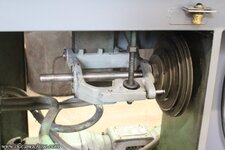
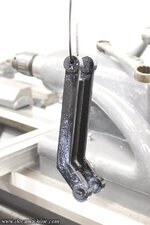
To avoid these ads, REGISTER NOW!

Inside Doc's Shop...

bugnut

ALLIANCE MEMBER
Joined
Jul 14, 2012
Messages
3,850
Location
Central Ohio
Hey Doc, might you save yourself some effort and fitting work by putting a couple brass dog point set screws on the underside pc. It would allow a bit of "slop" to be adjusted and removed by using a doubled set screw to lock in place. Liking the new lathe!
 
To avoid these ads, REGISTER NOW!
OP
D

DocsMachine

Well-known member
Joined
Sep 16, 2006
Messages
1,848
Day 437 of eating this particular elephant, and running low on ketchup. :)

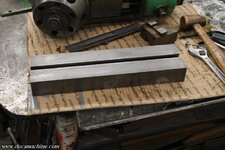
Not much today, took the other part of that bit of scrap steel and milled it to shape, then drilled and tapped it all, again.

rivett162.jpg

And, if I might be allowed to toot my own horn here in public without fear of arrest, it fits perfectly. :)

rivett163.jpg

Loosen the front screws a turn and a half, and she slides right on. Snug the screws back up and it's solid as a rock.

The only drawback- and kind of expected- is the screws are tough to get at. I can reach 'em easily with a ball-end wrench, though what I might do for regular use on this machine, is cut down the short leg of a wrench, to make it easier to tighten them, once they're snugged with the ball-end. A second option is to use a shouldered screw (since they're countersunk holes) with a hex head, and simply use an open-end wrench on them.

Not the slickest setup, but I was pretty limited on what I could fit in there.

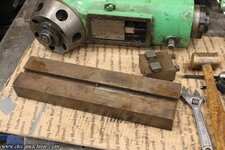
The only other thing I did was get out some solvent and scrubbed clean the base pieces for the turret:

rivett164.jpg

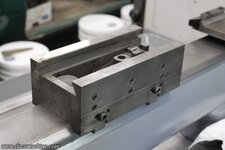
The parts themselves are cherry- there's very little sign of wear. But on the other hand, there's also zero adjustment- as in none whatsoever. Theoretically, you could tighten up the dovetail by lightly surface grinding one of those side plates but as for up, down or left and right? None. Nothing at all. (The Warner & Swasey has tapered gibs for left-and-right, and replaceable hardened wear plates for up-and-down.)

I can hope the turret sockets are still closely aligned- and some turret tooling can be adjusted a little for alignment- but that remains to be seen.

Doc.
 
OP
D

DocsMachine

Well-known member
Joined
Sep 16, 2006
Messages
1,848
Hey Doc, might you save yourself some effort and fitting work by putting a couple brass dog point set screws on the underside pc.

-Yeah, that was one option I had in mind, and if these 'clamps' didn't work out, probably the direction I'd have gone. I thought that might put a 'bending' force on the mounting screws though- moreso than this setup, but probably wouldn't have been a big thing.

Wish I could have found a factory slide, though- those have a nice, easy-to-get-at knob up front. :)

Doc.
 
OP
D

DocsMachine

Well-known member
Joined
Sep 16, 2006
Messages
1,848
With the base casting suitably modified, it was a simple matter of just reassembling the slide back into place.

Simple, yes... :D

rivett165.jpg

Okay, so it needs just a little cleaning first.

Most of the surface rust came off easily with some solvent and Scotchbrite...

rivett166.jpg

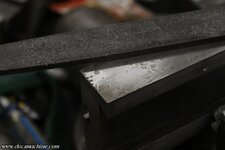
But revealed that the casting had kind of a hard life, with dings, dents and hammer marks here and there. No surprises, as this assembly is probably some eighty years old. (The Hardinge "split bed" format, as I understand it, was phased out around WW2.) I smoothed down what I could first with a file...

rivett167.jpg

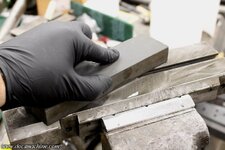
Then hit the whole surface with a stone to knock down even the small stuff (just a cheap whetstone, which is hardly ideal, but it did the job.)

rivett168.jpg

And then I evened up the surface finish with a little 600 grit wet/dry paper on a sanding block.

rivett169.jpg

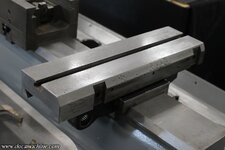
Slid back into place on the base casting, it looks tons better.

rivett170.jpg

A little more Scotchbrite took care of the surface rust on the lever arm...

rivett171.jpg

And that slid back into place with the gear, and a little oil on the needle bearings.

rivett172.jpg

The travel stop blocks, screws and cover plates were simply cleaned and put back into place as well- at some point in the not-too-distant future, I'll touch those up with some fresh black, but I just didn't have time today.

rivett173.jpg

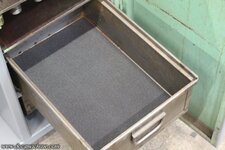
One other little bit I did a few days ago, I cut some of that leftover drawer liner for both the "drawers", since I'm going to start setting this machine up with it's own tool set here shortly.

rivett174.jpg

And, for those thinking I've been neglecting my other duties (can't imagine why you might think such a fool thing) my robot was churning away this whole time:

macheenin1.jpg

macheenin2.jpg

This particular one is a job that's going to eat most of the week- I still have three more full bars to cut up. In fact, I need to get a buddy's Scotch cold saw running in order to chop them up- doing it with a Portaband is annoyingly slow, and is hard to keep the cut straight.

More on that later. :)

Doc.
 
OP
D

DocsMachine

Well-known member
Joined
Sep 16, 2006
Messages
1,848
Quick update: We're finally comin' round to the turret!

rivett175.jpg

I of course pulled off the base and clamp castings, and cleaned those up, several days ago, so it was time to break down the ram assembly itself. I won't
detail all the bits and pieces, but I have more photos if anyone needs help reassembling or troubleshooting their turret. I also have access to a Hardinge DV/DVS-59 turret for comparison. (Quick analysis: They're very close, to the point the Rivett was almost certainly inspired by the Hardinge- or possibly vice versa- but one major difference is the Hardinge has "box" ways, and the Rivett has a dovetail. They're not at all interchangeable.)

Anyway, the turret locking mechanism was kind of surprising:

rivett176.jpg

A roller-bearing-supported and very beefy bolt locks the turret in place.

Here's the cam mechanism from underneath- this of course automaticaly advances the turret each time it's retracted.

rivett177.jpg

And the underside of the turret. The notches are where the "bolt" locks in, and that 'ring' on the pillar is a thin roller bearing. There's a smaller one at the top of the turret.

rivett178.jpg

I won't bore you with more of the cleaning- the usual degreasing (including spooning half a pound of dried-up grease out of it) then a couple applications of paint stripper, and multiple pressure-washings.

rivett179.jpg

'Couple things to note: I borrowed a bearing puller to try and get that bearing off, but it refused to budge, even with some heat, and even with enough pressure to lightly but visibly distort the outer race. There's nothing wrong with the bearing- it rolls smoothly- so I didn't want to ruin it. Lacking a better option, I carefully pried out the snap ring and seal befoe scrubbing anything. I wouldn't be able to keep water, cleaners or gunk out of the bearing, but at least the seal wouldn't hold it in- and I can blow it out and re-grease afterward. (In this pic, I've applied some WD-40, after blowing the water out, to keep it from spot-rusting. It's not ideal, but it's a low-speed bearing, and I had no other real options.)

Second, that white spot next to the oil cup? There's two adjuster screws- apparently that locking bolt mechanism can be tweaked slightly left or right, to align the turret. But the factory clearly intended them to be "aligned for life", as they've been potted over with a filler, and had been smoothly painted over. At the factory, not just by the later green layers.

I have no reason to suspect misalignment of the turret, but it's nice to know it could be tweaked lightly if necessary.

Over the weekend, I'll scuff the remaining primer/filler and give it the usual two coats.

Doc.
 
OP
D

DocsMachine

Well-known member
Joined
Sep 16, 2006
Messages
1,848
Closin' in on it, thankfully. Next step on the turret ram was easy, just scuff the remnants of the old filler smooth, brush and Scotchbrite the tarnish, blow it clean, and paint.

rivett180.jpg

A working turret, however, won't do us any good without a working spindle. And in this case, the spindle turns, but I don't like how much noise it makes. The little Hardinge is nearly silent compared to this thing.

Now, I've tried just the drive- and it, too, makes noise. But the spindle had a definite "whirr" I didn't like. So I pondered a bit, and came up with a puller... of sorts. :)

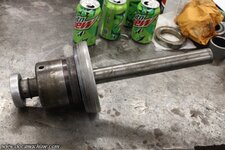
First, I removed the lock-ring at the back, then stacked up this monstrosity out of scrap and leftovers.

rivett181.jpg

That let me smoothly "winch" the spindle assembly out- you don't want to hammer it out, that WILL ruin the bearings.

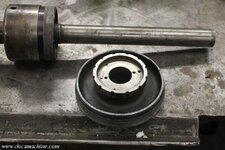
rivett182.jpg

Unfortunately, to disassemble, there's this inner locking ring, that's going to need a pin-spanner wrench, which I don't have. It'll also have to be a pretty beefy one, as the nut has been staked into place.

rivett183.jpg

There's no easy way to undo that staking, so I'll have to put some muscle to that nut, with a suitably beefy spanner wrench.

Rather than getting into that now- I saw how 'dry' the rear bearing looked, and turning the spindle by hand, it seemed that was the one that "whirred".

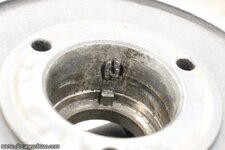
Other thing to note: Right above the staking? See that gunk line on the shaft? Seems the locking ring I took off, which was intended to hold the pulley in place... didn't. The nut tightened against the end of the thread, with the pulley still almost a quarter inch from seated against the spindle step.

Remember my mentioning the nonfunctional "spindle lock" from earlier? I suspected back then that the pulley had been replaced for some reason- this may kind of confirm it. The pulley is too thin- the nut literally cannot tighten it.

Anyway, I decided not to dig into the spindle just yet- but I recorded the bearing numbers, and checked for replacements online. Name brand and "super precision", they go for around $200 each. That's steep, and I'm sure not gonna swap 'em just on a whim, now, but it's not an absurd price if I indeed have to. And, moreover, they're not 'unobtainable', as they are for some machines.

So, since the rear bearing looked relatively clean, just kind of dry, I packed a mix of a light, and a heavy, sticky grease in there:

rivett184.jpg

Why that? Because that's what I had on hand. :) I used up my last tube of Lucas on the horizontal mill a year or two ago, and the gun of moly high-pressure stuff is running dry. And it may not be too long before I revisit this spindle anyway, so any grease is better than none.

After cleaning up the threads and whatnot, I reversed that monstrosity and 'winched' the spindle back into place.

rivett185.jpg

Which left me the pulley. The spacing is wrong to make a spacer that would fit with the "spindle lock" pin- I'm not sure I grok that yet. But no matter what, I needed a spacer so the nut would tighten it into place as it's supposed to.

I found a big galvanized washer in my parts bins (packrat! :) ) and bored it out and faced it down into something that kind of looks spacery.

rivett186.jpg

Since I couldn't hold a ring that thin exactly precisely, I got it close, and then took it for a ride through the surface grinder, so that the two faces would be exactly parallel.

rivett187.jpg

Double-checked with a micrometer, four separate points measured 0.2322", with one outlier, by inferring from the vernier, may have been 0.23225" :D

The actual dimension didn't matter- it just needed to be about that to take up the gap, and it needed to be as parallel as I can get it, so the pulley will run true. This is potentially a 4+K RPM spindle, and such things matter at those speeds.

Anyway, installed, tightened- with a brass drift, but gently- and locked.

rivett188.jpg

I threw one belt back on and took it for a spin. It seemed a little quieter, but the lower drive jackshaft bearing is making a great deal of noise, so it's hard to tell.

I'm thinking since there's not much to do on the turret except paint, my next task might be to pop that jackshaft assembly out- which I'm afraid is going to take some nontrivial disassembly- and swap those bearings.

Doc.
 
OP
D

DocsMachine

Well-known member
Joined
Sep 16, 2006
Messages
1,848
While I really need this thing done and working, and to move on to other projects, the noise in the drivetrain has me kind of annoyed. As with so many other things in life, if I'm going to do this, it's worth doing it right.

Just to get a couple of things out of the way, I got the second coat on the turret ram, and a first coat on a couple of the other bits. Since the weather was amazing- 70-ish and mild wind- I got out some patented lead-free solvent and scrubbed all the turret guts clean:

rivett189.jpg

Thankfully nothing needs repair, though I ran the threaded stop rods through a die, as some of the threads had been dinged and dented over the years. Once the ram is dry, I should just have to slather everything with oil and grease, and screw it all back together.

I then spent the rest of the morning trying to determine which bearings in the system were making noise- and the answer was 'most of them'. :)

rivett190.jpg

Figured I'd start at the bottom and work my way up, and to do that, I removed the motor:

rivett191.jpg

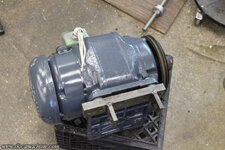
And the simple phrase "removed the motor" kind of skips over a bit. :) It's like saying "I built a 4,000 square foot house" or "I moved the piano up to the third floor". :D It was heavy and awkward, the fasteners almost inaccessible, and I had no help.

Anyway, with it loose, the unloaded motor made a little noise, but not as much as I'd thought when it was in place. But the main thing was that the bearings didn't seem bad. I pulled the pulley, as shown, and as I thought I'd heard a slight 'tick' from the fan bell, I removed that too. The bare motor was damn near silent, ramping up to an expected "hum' as we approached top speed. (2400 RPM according to the tag.)

The fan bell was caked with oily dust- half an inch thick in places- which I thought kind of interesting because the fan itself was basically clean and dry. Did somebody clean it but not the bell, at some point?

I scraped out and cleaned the bell, scrubbed the pulley and fitted a fresh key, and bolted it all back together. The re-assembled motor made a little more noise than bare, which was to be expected, but I did NOT hear any bearing whirr or other unwanted noise.

rivett192.jpg

With the motor out of the way, I managed to get the jackshaft assembly out as well:

rivett193.jpg

Which itself was akin to saying "I ate the entire sofa". :)

The bearings are flanged and the shaft held in by snap rings, but with those out, the shaft pressed out easily.

rivett194.jpg

And there, I think, was a bunch of my noise. Assembled, with the pulleys, they felt smooth enough, not obviously bad- but loose, on their own? Yeah, they're worn. You can feel they're mildly brinelled in there, and probably a little dry.

Found a supplier for some duplicates, and ordered a set. I expect that should make a difference right there.

In the meantime, I scrubbed and pressure washed the casting...

rivett195.jpg

And cleaned and Scotchbrited the shaft, so I can throw those right together once the bearings arrive.

One interesting bit on that casting? Somebody replaced what were probably originally rubber antivibration bushings... with chunks of heater hose. :)

rivett196.jpg

I'm wondering if there was originally something like a rigid rubber, or even a harder bushing, like teflon. The jackshaft tries to twist- the motor pulls down on one end, and the headstock pulls up on the other. Trying to decide if I want to try fitting a Delrin, teflon or high-durometer urethane bushing in there instead.

Doc.
 
OP
D

DocsMachine

Well-known member
Joined
Sep 16, 2006
Messages
1,848
Just a bit of a jigsaw puzzle today, reassembling the turret ram. Easy-peasy, the paint's dry, the parts are already clean, etc.

Screw down the locking bolt assembly...

rivett197.jpg

Blow out, rinse out and regrease the lower turret bearing, then reinstall the seal and snap ring...

rivett198.jpg

And, after having scuffed and Scotchbrited the turret rotor, that's slid into place, then snugged down with the key I made to disassemble it.

rivett199.jpg

The advance mechanism goes in from underneath...

rivett200.jpg

And finished with the cover plate.

rivett201.jpg

Since the three parts of the base assembly have bolts coming up from underneath, I assembled it all while still on the bench and upside-down.

rivett202.jpg

Once back in place on the bed, the lever linkage parts are simply bolted on...

rivett203.jpg

And there you have it!

rivett204.jpg

It's not done yet, it still needs some adjustments- the advance linkage isn't cooperating for some reason- and I still need to sort out the depth-stop rotor assembly on the right-hand end, and the "drive flange" that goes on the top of the rotor.

But, that's about the last major thing that needed to be done 'til the new bearings come in. Stand by, we'll finish this thing yet! :)

Doc.
 
OP
D

DocsMachine

Well-known member
Joined
Sep 16, 2006
Messages
1,848
Today was, among other things, Clean The Damn Shop Day. I've been going dang near full tilt since before this lathe even arrived, and I have tools, parts and materials scattered from just outside hell, to well after breakfast. As usual, it's really starting to cost time and frustration when things aren't where they're supposed to be- or even in the same room as they're supposed to be.

I've never been the worlds neatest or most organized person in the first place (a friend of mine once described my office as a "bomb crater" :D ) but when it takes five minutes and walking between two rooms at least four times, to find a tool I just had!, it's time to take a breather and clean.

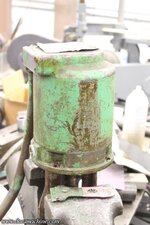
In any case, I'm kind of at a pause on this machine anyway, until those bearings come in. One thing I have been wanting to do, however, is paint the coolant pump.

rivett205.jpg

I don't really know if I'll ever use it, and for that matter I don't actually know if it even works (probably, but I haven't tested it) but the cabinet is built to accept it, and I can either store it there, or stick it in a box somewhere.

The top tag is pretty badly hammered, and I'm not sure I'll be able to even adequately straighten it, but either way I wanted it off. The pins came out easily with the same screwdriver trick as before, and the paint came off easily with a razor blade and some picks.

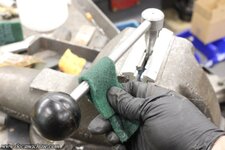
I just set it up in the big vise, and poked at it every now and then as I was passing by- and before I knew it, it was pretty much clean.

rivett206.jpg

I didn't want to waste a roller or tray for a part this small, so I brushed it- and I suspect the finish won't look much better when it dries. :)

rivett207.jpg

But, it still looks better, and when it's dry I'll just bolt it in place, and leave the wiring and plumbing for another time. (If ever.)

Doc.
 
OP
D

DocsMachine

Well-known member
Joined
Sep 16, 2006
Messages
1,848
I have, and I've thought about that. (Well, not in this case, 'til you mentioned it, but I have considered it for some of my other machines. :) )

While I'm not really looking for a 'restoration', here, might not be a bad idea. Might see about getting a good pic of the tag and cleaning it up digitally.

Doc.
 
OP
D

DocsMachine

Well-known member
Joined
Sep 16, 2006
Messages
1,848
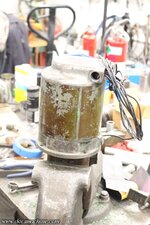
Today's single small bite at the elephant: I bolted the mounting plate to the pump motor, cleaned and reinstalled the conduit elbow, and got the wire-box cover back in place.

rivett208.jpg

That was pretty much it, too many other things to do. Should be more fun this weekend. :)

Doc.
 
OP
D

DocsMachine

Well-known member
Joined
Sep 16, 2006
Messages
1,848
And now for something almost, but not quite, completely different. :)

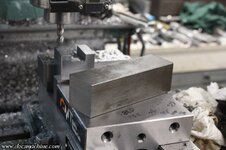
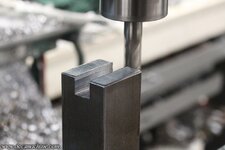
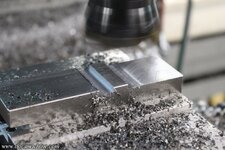
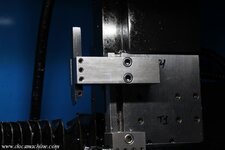
A common task for a machinist is to build a jig or fixture, to hold a part while it's being machined. The part might be oddly shaped or need to be held at an odd angle, and so to make it easier for the operator to run a number of identical parts, whether in a CNC or on a manual machine, a fixture is made to hold the parts. That tends to save time, reduce the scrap rate, etc.

I've had something on the table for all too many weeks now, that needed such a fixture. I just needed to hold the parts at a specific angle, but I wanted it to be easy and quick to get each one in and out of said fixture, firmly enough for milling and drilling, at a repeatable position and angle, and I needed to be able to reverse it to do both sides.

I finally had a moment today- well, not really, but enough of one to finally get these parts done and out the door. So, as per usual procedure, I pondered a number of increasingly-complex and often absurd ideas for fixtures, before finally hitting on a fairly simple one. I whipped up a cardboard template, and found a couple of chunks of scrap that looked like they wanted to join the party.

fixture01.jpg

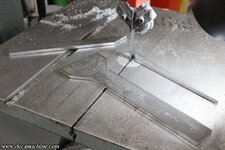
Those got bandsawed out...

fixture02.jpg

Milled more or less like so...

fixture03.jpg

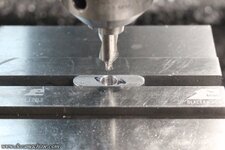
And finally drilled and counterbored.

fixture04.jpg

Due to clearances, I made two of the counterbores smaller than usual, and then turned the OD of the screws to fit those bores somewhat snugly.

fixture05.jpg

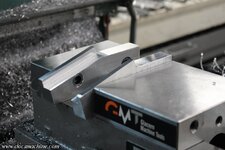
That both keeps the bore from breaking through to the working face, and also acts as a sort of locating pin, so both sides are fairly closely aligned to each other. And, of course, they fit my milling vise like so:

fixture06.jpg

Those then hold these "L Stocks" I make for paintball guns.

fixture07.jpg

That lets me mill a consistent flat at the end, where it screws to the bottom of the marker's grip frame...

fixture08.jpg

As well as letting me reverse the part in the fixture, in order to drill and countersink the mounting holes themselves.

fixture09.jpg

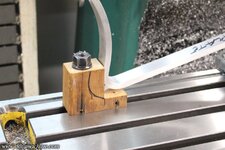
The final trick is a separate, movable "stop", to **** the... er, **** of the stock up against, so each one can be machined to the same spacing. I'm still noodling a design for this, but to get through this current job, I just used a quick bandsawed hunk of old 2x4.

fixture10.jpg

The proof, as they say, is in the pudding, so a fresh part goes in like so...

fixture11.jpg

And gets milled flat, like so.

fixture12.jpg

I was getting just a touch of chatter, so I'll probably slide the part backward (lower) into the fixture, to better support it, but in either case, it worked like a champ! It'll get me through this current batch, and make the next batch quicker and easier as well.

Doc
 
OP
D

DocsMachine

Well-known member
Joined
Sep 16, 2006
Messages
1,848
Yeah, I've been thinking of getting something like one of those. I have a set of ground angle blocks I use for the odd occasion I need to hold a single item at an angle, but they can be a hassle when doing multiple parts.

In this case, this is a product I'll be making on a semi-regular basis, so a few minutes making the specialty jaws was by no means wasted time. :)

And on to Today's Major Accomplishment:

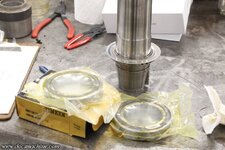
I received two of the five bearings I need. :)

rivett209.jpg

Stand by for more exciting updates!

Doc.
 
OP
D

DocsMachine

Well-known member
Joined
Sep 16, 2006
Messages
1,848
And now, for the latest incredible installment of this amazing project!

I got two more bearings in!

rivett210.jpg

I wish I had the time to, you know, actually do something with them... but hey, they're here, at least. :)

What about that fifth one? That's the third on the spindle- and I can't get a number off that 'til pull that apart. Which I ought to do this weekend, so I can order said bearing on Monday, I suppose.

I just need three more clones, another dozen minions, and for somebody to add nine or ten more hours to a day.

Or to huck it all and take up stamp collecting, but that's just crazy talk. :D

Doc.
 
OP
D

DocsMachine

Well-known member
Joined
Sep 16, 2006
Messages
1,848
Once again, trying to save time by spending time. Or at least, that's the excuse I'm using today. :)

Figure I won't have much time to fool with this thing this coming week, but I could still try to use that time wisely, and get that last bearing on its way in. But that, of course, meant pulling the spindle back out, and then pulling it apart- pulling it out was easy, as I still had the bits 'n bobs from doing it the last time.

rivett211.jpg

The tricky bit is, now I needed that spanner wrench I mentioned, and I expected it'd need to be fairly beefy, to overcome that staking on the nut. I didn't get pics of everything, as time was short, but simply put, I mocked up a profile in thin cardboard, transferred that to a chunk of some 1/4" steel plate, and bandsawed it out.

rivett212.jpg

I had the plaz the center out, and then spent all too long with the belt grinder getting the thing smooth and fit to size. I marked and drilled for the pins, cut and faced a couple bits of 3/16" rod in the lathe, and TIGged 'em in place.

rivett213.jpg

Now, the trick here was that I had no way to securely hold the spindle firmly enough to break the 'staking' on the nut. I tried grabbing it with the 3-jaw in the big lathe, but it just spun. I pondered the issue a bit, and came up with an alternate method. That method first needed a new key...

rivett214.jpg

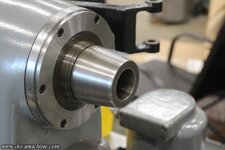
Which goes in the spindle nose like this.

rivett215.jpg

That's the drive key for the L-00 chucks, and I'd been meaning to make one anyway. This will primarily be a collet machine, but I like the idea of having the option to use a chuck.

I got out the locking collar bits that came with the machine, and installed them for the first time. They're well made, and fit perfectly.

rivett216.jpg

A couple of weeks back, I found an unfinished L-00 backing plate on eBay, when I was looking for some other parts. I have a 5" 3-jaw laying around, that I think will be perfect for this machine, so I picked it up.

I attached the plate to the spindle, and then bolted the spindle to my mill table. I used an aluminum plug with a taper machined into it, to help support the upper end of the spindle, and snugged it all up.

rivett217.jpg

The nut did indeed take some force to overcome, but once "broken loose", it spun off the rest of the way with relative ease.

rivett218.jpg

With that out of the way, I popped it off the backing plate, removed the retaining nut parts, and set it up in the press to remove the bearings.

rivett219.jpg

Note how this has a spring-loaded center spacer, apparently to allow the bearings to move, ever so slightly, as the machine warms up in use. (And/or warms up more at the higher spindle speeds.) I don't know why it was missing six springs- if that's a factory thing or whoever rebuilt this thing before, for some reason left those out.

rivett220.jpg

And there's the bare spindle.

rivett221.jpg

Got the number off the rear bearing, and was surprised to find that it, too, was a "super precision". Rivett didn't fool around, it seems. Looks like another $150, for a little over $550 total just in spindle bearings. Good thing I'm rich, eh? :)

Interestingly enough, the rear one feels the worse of the three. I may wash these out with solvent and see how they feel while clean and with some thin oil.

Yeah, I probably could have lived with the only-somewhat-noisy ones for a while, but while I have this thing apart, I might as well go all the way, before I put it into service.

Doc.
 
OP
D

DocsMachine

Well-known member
Joined
Sep 16, 2006
Messages
1,848
Today's quick nibbles at the rapidly dwindling carcass:

I fitted the two new bearings to the jackshaft assembly....

rivett222.jpg

And got that reinstalled into the cabinet.

rivett223.jpg

Then, with a rather considerable struggle that involved a good deal of cursing, I got the motor remounted as well.

rivett224.jpg

I wanted to give it a try, to see if or how much quieter it is, but I damaged the conduit connecting the motor, as I was manhandling that nine hundred pound pig back into place. So before I power anything up, I need to make sure the wires inside are okay, and repair or replace that length of conduit.

The only other accomplishment of note today- at least on this machine- was I painted one of the last parts for the collet closer.

rivett225.jpg

It was just a quick spray-job, but I wanted to get it out of the way.

Doc.
 
OP
D

DocsMachine

Well-known member
Joined
Sep 16, 2006
Messages
1,848
Possible crisis, ladies and gentlemen.

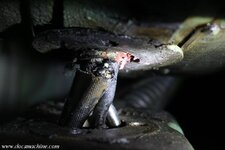
I opened up the junction box on the motor- which was worryingly loose in the first place- to check to see if I'd damaged any wires yesterday.

The bad news is, I found damaged wires. The worse news is that they weren't the ones I was expecting, and are damaged in the absolute worst possible location.

rivett226.jpg

I know it's not clear, but the overhead part is the motor body, while the lower one is the junction box. And at least one, possibly two, of the main wires coming out of the motor, have broken insulation.

At the very least, I'm going to have to disconnect the motor, and remove it again. Repairs, if they're even possible, will require at least partial dismantling of the motor itself.

Best course, I may be able to splice on some fresh wire. Last ditch? The wire isn't broken, so I may be able to just smear on some liquid electrical tape and maybe cover that over with some good heat-shrink.

There's a motor-rewinding shop locally, and it's possible I could have them take a look at it- which is a last ditch before buying a replacement DC motor. Assuming I can find one rated for the same voltage ranges and speeds. Input welcome, from anyone familiar with DC motors, and/or this kind of wire repair. Gonna need help on this one.

Definitely not what I wanted to see, and I definitely don't have time for it, but it's gotta be fixed nonetheless.

Doc.
 
To avoid these ads, REGISTER NOW!
OP
D

DocsMachine

Well-known member
Joined
Sep 16, 2006
Messages
1,848
Yep, this is one for the experts.

I got the wires marked, disconnected and the junction box out of the way. And the pigtails coming out of the motor body were stiff as a board... except where they go into the box. All four of them feel... for want of a better term, loose at the base. The two larger wires are definitely and visibly damaged, and the two smaller feel 'loose' enough I suspect their insulation is failing, too.

So, it had to come out.

rivett227.jpg

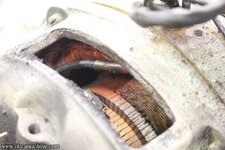
Once on the bench, the feeling was confirmed. Worse, there is zero slack in the wires, and looking in through the brush ports, it's clear that at least two of the wires go directly into the field windings.

rivett228.jpg

That is not something I'm comfortable trying to fix, so in the morning I'll be running it over to the local motor shop to see what they say.

Doc.
 

WoodsTruck

Well-known member
Joined
Jan 12, 2013
Messages
1,019
But don't you feel better that you didn't fire it up to find out what kind of damage exposed wires could create?
 
OP
D

DocsMachine

Well-known member
Joined
Sep 16, 2006
Messages
1,848
Actually, I have run it, several times. And the previous owner says he ran it quite a bit. No issues, no shorting, no nothing.

It's entirely possible the wires were more or less okay, until I dropped the motor the first time (as shown- not dropped dropped :) ) and the loose and able-to-twist junction box damaged them as I moved it around.

Wouldn't be the first such foul-up I've committed. :)

Doc.
 
OP
D

DocsMachine

Well-known member
Joined
Sep 16, 2006
Messages
1,848
Dropped the motor off at the local repair shop, and they were happy to have a look at it. Apparently their "rewinder guy" had just finished and delivered the previous job, and put mine right on the bench and started working on it. They're going to replace the leads and the bearings, and let me know if there's any other issues that we might need to attend to.

The commutator looks good- no grooving or stepping, and appears properly undercut- so I'll assume the brushes are okay too. So I should get back a pretty fresh motor good for a few more thousand miles.

I told the guy that it was part of a Ward-Leonard drive, and he showed me their setup- two gigantic 3-phase AC motors that turn a similarly gigantic DC generator (it's an easy four-plus feet in diameter and at least six long) to supply DC so they can test the big motors that come off the oil platforms and the like.

They told me it's basically antique- to took that to mean about as old as my lathe- roughly the 1960s- but works essentially the same way, and supposedly as good today as it when it was first installed.

Anyway, looking forward to getting the repaired motor back- I got the impression of less than a week, so here's hoping.

Doc.
 

larry4406

Well-known member
Joined
Jan 27, 2006
Messages
19,061
Location
Northern Virginia
Dropped the motor off at the local repair shop, and they were happy to have a look at it. Apparently their "rewinder guy" had just finished and delivered the previous job, and put mine right on the bench and started working on it. They're going to replace the leads and the bearings, and let me know if there's any other issues that we might need to attend to.

The commutator looks good- no grooving or stepping, and appears properly undercut- so I'll assume the brushes are okay too. So I should get back a pretty fresh motor good for a few more thousand miles.

I told the guy that it was part of a Ward-Leonard drive, and he showed me their setup- two gigantic 3-phase AC motors that turn a similarly gigantic DC generator (it's an easy four-plus feet in diameter and at least six long) to supply DC so they can test the big motors that come off the oil platforms and the like.

They told me it's basically antique- to took that to mean about as old as my lathe- roughly the 1960s- but works essentially the same way, and supposedly as good today as it when it was first installed.

Anyway, looking forward to getting the repaired motor back- I got the impression of less than a week, so here's hoping.

Doc.
That is fantastic that you have a competent shop close by for this specialty!
 
OP
D

DocsMachine

Well-known member
Joined
Sep 16, 2006
Messages
1,848
Lacking anything better to do, I rolled out of my comfy hammock, put down my spiced rum drink, and told the hula girls to go take five. :)

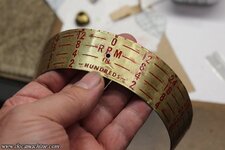
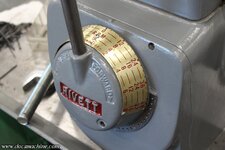
I had, several days ago, taken the brass dial plate off the speed control, and tried sanding some of the scuffing down.

rivett229.jpg

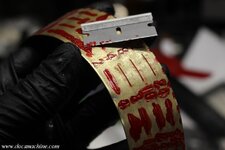
It had clearly been bent and re-bent a couple of times over its life, and the sanding kind of highlighted the "bend points", but there wasn't much I could do about that. Anyway, I thoroughly scrubbed and degreased it, and then filled in the lettering with more of that red Testor's.

rivett230.jpg

I'd originally tried the old trick of then lightly wiping it off, with a cloth wetted with thinner, and wrapped around a rigid backing. That worked great on the Springfield oil-sump plate, and the W&S speed control plates, but didn't work well here. The numbers were just too shallow- or I was too ham-fisted. Probably both. :)

So I re-painted them, and set it aside the dry as-is.

Today, I took a fresh razor blade to it, and simply carefully scraped off the excess paint.

rivett231.jpg

Was a bit on the tedious side, but it worked.

rivett232.jpg

I then re-wet-sanded it with some 800 grit, and a semi-soft backing to the paper in order to knock off the residue, and hone out the minor scratching from the scraper. I think it came out quite well.

rivett233.jpg

That definitely gives it a much more finished look, and makes it a lot easier to read the numbers.

Now to go lay back in my hammock 'til the motor's done. :D

Doc.
 
OP
D

DocsMachine

Well-known member
Joined
Sep 16, 2006
Messages
1,848
That is fantastic that you have a competent shop close by for this specialty!

-Oil field area. They had a bunch of huge 50, 100, and 200 HP motors in various states of repair and rewinding. I get the impression they enjoy these smaller motors because you can work on them without an overhead crane. :)

Doc.
 
OP
D

DocsMachine

Well-known member
Joined
Sep 16, 2006
Messages
1,848
Now that I had all the bearings in, I finally took a day to slap the spindle back together.

rivett234.jpg

The spindle just needed a light cleaning, and then it was time to... well, get dirty again. :)

rivett235.jpg

Mmmm... hand-packed bearings. :)

Kind of wish I had a bearing heater, but lacking that, I lightly pressed the front two into place, and then cleaned the spring spacer and the springs.

rivett236.jpg

The ring has space for 24 springs, but only came with 18, in two rows of 9 each. No idea why they did it that way, and I'd toyed with the idea of finding some replacements, but hey, if it's worked and lasted this long....

I did space them out more evenly, as you can see- probably won't make the least bit of difference, but still, it assuages my OCD. :)

The two steel spacers are cleaned and dropped on, and the third bearing lightly pressed into place.

rivett237.jpg

And finally, the locknut is tightened back into place, leaving some "preload" for the springs, and lightly re-staked.

rivett238.jpg

After that, it was a case of winching it back into place, seating it, and installing both the end caps.

rivett239.jpg

It rolls quite smoothy and soundlessly- of course, I suspect the old ones would have, too, if I'd cleaned and regreased 'em. :) We'll see once I have it back under power.

Now for my next trick: The spindle lock pin.

rivett240.jpg

Making this thing functional means fabricating another, thicker spacer. Not a great deal of work, but I had to ask: Do I even need the darn thing? And, after some thought... yes, actually, I do.

Remember this thing is equipped with an L-series "long taper" spindle. These use a threaded "retaining nut" to hold the chuck to the spindle. You can use a Crescent on a chuck jaw to hold the spindle if you're mounting or dismounting a chuck, but you can also attach a simple protective cap, to cover the outer taper, while using the inner 5C taper.

The only way to tighten, or to loosen once tightened, this cap is to have a way to hold or lock the spindle.

As I've said before, I don't expect to use a chuck much on this thing, and there's no particularly firm need to use the screw-on cap, as I can just remove the entire retaining ring assembly and use that sheetmetal slip-on cap.

BUT... I may still have a week or more before I get the motor back, and I figure while I'm here, why not? Better to have it and not need it, and all that. :)

The only steel I had in the shop that was big enough to pry a spacer out of, was this fifteen-some-odd pound doorstop, that has been sitting around for so long, I can no longer remember its origins.

rivett241.jpg

That I chucked up in the oft-neglected Springfield, and proceeded to peel off several pounds of what turned out to be alloy steel. (It cuts like 4140 chrome-moly.)

rivett242.jpg

That got a rough spacer- only rough as I wanted to use the faster Sheldon spindle to complete it, in order to get a better surface finish.

rivett243.jpg

Unfortunately, while the big parting tool was easily able to slice through this stuff, it wasn't deep enough to cut it all the way through.

rivett244.jpg

So I used the Portaband- at the absolute full extent of its capacity- to knife it off the rest of the way.

rivett245.jpg

Switching over to the Sheldon, I turned up a set of soft jaws, squared it up, thinned it to 'bout thar, touched up the bore, and faced a 10-thou tall step on one side- so it pressed against the inner race of the bearing, and cleared the outer.

rivett246.jpg

And, she slides smoothly and snugly into place. The locking pin falls put'near exactly in the middle of it, so the next trick will be to either bore a couple of holes, or mill a couple of notches to accept the pin.

rivett247.jpg

The other trick is I need to broach a keyway in it- and, of course, I don't actually have a 5/16" keyway broach. :) I could saw and/or file one, but again, I'm still waiting on the motor anyway, so I'll probably just order one.

Hopefully it won't be too long before the motor's done!

Doc.
 

bimmer1980

Well-known member
Joined
Feb 5, 2009
Messages
2,103
Location
York, PA
Perhaps the quantity of springs correlates to the appropriate amount of bearing preload? I.e. each spring force times the amount of deflection, times the quantity needed?

Regardless, nice work bringing this lathe back to factory spec (or better!!)
 
OP
D

DocsMachine

Well-known member
Joined
Sep 16, 2006
Messages
1,848
Towards the end of last week, I was able to finish up a job I had already in the turning center...

toolpost01.jpg

And started retooling for the next job. I'm hoping to get a big anno run sent off as soon as I can- I'd like to see two gone this month, if I can pull it off- and this piece was supposed to be a fairly easy little bit I could punch out. I got out a chunk of material, and chopped it into 32" sections- the longest single pieces I can fit in the Omni's spindle.

toolpost02.jpg

I then started programming. And, as I've taken to doing, I "built" the program in steps- write and prove the bore, write and prove the thread, write and prove the OD turn. Everything was going great- smoother than usual, which was, of course, a warning sign.

Like the steel collars I made earlier this year, I wanted to part the bar stock in the spindle- easier, faster, more consistent length, all that good stuff. But, the part is just over 2" long, and a large enough diameter it won't clear the tool slide. In order to reach, I need to extend the parting tool out about yea much:

toolpost03.jpg

Now, at some point I wound up with an Omni toolpost extension, but it's an older one that apparently doesn't work with my newer style tool blocks. The post can clamp and hold it, but the tool block is supposed to have it's own setscrew or something.

Omni sells the extension I need... for $190.

So, today, after a weekend of debauchery, I dug through the piles of scrap I have, and found a piece of mystery metal- probably mild- with sufficient volume I thought a custom extended tool post could be hiding inside. That got a slow and laborious trip through the bandsaw...

toolpost04.jpg

(Hey, it was an inch and a half thick!) And then a standard squaring-the-block exercise in the mill.

toolpost05.jpg

toolpost06.jpg

I then started carefully milling the dovetail feature....

toolpost07.jpg

.... And of course ran into a snag. I don't have a dovetail cutter that fits.

The one I thought I could use, turned out to be a 65 degree cutter, and I need 60 degree. All the 60 degree cutters I have are either far too tiny, or far too big.

I no longer own a shaper, and there's not really any other easy easy way to make that cut. I could make a cutter that might last long enough to finish this one part, but now I have to make a tool to make a tool so I can complete this job.

That time would be better spent on other pressing work, so I guess I have to set this aside, order a suitable cutter, and move on to some other task 'til it comes in.

Doc.
 
OP
D

DocsMachine

Well-known member
Joined
Sep 16, 2006
Messages
1,848
I, ladies and gentlemen, am an idiot. I know this doesn't exactly come as a surprise to many of you. :)

In this particular case, as has happened all too many times in the past, I got too focused on one "solution". Focused on trying to execute that one idea, I didn't bother thinking of other options.

My problem was I needed a way to hold my parting tool further out than my basic tool post could. I had an extension, that didn't work. I had a different tool holder entirely- that turned out to be slightly too short, and oriented the tool in the wrong direction. I hit upon making an extended tool block to fit my existing tool post, and as already recorded for posterity, was stopped by a lack of suitable tooling.

This morning, in the sober light of noon or so, I realized that yes, indeed, I was an idiot. There was a way I could do it right and do it fast.

So, I went to my metal supplier, and bought 5" of 1-1/2" (38mm) square steel stock.

toolpost08.jpg

After a quick deburr in the belt grinder, I clamped it end up in the vise, and gingerly cut a 1/2" square notch in the end.

toolpost09.jpg

That got lightly chamfered for both looks and to reduce blood leakage...

toolpost10.jpg

And then drilled and tapped for 5/16"-18:

toolpost11.jpg

The soon-to-be underside got a notch and a flat to make a "key"....

toolpost12.jpg

And then two carefully-measured and located bolt holes to mate up with the 'key' on the underside.

toolpost13.jpg

The bolts wound up just slightly long, so I threw a collet in the little Hardinge and shortened 'em up by about a sixteenth. (21 millifarthings.)

toolpost14.jpg

The whole thing bolts on, nice and solidly, like so:

toolpost15.jpg

Including the trip to the metal shop, the whole process took roughly three hours. (There was a lot of fiddling, fettling and fitting I didn't show. :) )

Anyway, I finished up programming the part, and took 'er for a spin:

toolpost16.jpg

toolpost17.jpg

You can see the "parted" piece falling towards the back, at the bottom center of the frame.

And, since I had the raw stock already cut and ready, I ran the first two pieces, for a total of 24 parts so far.

toolpost18.jpg

I'll be able to turn more over the rest of the week, which will put me- at least on this one task- three or four days ahead of where I'd be if I'd just waited for the cutter for the other block.

I'll still finish up the other block- it'll have its uses- but at least I can make a little quicker progress than I'd anticipated.

Doc.
 
OP
D

DocsMachine

Well-known member
Joined
Sep 16, 2006
Messages
1,848
With all the stuff I have going on at the moment, it's time to wrap this little project up, if I can, and get it out of the way. Projects are fun, but there are times when it's better to have a working machine, than to be working on the machine. :D

In last week's exciting episode, our heroes had just made a new disc to act as the spindle lock. The next step was to bore the pin-receiving holes in it, for which the first step was to mark them. I gutted the locking-pin assembly, and used just the collar and a transfer punch, to lightly mark the OD of the disc.

rivett248.jpg

I then set up the dividing head on the green mill, found the axis center, and located the punchmark as close as I could, with a point turned in a 1/4" steel rod.

rivett249.jpg

The idea here is to try and keep some semblance of balance to the new disc- so I needed an easy way to make sure the two holes are exactly 180° from each other- within the limits of a budget-priced Japanese dividing head, anyway. :)

A simple set of the quill travel stop also assures that both are the same depth. I pilot drilled them, and then bored them smooth with a 3/8" endmill.

rivett250.jpg

After that, the disc needed a keyway. I'd ordered and received the broach I needed, but I didn't have a guide bushing. So I found a likely-looking section of 3" round 'looneymum (or for you Brits, 'looneyminimum :) ) and turned it down 'til she fit through the disc.

rivett251.jpg

Swapping back to the mill- which at this point desperately needs a cleaning- I located center and milled a groove of the proper width and depth to accept the broach.

rivett252.jpg

Moving over to the hydraulic press, I carefully broached the keyway, trying to keep it 90° to the two pin holes.

rivett253.jpg

Et Voilá! (Which, I have on good authority, roughly translates to "Hey, check this sh*t out!" :D )

rivett254.jpg

One last-minute thing: Because the collar is in under a casting, a proper setup is to provide an easy way to remove it- in this case, since you can't get a gear puller in there, a pair of threaded holes lets you grab it with something like a steering-wheel puller.

rivett255.jpg

Again, centered and evenly spaced, to try and maintain a decent balance.

This slips in like so, along with a new key (since the one I'd made before is now too short.)

rivett256.jpg

The original pulley goes over that....

rivett257.jpg

And finally the locknut and it's retainer.

rivett258.jpg

But, we're not done yet!

The locking pin assembly needs to be reworked. It had a spring-loaded detent, that both held it up out of the way, and held it down in the 'locked' position. That meant it was possible to lock it... and then forget to UNlock it. This DC drive setup has a fair bit of low-speed torque, and it's entirely possible that doing so could damage something.

Point in fact, I suspect that's why the factory lock-disc was missing- either some operator kept forgetting it was on, or to keep such an occurrence from happening.

So I set about redesigning it a bit. I found a chunk of 3/8" round stock in my scrap bin, that turned out to be 304 stainless. Not ideal from a machining standpoint, but it was a nice, clean, accurate bar, so I went with it.

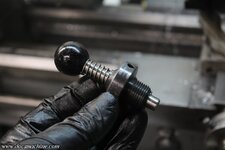
It got turned to length, grooved for the snap ring, and one end threaded for the original ball-knob.

rivett259.jpg

I then found a suitable spring in my Suitable-Springs Stashes®, and assembled it like so:

rivett260.jpg

And that assembly simply tightens into place just as the original did:

rivett261.jpg

Where it, of course, works like a champ. :)

The spindle is now back up to 100%. We just need a motor. And the collet closer. And the turret still needs some fiddling, and...! :)

Doc.
 
OP
D

DocsMachine

Well-known member
Joined
Sep 16, 2006
Messages
1,848
NOW we're getting somewhere! :D

I rolled into the shop about two in the afternoon, having had some prior engagements on my schedule, but with the intention to finally get the motor back into place and wired.

I'd gotten the motor back from the shop last Friday, but was unable to clear enough time to do much with it. They did a great job, and while it was a tad more than I was hoping to spend, they gave it a full workover, including new bearings.

But before I could attend that, I needed to patch up the flexy conduit, and double-check the wires in there were okay.
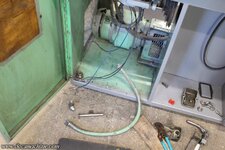
rivett262.jpg

Turns out the only real damage was to the outer plastic sleeve- which was old enough it cracked when bent too far. The inner steel armor held up nicely, and the wires were fine.

The ends are older, and likely obsolete, fittings, but I was able to extract the sealing ring from the bad end, bandsaw off the 3" or so of damage, and carefully resinstall everything.

But first, the motor!
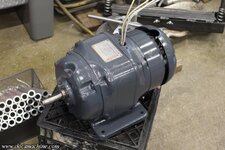
rivett263.jpg

New bearings, dipped and baked rotor, new field and armature wires, and they checked the comm and brushes. I didn't know paint was on the agenda, but I ain't complainin'. :D

I cleaned the junction box, and snipped a sort of "gasket" from some of the leftover tool-drawer liner...
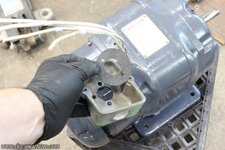
rivett264.jpg

And fixed it in place with fresh bolts and washers.
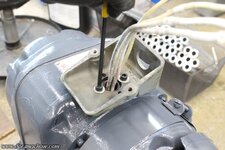
rivett265.jpg

Bolted on the pivot/hanger...

rivett266.jpg

And with remarkably little cursing, got it hung up, the belt installed, and the tension adjuster bolted in place.
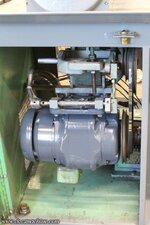
rivett267.jpg

Since the spindle pulley was now in it's final resting place, I was able to slide on the jackshaft pulley, and with the aid of a piece of string and a weight, align it to the spindle and lock it down.

rivett268.jpg

This one's a taper-lock pulley, likely an aftermarket, as the few diagrams I've seen online- including the paper one glued inside the door- show a stepped pulley. Two sets of two pulleys, to give two different speed ranges- one normal and one slower, for more torque.

I had again used a buddy's heat-shrink printer thingy, and made a new set of ID tags for the new wires.

rivett269.jpg

The shop had put their tags out at the end of the long wires- not unreasonably- but in my case, I wanted to snip about 4" off each one, so they'd fit better inside the junction box. Anyway, simple matter of double-checking, sliding, shrinking and snipping.

I similarly relabeled the wires in the conduit, slid that into place, and got it connected up at both ends.
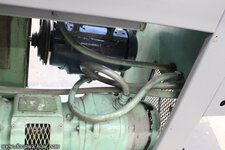
rivett270.jpg

With the wires wire-nutted in place and in proper order... it was time to test this puppy!
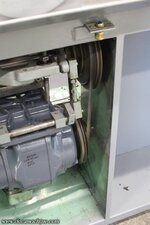
rivett271.jpg

And it works like a champ! There's a touch of vibration, probably from the big iron step pulleys, but plenty smooth enough, and at this point, with just the motor and jackshaft, damn near silent. The motor-generator pair makes more noise. :)

Throw the two spindle belts on...

rivett272.jpg

And take that for a spin:

rivett273.jpg

Smooth, quiet.... A significant difference from the as-delivered sound level. The original setup didn't "howl", but as noted earlier, it made more noise than I thought it should.

All this was a nontrivial extra expense and expenditure of time, but it was worth every penny. I'm actually wondering now, if the motor-generator pair couldn't stand a set of bearings... :)

All the way up to top speed- in this range, about 1600 RPM- and still nearly no noise save for the M-G setup. I mean, it's not library-silent, but the fans on the VFDs on some of my other machines, make more noise than this spindle and drive. :)
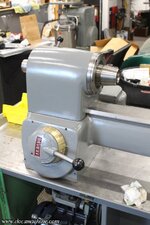
rivett274.jpg

And finally, the back covers can go back on, more or less for good at this point.
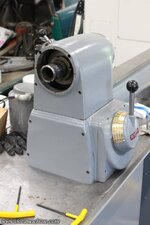
rivett275.jpg

Over the course of the day, I snuck in a few other little fiddly bits as well. One item was the electrical enclosure had no latch- it used two bolts to hold the door shut. I'd imagine that's in part to keep operators from poking around in there, but in my case, I didn't like having to get a wrench when I wanted to fiddle with it.

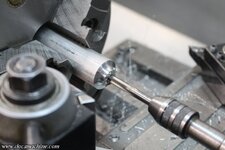
So I found a hunk of 1" 'looneymum, gouged a curvy bit into it, drilled and tapped it...
rivett276.jpg

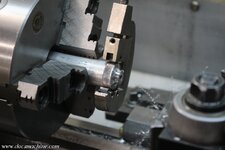
Gave it a quick knurl with a handheld knurling tool...
rivett277.jpg

Parted it off, faced and chamfered it...

rivett278.jpg

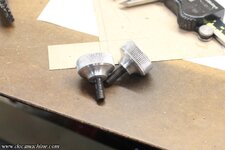
And somehow ended up with two of them. :)
rivett279.jpg

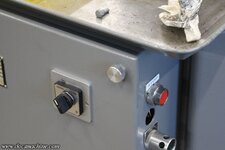
These simply go in place of the bolts, and let you open the enclosure, if necessary, by hand. There's a gasket on the door, to give some 'crush', so the knobs are unlikely to vibrate out.
rivett280.jpg

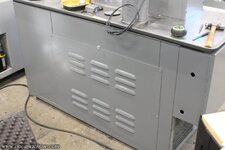
I also bolted the back cover... er, back on, including adding a middle bolt at the top edge, as the cover tended to "oil can' a little, and rumble slightly under vibration. I had to use the large washer there, as there wasn't enough depth to the cabinet edge to put a screw through both.
rivett281.jpg

I may wind up putting a screw or two at the bottom, too.

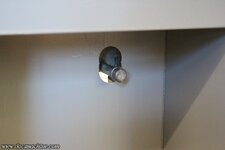
And finally- finally!- I remembered to cap the sump drain. :)
rivett282.jpg

I'm still not sure if I'll ever use flood coolant or oil- this thing doesn't have enough splash guarding- but I figured if I ever do, it'd be just my luck I'd have forgotten I'd never capped it.... after I dumped two gallons of oil into it. :)

Stand by, we're nearin' the end!

Doc.
 
OP
D

DocsMachine

Well-known member
Joined
Sep 16, 2006
Messages
1,848
The last major subassembly: the collet closer!

rivett283.jpg

The first bit is the handwheel, and it's notched... locking ring... thing. :)

rivett284.jpg

The handwheel is to let the operator turn the spindle by hand, of course, and the locking ring is what helps keep the threaded drawtube from unscrewing from the collet. Fortunately, this unit only needed a good scrubbing and some paint.

One interesting bit was this key, which I'm not actually convinced is original:

rivett285.jpg

The setscrew coming in from the outside is tapered, and wedges those two blades apart, locking it into the keyway. Odd indeed, but it works.

rivett286.jpg

rivett287.jpg

After that quick check, I split the parts, scrubbed everything thoroughly....

rivett288.jpg

And gave the handwheel a quick squirt of gloss black.

rivett289.jpg

While that was drying, it was time to look at the rest of the locking mechanism.

rivett290.jpg

It had puzzled me for a bit, as this style of collet closer had no obvious "lock"- a way, as noted above, to keep the drawtube from unscrewing itself from the collet. Which could throw off dimensions, cause the work to come loose, etc.

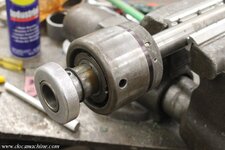
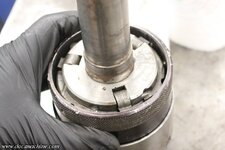
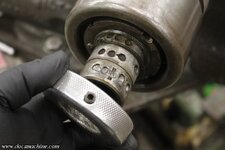
Once I finally sat down and studied it, it seems this arrangement uses a sliding collar, rather than a small lever-shaped lock. The knurled collar in the middle of the assembly, pulls to the left, and unlocks two little studs from that notched ring shown earlier. The collar is spring-loaded, and has a detent to help hold it 'locked'.

rivett291.jpg

One of the problems was that those little studs were missing.

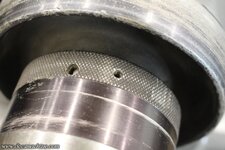
rivett292.jpg

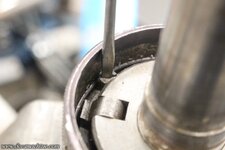
I'm guessing that the larger holes (there's two sets, 180° apart) were the original studs, that long ago stripped out. And at some point, somebody drilled and tapped two more, for some 10-32 screws.

Either way, I pondered way to replace them, but we'll come back to that.

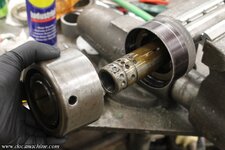
Continuing the disassembly, the worn-smooth aluminum handwheel at the very end came off easily, but had clearly at one time been keyed in place- the setscrew had mashed the Woodruff key slot into an unusable mess.

rivett293.jpg

Fortunately, this wheel is just there to turn the drawtube while installing or removing a collet, so it doesn't see a lot of horsepower. I'm going to try cleaning up the ring and maybe re-knurling it, but probably not 'til later.

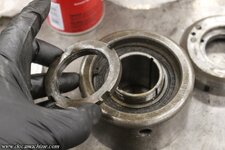
Removing the badly-damaged snap ring lets bearing carrier slide off- and I was happy to find that bearing, at least, was in excellent shape. :)

rivett294.jpg

Less so, could be said of the two screws that retain the locking collar. I got 'em out, but they're badly buggered, and were very likely not original.

rivett295.jpg

That revealed the inner locking mechanism, which thankfully just needed a good scrubbing in our favorite non-leaded solvent. :)

rivett296.jpg

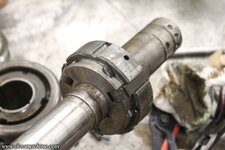
The bearing carrier assembly came apart easily- though you can see some ham-handed types have beat up this locknut, too.

rivett297.jpg

The inner cone pressed out easily, and then, once the snap ring was out, the bearing pressed out easily too.

rivett298.jpg

With most of it all apart, and thoroughly cleaned, it was time to do a little spiffing up. The bearing carrier took a ride in the other lathe...

rivett299.jpg

And after filing down some of the more egregious nicks and dings, took a nice buff from some Scotchbrite and WD-40.

rivett300.jpg

Which, Ladies and Gentlemen, marks the Three-Hundredth photo in this project series. :D

And we're still not done yet.... to be continued. :)

Doc.
 
OP
D

DocsMachine

Well-known member
Joined
Sep 16, 2006
Messages
1,848
I can't put it entirely together just yet, but thankfully most of this assembly just needs a cleaning.

One thing I was looking at, was the back of the headstock- the belt cover casting. There's these four little threaded holes around the opening...

rivett301.jpg

That I suspect once held a thin sheetmetal cover. Meant, most likely, to be a splash guard, so oil, coolant or chips don't get down into the belt area, and/or drip on the motor.

With the handwheel in place...

rivett302.jpg

There's a gap there, about 1/16" wide. So the cover was probably something like 18 gauge. I'm toying with the idea of making a new one... If I ever do run flood coolant or oil on this thing, it'd help keep it off the belts.

Anyway, after the wheel had had a chance to dry a bit, I bolted it and the locking ring thing back together, and clamped it back in place.

rivett303.jpg

For those two little lock studs, I decided to keep it simple- I turned a pair of stainless button-head screws to just .350" OAL, degreased everything, and screwed them in to the 10-32 holes with a touch of blue Loctite.

rivett304.jpg

Those mate up with the notched ring like so:

rivett305.jpg

With that done, I used a little grease to stick the three springs in place, so I could slide that collar back on.

rivett306.jpg

That round hole in the center is where the detent ball goes.

To replace those buggered screws, I took two more buttonheads, turned about .020" off the edge so they'd fit cleanly- and still retain the collar- slid everything more or less into place, and snugged 'em down.

rivett307.jpg

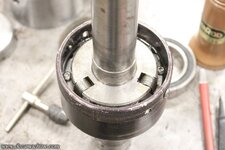
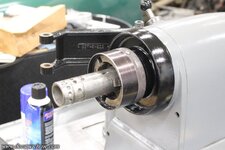
I slid the whole mess back into the headstock to finish the assembly. Note the empty Woodruff key slot- that keeps the locking 'cone' from trying to spin on the drawtube- which it's not designed to do, and could damage both parts if you let it do so for too long. That key was missing, and probably has been for some time.

rivett308.jpg

I had a replacement key, but it needed to be cut down quite a bit before the parts slid together smoothly.

rivett309.jpg

rivett310.jpg

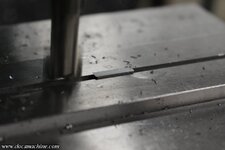
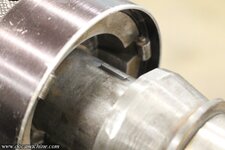
Unfortunately, the key notch in the drawtube was bigger than the keyway in the sliding cone- which, for anyone who's used Woodruffs will know, means that allows the key to "rock" as you try to slide the parts together. Once it rocks upward, you can't assemble the pieces.

I finally managed it, but it was frustrating- and I probably didn't assemble the whole thing in the factory-specified manner. :)

Anyway, with that fitted, I of course had to slide the 'cone' back off, and assemble it into the bearing carrier.

rivett311.jpg

Aaaand go through that little but of frustration again, this time with the carrier's dust shield making the key all but inaccessible.

rivett312.jpg

But, after all that, here it is fully assembled (save for the actuating arm) and "locked".

rivett313.jpg

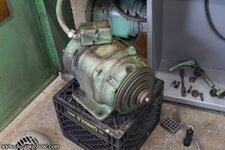
For the first time in the nearly two months (!!!) I've had this thing, it has a collet and a workpiece properly locked into place. :)

rivett314.jpg

Stay tuned, we're on the home stretch!

Doc.
 
OP
D

DocsMachine

Well-known member
Joined
Sep 16, 2006
Messages
1,848
We're damn near done, ladies and gentlemen! At least with the major bits, anyway. :)

I had to make a parts run this morning, and among other things, stopped to get a new section of flexy conduit for the pump connection.

rivett315.jpg

The old stuff was getting brittle, and I didn't feel like trying to scrape off the old green paint. I was again able to save the old-style conduit ends, and it just took a little finagling to get it all back into place.

It's not actually wired to anything, as I don't have a source of 3-phase on this machine apart from the VFD, but as I've said before, I'm still not sure I'll even use flood on this thing. At least not right away.

Anyway, after that... it was finally time to finish the collet closer, the last major assembly in this project. :)

The last piece was the yoke, a casting with the actual handle the operator... er, actuates. In this machine's case, the casting had been damaged at some point in the past, stripped and repaired, and the handle itself was missing.

rivett316.jpg

I suspect the original setup had a short rod as a handle, with the typical black phenolic ball-knob, and which had at some point become stripped out of it's threads. Or some damage occurred and the casting got cracked. Either way, somebody had repaired the crack via brazing, and also welded on an extra nut to give the threads more support.

rivett317.jpg

The braze seemed solid enough, and I saw no reason to try and re-do it, so I just ground on it a little to smooth it up slightly, and then lightly sandblasted it, to get the last of the old paint off.

rivett318.jpg

The trick now was to mount a handle. I'd picked up a "long teardrop" shape phenolic handle on one of my earlier McMaster orders, so I just needed to make a rod that goes between it and the casting. I rooted through the junkbins and found a suitable hunk of 7/8" hot-rolled mild steel.

rivett319.jpg

One end I threaded to 5/8"-18, which is what the yoke casting had been tapped to. (I have no idea if that was the original thread- I suspect not.)

rivett320.jpg

The other end I turned down and threaded to 1/2"-13.

rivett321.jpg

That gave me my mounting shaft, but it still needed a little something.

rivett322.jpg

So I turned a "wasp waist" into it, with a couple of smooth curves to the ends. 100% for looks, but hey. :)

rivett323.jpg

Then, using a square collet block in the mill, I cut two wrench flats on the "fat" end.

rivett324.jpg

Which of course lets me firmly tighten it into place.

rivett325.jpg

After that, I took it back apart, and masked and painted the yoke.

rivett326.jpg

The last bits of this little job were to cut down some long 1/2" setscrews, and turn a smooth 3/8" "dog point" on the ends.

rivett327.jpg

Then, using a different piece of 1/2" threaded rod as an arbor, I thinned and flattened two 1/2" nuts to go with them.

rivett328.jpg

These are the 'pivot pins' for the yoke to connect to the bearing carrier- which of course stays still (non rotating) as the spindle is turning, and lets the handle pull and push on it and the drawtube.

rivett329.jpg

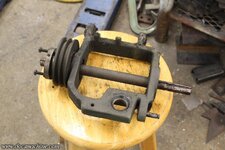
And done, ladies and gents!

rivett330.jpg

Assembled, adjusted, lubed and 100% functional. It opens and locks smoothly, and there's only a hint of shake as the spindle turns. (That's common for this kind of closer.)

So what's left to do?

Just a few detail things, a clip here and a snap-ring there. I need to finish tweaking the turret, and at some point set up an X/Y slide on this thing. That won't be cheap, but it'll make the machine much more useful.

That and getting a first batch of tooling set up, will get us actually cutting chips!

Down the line sometime, I'll replace that wooden slide-out collet tray. The old wood is, I think, a little too thin, and I can make the pattern denser, to hold half again as many collets. I'll eventually make a tool rack for up top, for the often-used stuff, and eventually start considering splash guarding.

But... after almost two months- two months of time I really couldn't spare- she's damn near done!

And now... I really, really need to clean the shop. :D

Doc.
 
OP
D

DocsMachine

Well-known member
Joined
Sep 16, 2006
Messages
1,848
Today was Shop Cleanup Day- probably the first of several over the next couple of days. :)

I've been going pretty much flat-out since at least May, and certainly since mid-June or so. And, as a result, the shop is a wreck. And I'm a slob, so that's saying something.

Tools, parts and leftovers are scattered literally everywhere, I have bins of in-progress CNC parts on damn near every available flat surface, and almost every machine is choked with swarf and dripping with oil. All the trash cans are full, there's extension cords and air hoses everywhere, and I have boxes and tools piled on some of the unused machines.

The floors look like there was an explosion at the glitter factory, all the workbenches are too crowded to work at, and thanks to the new machine displacing a non-trivial amount of shop space, I have a bunch of things, like the big vacuum, that no longer have a 'home'.

Much as I wish I had a nice, clean, well-organized CNC shop like you see on all those YouTube videos, that's just not in the budget.

So I took a chunk of day and tried to wring a little order out of this five-pound sack full of fifty pounds of packrattery. :)

Here, for example, was the Sheldon lathe at the start of the day:

clean1.jpg

And here it is about an hour later.

clean2.jpg

All the collets are back in the drawer, all the lube points have been lubed, and all the chipped inserts have been replaced, too. :)

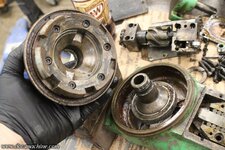
I also cleaned out the chuck. It's an integral-back Bison, and was almost new when I bought this machine back in 2008. I have since put a ****** great lot of miles on it, and have strove to keep the chuck in as good a condition as I can- I don't overtighten it, I've never had a real crash, and I used to open it up, clean it, and regrease about once a year.

Lately it's been binding- a sure sign there's too much swarf in the scroll. And it occurred to me... I couldn't really remember when I'd cleaned it last. It might have been pre-pandemic.

So I popped it off of there, opened it up, and let it marinate for a while in Mr. Wizard's Amazing Lead-Free Universal Solvent:

clean3.jpg

Thankfully there's no apparent damage and no real wear, so I just scrubbed off the old grease, rinsed out all the swarf- and there was a lot- and blew it all dry.

clean4.jpg

After that, I reassembled it with some fresh grease...

clean5.jpg

And put 'er back on the also-freshly-cleaned lathe.

The whole shop is looking a little better- somewhat less like a fresh bomb crater than it did yesterday. :) Still have a lot of tidying up to do, and as always, I still need to find a 'home' for some of this junk, but like the cleaning itself, that's a neverending process. :)

Doc.
 
OP
D

DocsMachine

Well-known member
Joined
Sep 16, 2006
Messages
1,848
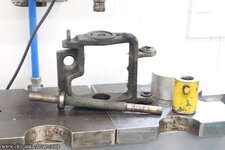
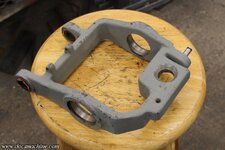
One quicky little bit today: To get it up off the floor, I remounted the lever cross slide, and since the accessory bits looked a bit shabby, I gave 'em a quick coat of black.

rivett331.jpg

rivett332.jpg

That and a teeny dab of some RTV to seal a couple of gaps where the headstock casting meets the bed, in order to seal it against oil or coolant intrusion, is all I did to the Rivett today. :)

More later.

Doc.
 
To avoid these ads, REGISTER NOW!
Top Bottom