What about something like these? You could even make your own.dedicated allen wrenches and the like, so I don't have to hunt elsewhere for them

You are using an out of date browser. It may not display this or other websites correctly.
You should upgrade or use an alternative browser.
You should upgrade or use an alternative browser.
Inside Doc's Shop...
- Thread starter DocsMachine
- Start date
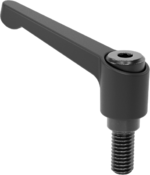
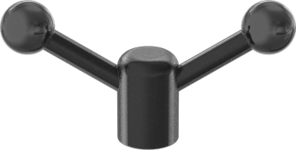

OP
DocsMachine
Well-known member
- Joined
- Sep 16, 2006
- Messages
- 1,923
Something like that, or a thumbscrew or wingnut could work in one or two places, but there's a lot of places where it'd be more trouble than it's worth.
The locks on the cotters I just made, would be too close together- the handles would get in each others' way. I also need a small wrench- like 1/8"- for the locking screws on the adjusting screws, plus a 3/16" for those screws themselves. And since those occasionally overlap, the 'wingnut' couldn't be very big.
The plan is to make a simple backsplash, not only to reduce oil being sprayed off the collet or chuck, but also as a place to hang a small rack of various Allen wrenches. (Along with tool blocks and the like.)
I could use something like that first lever, on the locking screws at the back of the cross slides... that's actually kind of an interesting idea I hadn't thought of... Unfortunately, I tapped my parts for 3/8"-24, and it doesn't look like that kind of handle is available in that caliber. I'd have to make new ones- which is of course possible...
Doc.
The locks on the cotters I just made, would be too close together- the handles would get in each others' way. I also need a small wrench- like 1/8"- for the locking screws on the adjusting screws, plus a 3/16" for those screws themselves. And since those occasionally overlap, the 'wingnut' couldn't be very big.
The plan is to make a simple backsplash, not only to reduce oil being sprayed off the collet or chuck, but also as a place to hang a small rack of various Allen wrenches. (Along with tool blocks and the like.)
I could use something like that first lever, on the locking screws at the back of the cross slides... that's actually kind of an interesting idea I hadn't thought of... Unfortunately, I tapped my parts for 3/8"-24, and it doesn't look like that kind of handle is available in that caliber. I'd have to make new ones- which is of course possible...
Doc.
OP
DocsMachine
Well-known member
- Joined
- Sep 16, 2006
- Messages
- 1,923
It would seem I can still trip-out the VFD, if I go from forward to reverse too fast. And "too fast" isn't all that fast, really.
That may be a problem when I go to do some tapping with a releasing head- which is one of the main tasks I got this smaller turret for.
Anyone have any ideas about making the setup a little more 'fault tolerant'? It's an Automation Direct GS2 VFD, presumably a 2HP capacity given the 2HP drive motor. Would bumping it up to a 3HP-capable VFD help any?
Doc.
That may be a problem when I go to do some tapping with a releasing head- which is one of the main tasks I got this smaller turret for.
Anyone have any ideas about making the setup a little more 'fault tolerant'? It's an Automation Direct GS2 VFD, presumably a 2HP capacity given the 2HP drive motor. Would bumping it up to a 3HP-capable VFD help any?
Doc.
tool_scrounge
Well-known member
Lower the acceleration / deceleration value
Less preferably, increase the max drive current setting.
Less preferably, increase the max drive current setting.
dutchgray
Well-known member
Fit a lower resistance valve braking resistor, if the VFD allows.
OP
DocsMachine
Well-known member
- Joined
- Sep 16, 2006
- Messages
- 1,923
Fit a lower resistance valve braking resistor, if the VFD allows.
-Lower resistance? I'm definitely something of an electrical dunce, but I suppose I can see how that would work. Most of the braking resistors I've seen are listed in ohms and wattage- the manual for this one recommends a 100-ohm, 300-watt unit.
So maybe try something like a 75-ohm, or drop all the way down to 50-ohm?
Doc.
dutchgray
Well-known member
Didn't you say you fitted a 200 ohm?-Lower resistance? I'm definitely something of an electrical dunce, but I suppose I can see how that would work. Most of the braking resistors I've seen are listed in ohms and wattage- the manual for this one recommends a 100-ohm, 300-watt unit.
So maybe try something like a 75-ohm, or drop all the way down to 50-ohm?
Doc.
I would drop to 100 ohm, lower resistance allows higher current to flow through, it will turn electricity into heat quicker. Going lower than the drive recommends could allow too many amps to flow and potentially damage the drive.
The wattage rating is how much power it can handle and not burn up, so don't go lower on that.
OP
DocsMachine
Well-known member
- Joined
- Sep 16, 2006
- Messages
- 1,923
I got the new braking resistor in yesterday, and after a few other must-dos, took a moment to install it:
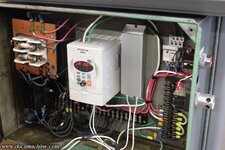
The one I had, it turns out, was a 200-ohm, 80-watt. Not sure why I got that one, though as I've said, it was intended for the Nichols, which has a 1HP VFD (on a 3/4 HP motor) so it may have been what was recommended at the time. Or possibly the closest I could find. Whichever.
The new one is 100-ohm, 300-watt, as the manual suggests- and is more than twice the physical size of the other.
Fired up the machine, and did some test runs- and I believe the issue may indeed be solved. I stopped and started the spindle about as fast as one can reasonably expect to move the control, with no hiccups. I then tried forward-to-reverse... and still had no hiccups.
I may not have been yanking the handle back and forth as fast as possible, but I was going from 2K RPM or so in reverse and back to 2K or so forward, in maybe two seconds, and she never skipped a beat.
I'll still try and do the reverse switch at a moderate rate- and always planned to, I don't beat on my machines- but just not having to worry about being right on the ragged edge of "switching too fast" is a boon.
Oh, and I poked around in the manual to see if there was a parameter that could be adjusted? There was only one, something like 'overcurrent tolerance in operation', which according to the brief description, seems to help compensate for sudden loads, or loss of load.
But, when I checked, it was already set to the maximum 200% default.
So it would seem the more properly sized braking resistor was the key. I still have some tapping operations to run, so we'll see what happens under actual use.
Doc.
The one I had, it turns out, was a 200-ohm, 80-watt. Not sure why I got that one, though as I've said, it was intended for the Nichols, which has a 1HP VFD (on a 3/4 HP motor) so it may have been what was recommended at the time. Or possibly the closest I could find. Whichever.
The new one is 100-ohm, 300-watt, as the manual suggests- and is more than twice the physical size of the other.
Fired up the machine, and did some test runs- and I believe the issue may indeed be solved. I stopped and started the spindle about as fast as one can reasonably expect to move the control, with no hiccups. I then tried forward-to-reverse... and still had no hiccups.
I may not have been yanking the handle back and forth as fast as possible, but I was going from 2K RPM or so in reverse and back to 2K or so forward, in maybe two seconds, and she never skipped a beat.
I'll still try and do the reverse switch at a moderate rate- and always planned to, I don't beat on my machines- but just not having to worry about being right on the ragged edge of "switching too fast" is a boon.
Oh, and I poked around in the manual to see if there was a parameter that could be adjusted? There was only one, something like 'overcurrent tolerance in operation', which according to the brief description, seems to help compensate for sudden loads, or loss of load.
But, when I checked, it was already set to the maximum 200% default.
So it would seem the more properly sized braking resistor was the key. I still have some tapping operations to run, so we'll see what happens under actual use.
Doc.
OP
DocsMachine
Well-known member
- Joined
- Sep 16, 2006
- Messages
- 1,923
Quick little in-action video on the new lathe. Not a proper piece, just a test part to demonstrate some of the tools.
Doc.
Doc.
dutchgray
Well-known member
I'd say the Rivett 60 turned out pretty good, should be useful for small production runs of simple parts or for second operation on parts off your CNC.
OP
DocsMachine
Well-known member
- Joined
- Sep 16, 2006
- Messages
- 1,923
That's... pretty much what I got it for.
Doc.
Doc.
danielbuck
Well-known member
- Joined
- Apr 15, 2014
- Messages
- 948
man, that's super nice to just switch from center drill to a regular drill so quickly, everything else after that is just icing on the cake
OP
DocsMachine
Well-known member
- Joined
- Sep 16, 2006
- Messages
- 1,923
One common accessory for both turret lathes and some of the conventional lathes, is a work stop. It's a fixed feature mounted in the spindle, or attached to a collet, etc. that lets you put a part into the machine, and holds it in a repeatable position.
That is, if you have, say, ten parts, and they all need to be faced off to the same length, you set up a stop. The part is put into the collet or chuck, butted up against that stop, so that if you take a cut to the same setting on each one, they all come out to the same dimension.
Things like 5C collets have internal threads, and you can screw an internal stop into it- so each part put into that collet, ends up in the same relative position.
I have a drawerful of such 5C stops (I have five machines that take 5C ) and have fitted both the Sheldon and the Omniturn with adjustable stops that fit in the drawtube. That way I can do longer parts than just what can fit inside the 5C.
Unfortunately, neither of those fit the new Rivett, and I had some nominally-12" pieces to drill and tap, so I had to take a few moments and make a new one.
I found out that, after removing the collet closer (I'll be using the 3-jaw for this) the bore of the end of the spindle was right at 1.500", with a slight step about half an inch in. I found a chunk of 1.5" aluminum round in the bins, pondered it a bit, and proceeded to stab it with spinny blades of death.

I needed two "clamping" features- expanding on one end to hold the bore, and the other contracting, to hold the stop-rod. The expanding part is tricky, but I've done a couple of these now- you use a setscrew, in an incomplete thread made with a taper plug tap. That way, as the setscrew is screwed into the hole, it wedges the parts outward to hold onto the bore.
I found a couple of stubby, coarse-thread 7/16" setscrews that looked like they wanted to join the party, marked off and drilled a couple of appropriate holes, and then ran the tap in 'til the screws were just flush before they started wedging.
I then used a slitting saw to strategically slice the part, so that the screws could actually move the material. The fit to the bore was pretty snug "at rest", so the required wedging movement is minimal.
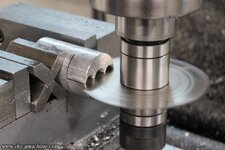
The only trick being that you have to reach them from the outside- so there are passages drilled from the outer end to allow Allen wrench access, and you turn them counterclockwise, as if unscrewing.
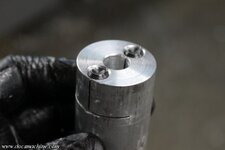
Then, on the outer half, I bored the center to a close running fit to the aluminum rod, cross-drilled it to help allow a tiny but of flex, then drilled, counterbored and tapped it for two pinch bolts.
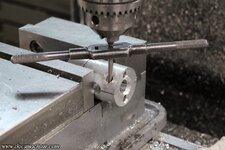
Et voilá!
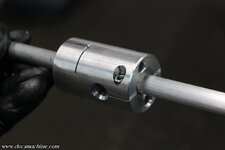
She fits like so, and holds quite solidly. The rod can adjust basically the full length of the spindle, allowing parts- using the chuck- of almost two feet long if necessary.
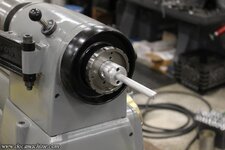
Now, the trick with the rod is that we need a disc on the end, that's close to the diameter of the ID of the spindle. Sometimes parts are hollow, and a plain 1/2" rod wouldn't work. The disc allows it to contact any part, hollow or not, and being close to the bore size, helps keep it from "whipping" when spin fast.
So, I found a thick disc of aluminum in the bins- a core left from a holesaw- and drilled and tapped it to 1/2" coarse. I threaded the end of the stop rod to match, loctited the two together, and using the rod for an arbor, turned it to size and shape.
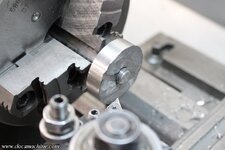

All that was left was to cut the excess off the rod and install it, set to accept the part I'm working on.

I just need to set the drills and tapping head in the turret, and chances are the actual job will take half as long as it took to make the tool.
Doc.
That is, if you have, say, ten parts, and they all need to be faced off to the same length, you set up a stop. The part is put into the collet or chuck, butted up against that stop, so that if you take a cut to the same setting on each one, they all come out to the same dimension.
Things like 5C collets have internal threads, and you can screw an internal stop into it- so each part put into that collet, ends up in the same relative position.
I have a drawerful of such 5C stops (I have five machines that take 5C
) and have fitted both the Sheldon and the Omniturn with adjustable stops that fit in the drawtube. That way I can do longer parts than just what can fit inside the 5C.Unfortunately, neither of those fit the new Rivett, and I had some nominally-12" pieces to drill and tap, so I had to take a few moments and make a new one.
I found out that, after removing the collet closer (I'll be using the 3-jaw for this) the bore of the end of the spindle was right at 1.500", with a slight step about half an inch in. I found a chunk of 1.5" aluminum round in the bins, pondered it a bit, and proceeded to stab it with spinny blades of death.
I needed two "clamping" features- expanding on one end to hold the bore, and the other contracting, to hold the stop-rod. The expanding part is tricky, but I've done a couple of these now- you use a setscrew, in an incomplete thread made with a taper plug tap. That way, as the setscrew is screwed into the hole, it wedges the parts outward to hold onto the bore.
I found a couple of stubby, coarse-thread 7/16" setscrews that looked like they wanted to join the party, marked off and drilled a couple of appropriate holes, and then ran the tap in 'til the screws were just flush before they started wedging.
I then used a slitting saw to strategically slice the part, so that the screws could actually move the material. The fit to the bore was pretty snug "at rest", so the required wedging movement is minimal.
The only trick being that you have to reach them from the outside- so there are passages drilled from the outer end to allow Allen wrench access, and you turn them counterclockwise, as if unscrewing.
Then, on the outer half, I bored the center to a close running fit to the aluminum rod, cross-drilled it to help allow a tiny but of flex, then drilled, counterbored and tapped it for two pinch bolts.
Et voilá!
She fits like so, and holds quite solidly. The rod can adjust basically the full length of the spindle, allowing parts- using the chuck- of almost two feet long if necessary.
Now, the trick with the rod is that we need a disc on the end, that's close to the diameter of the ID of the spindle. Sometimes parts are hollow, and a plain 1/2" rod wouldn't work. The disc allows it to contact any part, hollow or not, and being close to the bore size, helps keep it from "whipping" when spin fast.
So, I found a thick disc of aluminum in the bins- a core left from a holesaw- and drilled and tapped it to 1/2" coarse. I threaded the end of the stop rod to match, loctited the two together, and using the rod for an arbor, turned it to size and shape.
All that was left was to cut the excess off the rod and install it, set to accept the part I'm working on.
I just need to set the drills and tapping head in the turret, and chances are the actual job will take half as long as it took to make the tool.
Doc.
cvairwerks
Well-known member
Doc: Watched your video with the mist cooling and saw something worth asking about. You marked and were hand cutting those blanks. Give any thought to making a sled with a locating stop on it to speed that process up? Wouldn't have to mark each blank, just put a piece of stock on the sled and cut away.
OP
DocsMachine
Well-known member
- Joined
- Sep 16, 2006
- Messages
- 1,923
Yeah, I've thought about it, in a vague "the concept's in my head somewhere" way.
The issue is that it needs to be adjustable, anywhere from maybe an inch, out to 12" or so. And at this point, I haven't had either the time nor the mental clock cycles to spare to design and build it.
Got a link to any good plans? (Keeping in mind I'd be using aluminum and steel, not wood on a tablesaw. )
Doc.
The issue is that it needs to be adjustable, anywhere from maybe an inch, out to 12" or so. And at this point, I haven't had either the time nor the mental clock cycles to spare to design and build it.
Got a link to any good plans? (Keeping in mind I'd be using aluminum and steel, not wood on a tablesaw.
)Doc.
Last edited:
cvairwerks
Well-known member
No plans, but spitballin here... A wood sled with a piece of 80/20 along the bottom, squared 90 degrees to the blade, with one of the tall gusset brackets or a piece of L stock as the stop. Couple of short screws and sliding nuts for the tracks in the profile. Sorta like a sled for a table saw, but with the fence on the sled as well.
OP
DocsMachine
Well-known member
- Joined
- Sep 16, 2006
- Messages
- 1,923
One quick mod to yesterdays part stop; Since I was dealing with a long, thin part, I decided I'd make a second internal rod, this one with a concave coned end. That would help center the far end of the rod, hopefully letting it all run a little truer.
So I rooted through the scrap bin, and found the old shop-made ball handle that came on this lathe's speed control. It's not factory, the original one was typical black phenolic. Either that was broken or lost at some point, or some operator decided they wanted a bigger "shift knob". I swapped it back to a black phenolic ball during my 'rebuild', and dropped this in the bin for eventual reuse.
And, since it was plenty big and already drilled and tapped for 1/2" coarse, that eventual reuse was now.

It was a simple matter to turn it down to a cylinder, and then bore out a rough cone...

Then, just as before, I threaded the end of another chunk of 1/2" round aluminum, screwed the cone on with some loctite, then trued the OD to size, and smoothed up the cone to blend in with the rod.
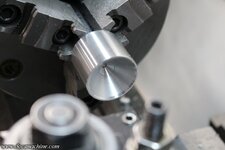
It fit right into place, of course, and let me set up a center drill, tap drill, and the little releasing head, to make quick work of drilling and tapping two dozen 12" or so rods.
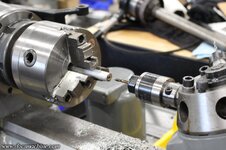
This is the exact part and situation I was concerned with that braking resistor, faulting the VFD when reversing to "unwind" the tap. Thankfully, it worked great; zero problems, zero faults, both the machine and the tapping head worked great.

And, as I predicted, making all the tooling took almost three times longer than it did to actually do the job.
BUT... that tooling made the job easier and the results more consistent, and, of course, I'll have it all ready for the next job.
Doc.
So I rooted through the scrap bin, and found the old shop-made ball handle that came on this lathe's speed control. It's not factory, the original one was typical black phenolic. Either that was broken or lost at some point, or some operator decided they wanted a bigger "shift knob". I swapped it back to a black phenolic ball during my 'rebuild', and dropped this in the bin for eventual reuse.
And, since it was plenty big and already drilled and tapped for 1/2" coarse, that eventual reuse was now.
It was a simple matter to turn it down to a cylinder, and then bore out a rough cone...
Then, just as before, I threaded the end of another chunk of 1/2" round aluminum, screwed the cone on with some loctite, then trued the OD to size, and smoothed up the cone to blend in with the rod.
It fit right into place, of course, and let me set up a center drill, tap drill, and the little releasing head, to make quick work of drilling and tapping two dozen 12" or so rods.
This is the exact part and situation I was concerned with that braking resistor, faulting the VFD when reversing to "unwind" the tap. Thankfully, it worked great; zero problems, zero faults, both the machine and the tapping head worked great.
And, as I predicted, making all the tooling took almost three times longer than it did to actually do the job.
BUT... that tooling made the job easier and the results more consistent, and, of course, I'll have it all ready for the next job.
Doc.
You got that right Doc.One quick mod to yesterdays part stop; Since I was dealing with a long, thin part, I decided I'd make a second internal rod, this one with a concave coned end. That would help center the far end of the rod, hopefully letting it all run a little truer.
So I rooted through the scrap bin, and found the old shop-made ball handle that came on this lathe's speed control. It's not factory, the original one was typical black phenolic. Either that was broken or lost at some point, or some operator decided they wanted a bigger "shift knob". I swapped it back to a black phenolic ball during my 'rebuild', and dropped this in the bin for eventual reuse.
And, since it was plenty big and already drilled and tapped for 1/2" coarse, that eventual reuse was now.
It was a simple matter to turn it down to a cylinder, and then bore out a rough cone...
Then, just as before, I threaded the end of another chunk of 1/2" round aluminum, screwed the cone on with some loctite, then trued the OD to size, and smoothed up the cone to blend in with the rod.
It fit right into place, of course, and let me set up a center drill, tap drill, and the little releasing head, to make quick work of drilling and tapping two dozen 12" or so rods.
This is the exact part and situation I was concerned with that braking resistor, faulting the VFD when reversing to "unwind" the tap. Thankfully, it worked great; zero problems, zero faults, both the machine and the tapping head worked great.
And, as I predicted, making all the tooling took almost three times longer than it did to actually do the job.
BUT... that tooling made the job easier and the results more consistent, and, of course, I'll have it all ready for the next job.
Doc.
I tell my customers that if I have to make tooling and add that to the set up time, it takes longer than making the part.
I enjoy what you add to the forum.
OP
DocsMachine
Well-known member
- Joined
- Sep 16, 2006
- Messages
- 1,923
Looks like I missed one for you gents. Quick video of making a part for a Trracer paintball gun:
This unit is a short extension, with a slightly constricted bore, so the older marker can use today's slightly smaller diameter paintballs.
Doc.
This unit is a short extension, with a slightly constricted bore, so the older marker can use today's slightly smaller diameter paintballs.
Doc.
OP
DocsMachine
Well-known member
- Joined
- Sep 16, 2006
- Messages
- 1,923
And those, I just back from the anodizers earlier this week, and finally had a chance to sit down and finish them. In this case, they needed to be laser engraved to mark the two different sizes. I have a laser, the typical K-40, with some tweaks, but I hadn't used it in a couple of years. So I had to refresh my memory, reload some software, and, y'know, read the f**kin' manual.
The base image- just a few numbers- was easy enough in a typical art program, and that got washed through another program called Inkscape, to scale it and convert it to the format the laser wants. I tested that on a piece of card stock to make sure the size was right- which it was.
I was doing some eighty parts, though, so I wanted a jig or fixture to hold each one repeatably. I was going to machine something, maybe just out of some scrap wood, when a brighter idea prevailed. One of the Starrett V-blocks, a chunk of broken donut magnet as a stop, and a couple chunks of masking tape to keep it from sliding anywhere, and [i[]voila![/i]

I have a power elevation table, so setting the focus with that was easy once the part was in place. I then used one of the unanodized prototypes, with a bit more masking tape, to line up the image. Once I was happy with that, I plunked a proper part in there and stabbed the go-button.

80mm/sec and 20% power (by the digital readout, I didn't look at the analog) bleached the dye nicely, without overtly damaging the anodizing itself.

It did the job admirably on all eighty pieces

The two sizes of part are now clearly and permanently marked, and that, Ladies and Gentlemen, means they're freakin' done!
Doc.
The base image- just a few numbers- was easy enough in a typical art program, and that got washed through another program called Inkscape, to scale it and convert it to the format the laser wants. I tested that on a piece of card stock to make sure the size was right- which it was.
I was doing some eighty parts, though, so I wanted a jig or fixture to hold each one repeatably. I was going to machine something, maybe just out of some scrap wood, when a brighter idea prevailed. One of the Starrett V-blocks, a chunk of broken donut magnet as a stop, and a couple chunks of masking tape to keep it from sliding anywhere, and [i[]voila![/i]
I have a power elevation table, so setting the focus with that was easy once the part was in place. I then used one of the unanodized prototypes, with a bit more masking tape, to line up the image. Once I was happy with that, I plunked a proper part in there and stabbed the go-button.
80mm/sec and 20% power (by the digital readout, I didn't look at the analog) bleached the dye nicely, without overtly damaging the anodizing itself.
It did the job admirably on all eighty pieces
The two sizes of part are now clearly and permanently marked, and that, Ladies and Gentlemen, means they're freakin' done!
Doc.
cvairwerks
Well-known member
Doc: Ever try it on a Dykem'd piece? I've got one that I want to try and use for marking layout lines on various small parts.
OP
DocsMachine
Well-known member
- Joined
- Sep 16, 2006
- Messages
- 1,923
You mean like painting a piece of material with Dykem, and then lasering your lines and dimensions into it? Actually, can't say I'd ever even heard of the idea 'til just now.
Don't see why it couldn't be done, though I'd wonder about the accuracy of the scale. That is, if it marks off a 1.000" line, is it actually 1.000" long, or is it .995" or 1.008" long?
You can set the scale pretty accurately in the software, but I've never checked to see how that translates to the generated image.
Seems like it's be pretty time consuming for minimal gain, though- unless you had a dozen or more blanks you needed marked off.
Doc.
Don't see why it couldn't be done, though I'd wonder about the accuracy of the scale. That is, if it marks off a 1.000" line, is it actually 1.000" long, or is it .995" or 1.008" long?
You can set the scale pretty accurately in the software, but I've never checked to see how that translates to the generated image.
Seems like it's be pretty time consuming for minimal gain, though- unless you had a dozen or more blanks you needed marked off.
Doc.
cvairwerks
Well-known member
Reason I'm looking at it, is the quantity of parts and their complexity. I've got a number of parts that only took about 20 minutes to pop into CAD, but will take at least 45 minutes each to lay out on the sheet metal. If it works, I can dump the layout work to the laser while I'm working on other things in the shop. It's one of the reasons I want a small CNC lathe for the shop. I've got more than 200 bushings to make for a single project. There are about 4 different diameters, but about 10 different lengths for each. It's not enough quantity for a job shop to take on and it's rally too many to manually machine in a reasonable amount of time. And I do have a product that I would like to bring to market at some point, that would require the lathe anyway.
@DocsMachine, why do you use an upside-down boring bar for ID work, and not a left-handed bar? I'd think that'd help with chip evacuation.
@cvairwerks, what about photo etching your layout lines?
@cvairwerks, what about photo etching your layout lines?
cvairwerks
Well-known member
zanyard: Photo etching is a lot more involved process. I could revert back to doing hand layouts and be faster. Besides, it would take a lot of stuff to do photo etching on pieces of steel up to 2'x4'....
OP
DocsMachine
Well-known member
- Joined
- Sep 16, 2006
- Messages
- 1,923
why do you use an upside-down boring bar for ID work, and not a left-handed bar? I'd think that'd help with chip evacuation.
-Upside down? That's normal boring bar, it's just that, in this machine, the tool/part interface is rotated 75 degrees towards the operator. (Hence the machine being known as a GT-75; Gang tooled, 75 degrees.) (That is, compared to normal manual engine lathe format.)
All the OD tools are left handed, but to use a left-hand as an ID tool, I'd have to run the spindle in reverse. Easy enough to do- just an M command really, though I'd need to program in a delay for the spindle to come to a stop and restart in the other direction, etc.
For a short ID bore like these, getting chips packed in the bore isn't really an issue, and to be honest, I'm still green enough at programming this thing, that it helps to keep the tooling in something like the normal configuration I'm used to.
Wrks: I don't see why the laser-and-Dykem thing wouldn't work, though I could see there being some experimenting to get the proportioning spot-on. And, that presumes you have access to a laser, of course.
And, that presumes the laser is big enough- this K-40 only has about a 10" x 12" working area.
On the CNC in general, that's really why I bought these machines. I needed to make runs of parts, but not big enough runs to justify a pro shop doing them. I needed 50 to 100, sometimes 200. Most regular shops want to see 5,000 or more.
Doc.
[/QUOTE]
Last edited:
Oops, got my handedness mixed up. As you said, your ID tool is right-handed and it's programmed with its tip below centerline. I'm used to programming a boring bar with tip up, programmed with its tip above centerline. Most lathes I've seen, +X is above and -X is below centerline, though I have seen one or two that are the opposite (*shudder*).-Upside down? That's normal boring bar, it's just that, in this machine, the tool/part interface is rotated 75 degrees towards the operator. (Hence the machine being known as a GT-75; Gang tooled, 75 degrees.) (That is, compared to normal manual engine lathe format.)
All the OD tools are left handed, but to use a left-hand as an ID tool, I'd have to run the spindle in reverse. Easy enough to do- just an M command really, though I'd need to program in a delay for the spindle to come to a stop and restart in the other direction, etc.
With the tool oriented tip up, chips fall down below the tool and are flushed out along with the coolant. Especially when the bar is smaller compared to the bore and through-tool coolant, this helps with chip evacuation. Things can get a little hairy with chip evacuation and positioning move clearance, though, when the bore is only slightly larger than the bar.
cvairwerks
Well-known member
LOL Doc....I'm going to be using a K-40 for experimenting due to cost. A decent sized Epilog is way expensive and I don't want to drop the $ on one til I know it will do the job. If I can make it work on the K-40, then the Epilog won't be a a problem.
What upgrades have you done to your K-40 so far?
What upgrades have you done to your K-40 so far?
OP
DocsMachine
Well-known member
- Joined
- Sep 16, 2006
- Messages
- 1,923
With the tool oriented tip up, chips fall down below the tool and are flushed out along with the coolant.
-On this particular machine, there's also the fact that the tool slide is kind of biased towards having the tools below the work. There's more +X travel than there is -X. Not a huge thing, but there's also the simple fact that it eases programming, not having to remember that minus sign each time. (I hand-type out the programs for this thing.
)What upgrades have you done to your K-40 so far?
-I made a custom duct for the smoke extraction, and use an inline fan like you see the guys with grow operations use. This model came with just the digital "power level" display, and I had a bunch of guys telling me that "100%" was needlessly overdriving the tube- which doesn't give you more cutting power, it just shortens the life of the tube.
I fitted one of the common analog meters- a milliamp meter- and keep it under... what was it, 16Ma? Something like that. That's basically "full power" on these Chinese 35 watt tubes.
I put an air assist nozzle on it, but I admit I have yet to hook up an air source to it. I have a sort of "industrial aquarium" pump, but haven't hooked it up.
One of the biggest things I did was I put in a power lift table. It usually takes a small stepper motor, so you need a power supply and stepper controller for it, but I swapped it with a small 12V gearmotor, and just power that with a 12V 'wall wart', The raise-lower control is a simple momentary center-off rocker switch. The table is slow to raise and lower, but dirt simple to get the focus spot on.
Apart from that, and the aforementioned fact I run it on K40 Whisperer rather than the stock software, it's pretty much as delivered. I'm using their pump and hoses (and a 3-gal bucket as a reservoir- I don't burn enough to need a chiller) the factory tube and optics, the factory controller and power supply, etc.
Doc.
OP
DocsMachine
Well-known member
- Joined
- Sep 16, 2006
- Messages
- 1,923
Unscrapping a scrap 'Cocker!
I'm going to be doing some fairly extensive milling to a customer's AutoCocker body, and while I think I have the dimensions for this particular fairly complex design.... well, they're a bit cocktail-napkin-y. So I've been remeasuring, cleaning up the numbers, and putting together a proper set of drawings. I believe I have those nicely sorted out, but I'm a bit of a pragmatist. I wanted to test and 'prove' my numbers before I start slicing away bits of a customer-supplied part.
So I rooted through my dusty old box of... well, more or less "scrap" 'Cocker bodies, for one I could chop up, and not be too concerned about if something went haywire.
In said dusty old box, I found the last few old bodies that I got, literally over twenty years ago, from a production shop that had mismachined them. They were just going to junk 'em, but I picked them up, since I could fix some of the issues and actually use them.
The main issue was the front-block bolt. The bodies were machined to accept 9/16" fine thread- except that's nominally 9/16"-18. The factory 'Cockers use an extra fine- 9/16"-24. The shop offered to make a run of bolts to fit, but the client declined to accept them- and not unreasonably.
The majority of the ones I sold, I cut off the front of the body, into what's called a "Mini" configuration, and rethreaded it to the proper extra fine thread.
Eventually most of them sold, but I saved a few aside to build a few of my own custom guns from, such as this one:

I never got around to using these last few, since they needed more work than the rest, and, well, I had other things to work on. But it's perfect for this job. If all comes out well, I can actually use the body. If something goes wrong, no great loss. This is what I started with:
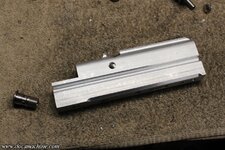
Nothing too terribly exciting, but even to just use it as is, would take some work. It's machined to take the old-style pre-2K vertical ASAs, the old-style non-threaded IVG (internal velocity adjuster) it needs a feed neck pressed in, it takes the wrong front block thread and the old-style valves.
For the moment, though, that big billboard slab side is perfect for the purpose.
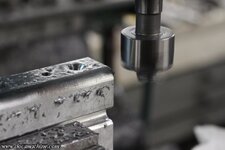
We start with a corner-rounding bit and get rid of that nasty lower body angle...
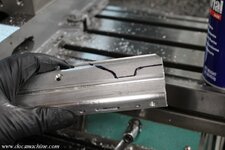
And then mark out a rough idea of what needs to go away.
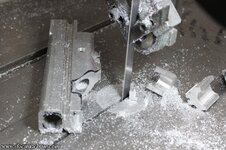
The bandsaw then makes short work of that, saving quite a bit of milling time.
Two strategically-located holes are drilled...
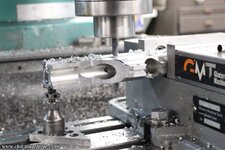
And then everything in between is milled out into a slot.
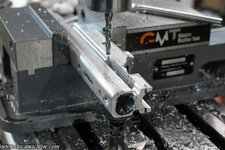
The forward edge of the cut is supposed to have a nice, swoopy curve to it, and rather than getting out the rotary table, a mongo RotaBroach slices it out with ease.

You long-time 'Cocker freaks might start recognizing where we're going, 'bout now.
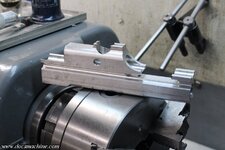
The 'wings' on either side of the breech threads are milled down, leaving a nice curve...

And then trimmed to match.

The lower edges of the pumprod slots get rounded over too...

And then the too-thin metal at the very bottom of what's left of the bolt bore, gets trimmed back.

The same happens at the front, as well as the bolt-pin slot so it can engage the hammer.

The "fangs" at the back of the body get narrowed, just for aesthetics...
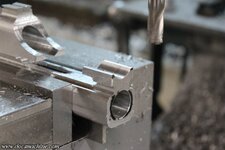
And then milled off at an angle. This area will get more hand-sculpting later.

And finally- at least for today- the last of the sight rail boss behind where the feed neck goes, gets trimmed down too, also leaving a bit of a swoop to it.
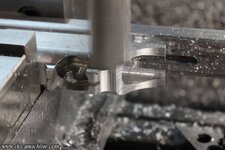
Wiped down, blown off and lightly deburred, and there you have it:

Near as I can measure, my specs and drawings were spot-on, so I should have no difficulty with applying them to the customer's parts. This particular unit, with not a whole lot more work, can also be finished and used. I'll need to make some of the other pieces- bolt, pin, hammer, etc. - for said customer gun, so I'll probably make them for this body too.
All in all, not a bad way to spend a few hours.
Doc.
I'm going to be doing some fairly extensive milling to a customer's AutoCocker body, and while I think I have the dimensions for this particular fairly complex design.... well, they're a bit cocktail-napkin-y.
So I've been remeasuring, cleaning up the numbers, and putting together a proper set of drawings. I believe I have those nicely sorted out, but I'm a bit of a pragmatist. I wanted to test and 'prove' my numbers before I start slicing away bits of a customer-supplied part.So I rooted through my dusty old box of... well, more or less "scrap" 'Cocker bodies, for one I could chop up, and not be too concerned about if something went haywire.
In said dusty old box, I found the last few old bodies that I got, literally over twenty years ago, from a production shop that had mismachined them. They were just going to junk 'em, but I picked them up, since I could fix some of the issues and actually use them.
The main issue was the front-block bolt. The bodies were machined to accept 9/16" fine thread- except that's nominally 9/16"-18. The factory 'Cockers use an extra fine- 9/16"-24. The shop offered to make a run of bolts to fit, but the client declined to accept them- and not unreasonably.
The majority of the ones I sold, I cut off the front of the body, into what's called a "Mini" configuration, and rethreaded it to the proper extra fine thread.
Eventually most of them sold, but I saved a few aside to build a few of my own custom guns from, such as this one:
I never got around to using these last few, since they needed more work than the rest, and, well, I had other things to work on.
But it's perfect for this job. If all comes out well, I can actually use the body. If something goes wrong, no great loss. This is what I started with: Nothing too terribly exciting, but even to just use it as is, would take some work. It's machined to take the old-style pre-2K vertical ASAs, the old-style non-threaded IVG (internal velocity adjuster) it needs a feed neck pressed in, it takes the wrong front block thread and the old-style valves.
For the moment, though, that big billboard slab side is perfect for the purpose.
We start with a corner-rounding bit and get rid of that nasty lower body angle...
And then mark out a rough idea of what needs to go away.
The bandsaw then makes short work of that, saving quite a bit of milling time.
Two strategically-located holes are drilled...
And then everything in between is milled out into a slot.
The forward edge of the cut is supposed to have a nice, swoopy curve to it, and rather than getting out the rotary table, a mongo RotaBroach slices it out with ease.
You long-time 'Cocker freaks might start recognizing where we're going, 'bout now.
The 'wings' on either side of the breech threads are milled down, leaving a nice curve...
And then trimmed to match.
The lower edges of the pumprod slots get rounded over too...
And then the too-thin metal at the very bottom of what's left of the bolt bore, gets trimmed back.
The same happens at the front, as well as the bolt-pin slot so it can engage the hammer.
The "fangs" at the back of the body get narrowed, just for aesthetics...
And then milled off at an angle. This area will get more hand-sculpting later.
And finally- at least for today- the last of the sight rail boss behind where the feed neck goes, gets trimmed down too, also leaving a bit of a swoop to it.
Wiped down, blown off and lightly deburred, and there you have it:
Near as I can measure, my specs and drawings were spot-on, so I should have no difficulty with applying them to the customer's parts. This particular unit, with not a whole lot more work, can also be finished and used. I'll need to make some of the other pieces- bolt, pin, hammer, etc. - for said customer gun, so I'll probably make them for this body too.
All in all, not a bad way to spend a few hours.
Doc.
OP
DocsMachine
Well-known member
- Joined
- Sep 16, 2006
- Messages
- 1,923
Doc's Christmas Vacation, Day 2:
One minor project I've been meaning to do for way too long now, is set up my Haas digital indexer on the Arboga drill press. I have a number of parts runs, both already on the floor and in the works, that need radial drilling- air vents, "muzzle brake" type holes, etc. One of these days I'll get this thing set up in the CNC mill proper and do this kind of thing automatically, but for the time being, I still have product I need to get out the door.
I usually set this indexer up on one of the manual mills, but it's really just drill press work- and I have this really nice gear-head drill press with an X/Y positioning table that doesn't get anywhere near enough use.
So I've wanted to set it up on there, where I can leave it set up for a while. The problem with this is the table has no center T-slot:
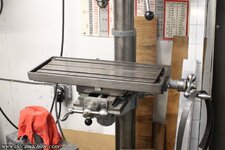
Because of the channel where the leadscrew goes, what would usually be a center T-slot on a milling machine, is just a groove. In this case I could mount the indexer and it's tailstock to either the fore or aft slot, but that uses up quite a bit of the table's limited travel- and besides, my OCD says they need to be centered.
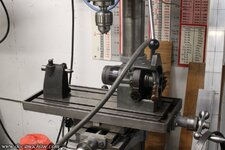
The fix, however, is pretty easy, just a chunk of aluminum plate as an adapter. I've had a chunk laying around for this exact use, for... longer then I care to think. So I got that slab out, and bandsawed it in half. That got set up in the mill and both long edges milled straight.
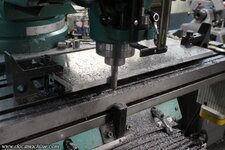
I started drilling some holes- this was all designed on the fly, by the way - and realized I was going to need a bunch of threaded holes, to be able to adjust the spacing between the indexer and the tailstock, to accommodate different length parts. That led to the realization- hey, I'm slow -that the two parts didn't necessarily need to be bolted to the same adapter plate.
And, I remembered one of the other adapters I wanted to make- one to mount a 4" Kurt-style vise to the table.
So, I shifted my plans a bit, drilled a few holes in other locations...
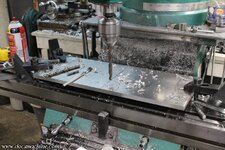
And bandsawed that in half.

That meant I only needed to drill and tap two pairs of holes in the indexer's baseplate- one more or less centered, the other shifted to an extreme side to allow maximum length.

Et voila!

I need more bolts the right length, and some washers, but just for a mock-up, we're doin' good so far.
I then cut a fresh piece from the other half of that plate, milled it square, and drilled six holes and tapped two.
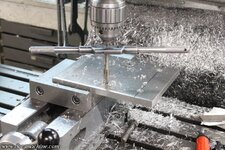
That will set the tailstock up like this:

I'll have to pick up the rest of the bolts and washers I need when I make my next town run, but this should work just fine. I'll need to set up a small shelf or table for the indexer controller, but I can use a stool just to get through the current projects.
Oh, and the other sawed-off bit?

Mounts a little 4" Kurt-style vise in the same way, which will make the drill a little more convenient to use on a typical day-to-day basis. I'll have to take that spider handle off, though, as it interferes with the table's crank, but that's no big.
Not a bad way to spend the evening. [checks one item off of 387-entry list]
Doc.
One minor project I've been meaning to do for way too long now, is set up my Haas digital indexer on the Arboga drill press. I have a number of parts runs, both already on the floor and in the works, that need radial drilling- air vents, "muzzle brake" type holes, etc. One of these days I'll get this thing set up in the CNC mill proper and do this kind of thing automatically, but for the time being, I still have product I need to get out the door.
I usually set this indexer up on one of the manual mills, but it's really just drill press work- and I have this really nice gear-head drill press with an X/Y positioning table that doesn't get anywhere near enough use.
So I've wanted to set it up on there, where I can leave it set up for a while. The problem with this is the table has no center T-slot:
Because of the channel where the leadscrew goes, what would usually be a center T-slot on a milling machine, is just a groove. In this case I could mount the indexer and it's tailstock to either the fore or aft slot, but that uses up quite a bit of the table's limited travel- and besides, my OCD says they need to be centered.
The fix, however, is pretty easy, just a chunk of aluminum plate as an adapter. I've had a chunk laying around for this exact use, for... longer then I care to think.
So I got that slab out, and bandsawed it in half. That got set up in the mill and both long edges milled straight.I started drilling some holes- this was all designed on the fly, by the way
- and realized I was going to need a bunch of threaded holes, to be able to adjust the spacing between the indexer and the tailstock, to accommodate different length parts. That led to the realization- hey, I'm slow -that the two parts didn't necessarily need to be bolted to the same adapter plate.And, I remembered one of the other adapters I wanted to make- one to mount a 4" Kurt-style vise to the table.
So, I shifted my plans a bit, drilled a few holes in other locations...
And bandsawed that in half.
That meant I only needed to drill and tap two pairs of holes in the indexer's baseplate- one more or less centered, the other shifted to an extreme side to allow maximum length.
Et voila!
I need more bolts the right length, and some washers, but just for a mock-up, we're doin' good so far.
I then cut a fresh piece from the other half of that plate, milled it square, and drilled six holes and tapped two.
That will set the tailstock up like this:
I'll have to pick up the rest of the bolts and washers I need when I make my next town run, but this should work just fine. I'll need to set up a small shelf or table for the indexer controller, but I can use a stool just to get through the current projects.
Oh, and the other sawed-off bit?
Mounts a little 4" Kurt-style vise in the same way, which will make the drill a little more convenient to use on a typical day-to-day basis. I'll have to take that spider handle off, though, as it interferes with the table's crank, but that's no big.
Not a bad way to spend the evening. [checks one item off of 387-entry list]
Doc.
bugnut
ALLIANCE MEMBER
doc, really liking the looks of that Kurt vice and handle setup. Looking great and very useful!
OP
DocsMachine
Well-known member
- Joined
- Sep 16, 2006
- Messages
- 1,923
It's a Kurt-style vise. In fact, a really bad Asian copy of a Kurt that I'd have sent back for a refund, had it not been for the circumstances of my purchase. (A friend was driving a truck up from the states, and brought it and a bunch of other heavy stuff up for me. Shipping the vise back for a refund would have cost me more than the refund.)
But, I have a machine shop and a surface grinder, and I wrote up the fix in a little series I called Polishing a Turd.
Doc.
In fact, a really bad Asian copy of a Kurt that I'd have sent back for a refund, had it not been for the circumstances of my purchase. (A friend was driving a truck up from the states, and brought it and a bunch of other heavy stuff up for me. Shipping the vise back for a refund would have cost me more than the refund.)But, I have a machine shop and a surface grinder, and I wrote up the fix in a little series I called Polishing a Turd.
Doc.
I didn't realize you were in the great white north, no wonder why you're so polite!It's a Kurt-style vise.
But, I have a machine shop and a surface grinder, and I wrote up the fix in a little series I called Polishing a Turd.
Doc.
Man, I feel old. I'm pretty sure I remember when you were selling those autococker bodies some 20 years ago...
How's the paintball industry going these days? I haven't followed the developments much since those electro-cockers were the new hot item. It's cool to see you're still doing it.
How's the paintball industry going these days? I haven't followed the developments much since those electro-cockers were the new hot item. It's cool to see you're still doing it.
OP
DocsMachine
Well-known member
- Joined
- Sep 16, 2006
- Messages
- 1,923
I didn't realize you were in the great white north, no wonder why you're so polite!
-Alaska, not Canada.
The Last Frontier, not The Great White North. (The old meme about Alaska kinds reading about Canada in geography class, as "our neighbors to the North!" )How's the paintball industry going these days? I haven't followed the developments much since those electro-cockers were the new hot item. It's cool to see you're still doing it.
-Oh, I could fill a book. The industry was going like gangbusters 'til the '08-'09 recession, which cut the legs out from under a bunch of businesses. Smart Parts went bankrupt, WDP- makers of the Angels- went out of business, and a bunch of smaller shops like KAPP and Shocktech closed up, too. By all reports, we lost some 2/3rds of our regular players, and that really only started to rebound by '12-'13.
Currently the sport is... well, optimistically we'll call it stable. Operating costs, playing costs and land values have closed up a bunch of fields, and the ones remaining are seeing competition from... well, damn near everything. Paintball is little more than just a fun sport, like bowling or tennis. And the simple fact is, it can be kind of expensive, a little painful, and kind of dirty to play. There's a LOT of people that would rather sit in an nice air-conditioned room and play some online multiplayer game, or play a clean indoor game of Nerf or Laser Tag.
I've carved out my little niche, and sales are picking up a little thanks to a heavy investment on my part in CNC production (finally, after 20 years
) and I'm optimistic- for several reasons - that the next couple of years will pick up a little more. Both for me and, I hope, the industry- but it's still a long ways from an industry I'd recommend anyone get into.Doc.
OP
DocsMachine
Well-known member
- Joined
- Sep 16, 2006
- Messages
- 1,923
Doc's Christmas Vacation, Day 3: Ah, the sweet sting of abject failure.
Most of today was spent running the typical Monday errands- picking up and dropping off of mail, a little grocery shopping (I needed more salsa) and of course stopping off at the hardware store to get the bolts I needed.
I'd hoped to finish up the indexer setup this evening, and start punching out some of the parts, but life, as they say, had other plans.
First thing I did was... well I had to do something bout the rusty handle of the indexer collet closer:
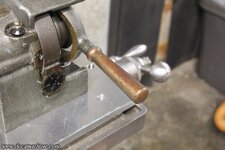
That's how I got it, and I've been meaning to do something about it, so no better time. (I'd probably have to turn in my Procrastinator's Club membership card... but they never got around to sending me one. )
The usual bit of green Scotchbrite, a little WD-40, and a measure of elbow grease...
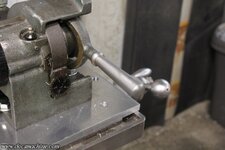
Then, once I realized that the quill spider was going to hit the indexer body- I put it on that side so the handle faces the operator- I reversed the setup, and using the new bolts and washers, well, bolted it all down.
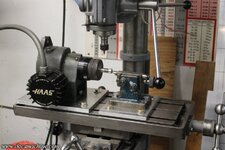
Now, this particular job takes a small, stiff center drill, but from previous experience on the mill setups, I knew the regular drill chuck can't get close enough to the collet face to reach. But fortunately, I had bought, a [ahem] number of years ago, an MT3 holder that takes ER-16 collets. This was the first such need for that particular tool, so I set it up and...
It won't fit either.
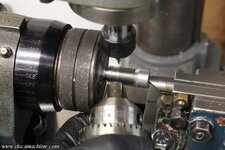
The hole needs to be drilled in that narrowed band, and you can see that neither one can reach. That knurled collar is just a thread protector for the spindle, but even removing that won't let the drill reach. Only way I can do it is with the collar off and the centerdrill sticking further out from the collet than I'd like. (ER's don't like having less than 2/3rds or so of the collet body clamping on the shank- much less than that and the inner portion can close, reducing contact to the outer end.)
What did I use on the mills? An R8 holder that takes the much-smaller ER-11 collets. A little fact that I totally spaced when ordering the MT unit.
So, I'm dinked before I can even start. The time, of course, hasn't been wasted, I just need to order the proper tooling- although at this time of year, it's likely to be the middle of January before I actually get it.
But, as I'm running dangerously low on finished product, I need to drill at least a small handful of these- I have a bin of about 200 to do. Which means I'll have to set the indexer up on one of the mills tomorrow, and punch those out, and at some point after Xmas, I'll order the tooling I need.
One other troublesome bit is the quill depth stop:
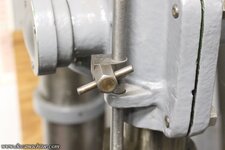
Which, in all the time I've had this drill (well over a decade) I've never needed the depth stop. I was trying to use that to set up the... er, setup, and found out it works as a solid stop only slightly better than warm Silly Putty. Using just the little T-handle (and no tools) I can't tighten it enough to hold. I can easily cause it to slide on the rod.
I could throw a wrench on there, but I'm thinking I might need a more reliable clamp. A nut on a threaded rod would be ideal, but I'd have to partially dismantle of the spindle to get the mount off. I may try just making a longer clamp, with two bolts rather than just the one and maybe a heavier wall so it doesn't 'stretch' as much....
Which of course means that even if I'd had the right ER holder, I probably wouldn't have been able to do the job tonight anyway.
Ah, the joys of trying to run a small machine shop... deep in the back woods of Left Armpit, Alaska, and on a shoestring so knotted and frayed it makes dental floss look like bridge cable. :roll:
Doc.
Most of today was spent running the typical Monday errands- picking up and dropping off of mail, a little grocery shopping (I needed more salsa) and of course stopping off at the hardware store to get the bolts I needed.
I'd hoped to finish up the indexer setup this evening, and start punching out some of the parts, but life, as they say, had other plans.
First thing I did was... well I had to do something bout the rusty handle of the indexer collet closer:
That's how I got it, and I've been meaning to do something about it, so no better time. (I'd probably have to turn in my Procrastinator's Club membership card... but they never got around to sending me one.
)The usual bit of green Scotchbrite, a little WD-40, and a measure of elbow grease...
Then, once I realized that the quill spider was going to hit the indexer body- I put it on that side so the handle faces the operator- I reversed the setup, and using the new bolts and washers, well, bolted it all down.
Now, this particular job takes a small, stiff center drill, but from previous experience on the mill setups, I knew the regular drill chuck can't get close enough to the collet face to reach. But fortunately, I had bought, a [ahem] number of years ago, an MT3 holder that takes ER-16 collets. This was the first such need for that particular tool, so I set it up and...
It won't fit either.
The hole needs to be drilled in that narrowed band, and you can see that neither one can reach. That knurled collar is just a thread protector for the spindle, but even removing that won't let the drill reach. Only way I can do it is with the collar off and the centerdrill sticking further out from the collet than I'd like. (ER's don't like having less than 2/3rds or so of the collet body clamping on the shank- much less than that and the inner portion can close, reducing contact to the outer end.)
What did I use on the mills? An R8 holder that takes the much-smaller ER-11 collets. A little fact that I totally spaced when ordering the MT unit.
So, I'm dinked before I can even start. The time, of course, hasn't been wasted, I just need to order the proper tooling- although at this time of year, it's likely to be the middle of January before I actually get it.
But, as I'm running dangerously low on finished product, I need to drill at least a small handful of these- I have a bin of about 200 to do. Which means I'll have to set the indexer up on one of the mills tomorrow, and punch those out, and at some point after Xmas, I'll order the tooling I need.
One other troublesome bit is the quill depth stop:
Which, in all the time I've had this drill (well over a decade) I've never needed the depth stop. I was trying to use that to set up the... er, setup, and found out it works as a solid stop only slightly better than warm Silly Putty. Using just the little T-handle (and no tools) I can't tighten it enough to hold. I can easily cause it to slide on the rod.
I could throw a wrench on there, but I'm thinking I might need a more reliable clamp. A nut on a threaded rod would be ideal, but I'd have to partially dismantle of the spindle to get the mount off. I may try just making a longer clamp, with two bolts rather than just the one and maybe a heavier wall so it doesn't 'stretch' as much....
Which of course means that even if I'd had the right ER holder, I probably wouldn't have been able to do the job tonight anyway.
Ah, the joys of trying to run a small machine shop... deep in the back woods of Left Armpit, Alaska, and on a shoestring so knotted and frayed it makes dental floss look like bridge cable. :roll:
Doc.
OP
DocsMachine
Well-known member
- Joined
- Sep 16, 2006
- Messages
- 1,923
Doc's Christmas Vacation, Day 4, Xmas Eve!
As planned, I cleaned off the table of the big Exacto mill, and set up the indexer and tailstock on it.

... I really need to paint that tailstock.
And, found out I was once again mistaken- which makes what, a total of three times in my entire life? Four at the outside? The holder I used previously in the mills was, in fact, an ER-16, but this one uses a "low profile" nut:
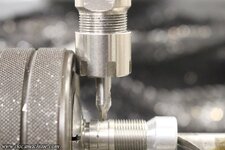
That, just barely, gave me the clearance, but unfortunately the nuts are not interchangeable between the two holders. I'll have to see if I can find an MT3/ER-16 with a low-profile nut... If such a thing is even made.
Another option I thought of was to get one of the extended nose "emergency" collets, and machine it to hold the part further away from the spindle face. Less than half an inch would be plenty, in order to use the existing holder ER in the drill press.
Anyway, for the moment, I need to get some parts cut. Recent sales have depleted my inventory of this bolt down to about half a dozen, and I ran these things on the Omniturn more than three months ago! So, with the indexer and tailstock set up, the ER holder given a freshly-sharpened centerdrill, said drill centered over the part, and the indexer control properly programmed, it was time to poke some holes.
Part in place, tailstock snugged- the aluminum bit 'adapts' the tip of the tailstock to the larger bolt hole- and the spindle started.

With the depth-stop (much more rigid on this machine) set, it's a simple matter of simply pulling down on the quill feed 'til it stops, and then let up. The centerdrill is both stubby enough to not wander as it drills, and also lightly countersinks the hole.
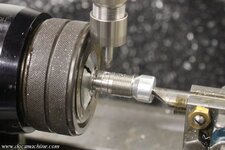
Press the button on the indexer, which rotates the part 90 degrees...
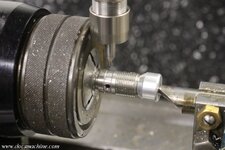
And drill again.

Lather, rise, repeat.
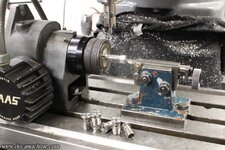
A few minutes with that setup gets me a handful of completed parts- this was the last operation for this particular piece- to give me a bit more buffer in inventory, and the rest I'll run as time permits, between now and the end of the year.
Yeah, shop time isn't exactly the height of Christmas festivity, but hey, it's my thing. And certainly not the first time I've ever worked on a holiday...
Doc.
As planned, I cleaned off the table of the big Exacto mill, and set up the indexer and tailstock on it.
... I really need to paint that tailstock.
And, found out I was once again mistaken- which makes what, a total of three times in my entire life? Four at the outside?
The holder I used previously in the mills was, in fact, an ER-16, but this one uses a "low profile" nut:That, just barely, gave me the clearance, but unfortunately the nuts are not interchangeable between the two holders. I'll have to see if I can find an MT3/ER-16 with a low-profile nut... If such a thing is even made.
Another option I thought of was to get one of the extended nose "emergency" collets, and machine it to hold the part further away from the spindle face. Less than half an inch would be plenty, in order to use the existing holder ER in the drill press.
Anyway, for the moment, I need to get some parts cut. Recent sales have depleted my inventory of this bolt down to about half a dozen, and I ran these things on the Omniturn more than three months ago! So, with the indexer and tailstock set up, the ER holder given a freshly-sharpened centerdrill, said drill centered over the part, and the indexer control properly programmed, it was time to poke some holes.
Part in place, tailstock snugged- the aluminum bit 'adapts' the tip of the tailstock to the larger bolt hole- and the spindle started.
With the depth-stop (much more rigid on this machine) set, it's a simple matter of simply pulling down on the quill feed 'til it stops, and then let up. The centerdrill is both stubby enough to not wander as it drills, and also lightly countersinks the hole.
Press the button on the indexer, which rotates the part 90 degrees...
And drill again.
Lather, rise, repeat.
A few minutes with that setup gets me a handful of completed parts- this was the last operation for this particular piece- to give me a bit more buffer in inventory, and the rest I'll run as time permits, between now and the end of the year.
Yeah, shop time isn't exactly the height of Christmas festivity, but hey, it's my thing.
And certainly not the first time I've ever worked on a holiday... Doc.
cvairwerks
Well-known member
Doc: You ever think about adding a live tool drill to the Omni and do those holes while still in the lathe?