To avoid these ads, REGISTER NOW!

Inside Doc's Shop...

OP
D

DocsMachine

Well-known member
Joined
Sep 16, 2006
Messages
1,848
Here's a repost of an older project, but I figured you ladies and gents might like it. :)

Fairly straightforward, just a bit tricky in execution.

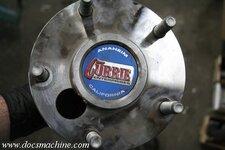
Customer came in with this aftermarket Currie axle shaft, I'm not sure what it originally fit, and a front Dana 44 4WD solid axle shaft.

spline01.jpg

The Currie axle is (was?) brand new, a nice heavy-duty racing piece.
spline02.jpg

The job? Cut it down to a foot long and respline it to fit the Dana pumpkin. The customer is making a custom diff for one of his customer's hot-rod project, so some of the excess meat had to go.

spline03.jpg

Unfortunately, the axle, despite a quick file test, proved harder than I expected, and I managed to wipe out a good fine-tooth Starrett bandsaw blade, inflicting virtually no damage to the axle in the process. Kinda cuts into the profit margin...

I had to use an abrasive saw, going very slowly and cutting in steps as to not overheat- and thus, risk spot hardening it. Took a bit of time, but it worked.

Next step was to rap out the studs with a non-marring bronze hammer...

spline04.jpg

... Which I had to do in order to be able to properly chuck it up in the lathe.

spline05.jpg

Note the roller steady rest in order to allow a good facing cut and accurate center drill, so that I can use a proper live center for the actual work.

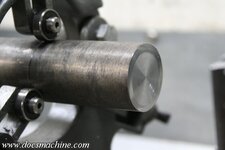
Also note the interesting behavior of the metal:
spline06.jpg

That's not due to differences in speeds or feeds. The axle shaft is, in effect, "case hardened". The outer "skin", about 3/16" deep in this case, is quite hard- or rather, very tough. Not so much 'hard' like glass or ceramic, but very cut-resistant.

While the inner "core" is considerably softer- still pretty tough (it's all the same piece of steel, just heat-treated differently) but noticibly easier to cut. This is pretty standard on most factory and aftermarket axle shafts- a very strong skin for strength, a softer core to help it absorb shock and flex so it won't break. You knife guys might recognize that as a standard concept for everything from sword blades to axe heads; hard cutting edge, softer, more flexible body to help resist shattering.

Now, a sharp carbide insert had no trouble cutting it- and in fact, given the right speed and feed, produced a very nice near-mirror finish.

spline07.jpg

However, the little lathe had neither the HP nor the rigidity for any significant cut. I tried heavier cuts in back-gear, but the metal tended to tear rather than cut. So I baby-sat it while it worried off 0.020" at a time. Last couple of finish passes left a very nice surface.

spline08.jpg

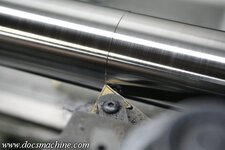
Last pass of... I think it was 0.006" to get to my final size.
spline09.jpg

And the slight 'step' of about 50 thou. The splined area is slightly smaller than where the seal goes, so the splines don't damage the seal upon installation.

spline10.jpg

Then it's over to the mill for the standard dividing head setup:

spline11.jpg

The chuck I have on the dividing head isn't big enough to grab the axle flange as I did in the lathe, nor would the jaws close down far enough to grab the center locating stub. Or, when the jaws are in the normal configuration, they wouldn't open far enough to grab even the center, let alone the outer.

My dividing head, however, came with a dead center and a sort of "dog plate" for between-centers use.

spline12.jpg

However, there was no way to use an actual dog, so I rummaged through the scrap bin, found a short chunk of heavy angle-iron, and with a few deft cuts and a run through both the Nichols mill and Arboga drill, had a suitable driver.

The dividing head, while an import, uses the same principles that makers have been using for well over a century. My favorite reference for these is a copy of Brown & Sharpe's Practical Treatise on Milling and Milling Machines from 1913 (as in, over a century old) which Google digitized and made available for download.

I had a shop print it out and spiral-bind it (though I'd love to have an original) and it's been surprisingly useful ever since.

So, since I needed 30 splines (I counted them at least twice) according to the book I could use the 18, 33 or 39-hole selections. I already had the indexing plate with the 33-hole ring installed so I used that one.

That required, in the book's parlance, 1-11/33rd turns. That is, one and one-third turns, or 11 of the 33 holes. The indexer has a pair of movable arms... Hm, I suppose I should have taken a photo of that... called a quadrant. You move these in order to help keep track of fractional turns- they simply serve as markers as you turn the crank handle.

That's a highly simplified description, of course- the book has a couple of chapters devoted to it- but in effect, I needed to mill a spline, crank the handle one-and-a-third turns, mill another spline, lather, rinse, repeat.

And, as a final double-check, I only made a light skim cut of about 0.010" for the first go-around. If the splines lined back up when I came back around to the start, everything's kosher.

spline13.jpg

It took about three passes to get to the correct depth (and that's my homebrew carbide cutter I made specifically for cutting splines.) The customer had brought one of the spider gears out of the diff, so I had in effect a go-no-go gauge for fitting. A little care and we've got a perfect fit.

spline14.jpg

The question, however, will be how strong the new splines will be. Most of the work was still in the hard "skin", but I think the root of the splines may be right on the ragged edge. I've warned the customer of this, and he understands, I think. We've considered the possibility of sending it off for re-heat-treatment, but that'll be up to the final owner- the guy who's building the actual hotrod.

All I have left is to give the splines a quick rub with a deburring wheel, and she's done.

spline15.jpg

Et voilá!

spline16.jpg

So what's the hotrod? If I understand it correctly... a midengine PT Cruiser. :)

Yeah, that's kinda what I said. If I ever see it, I'll get pics.

Doc.
 
To avoid these ads, REGISTER NOW!

36truck

Well-known member
Joined
Jul 13, 2010
Messages
980
Location
UP of Michigan
Any pictures of your Arboga drill press. I had a radial Arboga drill press back in Michigan. I had to let it go when I moved. I'll find some pics of it and post them.
 
OP
D

DocsMachine

Well-known member
Joined
Sep 16, 2006
Messages
1,848
Here ya go:

arboga20-01.jpg

It's a Swedish-made Arboga E-825-L eight-speed gearhead drill press, with an MT3 spindle taper. The gearbox gives four speeds, and the intergal 3-phase motor is a two-speed.

I specifically liked this model, as it came with the factory X/Y mill table for positioning. I admit don't use it as much as I ought, preferring to do my precision drilling on the mills, but it's a very nice drill and it's been very handy at times.

Doc.
 

bimmer1980

Well-known member
Joined
Feb 5, 2009
Messages
2,103
Location
York, PA
Thanks for posting the projects!! I always enjoy the detailed write-up.

I have both a mill and a lathe, but haven't use either much. Altho I did recently rebuild the drive belt assembly of the bridgeport -- new bushings in the sheaves and a couple of new bearings.
 
OP
D

DocsMachine

Well-known member
Joined
Sep 16, 2006
Messages
1,848
Never saw an Arboga radial drill, looks like a neat unit.

I have a 'spare' X/Y table just like the one that's on mine, plunking it on that drill would have made for a pretty versatile drill. :)

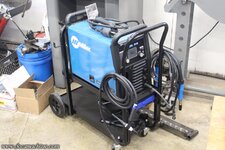
As I posted in my original thread, finally picked up that new multiprocess welder:

newwelder01.jpg

I basically 'consolidated' two big MIGs and an older transformer TIG, into this much smaller package- space in the shop is getting very tight.

Waited too long, and thanks to certain geopolitical conditions, the swap cost me over a thousand bucks more than it should have, but I hear the prices aren't going to come back down any time soon, so whaddyagonnado?

Doc.
 

36truck

Well-known member
Joined
Jul 13, 2010
Messages
980
Location
UP of Michigan
Yes the Arboga radial drill was a nice unit. It was 3 phase 440 volt plenty of power very solid machine. I bought it at auction for $75.00 from an old copper mine machine shop.
 

Balor

Well-known member
Joined
Feb 2, 2014
Messages
452
Location
Florida
Never saw an Arboga radial drill, looks like a neat unit.

I have a 'spare' X/Y table just like the one that's on mine, plunking it on that drill would have made for a pretty versatile drill. :)

As I posted in my original thread, finally picked up that new multiprocess welder:

newwelder01.jpg

I basically 'consolidated' two big MIGs and an older transformer TIG, into this much smaller package- space in the shop is getting very tight.

Waited too long, and thanks to certain geopolitical conditions, the swap cost me over a thousand bucks more than it should have, but I hear the prices aren't going to come back down any time soon, so whaddyagonnado?

Doc.
Doc which millers is it?
 
OP
D

DocsMachine

Well-known member
Joined
Sep 16, 2006
Messages
1,848
Doc which millers is it?

-That's a Miller Multimatic 220. I have a thread on it under "multiprocess machine" on this same page. Only test-fired it so far, but I like it.

Doc.
 

Monza Harry

Well-known member
Joined
Dec 29, 2018
Messages
1,433
Location
Windsor ON
Hey Doc, for radiuses like you did on the E-wheel upper mount, try just mounting an axle with a nut to prevent lifting vertically and with a pipe or wrench just rotate the work piece by hand (conventional not climb) with a slight DoC goes very quickly with a controlled/pretty radius and surface finish is in your hands, literally. Sounds crazy but I've done this a number of times with very favorable results. I had a co-worker video record me doing a hole in aluminum 6" dia. to mount a router in but we couldn't seem to get it off of his phone for me too share :( Your work turned out very professional looking for sure! As for that axle re-spline push hard for a re-heat treat. Damage will likely take out R&P, locker, all bearings, and maybe the whole case especially on a front diff, lots of bind while turning with traction. Harry

P.S. That skim cut for the splines will save thousands of F'ups👍that 10-20 thousandths will show a problem immediately and will hide completely after the correction. Pro $#!+ right there!👏
 
OP
D

DocsMachine

Well-known member
Joined
Sep 16, 2006
Messages
1,848
While that's certainly a legit technique for the radii... I have a rotary table. :) Haven't personally tried any 'hand feeding' techniques like that, but I tend to avoid them unless it's absolutely necessary.

Though I have a 10" and a 12" table, and I'd probably try hand feeding before getting out the 170lb 12" rotary. :D

And yeah, I strongly suggested re-heat-treating on the axle, but I have no idea if the client ever followed up. (Or, for that matter, ever finished the build.) The remaining heat-treating would be more than sufficient to get the car rolling and driveable, but yeah, I told him it'd be iffy in any kind of torque or acceleration situation.

Doc.
 
OP
D

DocsMachine

Well-known member
Joined
Sep 16, 2006
Messages
1,848
Quick little home-repair project. :) I did most of this with the old TIG, but finished it up with the new one, and gave it a quick coat of rattlecan.

steelthing.jpg

I'll show it in use, if I can actually get the project done. :)

Doc.
 
OP
D

DocsMachine

Well-known member
Joined
Sep 16, 2006
Messages
1,848
Time to get this Trak CNC mill up and running!

A lucky happenstance connected me to a local fellow, relatively new to the state, who is very nearly as enthusiastic about machine tools as I am- and better still, considerably better educated and experienced where CNC operation is concerned.

Remember, while I've been a manual machinist for some 25 years, I'm still very much the green noobie into the world of CNC. I've gotten a moderate and tentative handle on the CNC lathe, but I really haven't had much of a chance to sit down and play with the mill, since I did that repair work last year.

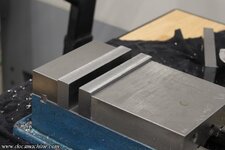
Anyway, the new fellow is as enthusiastic about seeing this thing cut a chip as I am, so now it's time to finally get the rest of it ready. I'd mounted the vise once, but never trammed it in, and since then, picked up some of the "gripper" jaws. These can be added to existing vise jaws, so I'd had a couple pieces of 3/4" steel cut at the metal supplier, oh, roughly most of a year ago.

They'd been squared up, so I got out one of the face mills and, well, faced the two wide faces flat.

23trak-001.jpg

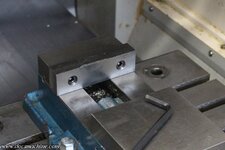
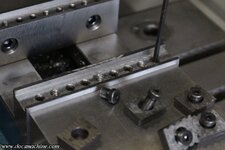
Got out the Heimanns and marked the hole location in the jaws, poked and counterbored a couple holes...

23trak-002.jpg

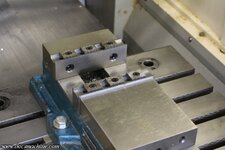
And fitted them to the vise.

23trak-003.jpg

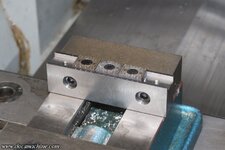
23trak-004.jpg

I'd made a set of mild-steel jaws for this vise a long time ago (the original chilled-iron ones had a .003" low in the center, and that was before I had a surface grinder) but I wanted to keep those, in case I wanted to hold some part where I needed smooth jaws. So these will get grooved, drilled and tapped to hold the 'gripper' teeth.

Then it was time to do a semi-proper survey. I got out my "tram ring"- a giant, unused, SKF bearing race I got from the college machine shop- set up the half-thou test mic and gave it a whirl.

23trak-005.jpg

Best run, I think, showed 0.00125" high at the left, just short of .002" high at the back, and .00125" high on the right. (best guess, splitting the marks on the dial.)

Nominally, .002" high at the back, over a distance of about a foot. Not bad, really- though most operators would probably deem that unacceptable. I'm going to have to try and figure out if the table is crooked to the ways, or the ways are crooked to the spindle. None of the axes are easy to adjust (it's a case of loosen-and-shim) but in my case, the proposed parts I'll hopefully be making don't need particularly tight accuracy, an are small enough that two thou over twelve inches means maybe a quarter thou over the length of the part.

At some point I may still try re-shimming the table, or I may just shim the vise itself slightly. But for the moment, this should get us up and running.

So I cleaned up the vise, plunked it in place, and trammed it in.

23trak-006.jpg

When I have another moment in the next couple days, I'll finish the 'gripper' install, and get some material the right size for that test piece.

Doc.
 
OP
D

DocsMachine

Well-known member
Joined
Sep 16, 2006
Messages
1,848
I've launched a Patreon for the shop stuff, and will eventually start posting more articles there, along with advance access to videos. (I know that sort of thing doesn't mean much right now, but I'm workin' on it. :) )

The day job isn't exactly the stuff of Fortune 500, so if any of you generous sorts can kick in a buck or two, it'd sure help move this stuff along a little faster. :D

Doc.
 
OP
D

DocsMachine

Well-known member
Joined
Sep 16, 2006
Messages
1,848
Had to remake the vise jaws, because as usual I got ahead of myself and didn't bother reading the instructions. :)

The way the "gripper" inserts fit, the jaws need to be 1" thick and have a .700" slot to receive them. That's both reinforcing, to help back up the bolts that hold them in place, as well as an 'anti twist' feature. The jaws I'd just made- the time for which was absolutely not 'wasted'- were only 3/4" wide.

Luckily I had some 1" material, and a few more minutes on the mill got them squared up and to size. So once again I located and drilled a couple holes, and then counterbored.

23trak-007.jpg

Only issue here was I needed new bolts because of the thicker jaws, and the old bolts were a bit well-used anyway. The new ones wouldn't fit in a 5/8" counterbore- it was a near thing, so I just turned down the bolts about 20 thou.

23trak-008.jpg

A quick test fit and everything's hunky-dory.

23trak-009.jpg

I then located the center on the top edge, and slotted it- a process that would have been ideally suited for, oh, say, a CNC mill. :)

23trak-010.jpg

A little care and finagling, and I had the slot to (almost) the exact width, and (almost) the exact depth. :D

23trak-011.jpg

As the finishing touch, in another move that would have been considerably easier if I could have just told JARVIS to do it, I located, drilled and tapped nine holes to accept the gripper inserts.

23trak-012.jpg

The supplied instructions called for eleven, but that was for a 6" jaw- I'm putting them on a 5" vise.

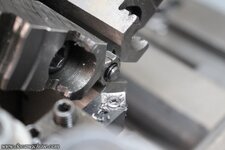
Also, the drawing calls for 2" tall jaws- These are only 1-1/2" tall. And that means- and I knew this going in- that two of the holes on each end, intersect with the big bolt holes. And the supplied retainer screws are too long, by roughly a quarter inch, to fully seat once the big bolts are in place.

23trak-013.jpg

I'll just have to order some more of the low-profile allen-head screws in a shorter length. But to start with, I can put the three 1" long grippers in a row, and the first test piece will be 3" square, so at least this will get us rolling.

Doc.
 
OP
D

DocsMachine

Well-known member
Joined
Sep 16, 2006
Messages
1,848
Finally had a minute to finish up the second jaw. (Pesky 'heads of state'! Why can't they solve their own problems?!?)

Got the last row drilled and tapped...

23trak-014.jpg

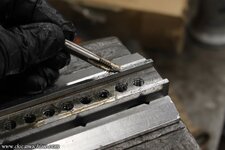
And then took it over to the bench vise to chase the holes a bit deeper with a semi-bottoming tap. And, of course, on the second-to-last hole...

23trak-015.jpg

Grumble, grumble... The second-in holes on the end intersect with the big bolt holes that hold the jaws to the vise body. As the tap hit an edge, the cutting action "wedged" the tap sideways, and it snapped with surprisingly little effort. Thankfully, the remaining end was in the big bolt hole, so I was able to tap it lightly with a drift, which shattered it a bit more, and I was able to pick the remnants out with a tweezers.

A light cleanup with the fresh tap, and thankfully, all was well again. :)

Now, that 'intersection' issue, as I said before, is a bit of a pickle. The jaws are supposed to be taller, so the screws that hold the gripper jaws down are longer. I went with shorter material- since that's what I had on hand- and that necessitated a considerably shorter screw when using either of the outer pair of holes on either jaw.

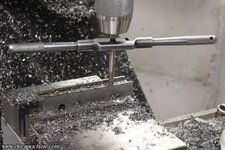
The old trick of slotting a spare nut makes for an easy way to hold the screw in the lathe...

23trak-016.jpg

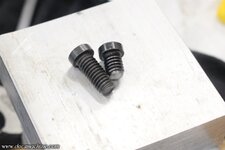
And after a few minutes work, had four of them appropriately shortened.

23trak-017.jpg

Too short, I think, and may compromise the ultimate gripping strength. But then, this is, after all, just a 3HP, 30-taper machine, and will virtually always just see aluminum, or occasionally brass or Delrin.

All in all, when funds become available again, I'll probably replace this whole mess with a new 5" Glacern and some one-piece 'gripper' jaws.

But 'til then, and just to get a trial part or two made, these should work fine. The spare holes are of course corked with some short setscrews, so they don't get packed with chips...

23trak-018.jpg

And there we go. Six pretty solidly mounted, hardened steel gripper jaws.

23trak-019.jpg

So we're now ready to finally try that "Euclid" test block. It's an aluminum piece with a circle and a triangular feature, so you can check the machine for dimensional accuracy, circularity, and angularity. The manual has all the dimensions in the drawing, and you compare those with the cut part.

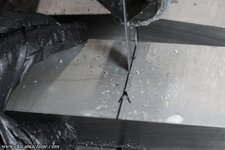
That takes a 3" square chunk of 1" thick plate. I'd picked up some 3x6" sections from the local metal supplier, and bandsawed those square.

23trak-020.jpg

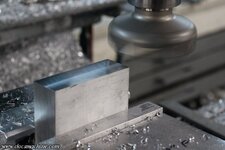
Those each got lightly faced opposite the 'factory' edge, so at least those two faces were parallel.

23trak-021.jpg

And, with the grippers re-set for a 3" workpiece, the first test block is tapped down and torqued.

23trak-022.jpg

... I should slap an indicator on it and see how 'flat' we are...

After that, a little more fiddling with the controls, and we'll be ready to cut our first chips!

Doc.
 
OP
D

DocsMachine

Well-known member
Joined
Sep 16, 2006
Messages
1,848
First chips! .... BUT...!

My expert help had a chance to come by today, so I went ahead and dumped two of my buckets of fabulously expensive cutting oil into the sump....

23trak-023.jpg

And tried the coolant pump for the first time.

23trak-024.jpg

This stuff was supposed to be water-thin and water-clear. It's neither of those. It's both a little thicker, and yellower- and smellier- than the stuff I have in the Omniturn and the turret lathe. Considering what it cost me, I'm not happy about it, but there's also nothing I can do about it just yet. It'll do for now.

Then, we loaded up the program, set our X and Y edges, set the Z height plus two inches, and "cut air" for the first pass- no tool, no workpiece. Looked good, at least as far as one can tell watching an empty holder move though empty space. :)

Put in the tool- a brand-new $60 three-flute carbide endmill- and put in a workpiece, and 'cut air' again, 2" over the top of the work. Still looked good.

Re-set the Z to the right height, hit the go-button again, and it rammed the endmill into the work and destroyed it.

23trak-025.jpg

Now, this is the test program straight from the factory. It's supposed to be known, proven, and is intended to make a part you can measure, to see how close that particular machine is to the dimensions.

Looking a little more closely at the program, it was trying to plunge Z - not 'circular interpolate', but a straight plunge- into the work. There was zero delay given for the first move, so the spindle was not anywhere near up to speed- I figure it was doing less than 200 RPM- before it hit the work. At ten IPM.

I'm guessing they assumed the spindle would be up near the 'home' position, and thus there'd be another second or two for it to get up to speed. Plunging at 10IPM at only 2,000 RPM is still a bit stiff for a 30 taper.

We swapped the tool- hey, it's only money- re-homed, re-set Z, and slowed the downfeed to 2 IPM, and moved the point where it started feeding in, from 50 thou to 250 thou. With the head raised to the max, that all gave the spindle time to get up to speed before it hit the work.

So we tried it again- and this time it worked! ... sort of. It was trying to take a massive cut- 1/2" diameter, 1/4" deep slot in one pass, for the outer feature- at only 2,000 RPM. It was doing it, but it sounded like it was only under protest.

We stopped the program about a third of the way through, and both dropped the feed and bumped up the RPM. Ran it again. And this time, about halfway through the program, it became obvious to me it wasn't doing it right.

23trak-026.jpg

The wall of the circular feature is nominally an 1/8" too thick. That thin curved wall at the corners, shouldn't be there at all. That notch in the circular feature, also shouldn't be there.

Best guess- in large part going by a Trak video on the 'Tube showing this part being cut- is that the program was intended for a 3/4" endmill, not a 1/2". The manual gives instructions on running the program, and also calls it a different part number from what I was given- again, by the factory itself.

Except that would have been even more of a heavy cut for those parameters- maybe okay for something in the 40-taper range, but I keep being told that 5/8" is about the generally accepted limit for a 30-taper.

The test part that came with the machine, was clearly milled with a 1/2" endmill, so I think I got the wrong program from the factory.

I'm going to email and see what they say, but I think I'll also light my (currently expired) copy of Fusion360 back up, and maybe try to draw a simple test part- just a square, maybe with rounded corners or something. I need to dive into their post-processors anyway, and learn how to use those...

Anybody know if you can still access all the post-processors even with the 'free' version?

Doc.[/I]
 
OP
D

DocsMachine

Well-known member
Joined
Sep 16, 2006
Messages
1,848
Success! One of my Guild regulars re-drew the test part out of the manual, and set it up with a more modern- and less "brute force"- toolpath

I checked it with the visualizer first, and then "cut air" at least three times- once with the Z set extra high, once with the Z set high but close and once with the tool and part in place, but just set 2" high. Only hiccup in that routine was he'd set the work zero at the center of the part- I'd zeroed on the edges, so had to re-set those inboard a bit.

23trak-031.jpg

Love this Haimer- it wasn't cheap, but boy does it make finding edges easy. And I haven't broken a tip yet! :)

Finally, it was time to cut for real. I even set up a GoPro with a waterproof case inside the enclosure, since I can't run with the door open a crack like I can with the Omni. But, unlike the Omni, this thing has a considerably faster spindle speed, and the enclosure rapidly filled with oil vapor.

23trak-032.jpg

This is going to be a problem. The quick fix for the moment is I'm likely going to have to set it up to run less aggressive feeds and lower spindle speeds, and will likely still have to look into some sort of vent and oil-capture setup. I was worried I was going to have to- the top of the mill's enclosure is open, wheras the CNC lathe is almost entirely closed.

And yeah, I know the correct fix is, of course, to go with water-based coolant, but the time-between-uses is still going to be a major issue for a while. I haven't yet, for example, used the lathe yet this year. So for the time being, I'll just have to work around it, mitigate it as best I can.

Anyway, I wish I'd have been able to see the action better, but between the London fog and the windows that were none to clear to start with, this was about the best photo I could get:

23trak-033.jpg

But, she completed with no fuss, no crashes, no broken anything- but definitely a bit of a mess. :)

23trak-034.jpg

Haven't measured it yet, but it looks as good as the factory piece, if not better.

23trak-035.jpg

Factory program on the left, our new one on the right. :)

23trak-036.jpg

Extremely happy to see the machine works and works well, can cut a healthy chip, gives a good surface finish, and I've learned a nice bit more on its operation. Now I just need to get back up to speed on F360, so I can start whining about not knowing how to run the CAM part of it. :)

Doc.
 
OP
D

DocsMachine

Well-known member
Joined
Sep 16, 2006
Messages
1,848
Video of those first few moments before everything got too foggy. :)


Yeah, it does look a little jerky- it smooths out later, and the original test-part program was quite smooth, so I'm assuming it has to do with how the part was post-processed.

Doc.
 

dutchgray

Well-known member
Joined
Sep 28, 2014
Messages
6,463
Location
Dorset. England.
Nice Doc.
The new test piece certainly looks nice enough but the proof is what it measures versus what it's supposed to measure.

I think a circulating air flow running through a labyrinth of steel plates that allow the oil to drip back down into the machine should do to something to reduce that oil fog.

I run oil in my manual lathe for coolant (I think it's ISO32) but it doesn't work that well, there isn't enough capacity so I only get about 10 minutes before it runs out as it doesn't run back to the tank quick enough.
I should probably lift the headstock end of the lathe a bit to help but I like the machine to be leveled at actual level.
 
To avoid these ads, REGISTER NOW!
OP
D

DocsMachine

Well-known member
Joined
Sep 16, 2006
Messages
1,848
I think a circulating air flow running through a labyrinth of steel plates that allow the oil to drip back down into the machine should do to something to reduce that oil fog.

-Yeah, I've been pondering ways to make a mist remover. There are of course commercial units, that generally use an electrostatic grid to remove the oil (and presumably collect it) but even a small one of those can be thousands of dollars.

I'll have to do more research before I actually build anything, but I've been kind of thinking of something like those "Dust Deputy" centrifugal separators like the wood-router guys use.

Scale it up, add some baffling for the vapor to deposit against, a point at the bottom for the oil to collect- even if I have to manually dump that back into the machine- and a fan of some kind that isn't an ignition point...

Doc.
 

dutchgray

Well-known member
Joined
Sep 28, 2014
Messages
6,463
Location
Dorset. England.
You want a decent size centrifical blower as the fan. Keeps the electric motor part completely separate to the explosive oil mist.

My little all manual surface grinder has one mounted on the back of the base casting, which extracts all the grinding muck and dumps it out in the base casting. There is a narrow cover you can remove to clean it out.
It doesn't have coolant however, I suspect using coolant would make one almighty mess.
 
OP
D

DocsMachine

Well-known member
Joined
Sep 16, 2006
Messages
1,848
Looked up a few commercial systems, but most are "if you have to ask the price, you can't afford it". :)

I'm sure there's something out there that's at least somewhat affordable, but there's a lot of options out there, I just have to find the right one.

One thing's for sure, I'll need a lot of volume, and it'll have to handle a pretty heavy mist.

Doc.
 

Monza Harry

Well-known member
Joined
Dec 29, 2018
Messages
1,433
Location
Windsor ON
You crack me up Doc! 137 1/2 steps, you lazy b'tard! There was room for another 15-20 steps, at least. LOL! Nectar of the God's LOL+! The waste/recycle bin was funny as Hell/well ! Don't you have any more files? And those F'king center drills :mad: . Thanx for sharing, that was well worth my time. Harry :)
 
OP
D

DocsMachine

Well-known member
Joined
Sep 16, 2006
Messages
1,848
Don't you have any more files?

-I have, without exaggeration, almost two hundred files. :) Coarse, fine, extra-fine, *******, mill-cut, safe-edge, round, rat-tail, needle, Swiss, rasp, Vixen, half-round, square, triangular, knife... I have files I've ground flat on one face or an edge, I've heated and reshaped with a torch, welded special handles to... And then there's the thirty-or so die-filer files. :D

I'm not as good as Clickspring*, but I know my way around a file. :)

Doc.

(*Yet.)
 
OP
D

DocsMachine

Well-known member
Joined
Sep 16, 2006
Messages
1,848
I would like to take a moment to recognize- and perhaps brag a a bit- that July 1st, 2023 officially marks my Twenty-Fifth Year in business! :)

I had kind of hoped to have something special to mark the occasion- a secret project, a special comic, a video, a B-52 flyby... But unfortunately I've just been too busy. The story, as they say, of my life.

I officially hung out this particular shingle on July 1st, 1998. My 'shop' was a small, dimly lit storage room, of which I occupied perhaps sixty square feet. My first machine was a worn-out Jet mill-drill, and it was a few months before I was able to pick up a Grizzly 9x19 lathe. I made do with those, and upgraded as funds and opportunities allowed. And with a great deal of hard work and perseverance... that room is no longer dimly lit. :D

I started out doing mods to paintball guns and making paintball parts, and I am still doing so today. There have, of course, been uncountable ups and downs, innumerable side-tracks, and of course the endless issues of trying to run a one-man business in the back waters of Left Armpit, Alaska- especially when that one man has all the business acumen of an inebriated snail. But with luck, hard work, skill, and a great deal of outside help from friends and family, I'm still here. :)

I can't be completely certain- I'm sure somebody will correct me- but I may very well be the longest-running paintball airsmith at this point. We might need to modify that with full time airsmith- this has been my day job since day one- and the entire time under the same 'shingle' (company, business name, etc.)

... Aaand that and two-fifty'll get'a a cup of coffee. :D

Twenty five years, five Presidents, more than twenty different machine tools, over three hundred different products, I'd wager between four and six thousand different markers through the doors, likely better than 30,000 individual sales, and and I can very probably legitimately claim over 150,000 items made and sold.

When I started this biz, I gave myself a year. If at the end of that year, things weren't working out, I'd go and get a 'real' job.

That was twenty-five years ago. :)

Doc.
 

Balor

Well-known member
Joined
Feb 2, 2014
Messages
452
Location
Florida
I would like to take a moment to recognize- and perhaps brag a a bit- that July 1st, 2023 officially marks my Twenty-Fifth Year in business! :)

I had kind of hoped to have something special to mark the occasion- a secret project, a special comic, a video, a B-52 flyby... But unfortunately I've just been too busy. The story, as they say, of my life.

I officially hung out this particular shingle on July 1st, 1998. My 'shop' was a small, dimly lit storage room, of which I occupied perhaps sixty square feet. My first machine was a worn-out Jet mill-drill, and it was a few months before I was able to pick up a Grizzly 9x19 lathe. I made do with those, and upgraded as funds and opportunities allowed. And with a great deal of hard work and perseverance... that room is no longer dimly lit. :D

I started out doing mods to paintball guns and making paintball parts, and I am still doing so today. There have, of course, been uncountable ups and downs, innumerable side-tracks, and of course the endless issues of trying to run a one-man business in the back waters of Left Armpit, Alaska- especially when that one man has all the business acumen of an inebriated snail. But with luck, hard work, skill, and a great deal of outside help from friends and family, I'm still here. :)

I can't be completely certain- I'm sure somebody will correct me- but I may very well be the longest-running paintball airsmith at this point. We might need to modify that with full time airsmith- this has been my day job since day one- and the entire time under the same 'shingle' (company, business name, etc.)

... Aaand that and two-fifty'll get'a a cup of coffee. :D

Twenty five years, five Presidents, more than twenty different machine tools, over three hundred different products, I'd wager between four and six thousand different markers through the doors, likely better than 30,000 individual sales, and and I can very probably legitimately claim over 150,000 items made and sold.

When I started this biz, I gave myself a year. If at the end of that year, things weren't working out, I'd go and get a 'real' job.

That was twenty-five years ago. :)

Doc.
Congratulations Doc. :thumbup:
 
OP
D

DocsMachine

Well-known member
Joined
Sep 16, 2006
Messages
1,848
Thank you, gentlemen! There have certainly been some slips, slides and near-misses along the way, and it's worth noting that trying to do what I'm doing, in this backwater with literally nearly zero manufacturing resources or infrastructure, was a very poor overall choice. But, as they say, you play the cards you're dealt, and I've been trying to make the best of it.

And I hope you all stick around, I have lots more on the way! :D

Doc.
 

bimmer1980

Well-known member
Joined
Feb 5, 2009
Messages
2,103
Location
York, PA
Congrats on building a business and a life.

It would also be interesting to hear some stories and tactics that you did to make the business a success. I'm sure they are numerous!!

Maybe a beginner question, but how did you market and advertise your business? What steps did you take to build a network of customers? Is your typical customer a repeat buyer or is each new?

I for one, have enjoyed reading your efforts of machine restoration that add equipment to your shop.

Hat's off you to for building the business!!!!
 

Monza Harry

Well-known member
Joined
Dec 29, 2018
Messages
1,433
Location
Windsor ON
I'll add my congratulations Doc! No small feat especially for a non priority (discretionary) product given the economic upheavals we have been through! Cars, food, those are necessities those get bought no matter what! Luxury/hobby items, that is a tough one and your "Winning"! I have been reading along for maybe 7-8 years now and it has been a pleasure! That likeablity and your talent/drive is the glue and fuel for your success! Thank You for the ride! Harry
 
OP
D

DocsMachine

Well-known member
Joined
Sep 16, 2006
Messages
1,848
For those of you the know a little something about paintball, here's another video for ya!


Best guess is the gun was customized some time in the 90s, and has been sitting, dismantled, for most of that time. The current owner received it from a now-deceased uncle, and wanted it fixed back up into playable condition. I didn't get too carried away trying to polish out all the corrosion marks, out of both time and sentimentality reasons.

This one was kind of rushed, as I'm currently up against more than a couple deadlines, let me know what'cha think, and feel free to critique.

Doc.
 
OP
D

DocsMachine

Well-known member
Joined
Sep 16, 2006
Messages
1,848
One for you old-school machinists! :)


The power supply for my CNC lathe croaked at some point between the last time I used it and this weekend. But, I still have parts I need to make, so while waiting on a new PSU I turned back to my eighty-four-year-old Warner & Swasey turret lathe.

Maybe not quite as fast, and certainly not quite as effortless, but she still works. :)

Doc.
 
To avoid these ads, REGISTER NOW!
Top Bottom