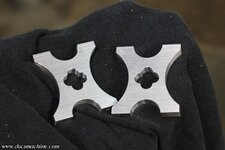
OP
DocsMachine
Well-known member
- Joined
- Sep 16, 2006
- Messages
- 1,916
Here's a repost of an older project, but I figured you ladies and gents might like it. 
Fairly straightforward, just a bit tricky in execution.
Customer came in with this aftermarket Currie axle shaft, I'm not sure what it originally fit, and a front Dana 44 4WD solid axle shaft.

The Currie axle is (was?) brand new, a nice heavy-duty racing piece.
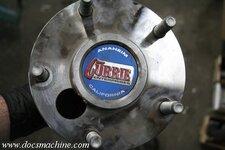
The job? Cut it down to a foot long and respline it to fit the Dana pumpkin. The customer is making a custom diff for one of his customer's hot-rod project, so some of the excess meat had to go.

Unfortunately, the axle, despite a quick file test, proved harder than I expected, and I managed to wipe out a good fine-tooth Starrett bandsaw blade, inflicting virtually no damage to the axle in the process. Kinda cuts into the profit margin...
I had to use an abrasive saw, going very slowly and cutting in steps as to not overheat- and thus, risk spot hardening it. Took a bit of time, but it worked.
Next step was to rap out the studs with a non-marring bronze hammer...

... Which I had to do in order to be able to properly chuck it up in the lathe.

Note the roller steady rest in order to allow a good facing cut and accurate center drill, so that I can use a proper live center for the actual work.
Also note the interesting behavior of the metal:
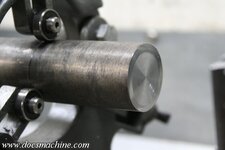
That's not due to differences in speeds or feeds. The axle shaft is, in effect, "case hardened". The outer "skin", about 3/16" deep in this case, is quite hard- or rather, very tough. Not so much 'hard' like glass or ceramic, but very cut-resistant.
While the inner "core" is considerably softer- still pretty tough (it's all the same piece of steel, just heat-treated differently) but noticibly easier to cut. This is pretty standard on most factory and aftermarket axle shafts- a very strong skin for strength, a softer core to help it absorb shock and flex so it won't break. You knife guys might recognize that as a standard concept for everything from sword blades to axe heads; hard cutting edge, softer, more flexible body to help resist shattering.
Now, a sharp carbide insert had no trouble cutting it- and in fact, given the right speed and feed, produced a very nice near-mirror finish.

However, the little lathe had neither the HP nor the rigidity for any significant cut. I tried heavier cuts in back-gear, but the metal tended to tear rather than cut. So I baby-sat it while it worried off 0.020" at a time. Last couple of finish passes left a very nice surface.

Last pass of... I think it was 0.006" to get to my final size.
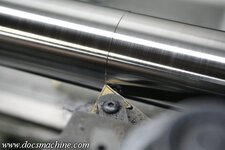
And the slight 'step' of about 50 thou. The splined area is slightly smaller than where the seal goes, so the splines don't damage the seal upon installation.

Then it's over to the mill for the standard dividing head setup:

The chuck I have on the dividing head isn't big enough to grab the axle flange as I did in the lathe, nor would the jaws close down far enough to grab the center locating stub. Or, when the jaws are in the normal configuration, they wouldn't open far enough to grab even the center, let alone the outer.
My dividing head, however, came with a dead center and a sort of "dog plate" for between-centers use.

However, there was no way to use an actual dog, so I rummaged through the scrap bin, found a short chunk of heavy angle-iron, and with a few deft cuts and a run through both the Nichols mill and Arboga drill, had a suitable driver.
The dividing head, while an import, uses the same principles that makers have been using for well over a century. My favorite reference for these is a copy of Brown & Sharpe's Practical Treatise on Milling and Milling Machines from 1913 (as in, over a century old) which Google digitized and made available for download.
I had a shop print it out and spiral-bind it (though I'd love to have an original) and it's been surprisingly useful ever since.
So, since I needed 30 splines (I counted them at least twice) according to the book I could use the 18, 33 or 39-hole selections. I already had the indexing plate with the 33-hole ring installed so I used that one.
That required, in the book's parlance, 1-11/33rd turns. That is, one and one-third turns, or 11 of the 33 holes. The indexer has a pair of movable arms... Hm, I suppose I should have taken a photo of that... called a quadrant. You move these in order to help keep track of fractional turns- they simply serve as markers as you turn the crank handle.
That's a highly simplified description, of course- the book has a couple of chapters devoted to it- but in effect, I needed to mill a spline, crank the handle one-and-a-third turns, mill another spline, lather, rinse, repeat.
And, as a final double-check, I only made a light skim cut of about 0.010" for the first go-around. If the splines lined back up when I came back around to the start, everything's kosher.

It took about three passes to get to the correct depth (and that's my homebrew carbide cutter I made specifically for cutting splines.) The customer had brought one of the spider gears out of the diff, so I had in effect a go-no-go gauge for fitting. A little care and we've got a perfect fit.

The question, however, will be how strong the new splines will be. Most of the work was still in the hard "skin", but I think the root of the splines may be right on the ragged edge. I've warned the customer of this, and he understands, I think. We've considered the possibility of sending it off for re-heat-treatment, but that'll be up to the final owner- the guy who's building the actual hotrod.
All I have left is to give the splines a quick rub with a deburring wheel, and she's done.

Et voilá!

So what's the hotrod? If I understand it correctly... a midengine PT Cruiser.
Yeah, that's kinda what I said. If I ever see it, I'll get pics.
Doc.
Fairly straightforward, just a bit tricky in execution.
Customer came in with this aftermarket Currie axle shaft, I'm not sure what it originally fit, and a front Dana 44 4WD solid axle shaft.
The Currie axle is (was?) brand new, a nice heavy-duty racing piece.
The job? Cut it down to a foot long and respline it to fit the Dana pumpkin. The customer is making a custom diff for one of his customer's hot-rod project, so some of the excess meat had to go.
Unfortunately, the axle, despite a quick file test, proved harder than I expected, and I managed to wipe out a good fine-tooth Starrett bandsaw blade, inflicting virtually no damage to the axle in the process. Kinda cuts into the profit margin...
I had to use an abrasive saw, going very slowly and cutting in steps as to not overheat- and thus, risk spot hardening it. Took a bit of time, but it worked.
Next step was to rap out the studs with a non-marring bronze hammer...
... Which I had to do in order to be able to properly chuck it up in the lathe.
Note the roller steady rest in order to allow a good facing cut and accurate center drill, so that I can use a proper live center for the actual work.
Also note the interesting behavior of the metal:
That's not due to differences in speeds or feeds. The axle shaft is, in effect, "case hardened". The outer "skin", about 3/16" deep in this case, is quite hard- or rather, very tough. Not so much 'hard' like glass or ceramic, but very cut-resistant.
While the inner "core" is considerably softer- still pretty tough (it's all the same piece of steel, just heat-treated differently) but noticibly easier to cut. This is pretty standard on most factory and aftermarket axle shafts- a very strong skin for strength, a softer core to help it absorb shock and flex so it won't break. You knife guys might recognize that as a standard concept for everything from sword blades to axe heads; hard cutting edge, softer, more flexible body to help resist shattering.
Now, a sharp carbide insert had no trouble cutting it- and in fact, given the right speed and feed, produced a very nice near-mirror finish.
However, the little lathe had neither the HP nor the rigidity for any significant cut. I tried heavier cuts in back-gear, but the metal tended to tear rather than cut. So I baby-sat it while it worried off 0.020" at a time. Last couple of finish passes left a very nice surface.
Last pass of... I think it was 0.006" to get to my final size.
And the slight 'step' of about 50 thou. The splined area is slightly smaller than where the seal goes, so the splines don't damage the seal upon installation.
Then it's over to the mill for the standard dividing head setup:
The chuck I have on the dividing head isn't big enough to grab the axle flange as I did in the lathe, nor would the jaws close down far enough to grab the center locating stub. Or, when the jaws are in the normal configuration, they wouldn't open far enough to grab even the center, let alone the outer.
My dividing head, however, came with a dead center and a sort of "dog plate" for between-centers use.
However, there was no way to use an actual dog, so I rummaged through the scrap bin, found a short chunk of heavy angle-iron, and with a few deft cuts and a run through both the Nichols mill and Arboga drill, had a suitable driver.
The dividing head, while an import, uses the same principles that makers have been using for well over a century. My favorite reference for these is a copy of Brown & Sharpe's Practical Treatise on Milling and Milling Machines from 1913 (as in, over a century old) which Google digitized and made available for download.
I had a shop print it out and spiral-bind it (though I'd love to have an original) and it's been surprisingly useful ever since.
So, since I needed 30 splines (I counted them at least twice) according to the book I could use the 18, 33 or 39-hole selections. I already had the indexing plate with the 33-hole ring installed so I used that one.
That required, in the book's parlance, 1-11/33rd turns. That is, one and one-third turns, or 11 of the 33 holes. The indexer has a pair of movable arms... Hm, I suppose I should have taken a photo of that... called a quadrant. You move these in order to help keep track of fractional turns- they simply serve as markers as you turn the crank handle.
That's a highly simplified description, of course- the book has a couple of chapters devoted to it- but in effect, I needed to mill a spline, crank the handle one-and-a-third turns, mill another spline, lather, rinse, repeat.
And, as a final double-check, I only made a light skim cut of about 0.010" for the first go-around. If the splines lined back up when I came back around to the start, everything's kosher.
It took about three passes to get to the correct depth (and that's my homebrew carbide cutter I made specifically for cutting splines.) The customer had brought one of the spider gears out of the diff, so I had in effect a go-no-go gauge for fitting. A little care and we've got a perfect fit.
The question, however, will be how strong the new splines will be. Most of the work was still in the hard "skin", but I think the root of the splines may be right on the ragged edge. I've warned the customer of this, and he understands, I think. We've considered the possibility of sending it off for re-heat-treatment, but that'll be up to the final owner- the guy who's building the actual hotrod.
All I have left is to give the splines a quick rub with a deburring wheel, and she's done.
Et voilá!
So what's the hotrod? If I understand it correctly... a midengine PT Cruiser.
Yeah, that's kinda what I said. If I ever see it, I'll get pics.
Doc.

 that 10-20 thousandths will show a problem immediately and will hide completely after the correction. Pro $#!+ right there!