To avoid these ads, REGISTER NOW!

Inside Doc's Shop...

OP
D

DocsMachine

Well-known member
Joined
Sep 16, 2006
Messages
1,848
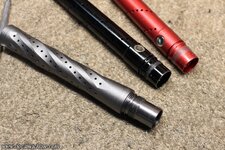
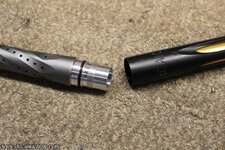
One product I commonly make is a paintball gun barrel that takes inserts of different sizes. This helps the player match the bore of the barrel to the size of the paintball that day, and this aids accuracy and gas efficiency. There are, however, some markers out there that weren't designed with such features in mind, and in order to use a barrel like this, it needs a shallow "step" inside the bore, to retain the insert.

The issue here is that there's a common, off-the-shelf aluminum tubing that has an ideal bore, as supplied. I've been using it for years, and point in fact, I'm all but certain the manufacturer that invented this system, used the same stuff. :D The problem being that, for those barrels that need that "step", there's no easy way to add that, without threading, welding or turning from solid bar.

I've pondered this issue for some time, and with a little thought and some advice from the Internet At Large® I came up with a solution: Since the end with the step needs to be fully machined anyway, what if I swaged the end of the tube down ? Basically just squished it in a controlled manner to a smaller OD and ID, and then turned the features into it.

A fellow over on HSM posted a pic of a shop-made guillotine swage that I thought would work. I really need to get moving on these parts, if I'm going to do anything with them, so I took some time this morning to build my own version. TL:DR version? It works perfectly. :)

I started with a hunk of old I-beam out of the scrap piles...
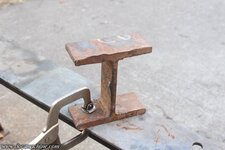
swage01.jpg

That got ground, sanded and brushed down...
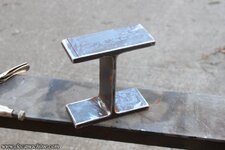
swage02.jpg

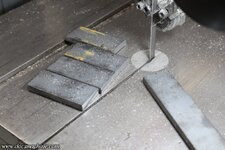
And then bandsawed into pieces.

swage03.jpg

For guides, I dug two chunks of 1" hot-rolled out of the same pile, and slotted each one to fit the web of the I-beam.

swage04.jpg

A little bit of fine-tuning with the belt-grinder and a smidge o' TIG, and voila!

swage05.jpg

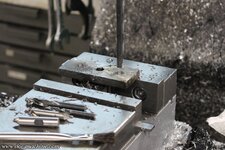
That goes into the mill and the operative bore... er, bored.

swage06.jpg

Bit of guesswork there: I wanted to reduce the bore by about .075", so the ID of the dies were cut to about .075" less than the OD of the tubing. The exact number was irrelevant, as long as there was enough material to turn it to the final dimension.

After a little deburring and smoothing, it was time to give it a try. I had some scrap barrels to try it on, so with a little bit of oil brushed on, I stuck the whole mess in the press and gave 'er a squish.

swage07.jpg

And that, actually, turned out just perfectly.
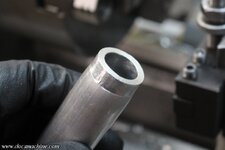
swage08.jpg

It's not an even squash, I may try going most of the way, turning the tube 90 degrees, and squishing the rest, but even still, that right there is 100% usable.

The bore ended up football shaped, .655" (down from the original nominal .750") across the die parting lines, and .675" vertically. The finished bore needs to be between .695" and maybe .705", so that's perfect.

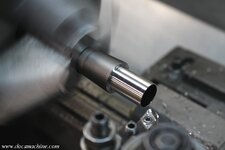
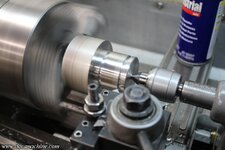
I chucked it up to see how it turned back to round...

swage09.jpg

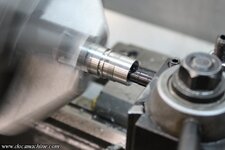
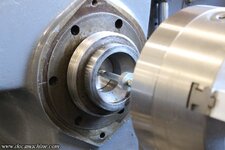
And it appears to have worked perfectly. I turned the bore back to .695", and it retains the insert perfectly.
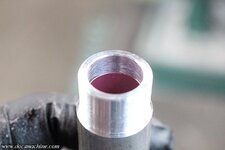
swage10.jpg

You can see just a touch of eccentricity to the left there, but taking another 5 thou or so, and maybe turning the tube 90 degrees should solve that. Might add a couple short return springs to the swage help make that go a little quicker.

Nice little win to cap off what had been a bit of a tedious week. :)

Doc.
 
To avoid these ads, REGISTER NOW!

Firstram

Well-known member
Joined
May 16, 2017
Messages
1,390
Hope you can point me in the right direction. I’m looking for an adjustable inline pressure regulator for paintball tanks. Special effects in the film industry and 0 to 400 psi is what I’m looking for. I have used a Palmer’s Persuit Fatty in the past but it’s not quite right. I have another manufacturer’s version that is a little more conventional looking that’s perfect but I can’t remember where I bought them. Any ideas?
 

Fixr

Well-known member
Joined
Dec 23, 2012
Messages
9,702
Location
SW VA
One product I commonly make is a paintball gun barrel that takes inserts of different sizes. This helps the player match the bore of the barrel to the size of the paintball that day, and this aids accuracy and gas efficiency. There are, however, some markers out there that weren't designed with such features in mind, and in order to use a barrel like this, it needs a shallow "step" inside the bore, to retain the insert.

The issue here is that there's a common, off-the-shelf aluminum tubing that has an ideal bore, as supplied. I've been using it for years, and point in fact, I'm all but certain the manufacturer that invented this system, used the same stuff. :D The problem being that, for those barrels that need that "step", there's no easy way to add that, without threading, welding or turning from solid bar.

I've pondered this issue for some time, and with a little thought and some advice from the Internet At Large® I came up with a solution: Since the end with the step needs to be fully machined anyway, what if I swaged the end of the tube down ? Basically just squished it in a controlled manner to a smaller OD and ID, and then turned the features into it.

A fellow over on HSM posted a pic of a shop-made guillotine swage that I thought would work. I really need to get moving on these parts, if I'm going to do anything with them, so I took some time this morning to build my own version. TL:DR version? It works perfectly. :)

I started with a hunk of old I-beam out of the scrap piles...

swage01.jpg

That got ground, sanded and brushed down...

swage02.jpg

And then bandsawed into pieces.

swage03.jpg

For guides, I dug two chunks of 1" hot-rolled out of the same pile, and slotted each one to fit the web of the I-beam.

swage04.jpg

A little bit of fine-tuning with the belt-grinder and a smidge o' TIG, and voila!

swage05.jpg

That goes into the mill and the operative bore... er, bored.

swage06.jpg

Bit of guesswork there: I wanted to reduce the bore by about .075", so the ID of the dies were cut to about .075" less than the OD of the tubing. The exact number was irrelevant, as long as there was enough material to turn it to the final dimension.

After a little deburring and smoothing, it was time to give it a try. I had some scrap barrels to try it on, so with a little bit of oil brushed on, I stuck the whole mess in the press and gave 'er a squish.

swage07.jpg

And that, actually, turned out just perfectly.

swage08.jpg

It's not an even squash, I may try going most of the way, turning the tube 90 degrees, and squishing the rest, but even still, that right there is 100% usable.

The bore ended up football shaped, .655" (down from the original nominal .750") across the die parting lines, and .675" vertically. The finished bore needs to be between .695" and maybe .705", so that's perfect.

I chucked it up to see how it turned back to round...

swage09.jpg

And it appears to have worked perfectly. I turned the bore back to .695", and it retains the insert perfectly.

swage10.jpg

You can see just a touch of eccentricity to the left there, but taking another 5 thou or so, and maybe turning the tube 90 degrees should solve that. Might add a couple short return springs to the swage help make that go a little quicker.

Nice little win to cap off what had been a bit of a tedious week. :)

Doc.
Good. Now get that tablet fixed.
 
OP
D

DocsMachine

Well-known member
Joined
Sep 16, 2006
Messages
1,848
A year or two ago, I picked up a couple of rolling tool cabinets from the local Homey-Dee, to not only store the tooling for each of the CNC machines, but also to give me a work surface to set tools and generally pile ****. :)

A common add-on for these things is a pegboard back, except either they weren't carried locally, or had been discontinued. I could see pics online, but the local store didn't have them, nor could they find them to order any.

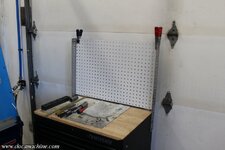
No big, I can DIY something.... Also at HD, I found some standard white pegboard, and some perforated angle material. A few weeks ago, while running some parts, I sliced the angle in two, and by luck, some of the holes in the long side lined up with the existing bolt holes for the side handle.

pegboard01.jpg

The top of the cabinet has a rolled edge, however, so I found some 60-thou aluminum sheet, and cut a couple of spacers.

pegboard02.jpg

That way the bolts could be tightened without distorting anything, and the uprights stayed, well, straight upright. :)

I got my buddy with a Festool track saw to slice up the pegboard to fit the new uprights...

pegboard03.jpg

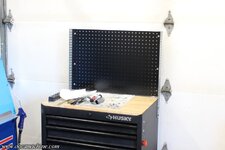
after which I drilled a few attachment screw holes (of course none of the existing holes lined up :) ) and then sprayed it a satin black:

pegboard04.jpg

Partly to match the existing cabinet, and partly to seal the particle board against the inevitable smears of cutting oil. But mostly to hide the dirty fingerprints. :D

After that had a few hours to cure, I mocked it up on the uprights:

pegboard05.jpg

I think that'll work just fine, and I could use it now... but we're not done yet.

(More to come.)

Doc.
 
OP
D

DocsMachine

Well-known member
Joined
Sep 16, 2006
Messages
1,848
Hope you can point me in the right direction. I’m looking for an adjustable inline pressure regulator for paintball tanks. Special effects in the film industry and 0 to 400 psi is what I’m looking for. I have used a Palmer’s Persuit Fatty in the past but it’s not quite right. I have another manufacturer’s version that is a little more conventional looking that’s perfect but I can’t remember where I bought them. Any ideas?

-If you mean a regulator that screws into the tank, there's no such thing these days. Plenty of fixed output, none adjustable.

You're going to have to go with an "inline" or "foregrip" regulator- and even there, options are pretty limited these days.

Custom Products has their V2 inline, and that's a pretty well-regarded reg. DYE still sells a Hyper reg as an accessory, and I think Planet Eclipse will sell a foregrip reg separately... but honestly, I think that's about it. Plenty on the used market, but of course condition and availability varies widely. (And deals or parts can be hard to get for the older models.)

Palmer's is out of business, too, BTW.

Doc.
 
OP
D

DocsMachine

Well-known member
Joined
Sep 16, 2006
Messages
1,848
Good. Now get that tablet fixed.

-It's fixed. As usual, it was a Microsoft stealth update. Looks like it loaded and enabled Windows Ink, which is their tablet software, and the two programs didn't get along.

Updates will resume Monday. :)

Doc.
 

Firstram

Well-known member
Joined
May 16, 2017
Messages
1,390
-If you mean a regulator that screws into the tank, there's no such thing these days. Plenty of fixed output, none adjustable.

You're going to have to go with an "inline" or "foregrip" regulator- and even there, options are pretty limited these days.

Custom Products has their V2 inline, and that's a pretty well-regarded reg. DYE still sells a Hyper reg as an accessory, and I think Planet Eclipse will sell a foregrip reg separately... but honestly, I think that's about it. Plenty on the used market, but of course condition and availability varies widely. (And deals or parts can be hard to get for the older models.)

Palmer's is out of business, too, BTW.

Doc.
Disappointed to hear Palmer’s is out of business. The common regulators that were available 5 years ago are all gone now, I wish I had stocked up!

Thanks for the advice
 
OP
D

DocsMachine

Well-known member
Joined
Sep 16, 2006
Messages
1,848
Hey Doc, do all of us with OCD a favor and rattle can the perforated uprights.😉 And might want to add a stiffener across the top of the pegboard!

-I said I wasn't done yet! :D

And I'm making two of these- as the painting board showed. One for the turning center, which will have specialized holders for 5C collets and some of the bar tools, the other for the mill, which will have sockets for the BT-30 toolholders and whatnot.

Still got work to do. :)

The common regulators that were available 5 years ago are all gone now, I wish I had stocked up!

-Thing is, most of the newest markers coming out these days, don't even have the traditional foregrip style regulators anymore. I'm not sure there's a marker being made today- apart from maybe some cheap Wal-Mart blowbacks- that even has a vertical ASA.

Doc.
 
OP
D

DocsMachine

Well-known member
Joined
Sep 16, 2006
Messages
1,848
The next step! Got out a scrap of some 1/2" sanded cabinet ply- the same stuff I used to make the collet tray for the Rivett- and cut myself some pieces. Two of them were 4" wide shelves for these pegboards. One will go on the backing for the Omniturn, the other will go on a similar backing on the cabinet for the Trak.

After some ponderment, I laid out a few places to poke holes...

pegboard06.jpg

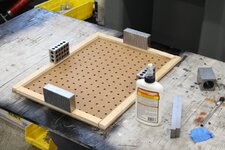
And this time, I dug out my oft-neglected set of Forstner bits, and drilled a dozen 3/4" holes, and half a dozen collet holes.

pegboard07.jpg

That, as per established tradition, got sanded, and the edges of the holes rounded over slightly with the trim router.

pegboard08.jpg

Along the way- I was doing several things at once- I whipped up a makeshift fence, and ripped a couple thin strips of that same ply, on the bandsaw:

pegboard09.jpg

Those got glued to the back of a leftover bit of the pegboard, as a 'spacer'...

pegboard10.jpg

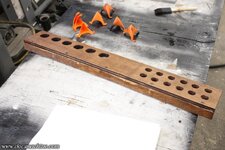
And while that glue was setting a bit, I also made a second, smaller, collet rack- which also got rounded and sanded.

pegboard11.jpg

After the glue had set up a bit, I drilled and countersunk four mounting holes, and then completely screwed it up. :)

pegboard12.jpg

Finally- it was about all I had the free time for today- I gave the two pieces a quick lick of stain.

pegboard13.jpg

In the morning, after the stain has had a chance to dry, I'll hit 'em both with some clear polyurethane.

... but we're still not done. :)

Doc.
 
OP
D

DocsMachine

Well-known member
Joined
Sep 16, 2006
Messages
1,848
I was hoping to just be able to spray these two bits with clear varathane, and then screw 'em up later this afternoon, but it turned out the larger of the two warped slightly overnight.

So, I went ahead and sprayed the smaller one...

pegboard14.jpg

And attached a brace of sorts to the back of the longer one:

pegboard15.jpg

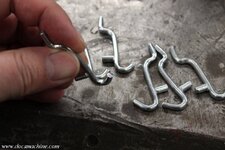
That required gluing, re-sanding and re-staining, so I won't be able to clear that one 'til tomorrow. But, in the meantime, I wanted to try another mod. I dug through my bins of pegboard hooks and found a few likely donors. These I cut down slightly and ground smooth:

pegboard16.jpg

Then, using a spare chunk of the cast-off pegboard, I TIG'd a section of 3/16" stainless TIG rod across the three of them:

pegboard17.jpg

That worked nicely, except...

pegboard18.jpg

I'm not sure I like how far out they're angled. The further they lean, the less secure the "hook" to the dovetail- and I already dropped one behind the machine when loading it the first time. I may need to put a splash guard back there, like I did on the Sheldon and Logan.

And, those were the only hooks I had of that type. I may have to play around with this idea a bit and see if I can't refine it a little.

But, that was also about all I had time for, today. Back to work!

Doc.
 

rharman

Well-known member
Joined
Apr 22, 2012
Messages
8,743
Location
SoCal
A 2" tall strip of pegboard piggybacked on the base may work to reduce the "lean".
 
OP
D

DocsMachine

Well-known member
Joined
Sep 16, 2006
Messages
1,848
Nope, doesn't look like the rod's gonna work. I tried a second version of the hanger, snipping off basically all of the "hook" and more or less welding the horizontal rod directly to the hook's vertical rod.

pegboard19.jpg

And it's a little better, but it's still way too easy to accidentally knock a block off the wire, while reaching for another. The stainless rod just doesn't provide enough contact- or maybe 'engagement'- to the dovetail.

I guess I'll fall back to the first idea I had- making a thin milled strip, probably aluminum, with a dovetail on the top edge. Only trick to that being that the easiest way to mount it is to either run the screws in from the back, or run them in from the front but have nuts and washers at the back.

But, I can make the hanger the full width of the pegboard, giving me room for at least one more block (six rather than five) and I think a matching dovetail- and basically flush with the board- should make them hang a little more securely.

On the plus side, I was able to screw up the new collet rack. :)

pegboard20.jpg

Doc.
 
OP
D

DocsMachine

Well-known member
Joined
Sep 16, 2006
Messages
1,848
The Varathane was of course dry this morning, so all that remained was to... well, screw it up. :)

pegboard21.jpg

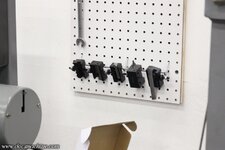
Now, that is, of course, by no means "done", nor is it anything like the final configuration. That's the whole point of pegboard- to be able to shift things as needed. As I get more tooling, and/or the tooling needs change, I'll be adding and altering for a while. The wood rack was the key, though- a secure place to put the collets between uses (the tabletop has no lip to keep them from rolling off) and a more convenient place to store the bar tools.

It opens up quite a bit of space in the drawers, as well as giving me a place to put things rather than just toss them on the worktop.

As I said, we're not done yet. I still have mods in mind for the uprights, a couple of ideas for custom hooks for the pegboards, and a few other things. But, that was about all the spare time I could... er, spare, at the moment. It was worth the expenditure because both of these machines are very frequently used, and I have a ton more work coming up to feed 'em both. A bit of time spent now will hopefully make that later work smoother and maybe a little more pleasant.

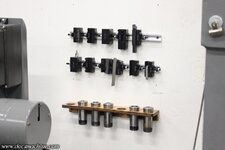
For those curious: The upright things at the lower left are bar-mounted indexible cutters, the staple of any "gang tooled" machine. They mount in blocks like the long one at the far left, and stick out like the teeth of a comb to engage the workpiece in turn.

The silver things at the lower right are 5C collets- five of my nine lathes take 5C, and I have a ton of them. :)

Top left is a cheap squeegee used to clear oil and chips off the door of the Omni's enclosure, next to that is a 5C wrench, used to hold the collet while you install a collet stop. The collet next to the yellow-handled screwdriver has a stop- you can see it sticking out the back. Upper right is a cheap adjustable square, I use that for setting the depth of parts in the collet, if there's no other shoulder or stop in use.

The three long silver things with barely-seen black tops, are 5/8" shank ER collet holders, typically used for holding drills, and which mount to the same tool block. Directly to the right of those is the nearly-invisible wrench for those holders, then a big Sharpie, and finally another collet stop.

Doc.
 
OP
D

DocsMachine

Well-known member
Joined
Sep 16, 2006
Messages
1,848
Nope, not wedded to using metal, it's just that these are 0XA blocks, the little ones typically used on things like the little desktop lathes. They're perfectly sized for the little Hardinge, and the only-slightly-larger Rivett, but in this case, the dovetail grooves are only about 1/4" deep. Even a good hardwood might be a bit fragile that small.

Thing is, I was thinking about milling some aluminum rails, and started thinking, why attach those to a pegboard? The walls are plywood, why not just screw 'em right to the wall?

Still pondering. I'll have to revisit it when I have more time, later.

Doc.
 
OP
D

DocsMachine

Well-known member
Joined
Sep 16, 2006
Messages
1,848
I could check my supplier, but I'm not sure either of those can be had small enough. And if I wind up having to mill it down... why not just buy some 1/4" flatbar and mill it from there? :)

Doc.
 
OP
D

DocsMachine

Well-known member
Joined
Sep 16, 2006
Messages
1,848
Sometimes I hate this stuff. I have a f**k-ton I have to get done in the shop. Yeah, some of it's personal-deadline stuff, but a lot of it is customer/client work, all too much of which is already well overdue.

I needed a blowgun at the little turret, and the nearest convenient drop to my manifolded air system is directly across from it... behind the hydraulic press.

progress10.jpg

Now, I put that there before I brought in... well, at least the last five machines, to say nothing of final placement of the big Springfield, and of course did some rearranging to make it all fit. This air fitting was originally ideally placed, but was now awkward and troublesome to use.

Today I was trying to hook up the hose, and there's so damn much clutter on the floor and in the way I couldn't get both hands on it or get a good push to connect the friggin' thing. It kept popping off and blowing out a ton of air.

I finally got it, but not without briefly doubling my blood pressure and coming up with a few new and interesting invectives.

I've had this as a thing to attend to on my to-do lists for at least a year or two, but I was pissed off enough I decided to damn well do it. My original thought had been to take the entire drop, from the overhead Tee on down, and move it six feet to the left. That would put it right behind the very tail end of the big turret, and make it a lot easier to access. (I'd replace the Tee with a union.)

Problem is, the fittings are somewhat barbed, and do not come apart very easily. One should probably trim back an inch or so and use fresh tube, rather than try to get the old stuff to seal again. Rather than go through all that, I decided the next-best was to simply raise up the existing mounting block. It still wouldn't be ideally placed, but it'd be a lot more accessible.

The other issue was that outlet box. Seems a previous owner pulled a 4-gang box out of the wall so he could add a switch and an external conduit, to power a vent fan. No big, except he never patched the old hole in the plywood. That, too, has been on the to-do list, since it lets in cold air in the wintertime.

So, I rooted through the wood scraps, found a backing strip and a piece of dirty plywood the right thickness, and put together a patch.

progress11.jpg

It's a piss-poor fit, but I neither had the time or the mood to do better. Next time I have some white paint out, I'll touch it up and it won't look too godawful.

After that, it was easy enough to snip off about 8" of the tubing, raise up the connector block and hook it back up.

progress12.jpg

Again, not ideal, but far more accessible.

I do still have some parts left from the original installation, and was thinking about adding that other drop to the left anyway. That's a busy corner with both turrets, both CNCs and the little Hardinge all within arm's reach, so a second accessible outlet certainly can't hurt...

Doc.
 
To avoid these ads, REGISTER NOW!

RickP

Well-known member
Joined
Jan 15, 2013
Messages
1,547
Location
Annapolis, MD
Sometimes getting pissed off is the best way to get stuff done!
(I'd replace the Tee with a union.)

Problem is, the fittings are somewhat barbed, and do not come apart very easily. One should probably trim back an inch or so and use fresh tube, rather than try to get the old stuff to seal again.
I've got the same tube and it's easier to just add fittings, rather than trying to remove the old ones.
I do still have some parts left from the original installation, and was thinking about adding that other drop to the left anyway. That's a busy corner with both turrets, both CNCs and the little Hardinge all within arm's reach, so a second accessible outlet certainly can't hurt...
Could you just add a tee partway down the last drop?
 
OP
D

DocsMachine

Well-known member
Joined
Sep 16, 2006
Messages
1,848
Could you just add a tee partway down the last drop?

-I'd prefer a straight drop down from the overhead run, with nothing horizontal on the open wall. No big, it'll be easy to add it, I just need to order more wall clips.

Doc.
 
OP
D

DocsMachine

Well-known member
Joined
Sep 16, 2006
Messages
1,848
Always nice when a slightly tricky little mod works out. :)

I spent the day trying to finish up a bunch of little projects, in a desperate attempt to regain both a little of my sanity, and maybe a little workbench space.

One of those was this odd little Spyder barrel, that the owner wanted me to convert to a Freak tip.

twisty1.jpg

After some careful measuring and a shot of Dew to steady my nerves, I turned off the old threads and down to about 'thar.

twisty2.jpg

Then I took a scrap 'Flashpoint' tip I had, and bored it out to match that dimension.

twisty3.jpg

That got parted off...

twisty4.jpg

And then faced down to a precise length. After double-checking, I degreased everything, glazed 'em in cherry syrup, and tapped 'em together with a small rubber mallet. :)

twisty5.jpg

If the parts were thicker, I'd have pressed them together with a slight interference fit, but both sides were so thin, doing so would run a strong risk of folding something during pressing. So these I have the barest .0005" clearance, and a healthy dose of red Locky to hold 'em together.

Cleaned and with the antivibration O-ring in place...

twisty6.jpg

And assembled!

twisty7.jpg

Almost like it was meant to be there! :)

Fun little job, and I hope the owner has his own fun with it. :)

Doc.
 
OP
D

DocsMachine

Well-known member
Joined
Sep 16, 2006
Messages
1,848
Sometimes progress is very slow...

I have a product to make, but the last time I made a batch, I had an absurd scrap rate- something like thirty percent(!), although I was later able to save a few of those with some manual reworking.

The main issue came at the initial drilling stage. It's a deep bore, and a longish part, so I had to drill from both ends- and sometimes, the two bores didn't come out concentric with each other. Which, generally, should come as no surprise given that I'm using antique and obsolete machines, probably the wrong tooling, and really, have little to no idea what I'm actually doing. :D

But, it's a popular product, and I need to get it back into inventory, so I've been pondering what may have gone wrong, and how I might fix it, for a while now. I haven't been able to focus much time on it- I haven't been able to focus much time on pretty much any one thing these days :) - but I'm trying to piece together a setup as I've had time.

To start with, since I finally cleared off a project I'd had set up in the big lathe for a while, I was able to sock in a chunk of 3" round stock I've had laying about and which was just taking up space.

progress16.jpg

The Springer happily chewed off nearly an inch of diameter...

progress17.jpg

But unfortunately, the power feed on that machine stopped working for some reason. I think the single-tooth dog clutch is misadjusted- or rather, has fallen out of adjustment yet again. Just one more thing to add to the list of **** I gotta attend to... sigh.

Anyway, since the heavy stock removal was done, to get a gooder finish I moved it over to the Sheldon, and buzzed down the last bit to get it on size:

progress18.jpg

This will be a sort of spindle-plug and work stop for the big turret lathe, so I of course checked to see if it would fit:

progress19.jpg

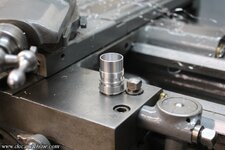
Which it did, and so I gave it two grooves for a pair of 2" OD O-rings, both as a partial seal to keep the cutting oil and swarf out of the spindle tube, and to hold it in place.

progress20.jpg

I bandsawed off the unneeded part, and turned the cut face down to square and true.

progress21.jpg

With a 3/8"-16 hole drilled and tapped, I test-fitted it into place.

progress22.jpg

The hole is both so I can screw in a bolt in order to pull the plug out (besides it being able to be knocked out from the left end of the spindle) and in the event I want a shorter work stop, or even something like a centering cone bolted to it.

And that let me screw on the freshly-cleaned chuck, and as a final step, I gave the soft jaws a quick clean-up pass so that they're square and true to the spindle.

progress23.jpg

That, unfortunately, was all I had time for, today. It's a start- finally- but I still need to set up the tooling. And as usual, I'm probably going to have to make some, first.

Doc.
 

zanyad

ALLIANCE MEMBER
Joined
Apr 26, 2018
Messages
2,756
Location
NE Ohio
How is that work stop held in place? Is there a step inside the turret lathe's spindle bore?
 
OP
D

DocsMachine

Well-known member
Joined
Sep 16, 2006
Messages
1,848
How is that work stop held in place? Is there a step inside the turret lathe's spindle bore?

-Ah, good point. :) Yes, there's a hollow tube in the spindle, like the drawtube for a 5C collet. This one, however, pushes towards the chuck. The collets this particular W&S turret lathe uses are what's known as "Dead Length". The collet stays in place, held on from the front of the spindle by a heavy screw-on cap (you can see the threads in the 4th photo.) While the pusher tube pushes a collet sleeve forward, forcing the collet closed.

Something like the common 5C collet gets drawn into the spindle, and therefore pulls the work in slightly. For repetitive work (which is what collets were designed for) slight variations in diameter therefore result in variations in length- for 5C, one thou difference in diameter equals three thou difference in length.

So collets like the Brown & Sharpe #22 SC like my turret uses, were developed to provide a more repeatable length.

Anyway, I take the collet and 'pusher' out- but I can't remove the tube itself- when I'm using the chuck. This insert slides in and seats against the end of the tube. Both protecting the tube from the oil and chips, but also providing a hard back for the workpiece to **** up against- again so I can get a repeatable length.

Doc.
 
OP
D

DocsMachine

Well-known member
Joined
Sep 16, 2006
Messages
1,848
I picked up the last pieces I needed, and got that new air drop assembled and installed:

progress14.jpg

Big turret to the left, little Hardinge to the right.

After modding the previous drop, I leak-checked it and got some tiny bubbles. So while I had the system down, I popped that back off and re-did the teflon tape. (It was a threaded junction, not the tubing connection.)

And while I had it unhooked again, I tried making a slightly better-fitting wall patch (which was good until the lower screw cracked some of the ply... ) and I found a nearly-dead can of Kilz and painted the new patch white.

progress15.jpg

But, because of the fresh paint, I can't spray on some Windex- as a bubble solution- so I'll have to pressurise and test it in the morning.

[Morning comes]

Fully leak-checked and bubble-free. :) Used the new drop yesterday while making that spindle stop, and it's quite handy. I need to get something like an eight or ten foot hose, so I'm not walking all over a 25 foot coil now that I'm only a few feet from the outlet. :)

Doc.
 
OP
D

DocsMachine

Well-known member
Joined
Sep 16, 2006
Messages
1,848
I'd been wanting to revisit the hanger rails for the little lathe since the ill-fated attempt with the steel rod, and, getting a bit frustrated with the project on the table, which seems to want to leak from basically everywhere, even the parts that don't even have an air connection, which basically makes me feel like I'm checking the license-plate bolts to stop the tire from going flat, and...

Wait.... where was I?

Oh, right. Lest I heave the whole thing through the nearest wall and book a flight to Tibet, I set it aside, and decided I'd try the idea I had for a better hanger rail for the little tool blocks for the speed lathe.

It's based off a wooden version I'd seen- and saved the photo of- years ago, but in this size, it's easy enough to duplicate in aluminum. So I bandsawed off a spare short chunk of 1" x 3/8" flatbar and attacked it savagely with some endmills:

progress24.jpg

No measurements were taken, pure seat-of-the-pants millery. I simply used the edge of a 45-degree facemill to make the 'hook' edge, and a 3/4" ball mill to make a clearance groove for the height-adjuster wheel. And, it worked perfectly.

progress25.jpg

I was a little surprised about how well it holds. The old steel-rod racks almost felt delicate, and in use, it was absurdly easy to knock a block off. This holds them surprisingly solidly- and they can only be removed by rocking them off. The lower edge has to be swung out in order to be unhooked.

With that little test successful, I made two more, each one 14" long. (The same width as the pegboard used to be, and the width of the collet shelf.) The vise jaws of course weren't 14" long, so I cut each feature in to steps, sliding the bar along between each.

progress26.jpg

I have a second vise I could have set up so they're side by side, but I was too lazy to take the time to set it up and dial it in. :)

After that, I did a little filing to knock off the burrs, and drilled and countersunk some mounting holes:

progress27.jpg

And done. Took about an hour, including the initial test piece.

progress28.jpg

Then, of course, the final step- completely screwing them up!

progress29.jpg

That's not my full collection of 0XA tool blocks, I still have about half a dozen more around here somewhere. But, keep in mind I'll be making more of these to go on the Rivett, too, and the majority of the blocks will live over there. (The two lathes are almost straight across form each other.)

Much happier with this than the pegboard-rods, though I'll need to make a few separate hooks for the other tools for this machine. (Chuck key, toolpost wrench, a couple of Allens, etc.)

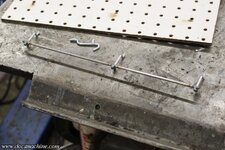
And, that worked out so well, that I got out some 1/2" x 1/8" steel flatbar, and made another of the rails I store the AXA blocks on, for the Sheldon and the Logan... except this one was 44" long. :)

progress30.jpg

I've been using racks like this- a simple welded rail- for over 20 years now, and they're secure and handy. This new section now gives me hang-up storage for nearly every AXA block I have- rather than stacking the extras in the drip tray, like some procrastinator. :)

Only been meaning to do that one for a couple of years...

Those weren't the only things I worked on today, but they were the only ones I finished. :)

Doc.
 
OP
D

DocsMachine

Well-known member
Joined
Sep 16, 2006
Messages
1,848
Grab a sammich, kids, this is a longish one. :)

Okay, as many of you know, I have a couple of turret lathes. Woefully outdated and obsolete, but are still capable of producing good work, and, more importantly, were cheap. :) Much as I'd like to have a fleet of modern turning centers, the budgetary shoestring I run this so-called business on is already pretty badly frayed, and can't possibly support that sort of weight.

So, I light the kerosene lamps, stoke the steam boilers, and machine like it's 1939! :)

Now, a common bit of tooling for a turret lathe, particularly for drills, is an adjustable or 'aligning' toolholder. It's also been called "floating", but it doesn't actively float, so I refer to them as adjustable, or perhaps centerable.

The idea here is that it's rarely possible to get a perfect alignment between the tool in the turret and the centerline of the spindle. Even with a perfectly-aligned turret, the tool has to fit loosely enough to slide into the turret socket, and the split cotter that locks it in, necessarily pushes the tool to the opposite side. The misalignment isn't much- a few thou at most, in a good setup- and on most tools it's almost irrelevant. Any single-point turning or boring tool, of course, a short, stiff centering drill, a tapping head (which generally allows a touch of "float") and so on.

But, for a drill, if the drill is small enough, if it starts off-center slightly, it can try to 'walk' towards the center, giving a tapered hole, or if large enough, it can "bore" off to one side, producing a larger hole than the drill size.

So, of course, they have tools like this- which in this case is an empty holder, that a drill chuck is supposed to be bolted to.

progress31.jpg

What you have is the shank that goes into the turret, and two matching plates, one threaded for some bolts, the other drilled for those bolts, but with somewhat loose holes. This allows you to loosen the bolts, and let the plate 'float', and the tool find center, and then be retightened. (Or you use a co-ax or other indicator to dial it in, etc.)

Now, I can buy these all day long- turret lathes of course have been around for some 150 years, and there's literal kilotons of tooling out there. But, most of the drill holders- especially the cheap ones- use solid bushings rather than collets. The only ones I've found that use collets either use DA series collets, or obscure screw-machine ones that are hard to find and expensive.

Worse, the last two DA holders I bought, were badly worn from extensive use- I'm not actually sure anyone makes new ones anymore.

What I wanted were the same kind of alignable holders, but which take modern ER collets- of which I already have multiple fistfuls. Thing is, I can't find any- ER is something that came out a bit after the day of the turret had passed, and nobody bothered- or likely will bother- to make such a thing.

So here we are.

I'm going to make a total of six of these- Two in ER-16, two in ER-20, and two in ER-25. I may make some in ER-32 eventually, but again, these are going to be primarily drill holders, so as long as I can hold a 1/2" shank, that should be all I'll need. (And ER25 can hold up to 5/8".)

Now, back when I first was tooling up the big Warner & Swasey turret, I bought several ER25 holders, with long 7" shanks- only because I couldn't at the time find any with short shanks. I cut a couple of them down, but I still had two left, so I got those and the Porta-Band out.

progress32.jpg

You can see I have a hard time making a straight cut with a PB. :)

progress33.jpg

The shank itself I sliced up into pieces, so I had short shank sections for the other holders. Between the two holders, I ended up with two a little long and four a bit shorter- the long ones will go to the bigger '25s, the shorter to the 16s and 20s.

progress34.jpg

These of course got faced square, chamfered, and given a generous bevel.

progress35.jpg

With those on hand, I decided to start with the smallest ER-16s, first. I had bought some holders, that were meant to be fitted to motor shafts for homebrew CNC or router use, last year when I was tooling up the new-to-me Rivett turret. To that end, I found a bar of 1/12" x 3/8" steel flatbar, and lopped off four pieces that looked about the right size.

progress36.jpg

These got drilled and bored- two to 1" for the shanks, and the other two to .788", or 20mm for those that don't grok Freedom Units. :)

progress37.jpg

And those, too, received a bit of a bevel.

progress38.jpg

I'd made them a light press fit, and so lightly pressed them together.

progress39.jpg

After that, it was a simple matter of TIG welding them together- those of you who know what a "weld bevel" is, saw that one coming a mile away. :)

progress40.jpg

With all four pieces done...

progress41.jpg

I left 'em to cool while I made the day's mail run and got myself a good deli sammich. When I got back, I took each one for a ride in the lathe, to face the bar both flat and square to the shank.

progress42.jpg

I was kind of surprised how little they warped, and just gave each one enough of a face to make it flat- I didn't want to try to take away all the weld, obviously, as that would have weakened the bond.

They then went back into the mill to receive their drilled and tapped holes. I didn't do that earlier, worried the bars would warp more than they did, from the welding, and worried that the tapped holes, at least, might make the bolts sit slightly crooked. Turns out probably not entirely necessary, but either way, it was easy enough to pick up the center again and drill a set of holes on each part. The shank end getting a pair of 5/16-18 holes...

progress43.jpg

And the collet end getting a pair of .355" holes, giving a little room for the thing to 'float' around the bolts as needed.

progress44.jpg

But, we're not done yet! I took both parts back through the bandsaw, lopping off a few of the superfluous corners...

progress45.jpg

And then rolled the belt grinder outside, and using the knobbiest belt I had, I hogged that puppy down into a pleasing and industry-standard ellipsoid shape.

progress46.jpg

Finally, after deburring, cleaning, and a fresh set of Grade-Eights, there's the first two done!

progress47.jpg

I don't have the turret mounted on the Rivett at the moment, but that's how they fit. The bigger ones may end up being too big for the Rivett, but they're mainly intended for the W&S anyway- and indeed, are integral parts of the next project I'm tooling it up for, and the reason I'm spending the time right now. :)

Tune in tomorrow- or possibly Thursday- for our next exciting episode!

Doc.
 
OP
D

DocsMachine

Well-known member
Joined
Sep 16, 2006
Messages
1,848
Okay, so it was Friday- and late Friday at that. Story of my life... :)

After that 'training run' with the ER-16s, I skipped forward to the main part of this project- the big ER-25s. I had already taken the heads cut off of the long shanks and faced them down, so those were ready to go.

progress48.jpg

I had also already bandsawed off the flange blanks, and washed them through some Evap-O-Rust for a day or two, to get rid of some light rust and the mill scale. So, just like before, I bored these out to size and countersunk them to give the welds a little penetration.

progress49.jpg

And, of course, thoroughly TIG'ed and left to cool.

progress50.jpg

I even left to get a sammich again, just to keep the tradition alive. :)

And, just for the coolness, check out the post-weld colors:

progress51.jpg

For the drilling and tapping, I got a bright idea on the previous run, and with a slight tweak to the setup, poked all the appropriate holes like so:

progress52.jpg

A quick test-fit...

progress53.jpg

And then back to the bandsaw.

progress54.jpg

The big trick there being that I only had to cut four corners in total, not eight. One other bright idea was to chuck the whole mess up in the lathe, and using a bullnose center, made sure the two halves were very closely aligned before tightening them together.

progress55.jpg

Third, this time I milled the excess off rather than trying to grind it all off.

progress56.jpg

After that, then I ground the remaining corners round, and deburred the bejeebers out of everything.

progress57.jpg

Et voilá! :)

progress58.jpg

Very happy with how they came out. I've been meaning to make these exact tools for two or three years now, and have been champing at the bit to set up this particular project for almost as long.

And finally, as installed in the turret and ready to try out. :)

progress59.jpg

As always, more to come!

Doc.
 
OP
D

DocsMachine

Well-known member
Joined
Sep 16, 2006
Messages
1,848
Two steps forward, one back. That, too, is the story of my life...

With the toolholders made, I now had to modify the tools so the toolholders can hold them. :) The ER25 collets can hold up to 5/8" shanks, but one of the drills I was using, had a shank the same diameter as the drill- .695" (For those that don't grok Imperial decimal, 5/8" is .625".)

So I chucked it up in the soft-jaws and turned the first shank down to that dimension.

progress60.jpg

Usually the shank of a twist drill is softer than the cutting flutes, so that a drill chuck can get a better bite on it. With a good carbide insert, it cuts nicely. 5/8" leaves plenty of strength, and now fits the collet.

progress61.jpg

The other drill had a Morse Taper 2 shank:

progress62.jpg

But that too was easy to bandsaw down a touch and turn to 5/8".

progress63.jpg

And once installed, initial setting is easy- loosen the flange bolts on the holder, clamp the drill in the soft jaws, jiggle things a bit to make sure everything's centered, and tighten the bolts again.

progress64.jpg

But, the initial test cuts were a mixed bag. After a little tweaking, the drills seemed to be doing well, but the final pass had less-than-ideal surface finish. I swapped out the second drill for a reamer, therefore, which gave much better finishes... but for some reason was cutting eccentrically, and I can't figure out why.

progress65.jpg

The smaller of the two rings is the issue. It was hard to get a good pic in there, but suffice to say the thicker ring, produced by the drill, is- at least to my eyeball- nicely even and concentric. The thinner one is basically a full cut on the left, and almost no cut on the right.

The workpiece is held in soft jaws that were machined in place- they're as concentric to the spindle bore as humanly possible, given the setup. The tool was centered to those same jaws. And since the workpiece turns, one would presume that if the tool were offset in some manner, it would give an oversized or tapered bore- not an eccentric one.

As a check, I did a quick survey on the turret. I had a bar of 1" brass, not the smoothest stuff, but good enough. I locked that in one of the empty sockets, and put a .0005" indicator on it:

progress66.jpg

Left to right (or front to back in you prefer) there's about .0015" swing- though hard to tell for sure as the bar, again, is not the smoothest surface.

Vertical was more surprising, with the nose of the bar higher by .005" than closer to the turret. (Both of these were in a range of about 6".)

Now, neither of these mean much to 95% of the work I do on this machine, most of which is only a few inches long. In this case, trying to drill 6+ inches deep, it's adding up. The drill-to-reamer difference is only .005", after all. (.695" drill and .700" reamer.) But, that error, again, doesn't explain an eccentric cut.

I may have to set this one back aside and let my subconscious chew on it for a while.

(And yeah, all of this would be a lot easier if I could just afford the right tools, or better yet some much more modern and better-shape machines... )

Doc.
 

Fixr

Well-known member
Joined
Dec 23, 2012
Messages
9,702
Location
SW VA
Two steps forward, one back. That, too, is the story of my life...

With the toolholders made, I now had to modify the tools so the toolholders can hold them. :) The ER25 collets can hold up to 5/8" shanks, but one of the drills I was using, had a shank the same diameter as the drill- .695" (For those that don't grok Imperial decimal, 5/8" is .625".)

So I chucked it up in the soft-jaws and turned the first shank down to that dimension.

progress60.jpg

Usually the shank of a twist drill is softer than the cutting flutes, so that a drill chuck can get a better bite on it. With a good carbide insert, it cuts nicely. 5/8" leaves plenty of strength, and now fits the collet.

progress61.jpg

The other drill had a Morse Taper 2 shank:

progress62.jpg

But that too was easy to bandsaw down a touch and turn to 5/8".

progress63.jpg

And once installed, initial setting is easy- loosen the flange bolts on the holder, clamp the drill in the soft jaws, jiggle things a bit to make sure everything's centered, and tighten the bolts again.

progress64.jpg

But, the initial test cuts were a mixed bag. After a little tweaking, the drills seemed to be doing well, but the final pass had less-than-ideal surface finish. I swapped out the second drill for a reamer, therefore, which gave much better finishes... but for some reason was cutting eccentrically, and I can't figure out why.

progress65.jpg

The smaller of the two rings is the issue. It was hard to get a good pic in there, but suffice to say the thicker ring, produced by the drill, is- at least to my eyeball- nicely even and concentric. The thinner one is basically a full cut on the left, and almost no cut on the right.

The workpiece is held in soft jaws that were machined in place- they're as concentric to the spindle bore as humanly possible, given the setup. The tool was centered to those same jaws. And since the workpiece turns, one would presume that if the tool were offset in some manner, it would give an oversized or tapered bore- not an eccentric one.

As a check, I did a quick survey on the turret. I had a bar of 1" brass, not the smoothest stuff, but good enough. I locked that in one of the empty sockets, and put a .0005" indicator on it:

progress66.jpg

Left to right (or front to back in you prefer) there's about .0015" swing- though hard to tell for sure as the bar, again, is not the smoothest surface.

Vertical was more surprising, with the nose of the bar higher by .005" than closer to the turret. (Both of these were in a range of about 6".)

Now, neither of these mean much to 95% of the work I do on this machine, most of which is only a few inches long. In this case, trying to drill 6+ inches deep, it's adding up. The drill-to-reamer difference is only .005", after all. (.695" drill and .700" reamer.) But, that error, again, doesn't explain an eccentric cut.

I may have to set this one back aside and let my subconscious chew on it for a while.

(And yeah, all of this would be a lot easier if I could just afford the right tools, or better yet some much more modern and better-shape machines... )

Doc.
Something eccentric in Doc's shop? Say it isn't so!
 
OP
D

DocsMachine

Well-known member
Joined
Sep 16, 2006
Messages
1,848
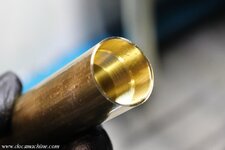
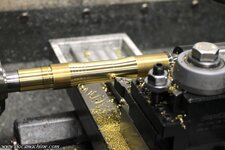
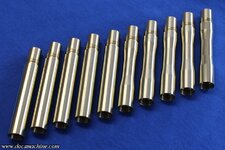
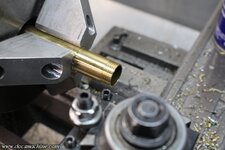
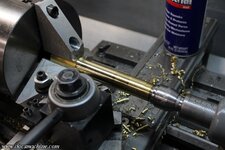
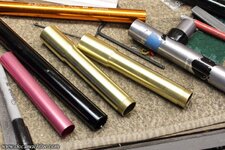
A month of brass!

This one'll be a bit scattershot, it's a project I've been working on basically just as time permits, for a little over a month now. I didn't always get pics, so bear with me. :)

Back in March, a reader asked if anyone had made a brass 'Freak' barrel back. To the best of my knowledge no one had, but I had already been thinking about trying it. There's no reason to, other than just to have brass on your marker. :)

I looked around, four some ideally suitable material, and, because I have all the business acumen of a potato, I bought some.

Brass, in case you haven't looked recently, is really friggin' expensive. This...

brassback01.jpg

... is six hundred dollars worth.

Anyway, after taking a few preorders just to make sure I wasn't flushing all that money down the loo, and after setting up a fresh array of tooling in the Omni (another forthcoming tale) I wrote a fresh program and started cutting some chips.

brassback02.jpg

brassback03.jpg

Typical 'Freak' threading- an internal 16 pitch, 32 TPI double-lead thread. I used to cut these by hand. :)

A quick test-fit...

brassback04.jpg

And then a fresh program to cut the breech threads. A quick scuff with some 800 grit, and we had some ready to go, for those that wanted a classic straight-sided back.

brassback05.jpg

I offered the option of profiling the back, both for looks and a touch of weight reduction, so we moved over to the CNC Logan, and cut even more chips. :)

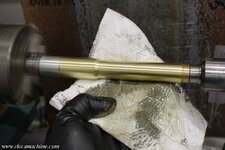
brassback06.jpg

These too got scuffed, using a cheap wood lathe as a "spinner", to make sanding batches of parts easier and quicker. A little WD-40, some 800 grit wet-or-dry paper, and a chunk of stiff foam sanding pad.

brassback07.jpg

Wiped down and washed in hot soap & water, and ready to go! (The right-hand-most is polished.)

brassback08.jpg

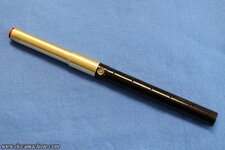
Now, because I'm a custom shop, I was asked for some custom threading- in two cases, they wanted threading to fit Phantom pumps. Kind of an odd request, but hey, I've made my living off of odd requests. :)

So, cut down slightly and threaded- 14 TPI "stub" ACME, by the way...

brassback09.jpg

Then the rest of the body profiled down...

brassback10.jpg

Sanded, as usual...

brassback11.jpg

brassback12.jpg

And done!

brassback13.jpg

(Not shown is an hour spent grinding an ACME point in a chunk of HSS so I can cut the dang threads in the first place. :) )

And, both of those ready to ship out in the morning!

brassback14.jpg

Kind of a fun little side project, brass is always nice to machine. I've had some other brass projects on the list for some time, maybe I ought to move those up... :)

Doc.
 
To avoid these ads, REGISTER NOW!
Top Bottom