To avoid these ads, REGISTER NOW!

Inside Doc's Shop...

To avoid these ads, REGISTER NOW!
OP
D

DocsMachine

Well-known member
Joined
Sep 16, 2006
Messages
1,848
I have several of the extended ones, but they were HSS- these parts are stainless, and the solid carbide holds up a lot longer.

But yeah, an extended one would have done the trick, along with the other possible fixes- as they say, more than one way to skin the proverbial cat. :)

Anyway: Doc's Christmas Vacation, Day 6! :)

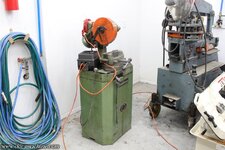
I've been talking with a buddy of mine about the use of his Scotchman "cold saw". It's basically a slowish-speed metal-cutting chop saw, with a built-in flood coolant system. Ideal for some of my uses, where I need to chop up long bars of raw stock into smaller bits to feed into the machines.

For aluminum, I use the DoAll bandsaw, but in this case, an upcoming jobs needs stainless steel.

scot01.jpg

This particular unit hasn't been used in a while, as he hasn't had 3-phase since they moved into this shop a number of years ago.

We're making an arrangement where I'll get the thing running, in exchange for being able to use it on occasion- so to that end, and with a looming need to chop some stuff, I brought over a spare KB VFD, and test-wired it.

It's not really "spare", I bought it for the Arboga drill I was just playing with- it's running on an undersized VFD at the moment- but haven't yet had a chance to mount and install it.

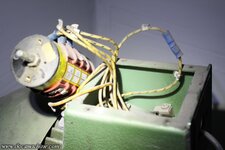
One worry was that the big switch at the top was loose and dangly:

scot02.jpg

It's a 2-speed 3-phase motor, so I was somewhat worried somebody had started disconnecting things- upon closer inspection, thankfully that wasn't the case. Presumably the last user had simply removed the switch just to disconnect the power cable. I was able to plug my VFD right in to the L1-L2-L3 terminals, and she lit right up.

So now I'll have to figure out where to mount the VFD- probably just bolt it to the side, the interior is mostly coolant reservoir. Then set up some new controls, probably the same as the aforementioned Arboga, which also has a 2-speed motor. The original switch was low-off-high, with the VFD, it'll need to be just low-high, and only switched when the VFD is off. (That is, not energizing the motor.)

It also need a pull handle- which, with the machine being Swedish, means metric threads. And all my manual machines are of course imperial. :)

And... the blade that's on it is thrashed beyond being able to be resharpened, so that'll need to be replaced, too.

But, today's exploratory was just to see if it even worked- which it does- before we start throwing money at it.

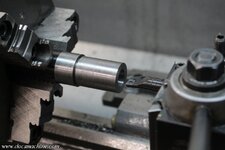
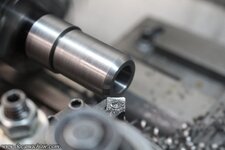
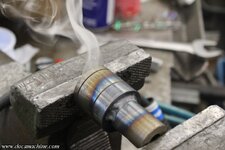
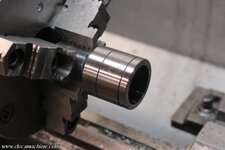
(Some of) the rest of the day was spent drilling and reaming another small batch of these barrel tips...

turn01.jpg

turn02.jpg

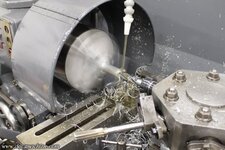
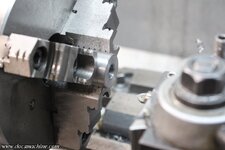
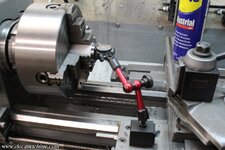
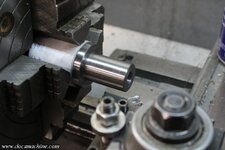
And with the bores done, I lit up the CNC-converted Logan and turned the ODs between centers, to true them up.

turn03.jpg

At some point this weekend, I'll run those through the other CNC, to get the last of that stuff out of the way. I need to set up some new tools in that machine, but needed to finish off that the current tool set needed to do, first.

Doc.
 

cvairwerks

Well-known member
Joined
Aug 12, 2016
Messages
7,195
Location
Within hearing distance of Texas Motor Speedway
Doc: I used these guy for cold saw blades. Fantastic and fast service when I ordered one. I asked then to confirm my selection for the planned work and was right on. While I was on the phone ordering the blade, they put me on hold for just a moment after my credit card charge went thru. When he came back on the phone, he told me the blade was ready and the shop had already laser engraved my name on it and were boxing it up to get it on the shipping run that was about to go out. Talk about service... I've got to order a couple of blades for my Haberle pretty soon.

 
OP
D

DocsMachine

Well-known member
Joined
Sep 16, 2006
Messages
1,848
Nice, thanks for the link. I think the one my buddy was looking at (came up in a search) was Cold Saw Shop, which seemed to have a good selection. I'll forward the link, but it's his machine, and his money. :)

Doc.
 
OP
D

DocsMachine

Well-known member
Joined
Sep 16, 2006
Messages
1,848
Doc's Christmas Vacation, Days 7, 8 and 9!

Been kind of all over the place, trying to get everything done before my vacation time dries up. :) One important thing is, I've managed to reduce my to-do list from 347 items to just 512! Progress! :)

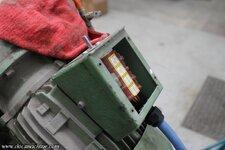
Anyway, to catch up on at least two of the bits- we've ordered a couple of blades for the Scotchman, and I've at least got the switch wired and a cable pigtail run.

scot03.jpg

The trick now is to figure out how best to mount the VFD, and where to put the new stop/start buttons. Easiest and simplest is to just bolt the VFD to the side of the cabinet, and then bolt a utility box to the switch cover.

Back in the turning front, I kept cycling the parts through the Logan CNC...

turn04.jpg

Eventually getting them all turned to size.

As I said, I still had the tooling set up in the Omni, so since I need to move on to other parts on that, I needed to get these cut and done.

turn05.jpg

turn06.jpg

turn07.jpg

And done!

turn08.jpg

And while those were running, I swept off the big turret lathe, and swapped back from the 3-jaw to the collet setup.

turn09.jpg

And started rough-drilling some stainless blanks.

turn10.jpg

Why do that on the turret? The Omni doesn't have the rigidity to drive that big a spade bit, which means I'd have to drill it in stages with a conventional twist drill- probably five steps before I could bore it. In the turret, I can ram that drill in, making a nominally 5/8" bore in stainless steel, in one pass, in a little over a minute.

Until I get the Scotchman saw up and running, I only have sixty or so blanks, but that's enough to bother running through the turning center. After I got the first batch drilled...

turn11.jpg

I swapped collets and re-set a two-tool block in the Omni...

turn12.jpg

And started processing those.

turn13.jpg

With all the other things I'm trying to get done, I'll only have a chance to do a few short runs, but even still, I should have this batch ready for the mill by Wednesday or so.

Wish me luck!

Doc.
 
OP
D

DocsMachine

Well-known member
Joined
Sep 16, 2006
Messages
1,848
Ladies and Gentlemen, may I introduce my *Tenth* Lathe!

springer25-001.jpg

It's a bit of a fixer-upper, sure, but whereas most of you might see missing important parts and broken castings...

springer25-003.jpg

I, of course, with my practiced eye can see the vast potential lurking in there. A mere several thousand dollars, a few thousand man-hours, and she'll be as bright as a new nickel in the wellwater again. :D

springer25-002.jpg

... Before you all finish sharpening the torches and lighting your pitchforks, yes, I am pulling your collective legs rather hard. :)

The truth of the matter is that this poor beast is a parts machine. Through a great deal of luck and some good connections, I was put in touch with a semi-local fellow who had this, which is a virtual twin to my big Springfield. Same swing, same bed length, same features- and a serial number just 47 newer than mine!

springer25-004.jpg

The owner bought it a few years back, and after some examination and consulting experts, it was determined it was just too far gone. Too many parts missing, too many Broken pieces, too much wear. Yeah, it could be saved, but you'd put a lot of time and parts into it- and the owner needed a working machine more than ne needed a heavy project.

To that end, he bought a different machine- a Polish made lathe that was in much better shape. And that meant this one's getting scrapped.

Luckily, word made it through the grapevine to me, and by juggling a few schedules, I had the opportunity to drive up, with help, and grab what parts I could before the rest goes off to the great Scrapyard in the Sky.

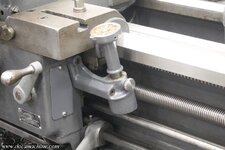
The main bit I was after was the taper attachment. Longtime readers that watched the older rebuild posts about my Springfield, may recall that mine had a taper attachment, but it wasn't the correct taper attachment. Mine's off an older Lodge & Shipley, and some previous owner made some adapter plates to make it work.

This parts machine has the complete attachment, including the shoe! (Although it appears to be missing the gib for said shoe.)

springer25-005.jpg

That alone would have made it worth the trip, but since I had more or less free reign to salvage, I also got the threading dial, which mine didn't have...

springer25-006.jpg

The original-style oil pump... (yes, it's all there.)

springer25-007.jpg

A period-correct "War Department Finish" tag (which I wasn't able to grab, but hopefully I can get later...)

springer25-008.jpg

And a handful of other cool bits!

springer25-009.jpg

I didn't take the tailstock or the chucks (the latter would have cost extra, and I already paid a little more than I wanted to) but I got an original compound (the one on my machine was repurposed, I think off a newer Leblond) with a cross slide and gib, a Springfield carriage stop (the one I have I think came off a Morei-Seki) and treasure of treasures, the tool-tray arm!

springer25-010.jpg

That's the thing with the board full of cylinders. That arm bolts to the back of the bed at the tailstock end, and usually holds some sort of tray or rack to hold common tools, oil cans, etc. In this case, some previous owner had a setup that held 2J collets, probably for a handwheel assembly like my 3J chuck. The collets were unfortunately very rusty- like mine, the machine had been stored poorly, outdoors for a period of time- and I don't have anything that takes 2J.

But, I also got one of the factory locking blocks for the tailstock (readers may recall I made my own to replace a missing one) the single-tooth 'dog clutch' assembly (mine's badly worn- this one's a little better) and an original steady rest! (Missing one of the fingers, but that's fixable.)

Again, I'd have been happy with just the complete taper attachment, but the rest is icing on the cake!

I will, of course, in my copious free time, at some point need to start cleaning, painting and installing some of these bits, but fortunately nothing will really take a great deal of work. A little sad to see a once-good machine junked, but I'm happy I was able to finally find some of the missing, original parts. :)

Doc.
 
OP
D

DocsMachine

Well-known member
Joined
Sep 16, 2006
Messages
1,848
You normally-sharp-eyed folks missed something big (comparatively :) ) in the previous set of pics. The parts machine's tailstock actually still had the original dauber!

springer25-011.jpg

For those of you woefully underinformed about the vagaries of antique machine tools, back in the early days of machine tools, one often used a "dead" center to support a long shaft. Basically just a piece of steel with a 60 degree point in it. There was a 'black art' to using these- too loose, and the shaft could push away by cutting pressure, and the accuracy would be lost, and too tight, and the tip of the center could overheat from friction.

To help with this, of course they used a lubricant- and for a long while there, one of the best "extreme pressure" lubes was a grease made with "white lead", or lead carbonate. And, to make it easy to apply and use, almost every lathe of that period, had a small well drilled into the tailstock housing, with a small plug called a dauber in there.

Pop it out, apply a little white lead to the part, put the dauber back.

Thing is, its a small and fiddly bit, and frequently lost. And of course white lead started being phased out in the 50s, and replaced with "live" centers, that is, ones with ball bearings, that don't need external lube.

This one, with all the time that has passed since this machine was made, was still there. :D

springer25-012.jpg

You can still see the traces of what I'll assume to be some of that white lead.

springer25-013.jpg

A small dollop of paint stripper got the two or three layers of paint off the thing...

springer25-014.jpg

And a ride through one of the other lathes....

springer25-015.jpg

And a slip of 320 grit, got most of the rust and tarnish off.

springer25-016.jpg

There's still some deepish pitting that won't easily sand out, but that's no big.

springer25-017.jpg

And voila!

springer25-018.jpg

Now, of course I am unlikely to ever actually use the thing- they invented live centers for a reason :) - this is pure OCD-assuagement. But hey, it was there, why not grab it? :)

Doc.
 
OP
D

DocsMachine

Well-known member
Joined
Sep 16, 2006
Messages
1,848
Organizing my Carbides!

Last weekend I got caught with my proverbial pants down. I was running some parts through my CNC turning center, and the internal threading tool started to show wear. No biggie, I thought, I have a couple packs of them...! Er, no, I don't. I had several packs of external threading tips- the 'points', er, point the wrong way.

Turns out I had no extra inserts for the internal tool. And of course the point that just wore out was the last of the three on that insert.

Nothing for it but to order more, and go do something else while I wait- thankfully this job isn't a particularly time-crucial one... But, one of the things I'd put on my To-Do list for 2025 was to organize my inserts a little better. I'd initially considered consolidating them at a single point in the shop, but after some thought, decided to keep some version of what I already had- two drawers near the manual machines, and one drawer near the CNC, with the inserts segregated to fit each machine.

The drawer for the manual machines was easy- it's one drawer in a Lista style cabinet (possibly a Vidmar, I don't honestly know) and I'd forgotten that I had some separator/dividers that came with it. I dug a few of those out and just randomly threw together a section that separates the packets of inserts:

inserts00.jpg

Again, that's just a rough first try, and basically just jumbled. I need to sort out the inserts by type and size, soak those old labels off and print some new ones, and generally just jog things around a bit 'til it feels right. :)

The tool rollaway for the turning center is a different story:

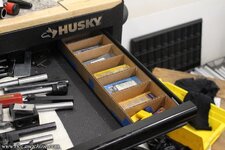
inserts01.jpg

That drawer used to be a bit more organized, but I've been running this machine a lot since last fall things have gotten a bit jumbled. The right-hand side was more or less the drop zone for inserts and wrenches, so I scraped some of the crud away, and laid the packs out to get a rough idea what I was looking at.

inserts02.jpg

Taking a few rudimentary dimensions, I got out some scrap cardboard and whipped up a quick tray.

inserts03.jpg

Which looked like it'd work nicely in that position.

inserts04.jpg

I cut and glued in a few dividers, kind of randomly spaced, making six pockets for inserts and one for wrenches.

inserts05.jpg

Roughly like so.

inserts06.jpg

The tray is deep enough to stack three packs per pocket, which should be plenty, all things considered. The two drawbacks of this design are first and foremost, the pockets are deep and narrow enough it's tough to grab the box. Second, that's as far as the drawer comes out, so the rearmost pocket is almost inaccessible.

So, onward to V2.0! :)

Considering for a moment, the walls between the pockets simply need a cutaway- a standard feature on things like silverware organizers. I won't worry too much about the rearmost pocket, and just put the least-used inserts in that one.

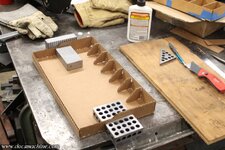
But, I thought while I'm at it, why not a few extra pockets for drill bits, taps, used inserts, screws, and so on. So I started on another tray, a few inches wider.

inserts07.jpg

That got some partial dividers...

inserts08.jpg

And then the other half...

inserts09.jpg

And then the central "wall" to divide the two rows.

inserts10.jpg

That fits in the same drawer, and takes up a bit more than a quarter of the space. It gives me six pockets for inserts (potentially a total of 18 packs) a pocket for the Torx wrenches, one for the regular Allens, and six more for 'whatever'.

inserts11.jpg

The cutaway dividers make it easy to reach even the bottom-most pack:

inserts12.jpg

Now, while I'm sure that lightweight laminated cardboard organizers are in fact the future, for now I need to figure out how to make this in a sturdier material.

Any ideas? I have a buddy that might be able to 3D print the whole thing in one go... Or I was thinking of making it out of some thin birch plywood. Either via traditional woodworking (table saw, scroll saw) or cutting it out with a laser.

The laser also offers the option of something like clear acrylic, which could be cut, slipped together, and then solvent-welded fairly easily.

I don't have a sheetmetal brake fine enough for this sort of detail work... And other ideas?

Doc.
 
Last edited:

zanyad

ALLIANCE MEMBER
Joined
Apr 26, 2018
Messages
2,756
Location
NE Ohio
A hybrid: https://www.instructables.com/Drawer-Organizer-Using-Quick-Connectors-Silverware/

Also may consider Gridfinity if you want a 3D printing rabbit hole:
It's basically a. 3D printed grid that lays in the bottom of each drawer, with a modular bin system so you can easily rearrange. The advantage in my eyes is that since the grid fills the drawer it locks the bins in place instead of having to use the bins themselves to lock position.
 

RickP

Well-known member
Joined
Jan 15, 2013
Messages
1,547
Location
Annapolis, MD
Hi Doc, I recently found your thread and just caught up to present day -- you crank out some really nice stuff in your shop!

Your CAD drawer organizer looks like something I threw together in some tool drawers (only yours is better -- mine are just random boxes). But I did 3D print an organizer for one drawer, and it just so happens to be for all my lathe tooling (all six tools that I have for it so far...). Anyway, if your buddy is willing to help with the printing, this organizer system might work for you: Gridfinity Wiki

Edit: @zanyad beat me to it!

I like it because it's reconfigurable, if you change your mind about what you want to store there later. And it's expandable if you decide to use more of the drawer space for bins at some point. Also, each component of the system has a relatively short print time, rather than one large organizer bin. I picked a grid design that had pockets for small magnets in the bottom, so it doesn't slide around the drawer. I just used standard sized bins for mine, but Fusion 360 has a plugin generator for gridfinity if you want to design your own bins with finger cutouts.

But I like your idea of laser cutting wood or acrylic too. Good luck with it!
 
OP
D

DocsMachine

Well-known member
Joined
Sep 16, 2006
Messages
1,848
Yeah, I've been watching the Gridfinity stuff for a couple of years now, and there are indeed some places in the shop such a thing might be useful.

I don't personally have a 3D printer, though, and at least in this case, I really do just need the one organizer. At least for the moment. :)

Doc.
 

dutchgray

Well-known member
Joined
Sep 28, 2014
Messages
6,463
Location
Dorset. England.
I would probably go with laser cut ply for the tray, would work well and be fairly cheap in materials.

I keep my lathe inserts in one of those small parts cabinets, the type with the little plastic drawers, get about 3 boxes of inserts in each. Mounted on the wall as my shop is so small there's not really enough room for drawer cabinets.
 
OP
D

DocsMachine

Well-known member
Joined
Sep 16, 2006
Messages
1,848
Picked up a quarter-sheet of some 1/4" Birch ply from Homey-Dee today. That's enough to make half a dozen of these things. :)

My buddy and I are going to schedule some time in the next week or two to use his wood shop. If nothing else, I'll want to use his tablesaw to make some straight, square bottom and side parts- and I can do the rest of the shaping on a scrollsaw.

In the meantime, I took a little time this afternoon and did some more organizing to the Lista drawer:

inserts13.jpg

I'm still going to consider this "in flux", and it's open to change, but that's the bulk of my collection right there. (Save for the half-dozen over in the Omni cabinet.)

Points of note: The box marked "inserts" at the top right is a relic of my days taking the classes over at the community college machine shop. The teacher there had a coffee can full of used- and some new- inserts, and he let me rummage through for some usable ones.

I picked out several dozen triangular ones- TPG flavor or thereabouts- and a few others, and those kicked off my use of carbides, over 20 years ago. I still pick through it on rare occasions, but they're so obsolete these days I think I only have one boring bar that even uses some of them.

The front corner of course is the collection of Torx and hex wrenches- and I'm thinking about making a stand, or even just a drilled block, to hold those upright.

The round can to the left has my collection of used and broken inserts. Carbide can be recycled, of course, and once I get a couple more pounds, I'll probably send it all in. (That can's about two and a half pounds now. :D )

And in front of that can- and a few in the other two rows- are some older oddball inserts, usually some solid stuff, no center hole, and none of which I have a holder for. These usually came in with bulk tool buys, or piles of tools that came with the other machines and the like. Probably ought to throw some of that up on eBay, or even just off to the recycler as well.

Anyway, may not be 'perfect' - if there even is such a thing- but it's better than before. If I can get the CNC cabinet tray done, I can check two things off the to-do list. :)

Doc.
 
OP
D

DocsMachine

Well-known member
Joined
Sep 16, 2006
Messages
1,848
I was running more of that stainless today, and if I haven't mentioned it before, it ended up with about a four-minute cycle time, maybe closer to four and a half. That helps the inserts live longer, and cuts down on the smoke.

Anyway, while those were running, and since it's fairly warm out there (high thirties) I decided to throw some paint stripper at some of the new Springfield parts. I wanted to do the tool arm, the threading dial and the carriage stop, but that **** non-meth paint stripper couldn't peel the sticker off a banana.

It softened the paint somewhat, which made it possible to scrape it with a razor blade, but it didn't wrinkle-and-loosen like the good stuff, so it can basically just be pressure-washed off.

I gave up on the bigger pieces, 'til I can buy a can of better stripper. I had some from Homey-Dee I used last year, which seemed to work well despite being the non-meth formula, but I think I used up that quart can already. That or I put it away somewhere safe. :)

The carriage stop had flat faces and relatively smooth castings, so that, at least, I was able to scrape reasonably clean.

springer25-019.jpg

As noted earlier, the machine had spent some time out in the weather, and hadn't been well-maintained even before that. I had to use a little... persuasion to get the barrel unscrewed from the body. :D

springer25-020.jpg

The barrel was already slightly bent when I got it, and the knob had been manhandled by somebody with pliers once or twice, so both of those will probably have to be remade.

springer25-021.jpg

But, after a little of the stripper, some razor blade action and a bit of Scotchbrite, at least the castings came out nicely.

springer25-022.jpg

And of course that was as far as I was able to go this evening. It's definitely one of those jobs I'll just have to keep pecking away at... The tool arm will be easy if I can get some good stripper- that one won't be much past strip, prime and repaint. (Though I'm still not certain I still have any of that particular color left on hand.)

I don't yet know what the threading dial will take, it's frozen solid, too. And the steady rest... that one will wait for spring. It needs more of a proper fix and rebuild, along with the whole taper attachment.

Doc.
 
OP
D

DocsMachine

Well-known member
Joined
Sep 16, 2006
Messages
1,848
Finally! I've been fighting with these damned parts off and on for almost two months!

partz-jan-1.jpg

I really need to get to the indexer set up and start figuring out how to run these in the CNC mill. That's why I have the dang thing! :)

But, that said, while I still need to wash 'em all through the ultrasonics, and get 'em packaged up, that gets me roughly a year's worth of product back in stock, and I can move on to the next project!

Doc.
 

dscheidt

Well-known member
Joined
Apr 26, 2017
Messages
2,884
Now, while I'm sure that lightweight laminated cardboard organizers are in fact the future, for now I need to figure out how to make this in a sturdier material.

Any ideas? I have a buddy that might be able to 3D print the whole thing in one go... Or I was thinking of making it out of some thin birch plywood. Either via traditional woodworking (table saw, scroll saw) or cutting it out with a laser.

I've made very similar dividers out of coroplast, which is corrugated plastic, commonly used for yard signs and other such signs. Used a paper cutter to cu the pieces. Stuck them together with hot glue. (I remember thinking that I should figure out a better way to glue them, because the glue took too long to cool enough to hold. the CA glues I had didn't work.) They have held up for five or six years. I've got a couple drawers with hardware that see a fair amount of use, and a couple small tool box drawers, one for organizing picks and tweezers and similar things, and another for measuring tools. Both of those were so horrible messes, and they make it so much easier to grab what I want (and put it back when done).
 
OP
D

DocsMachine

Well-known member
Joined
Sep 16, 2006
Messages
1,848
Buttonz!

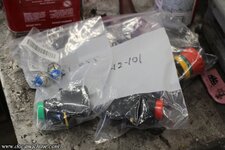
Finally got some parts in to get a couple of small tasks done. And it all started with a bag o' buttonz!

buttonz01.jpg

The first project was to finally replace the failing collet open and close buttons on the Omniturn. Longtime readers may recall the "close" button failed entirely on me a year or so ago, and I band-aided that with a momentary lever switch. That's been working fine ever since, but it's not really oil or water proof (and I flick it with a chronically oily glove when using the machine) and the "open" button was known to be in similarly poor shape.

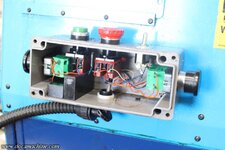
So, I cracked open the control pod...

buttonz02.jpg

And got ready for the swap. Note how there's a couple of plastic blocks supporting the left (top) button. The retainers on the switch body are cracked, so I'm guessing somebody threw that block in there to band-aid it at some point before I got the machine. :)

buttonz03.jpg

The only hiccup in this process, was the connectors crimped to the wires, were slightly too wide to fit the terminals of the new switches. I bodged that by carefully snipping a little off the outside of each fork. (They're coated soft brass.)

buttonz04.jpg

After a few minutes of finagling, everything was back in place.

buttonz05.jpg

I did get a new E-stop button, too (the middle, red one) and I'll be replacing that, too- note the red zip tie holding it together, another leftover from a previous owner. I wanted to make sure the collet buttons worked, first.

And, well, buttoned back up!

buttonz06.jpg

Quick and easy. I've been working this thing pretty hard, and hope to get a lot more out of it shortly, so best to keep up on this kind of thing.

The other job was my indexer. It's an early Haas digital indexer- the product that started Haas off, at the beginning- consisting of a rotary work head, and a small programmable controller to run it. The controller can be operated by a CNC's own controller- the CNC telling it when to rotate the part- or manually, so you can run it on a Bridgeport or something.

When I first got it, I was jumping into a couple of product runs using the manual mills, so I whipped up a quick and dirty handheld pushbutton dongle thing, just to get through the job.

pushbutton01.jpg

It did the job, and I've been using it extensively for a couple of years now, but I have more work coming up for it, and... well, it kind of offends my sensibilities. :)

It's just a chunk of wooden dowel, some old speaker wire, a cheap Radio Shack pushbutton, and all dolled up with some yellow electrical tape.

I've been thinking about it for a while, and as I've had to place orders here and there, I picked up a few extra parts. To get started, I found an ideal leftover hunk of 1" black delrin in the rolling cutoffs bin under the lathe.

pushbutton02.jpg

That got drilled...

pushbutton03.jpg

Tapped...

pushbutton04.jpg

and test-fitted for a strain relief.

pushbutton05.jpg

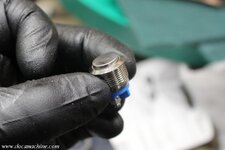
For the button, I picked up a stainless steel automotive momentary, often used for horn buttons or engine-start in custom cars. Has a nice "clicky" feel, and is supposedly waterproof.

pushbutton06.jpg

Unfortunately, it's also a metric thread, a 1.0 pitch, and I have no suitable tap to match it. I technically have metric interpolation gears for the Sheldon, or could set up either of the CNC lathes to cut it, but who has time for that? :D

According to a pitch gauge, 1.0 is very close to a 24 TPI- so I overbored the hole slightly, and kept cutting the threads 'til the switch more or less fit. :)

pushbutton07.jpg

pushbutton08.jpg

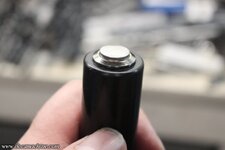
When it came time for final assembly, I connected the cord to the switch, and using a collet block with an old soft collet that by luck had been machined to about the right size, I was able to screw the switch, with it's O-ring, into the handle fairly snugly.

pushbutton09.jpg

pushbutton10.jpg

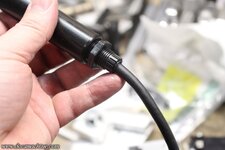
Slide on the strain relief and screw it into place...

pushbutton11.jpg

And Voilá! One momentary-pushbutton handpiece.

pushbutton12.jpg

Now, I wanted a fairly heavy cable, to withstand use and abuse, but unfortunately, this won't fit in the Amphenol type connector that fits the control box. I've looked around online, and can't find one that does- they're all like the one I have, which might take a 3/16" cable (5mm or so) and the cable I have is closer to 8mm.

The closest I can find on an image search is this one, which is out of stock, and in Germany.

I ordered one, that looks like it'll work- I have no part numbers to cross reference- but if it doesn't, if anyone could dig up a supplier that has one in stock, will accept a larger cable, and maybe even gives some dimensions I can compare, I'd appreciate it.

Doc.
 
OP
D

DocsMachine

Well-known member
Joined
Sep 16, 2006
Messages
1,848
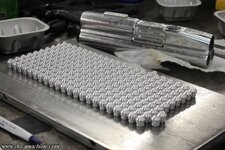
Progress! Today's tableful*:

progress1.jpg

Now, that's not today's production. To be honest, some of these parts have been sitting on my floor half-finished for... well, way too long. Most of it I started dusting back off around Thanksgiving, and I've been cranking handfuls here and there as I've had time. Its one of those cases where the whole task only took a number of hours, but those hours were spread out over months.

Yeah, this one-man-bandery thing ain't all it's cracked up to be. :D

BUT... irregardless**, they're finally done. I have a few more out in the shop that just need to be buffed, and these puppies will get boxed up and shipped off- finally!

Doc.

(*All the available flat spots in the shop are covered in foot-high piles of ****. Had to use the kitchen table. :) )

(**Yes, I know. :D )
 
To avoid these ads, REGISTER NOW!
OP
D

DocsMachine

Well-known member
Joined
Sep 16, 2006
Messages
1,848
All work and no play, as the saying goes, makes Jack a dull boy. And lemme tell ya, folks, Jack has been a dull boy indeed. :)

On the plus side, it warmed up this week, getting into the low forties, and one thing I've been champing at the bit to do, is clean up and paint some of these new (to me) lathe parts. That tends to involve stripping paint and pressure-washing them clean, especially if, like these, the parts have multiple layers of paint which are peeling not only off each other but off the base metal as well.

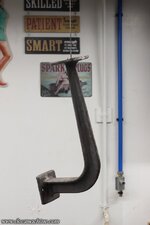
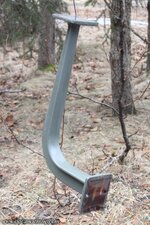
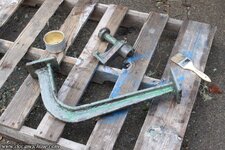
So I got some better stripper (still not as good as the good stuff) and stripped and hosed the first two parts a couple of times. The L-shaped bit is a tool-tray spar that bolts at the tailstock end of the bed, and the other is a threading dial.
springer25-023.jpg

The spar played stubborn, I think at least one layer of paint may have been an epoxy, or possibly a lacquer, as the stripper barely touched it. I had to help things along with some manual scraping, as well as the pressure-washing.
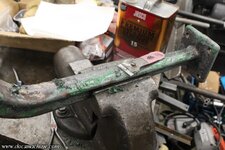
springer25-024.jpg

Still not 100% stripped, but I ran out of daylight before I was done. :)

The threading dial came out nicely, though, needing only a few touch-ups with a razor blade scraper. Note that thumbscrew, we'll be coming back to that in a moment.

springer25-025.jpg

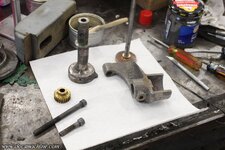
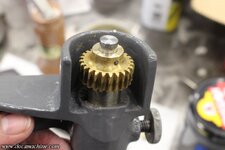
Now, this is a simple setup, and assembles pretty much the same way most other threading dials do. The gear that engages the leadscrew is simply pinned to the shaft...
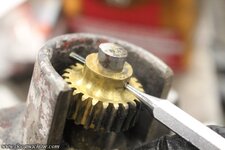
springer25-026.jpg

And with that removed, the shaft and dial simply slide out.

springer25-027.jpg

After that, the shaft housing slides out of the mounting body, and that's it. Some cleaning and painting, and it can go right back together.

springer25-028.jpg

The dial, interestingly enough, is cast bronze- an unusual use of the material given the wartime controls on the use of such strategic materials when this lathe was made. Years ago, when rebuilding the lathe itself, I noted a few other pieces were made of bronze, when cast iron would have worked just as well, but speculated that perhaps Springfield already had a large stock of the parts, already cast and machined, from prior to the war. And that said stock was small enough (Springfield was not a huge manufacturer on the level of Monarch or Leblond) that perhaps it was determined the already-made parts were more valuable than the relatively small amount of the metal.

springer25-029.jpg

100% speculation, of course, but still an interesting ponderable.

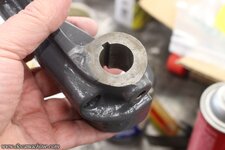
Now, here's a bit of a puzzler: That thumbscrew? When I first picked up these parts, I assumed that thumbscrew, when loosened, allowed one to "clock" the hashmark for the dial, to wherever the operator preferred it. 9 O'clock, 12 O'clock, 3 O'clock, etc. Or possibly adjust it to line up when "picking up" an existing thread.

It's not a feature I've seen before, but I'm hardly an expert on a wide range of lathes.

However... that thumbscrew sockets into this drilled spot on the shaft housing:

springer25-030.jpg

And, on the other side, there's this key that fits into a keyway in the mounting casting.

springer25-031.jpg

Okay, I can see the castings wanting/needing to be firmly attached... but why the thumbscrew? A normal setscrew would seem more appropriate, or even a short bolt.

Either the setscrew or bolt was lost at some point, and some wag just threw the thumbscrew in there simply because he had it... or the castings were originally intended to rotate, but at some point somebody got annoyed with that, and keyed it.

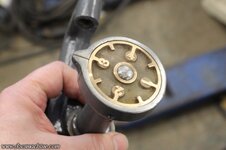
I was thinking the former was more likely... except note the orientation of the numbers on the dial. They're upright at the top of the disc. Here's a pic of how I found the dial on the parts machine:

springer25-006.jpg

That cast-in point? That's the 'hashmark' you line the dial up with, in order to engage the halfnuts. Given the orientation of the numbers on the dial, one would presume the hashmark would go at the top...

Was it originally adjustable, and some operator decades ago maybe got mad that somebody on one of the other shifts kept moving it, and so drilled and keyed it?

The world may never know. :D

Last, I found my old paint! I knew I had a bit of the 'dark grey' left that I'd used on the big Turret lathe, and managed to find it- and an even older can I'd used on the Springfield itself.

The newest if the two being closing in on five years old at this point. :)

I had to chisel through a thick dried top layer, and there was some still liquid paint left in each. That I poured through a filter into a spare glass dip jar.

springer25-032.jpg

It's probably still good, though I ought to add a touch of thinner to it, and I'm not so picky if the color isn't an exact matching shade, I'd get annoyed. On the other hand, this won't be anywhere near enough to do all the pieces I have, including the big taper attachment and the steady rest. I might be better off just tossing this- or using it on something unrelated- and getting a fresh can. It'll probably be months closer to summer before I get to the taper and steady, but the new can won't go bad that quickly...

Anybody used years-old paint? How'd it work out?

Doc.
 

RickP

Well-known member
Joined
Jan 15, 2013
Messages
1,547
Location
Annapolis, MD
Old paint? I'd use it -- 5 years seems 'young' to me.

I just pried open a 20-year old can of latex yesterday, and it worked okay.
(Definitely a pain to filter out all the solids, but still a lot easier than color-matching the original paint.)

I just found your thread recently, and I've enjoyed seeing all the machine restorations on your website.
 
Last edited:

ScepterToad

Well-known member
Joined
Nov 9, 2023
Messages
327
Doc, have you thought about a bead blast cabinet for the small parts? Might be "easier" than stripping with paint stripper and washing multiple times.
 
OP
D

DocsMachine

Well-known member
Joined
Sep 16, 2006
Messages
1,848
I have a blast cabinet, but in warmer weather- and with better stripper- doing it chemically is generally quicker. Especially on larger parts.

The spar would only barely fit in the cabinet, and given the thickness of the paints, would likely have taken two or three hours of blasting. What you see up there took two or three hours too, but 90% of that was just waiting, I was off doing other things while the stripper worked.

On the threading dial, I also didn't want to get grit in the shaft, or blast the dial face- at least not yet.

Doc.
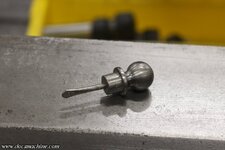
 
OP
D

DocsMachine

Well-known member
Joined
Sep 16, 2006
Messages
1,848
And that's one thing- finally- off the To-Do list! :)

The connectors for the pushbutton handpiece came in today, so after the day's projects were done, I popped one onto the other end of the cable.

pushbutton13.jpg

I wish the connector had a better strain relief, but it ought to last if I'm careful.

Did it work? Of course it did!

pushbutton14.jpg

Nice solid handgrip, nice clicky button... looks slightly more professional than a chunk of stick wrapped in electrical tape... :D

That's one I can mark off the list as 'done'... just a mere 634 or so to go! :)

Doc.
 
OP
D

DocsMachine

Well-known member
Joined
Sep 16, 2006
Messages
1,848
Warmed back up today- a little- so I was able to finish scrubbing and degreasing the big iron spar, making it pretty much ready for paint.

springer25-033.jpg

Once it had a chance to dry thoroughly, I hung it up outside and gave it two coats of self-etching primer.

springer25-034.jpg

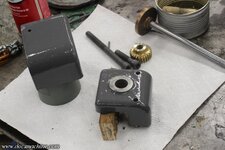
While that was curing (back inside where it's warm) I got the two castings for the threading dial cleaned fully cleaned and also degreased.

springer25-035.jpg

I also took the dial, and faced off the gear end of the shaft, which was still basically a rough saw cut.

springer25-036.jpg

Apparently they were trying to save a little time during the war... :)

Threw a 7/16" collet in the Rivett and used that to burnish the shaft itself with some 1000-grit and a touch of WD 40, just to be sure it's clean and free of burrs.

springer25-037.jpg

Then I reversed it and used the same paper to lightly burnish the raised parts of the lettering on the dial, as well as the end of the shaft.

springer25-038.jpg

Once everything was ready, I threw a capful of thinner in the jar of paint, stirred it well, and gave everything a first coat.

springer25-039.jpg

Both castings for the threading dial, both parts of the carriage stop (which I cleaned up some weeks ago) a little cover plate that goes on the carriage where the dial bolts on, the big spar, of course, and the tailstock clamping bar.

As per long-established procedure, I'll give those a second coat tomorrow, and they'll be good and dry on Monday.

The dial I can throw right back together, and hoping to give that a try. The carriage stop needs to have a couple new pieces made, first, so that'll have to wait 'til I have more time later. I'll bolt the spar into place just to get it out of the way, though I have to admit I'm not 100% sure what I'm going to do for a tool tray yet.

Oh, and I dunked the infamous thumbscrew into a dab of Evaporust:

springer25-040.jpg

I'll scrub that up in the morning, though the face is pretty heavily pitted. I may wind up leaving it off and just using a plain setscrew or short bolt.

Doc.
 
OP
D

DocsMachine

Well-known member
Joined
Sep 16, 2006
Messages
1,848
I have baskets full of tooling for these machines, and I still have to make or modify something almost every time I gear up for a new part. :D

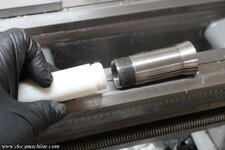
Today's tidbit- vaguely related to a customer order- is small bits turned from a long bar. Generally speaking, I can run bars about 32" long in the Omni (limited by the proximity of the adjacent machine :) ) But when running thin rod that long, you need a spindle liner- a tube that goes into the spindle to make the bore smaller, so the rod doesn't "whip" and cause vibration.

I don't have any for this machine, so I opted to cut the material I had into somewhat shorter bits, and came up with this idea: It's a chunk of white Delrin, bored to closely match the stock, and threaded to screw into the collet.

detentz01.jpg

Basically it's a short spindle liner, that'll keep the rod from whipping around eccentrically.

detentz02.jpg

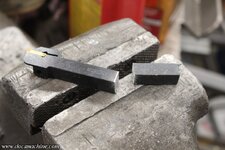
The other mod was I needed to cut down a parting tool, to have enough clearance for the tool above it.

detentz03.jpg

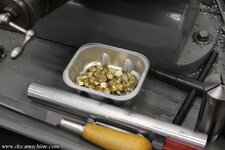
Like so (that's it under the pile of brass shavings. :) )

detentz04.jpg

Usually I put the parting tool at the top of the tool plate, but I'll be making a bunch of these parts (in a couple different flavors) and I wanted to add a catch bin below the tool. That way I don't have to chase teeny parts all through the machine enclosure. It's not so important on these brass parts, as I don't need to run the cutting oil- but when I switch to aluminum, I will. So the bin will need drains, or to be made out of mesh, etc.- as well as easy to remove and clean out the piles of random chips, etc.

An alternate idea I was thinking of was just a chute, that the part rolls down to a basket in the floor of the machine, maybe held in place with a magnet.
Also trying to think of a 'universal' kit- not one that will only work with the current parts.

Anyway, after wasting a few parts' worth of material getting the program dialed in, I was able to get a small trayful made, before it was time to bag it for the night. (Meaning about 10:30. :) )

detentz05.jpg

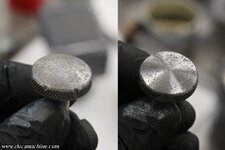
I'll run the rest in the next few days, and the parts still need some finishing work, buffing and tumbling, but if course I assembled a few for fitting and testing:

detentz06.jpg

For the non-paintballers out there, this is a ball detent for a marker called an Autococker. It's a spring-loaded device that holds the paintball in the chamber while the bolt is open. I've been making a polished stainless version for years, but I've had requests for brass and anodizable aluminum.

Doc.
 

zanyad

ALLIANCE MEMBER
Joined
Apr 26, 2018
Messages
2,756
Location
NE Ohio
I have baskets full of tooling for these machines, and I still have to make or modify something almost every time I gear up for a new part. :D
Boy, ain't that the truth! I just set up a part in our CNC Swiss lathe at work. I found an existing program when I went to write a new one, but nothing for documentation. Not sure how it was done previously, but I made a tube for the subspindle to support the parts, as at 12" O.A.L. they're too long to drop into the parts catcher and instead must feed through the tube out the back of the machine.
 
OP
D

DocsMachine

Well-known member
Joined
Sep 16, 2006
Messages
1,848
With the parts finally dry enough to handle, naturally I couldn't restrain myself from assembling things. Old Iron Disease is a sickness, kids. :)

The thumbscrew came out of the Evaporust pretty clean, though as previously reported the face was pretty badly pitted. I scuffed it a bit with some sandpaper, and it's not too bad. Why not use it?

springer25-041.jpg

As per established procedure, the first order of business was to clean the slop-over paint off the places where paint wasn't supposed to be, a task easy enough with a single-edge razor and a dab or two of solvent.

springer25-042.jpg

The two parts of the dial assembly slide together easily- I'm not going to try rotating anything just yet- and the dial itself, suitably lubed, slides in as well.

springer25-043.jpg

The the gear gets lightly tapped back into place, and the pin reinstalled. And... that's pretty much it. These things ain't that complicated. :)

springer25-044.jpg

Here's the carriage as it was- the aluminum plate covers an access hole to the inner workings. It was missing when I got the machine, so I fabbed my own. You can see the two holes where the dial attaches, too.

springer25-045.jpg

And there we go. The assembled threading dial, an original (and also freshly-painted) cover, and even the original screws.

springer25-046.jpg

Haven't had a chance to try it yet, as I have a small job set up in the machine at the moment. As soon as I have a chance to finish that, I'll chuck up a bar of random stock and try cutting a few threads- for the first timesince I acquired this machine... twelve years ago. :)

I also cleaned up and assembled the two casting halves of the carriage stop. That will need a couple of new parts made from scratch- the originals are too badly damaged- so for the time being I just clamped it to the bed next to the replacement I'd fitted all those years ago. (I think it's off a big Mori-Seki.)

And, as soon as the bolts are done in the Evaporust, I can bolt the tool-tray spar in place, too. Again, no actual tray yet, but also again, just to store it out of the way.

Doc.
 
OP
D

DocsMachine

Well-known member
Joined
Sep 16, 2006
Messages
1,848
Ah ha! See where stupid assumptions get you?

A couple of readers suggested the thumbscrew bit was to disengage the gear from the leadscrew. I didn't think that was the case, as the sliding travel of the upper portion wasn't enough to fully clear the gear- nor did it work in the way I've seen other dials disengage, which is typically swinging the whole assembly away from the leadscrew.

Once I had the whole mess assembled and in place, the upper dial section could be slid up and down, but it only went from fully engaged to partially engaged. There wasn't enough travel to fully disconnect the two. At that point I started assuming the thumbscrew was an adjustment, to lock the sliding portion into the "best" engagement.

That is, 'til I tried it in the full-up position:

springer25-048.jpg

At which point the thumbscrew fully seated in that drilled spot on the shank, which clearly showed that was it's "proper position". Checking the gear, it was fully engaged with the leadscrew- and all the way down only about a quarter of the gear is engaged.

So, full up, with the setscrew seated in that divot, is "in use", with the dial turning in relation to the leadscrew, as it's supposed to. Full down, with the thumbscrew simply holding it there, is supposed to be "disengaged", so the dial doesn't turn- and wear- when it's not needed.

That mystery settled! But, it leads to a new problem: The brass/bronze gear doesn't disengage. It almost does, but the upper edge still makes contact with the screw.

springer25-049.jpg

Now, see that extra length of the shaft? I'm suspecting the gear was supposed to be pinned lower on said shaft, which would allow it to fully release from the leadscrew. That would create a gap at the top, between the gear and the sliding casting, which means there's either supposed to be a spacer there, or somebody installed the gear upside-down. There's only the one pin hole in the gear shaft, so if that gear is upside down, it was done that way at the factory- or possibly the shaft and gear had to be replaced at some point. And whoever did the work didn't know (as I didn't) about the "disconnect" feature.

I didn't have much time to fool with it this evening, but if I get a chance tomorrow, I may try flipping the gear over- maybe remachining it for a set screw rather than that taper pin. (As I don't have a pin reamer that small.) That extra spacing should allow it to disconnect from the screw, and still allow it to engage enough to work, when raised.

It may take me a while, and I may make a few mistakes along the way, but I can usually figure these things out... eventually. :D

Doc.
 
OP
D

DocsMachine

Well-known member
Joined
Sep 16, 2006
Messages
1,848
Out of the frying pan and into the... thing wrapped in an enigma, I guess. :)

As noted, it just took a couple moments to drill and tap the gear for a setscrew...

springer25-050.jpg

Which, with the gear installed "upside down" (at least, compared to when I got the unit) did indeed allow the gear to clear the leadscrew nicely, and still engage it when the slider is raised.

springer25-051.jpg

BUT... that reveals a new problem. When said gear IS engaged in the leadscrew, it tries to push said screw inward. The gear, therefore, is too large- it's putting a nontrivial amount of pressure on the leadscrew when in operation.

Now, the screw, being an eight-foot-long bar, has a little give to it in the middle of the bed where the carriage currently is, but up closer to the gearbox supports... yeah, that's gonna damage something. (Kind of hard to tell from this pic, but the leadscrew moves noticeably inward when the slider is raised. Several mm at least.)

springer25-052.jpg

And that helps explain the wear on the gear that I'd noticed earlier:

springer25-053.jpg

Which I'd assumed- there's that word again- was simply age and use, considering the machine had been made in WW2, and had been used at a military base for many decades.

And... it's interesting to note that when the gear is teeth-up, as it came, when the sliding portion is raised, and the gear hits that 'step' in the shroud casting....

springer25-054.jpg

... The thumbscrew falls right into place in the divot that had been drilled for it. With it in what we're now presuming is "right side up" (as shown above) the slider can raise past the divot since the collar of the gear is smaller and so doesn't hit that step, meaning you have to fiddle with it to get the thumbscrew to tighten into place.

New, revised theory? Somebody in the latter years, replaced the gear, and probably the shaft. He cut the gear either based off of tricky in-place measurements (and possibly on a worn part of the leadscrew) or had to 'extrapolate' off a badly-worn or damaged original gear. Or, they bought an off-the shelf gear, which is perhaps the most likely, and fitted it to a new shaft.

Regardless of the origin- it's not impossible it came from the factory this way- it needs to be fixed. Which means either I need to buy or machine yet another gear, or very carefully set this gear up and cut the teeth a smidge shallower.

Not undoable, but will have to wait. My plates are pretty full at the moment, and I've already spent more time than I should have on it. (Because, of course, I thought it was a simple scrub-and-paint job. :D )

Doc.
 

dutchgray

Well-known member
Joined
Sep 28, 2014
Messages
6,463
Location
Dorset. England.
I know how I would fix that, which would be moving over the mounting holes in the bracket such that it could pivot for adjustment, since I see no location dowels in it.
 
OP
D

DocsMachine

Well-known member
Joined
Sep 16, 2006
Messages
1,848
It happened again. :)

I was shutting off the lights and getting read to head out of the shop for the evening, when...

NotLight.jpg

The sun can only 'thread the needle' through the trees, down the driveway and through the shop window like this, a few days of the year. Always kind of a nice treat when it does.

Doc.
 
OP
D

DocsMachine

Well-known member
Joined
Sep 16, 2006
Messages
1,848
Sometimes I think I spend more time making tools than actually using them...

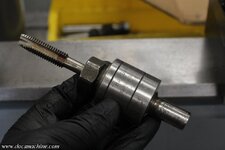
I have a chronically-overdue project on the list that I really need to get done and out the door- one of many, I'm afraid- and to speed things up, I want to be able to power-tap in the turret lathe. I already had a releasing tap holder, a good Hardinge TT unit, but I didn't like that I had to use an adapter to fit it to either turret. TT's only came in 5/8" and 3/4" shanks, and both the turrets use 1".

Earlier this winter, I'd had the brilliant idea I'd pick up another, and modify the shank by welding a sleeve of sorts to it, and so kept my eye out for a used one for a good price. Several months ago, I found just the ticket- one that had been damaged somehow, in the shank, and was selling cheap.

tapper01.jpg

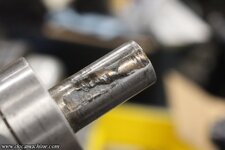
The shank had both spun in whatever was holding it, and been cracked- afterward repaired by brazing.

tapper02.jpg

Basically the thing was junk, which made it perfect for my plan- I just had to be a little more aggressive with the "sleeving". :)

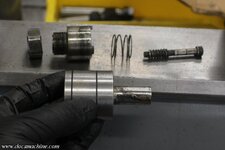
First, we dismantle the poor thing...

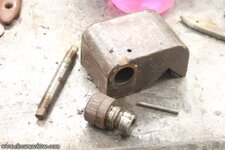
tapper03.jpg

And then, digging a bar of mystery metal* out of the racks, I turned and bored a sleeve to fit over the old shank.

tapper04.jpg

(*It turned like "free machining" steel, but welding on a test piece came out just fine, so it's probably not leaded free machining, like 12L14. Maybe something like 1144?)

The bore was a precision fit, a very light press fit over the shank, while I left .100" or so on the OD in case of warpage. And, of course, a healthy chamfer at the gonna-be-welded end. :)

tapper05.jpg

The opposite end I left a step for the old shank to seat against, and a smaller hole to match the bolt hole of the original part.

tapper06.jpg

With everything degreased, and the back face of the body buffed shiny with some sandpaper, I lightly pressed the sleeve onto the shank.

tapper07.jpg

After that, it was the big step- TIG welding the two together!

tapper08.jpg

After it had had a chance to cool, I spun it in the lathe and polished off the heat tarnish with some 800 grit wetted with WD-40.

tapper09.jpg

Switching to the 4-jaw, I reversed the body dialed it in about 0.0005" runout- the new shank was indeed warped.

tapper10.jpg

Then, with a little care, I turned it down to 0.9995", which appears to be the accepted dimension for the 1" turret tools.

tapper11.jpg

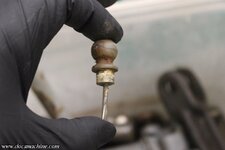
Now for the reassembly. The 'socket' of the inner spool, where the collet that holds the tap goes, has a little pin inside, which acts as a 'tooth' to keep the collet from spinning under cutting forces. I'm assuming that whatever crash broke the shank, snapped that off as well.

tapper12.jpg

Yep. Broke it good.

tapper13.jpg

Fortunately it's just a 1/8" die pin, and I had a few spares. I tapped one into place, and checked it for depth against a collet.

tapper14.jpg

Finally, before reassembly, I replaced the ratchet tooth spring, which was pretty badly buggered, with a new one out on my stash.

tapper15.jpg

I also had to replace the main retract spring- the old one was broken- and unfortunately the collet was buggered beyond use too. I have a set for the other tapping head, though, so I was able to set it up for the upcoming job.

tapper16.jpg

I still have to get a the rest of the tooling sorted out, but this was the big one. It's just what I wanted- short, not too much stickout (like the long drill in the background.)

I haven't tried it yet, but I have no doubt it'll work fine- these things are dirt simple. The only two issues being the weld. The body of the tapper is an alloy steel and heat-treated, and the welding almost certainly took some of the temper out of it. There's dog teeth inside which provide the drive, and those have almost certainly lost some of their toughness. It'll be interesting to see how long this unit lasts.

The other part is quite the opposite- welding a low-carbon steel to a high-carbon one tends to make a brittle heat-affected zone. It's possible the thing under use, could just crack at the weld, either right away or down the road.

Both I could likely solve by having it professionally re-heat-treated, although the braze on the old shank complicates that idea, and it'd be just my luck the new shank would warp slightly- and I have no more material to remove to straighten it back out.

But, for what I have into it- more labor than cash- if I can get a few years' use out of it, I'll probably call it good.

Doc.
 
OP
D

DocsMachine

Well-known member
Joined
Sep 16, 2006
Messages
1,848
And even mo' progress! The last step on those detent bodies is to drill and broach them for an allen wrench socket, so they can be installed and removed.

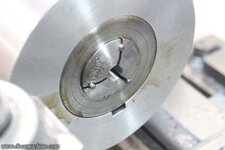
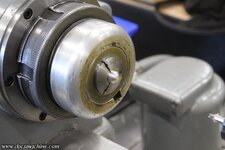
I was hoping to tool this up in the turning center, but I have too many jobs lined up for that as it is. So next best is to set it up in the little turret, and to that end, I rooted through my stash and found an "emergency", or "soft" 5C collet that had been machined for a small part, which I drilled, bored and tapped it for the 10mm 1.0 thread of these parts.

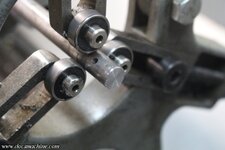
progress03.jpg

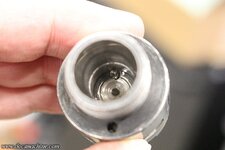
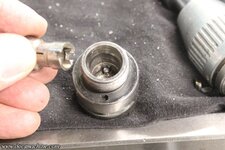
Moving that collet over to the Rivett, I set it up and tooled the turret. Why threads? Because otherwise, a smooth collet would only touch the tops of the threads, I wasn't sure if that'd be enough grip to hold against the drilling and broaching, so I tapped it, allowing the collet to grab more of the threads.

Was it necessary? Dunno. But it worked, and that's the important part. :)

With the turret tooled up, it was a matter of screwing in the detent body, closing/clamping the collet, and starting it up.

progress04.jpg

First, a small centering drill, run in deep enough to also countersink the hole slightly...

progress05.jpg

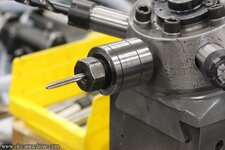
Then a regular drill to take it out to size and depth...

progress06.jpg

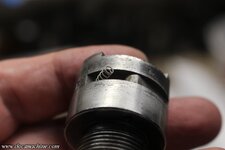
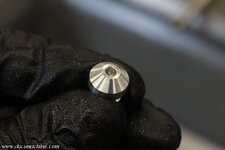
Then a 3mm rotary broach to form the ID hex.

progress07.jpg

Hard to see in the pic- this lens doesn't do 'macro' well- but that's a nearly perfect and on-size hex in there.

progress08.jpg

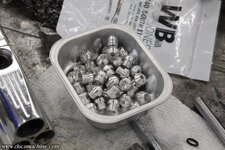
Today was pretty busy, and I only had a chance to do a few dozen.

progress09.jpg

I'll chew my way through the rest as time permits this week, then they just need to be washed and shipped off to the anodizer!

Doc.
 
OP
D

DocsMachine

Well-known member
Joined
Sep 16, 2006
Messages
1,848
I can assure you that your free-machining and weldable steel material is indeed genuine Scrapbinium.

-Came out of the finest scrapped treadmill I could find. :D

(Many years ago, a local gym/health spa got rid of several old treadmills- big professional ones, not the usual Wal-Mart coatracks. One had a 4HP DC motor. :) I scrapped those things out and made use of a lot of it- I sliced up a roller to make the rolled edge of the base of a grinder stand, got axles, bolts, sheet steel, heavy aluminum extrusions... Yeah, I'm a packrat. :) )

This shaft was an idler roller axle for one of them- probably nothing terribly exotic, but definitely machines nicely.

Doc.
 
To avoid these ads, REGISTER NOW!
Top Bottom