Part 2:
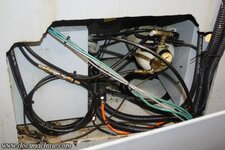
While the drive-enclosure fan filters came out nicely, the spindle fan was not so lucky.

There's supposed to be a perforated top cover over all that, and clearly the fan has been seeing a fair mist of oil or oil-laden coolant.
Hopefully the fan still works, but if not, or is too gummy to get up to speed, should be inexpensive to replace.
Now, before I put power to this thing, one of the first bits I wanted to check was the the air system. The inlet filter/coagulator thing on the back needed a new inlet ****** (one compatible with my existing hoses) and the mounting bracket straightened and tightened.

With that, I could pressure it up. There's a leak inside the enclosure, probably from the power drawbar since it's "open", and should hopefully stop once a toolholder is in place.
There's also a small one at the back there around the manifolding, possibly from that primary filter itself, but again I can't yet isolate it. I'll need to get out the soapy water and do a little chasing.
Now, this thing, like many VMCs (vertical machining centers) has a fairly heavy and actually somewhat armored door, to help protect the operator against crashes or parts flying out of the vise unexpectedly. On this particular unit, due to size and space constraints, the door folds and raises up in a track.
It's actually fairly heavy, and while you can easily lift it, it's not something you'd want to have to do 263 times in a shift. So it has a pneumatic system, acting like a couple assist springs, taking a great deal of the "weight" off.

And speaking of inside the enclosure, you can see the wood dunnage the seller put in place to help support the spindle during transit. I have not yet powered anything up to get that out of there.
The table is comparatively small, only something like 14" square or so. And the manual stresses heavily that you should not let work or fixtures overhang any edges.

I also comes with Jergens "Ball Lock" sockets at each corner, so you can use small pallets or fixture plates. Not 100% sure how to use them yet, and I can tell you they're not cheap to get the rest of the fittings- I got zero tooling with this machine- but it may prove handy at some point to have two or more parts-pallets, or a pallet and a plate-mounted vise or something.
Oh, and the vise? They sell a modified Kurt that instead of the usual hex stub sticking out the front, they have a hex
socket, like a big allen-head bolt. That's so the vise won't overhang, where the stub could smash into the door when it changes a tool.
The tool magazine is at the back, and the table slides full forward so the cradle can come out like a drawer. Any overhang at the front will hit the door, any overhang at the back can interfere with the tool changer, and any overhang at the sides can strike the gantry supports.
I haven't asked yet, but that modded Kurt, I expect, won't be cheap. I may look into buying another Glacern and modding the screw myself.
Moving on, the spindle area can use a good cleaning- and for those wondering why I use cutting oil rather than soluble-oil coolant, note the rust and tarnishing. That's what you get when using coolant.

Although, as a very nice, technically rather early but
very welcome Christmas present, it wasn't until I actually shot this very photo, that I found out I have the optional 10,000 RPM spindle, rather than the standard 5K RPM one.

Again, not that I expect to do heavy manufacturing with this thing, but on a complex part with some 3D profiling, that can literally cut the per-part time in half.
Looking up into the spindle, the taper looks cherry, and the pull-stud gripper fingers appear to be in fine shape.

And, as a bonus, they're real "claw" fingers, not just the ball-locks some manufacturers use. Which, as I understand such things, work fine and offers fast tool changes, but can beat up the pull studs.
And finally, the MPG knob on the front control panel is missing its cap and is slightly cracked.

Now, of course, I have no idea whatsoever- yet, that is- how the electronics work, or really, what kind of shape the ballscrews are in. Or the servos, or the spindle bearings, etc. etc. SWI makes good machines that are well-regarded, but that doesn't mean this one hasn't been abused. I was actually told it had comparatively few hours on it, and had been used mostly for demos and some in-house production at SWI.
The as-arrived condition didn't exactly tell me "low miles", but then, 'comparatively few' could mean 20,000 hours of operation rather than 50,000. The Omni has some hard miles on it and runs like a champ, so I guess we'll find out.
Oh, and back when I picked up some tooling for the Omni, I sprung for a very basic starter pack of BT-30 toolholders for this thing- as I said, I got zero tooling with it.
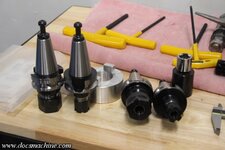
Got 'em from Maritool, which has a pretty good reputation for such things, and I started out with a pair of ER-16s, with one 3/8" collet each, and a pair of ER-20s, again with one 1/2" collet each. Still going to need to get some shiny new endmills to fit into 'em, but hey, I'm goin' as fast as funds allow.
The aluminum bit with the ears is a tightening fixture I got off eBay. Not one of the best, but definitely one of the cheaper ones. I'll eventually have to spring for a better one, as both ends of the toolholder need to be torqued. That is, the pull stud at the small end, and the collet cap at the angry end.
I'll almost certainly eventually need a dozen or more holders, even though the toolchanger only holds eight. But it's easier to keep tools set up and measured, rather than having to re-fit and re-measure each one, each time. Especially considering I'll be doing short run parts- again, like the Omni, 50-200 parts, maybe.
You can tell the computer what the size, shape and offset of tools one through forty-three or whatever, are, even though a particular job might only be using numbers 2, 3, 4, 11 and 16. (I believe it can store up to 99 tools in memory.)
To be continued.
Doc.