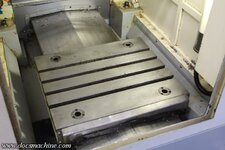
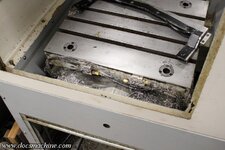
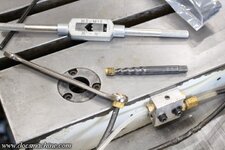
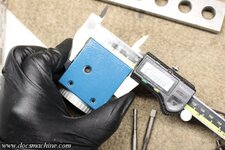
'Round about here, I just had a short list of small things to take care of. The first of which was to make a couple T-nuts. Why make some? Well, while I have a fair handful, they're all meant for the usual mill hold-down sets, which usually means they're not tapped quite all the way through. This keeps a user from cranking down on a bolt or stud, and cracking the cast-iron table by "jacking up" the nut with the screw.
All well and good, but it also makes it tricky to use actual bolts to hold down a vise or fixture- it's easy to "tighten" the bolt into the incomplete thread, and
not have the vise or whatever properly tightened to the table.
AND... I hate "using up" the hold-down nuts for things like vises and other semi-permanently mounted things. So for this sort of thing, I usually make some nuts- or a set of studs- specifically for that vise.
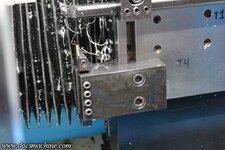
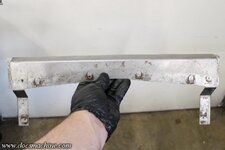
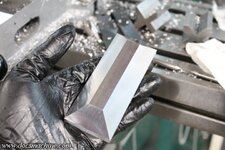
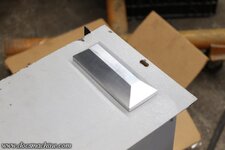
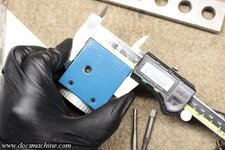
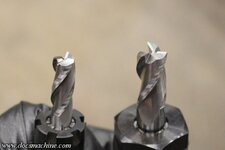
In this case, I didn't have any steel the right size- everything I had was either much too big or a little too small. What I did have was a hunk of aluminum that was just right to make a pair of extra-hurky T-nuts:

The 'trick' here is that the thin upper portion is considerably taller than a typical T-nut (seen at the back) and thus provides a lot more thread engagement, making up somewhat for the softer material. The fat part of the "T" is thicker, too, and the whole thing is longer to help spread out the load.
Couple that with some bolts that take up the majority of the available thread depth, and there shouldn't be any potential strength issues.
Besides, it's only a 3HP 30-taper machine.
Anyway, the re-cleaned and re-oiled vise is back in place, properly bolted down, and most of the way aligned.

That is, just by eye with a long straight edge, at the moment. I didn't want to power it up just to tram the vise, and in any case, once I started thinking about it, I figured I should also check the
spindle tram too. It's not easily adjustable, but I should check either way.
I'm also thinking I'll need to buy- or make- one of those aluminum speed handles for the vise. The original swivel handle is kind of awkward to use in there. Maybe just weld a handle to an old steel socket...
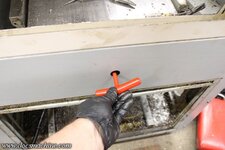
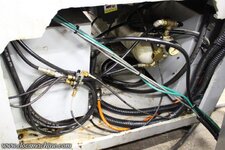
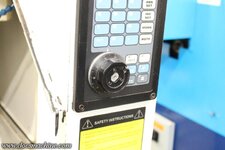
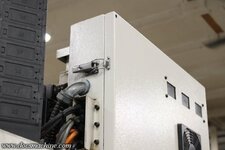
Next up was the back electrical enclosure- both of them, really- which had to be literally taped shut because the original screws were gone.
Without being able to properly close the door, the external switch- that is, the flappy bit you, the hapless user, actually turns- doesn't engage properly. So I've been leaving the door open and turning the internal switch rod/linkage thing manually. Still safe-ish, my hand is miles away from anything energized, but clearly not an ideal situation.
I have no idea what these things used for bolts or screws to hold the door shut originally, probably some specialty thing. It's not something one needs to get into on a regular basis, so having to use a wrench or screwdriver isn't a big deal.
After noodling a bit, I found that a hunk of 1/2" round aluminum fits in there, and a piece roughly 3/4" long fills the space between the inner and outer lips of the sheetmetal door.
To this end, I cut off, faced, drilled, tapped and counterbored two sections of said round, fitted each with a 30mm 6.0x1.0 screw (this machine uses metric fasteners) and made a couple screws that fit the holes in the door just about perfectly.

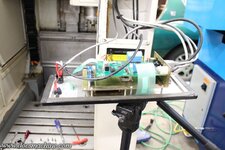
The upper enclosure won't be so simple. It has similar holes in the door corners, but no threads in the mating sheetmetal.
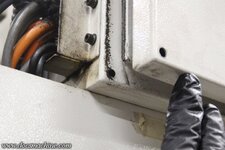
Obviously, once the door is closed, you can't get in there with a wrench to hold a nut, there's nothing to hold a cut or shaped add-on threaded bit, the lip of the opening precludes a Nut-Sert, and I'm not about to dismantle the enclosure full of electronic servo drives in order to tack-weld anything to it.
I'm thinking I'll have to make little L-shaped bits to go in each corner, with a small countersunk screw on each 'leg'. I suppose I could just 'glue' a similar tab into place with something like RTV- after all, it only has to hold the bit from spinning, there's not a lot of torque on it. Maybe buy a latch... we'll see.
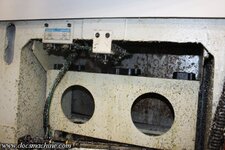
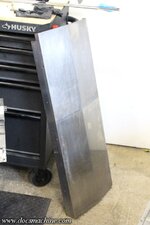
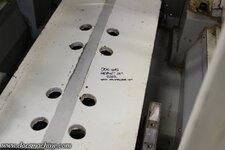
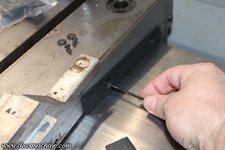
Last, there was a sheetmetal cover panel missing from the right side, which was an easy little project. A quick measurement, have the guys at the metal shop shear me a chunk of .090" steel, and that's almost it..
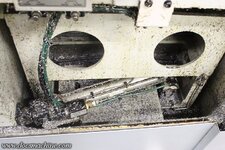
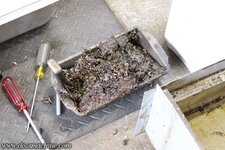
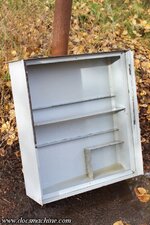
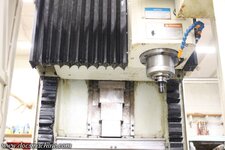
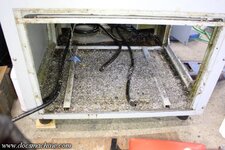
The cover goes on the right side, and encloses the chip drawer and coolant tub:

Note how I've never even used it, and there's no oil or coolant in it... and yet it's still leaking.

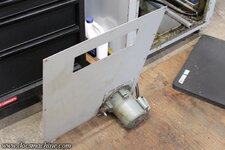
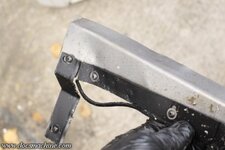
Anyway, easy enough panel, the guys sheared to to size, so all I had to do was measure and drill four holes, dig up some metric fasteners, and buff the sharp edges and corners with an air grinder. (That is, a grinder powered by air, not one intended for grinding air. Just figured I should clarify.
)

And then, of course, as per long-established procedure, degrease, a coat or two of etch primer, and two coats of Rustoleum machine grey.
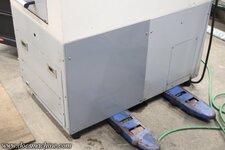
I wasn't expecting an exact match, though it's worth noting the
cap of the can was very close to the same shade as the original panels. Either way, it's better than a big open hole chips and oil can fall out of.
Doc.