To avoid these ads, REGISTER NOW!

Inside Doc's Shop...

OP
D

DocsMachine

Well-known member
Joined
Sep 16, 2006
Messages
1,848
I set mine up with mostly LH bars and 'conventional' rotation, simply because it's easier to wrap my head around those processes, since it's the same thing I've been doing for years on manual machines.

Some guys like the RH bar and reverse rotation, as it helps chips fall away better. With the bed angle of the GT-75, it's more likely for the chips and birds' nests to fall away than become entangled on the cutter.

I will say I've once or twice encountered chatter issues with the 5/8" bar, and had to reduce the feed, stickout or DOC to compensate. I later picked up one of the dovetail posts and a couple square-shank blocks, in the hopes those would be more rigid.

And, of course, don't forget you can make your own tooling. I only got one 3-hole block with mine, along with one of the odd extended dovetail posts. I wanted more of the round-shank holders, but at over $100 each from Omni, I was looking at nearly a grand including shipping, for the "set" I wanted. So I bought some steel and made them:

omniturn132.jpg

omniturn138.jpg

I also made a kind of oversized (and maybe a bit overheavy) parting tool holder:

omnitool011.jpg

With a little care, you could make a solid, one-piece block that holds a carbide insert wherever or however you want it. You're not stuck with only what's factory available.

Doc.
 
To avoid these ads, REGISTER NOW!

Xti04

Well-known member
Joined
Nov 11, 2016
Messages
2,289
man I loved my autococker gun when I was playin paintball. Worked at a mini golf course with a paintball filed and had a sweet autococker all tricked out with barrel 3 way valve and a nice bolt. At the time I had never shot a marker as accurate as that thing. And fast too! Excited to see what you turn out here !
 
OP
D

DocsMachine

Well-known member
Joined
Sep 16, 2006
Messages
1,848
(I don't know if I mentioned this, but what I've posted so far, and in the next few posts, is from earlier this year, back in January and February. I've recently gotten back into it, after a hectic summer, and figured I'd catch up, and make a full, single thread about it.)

That said, the part you've all been waiting for: Powered up for the first time! :)

Trak026.jpg

I was kind of hesitant about that one, as I'm using a rotary converter. I had to make sure the actual computer- which is an embedded Windows CE thing, apparently- was operating off the two "native" legs, and not one and the "generated" leg. The generated leg, by the nature of a rotary, is pretty much always going to be a lower voltage, which tends to not play well with sensitive electronics.

Trak027.jpg

Seems to be working so far... except contrary to what I said earlier, apparently you can't jog the axes before "homing" it.

And with that wood block in there, I was afraid it'd do something like try to 'home' the table, then the spindle, which could cause some major problems- that block was in there tight.

I eventually did what I should have done a while ago- with the machine powered down, manually turned the Z-axis coupler to "unscrew" the spindle slightly from the block. And once that was loose and out of the way, I booted it back up, and tried to home it.

And only got a little motion before I got a Z-axis "soft limit" error.

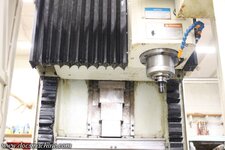
So while I wasn't able to home it, I was at least finally allowed to jog it- so I raised the spindle up more so I can clean the underside a little better, and slid the table forward so I can reach it easier.

Trak028.jpg

With that, I was finally able to give the table a good stoning, as there was some rust blooming and more than a few little dings from use, and then, slightly scrub off some of the tarnish with some fine Scotchbrite.

Trak029.jpg

I then dug out my venerable old "Elephant" branded import Kurt-clone 5" vise that spent a good many years on the manual mill, dusted it off, stoned it lightly too, and plunked it more or less into place.

Trak030.jpg

And, it looks like a 5" vise will fit and work just fine, actually. The clamping hex stub clears with a touch to spare...

Trak031.jpg

And if I have to, I could take maybe as much as 3/8" more off, just to be sure. Once I can "home" it and find the soft limits, and try the tool change mode, I can verify that everything clears.

And speaking of tool changing, there's a nice, helpful green button right there on the spindle, so I wiped out the spindle taper (was actually quite clean) and popped one of my holders in there.

Trak032.jpg

It would not, however, let me start the spindle, and I got a Y axis 'soft limit' warning too, while moving the table. So I need to read up more, figure out how to properly set the home, there's something about setting soft limits too, and figure out what else I'm doing wrong.

But it's a start.

Doc.
 
OP
D

DocsMachine

Well-known member
Joined
Sep 16, 2006
Messages
1,848
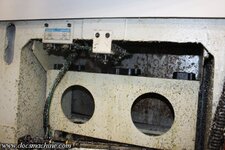
Now, on the toolchanger, I wasn't able to get that to cycle, so I popped the back cover off.

Now, the tool compartment is supposed to be fairly well protected from chips and coolant, so of course you're not getting chips on the toolholder tapers, which would cause all sorts of problems with accuracy and rigidity.

Let's just say I was kind of surprised at what I found.

Trak033.jpg

I mean, it's basically impossible to keep something like this showroom-clean, so some chips are to be expected. This, however, was frankly kind of absurd.

Trak034.jpg

I have no idea how that many chips could get in there. With the main door closed, it's actually pretty well sealed, unless they're somehow getting blown up from underneath? That would border on almost deliberately trying to blow chips in there.

Looks like I'll have to get out the vacuum, then the Purple again, along with some scrub brushes and probably a whole roll of paper towels.

... And, of course, I had to check to see if maybe there was a forgotten toolholder or two...

Trak035.jpg

No such luck. :)

The carriage and door work on pneumatic rams, so with the machine powered down and the tank drained, I was able to slide the carriage forward for more room.


Trak036.jpg

Cleaning was straightforward but tedious- Brush as much of the loose stuff as possible off the walls and whatnot, then vacuum up the piles down in the lower crevices.

Trak037.jpg

There was more in there than I'd originally thought.

After that, it was the same as the front, mist on some Purple Power, let it soak a moment, scrub with a plastic-bristle brush, rinse with a garden sprayer full of hot water (and just a touch of soap) and literally lather, rinse, repeat.

The debris could be hosed toward the front of the machine and down into the chip tray, though in spots I still had to get down there with a hunk of rag and scrub some piles loose. But, after a few cycles, it actually came out pretty clean.

Trak038.jpg

There's still some left at the bottom of the toolholder carriage, plus the whole spindle-facing side of the unit to do, but I'll have to get all that after I can pick up some more Purple.

Trak039.jpg

I also managed to soak the vise, so I took that back off, blew out what I could with the air gun, and hosed everything with Water-Displacement Formula No. 40.

Before I ran out, I hit the inside of the back cover, and I was actually kind of surprised how clean that came out.

Trak040.jpg

I've been generally pleasantly surprised how well that Purple (and, really, the Green) cut and cleaned this dried-on soluble oil residue. I won't say it's clean enough to eat off of in there, but I'm not sure it would have come out as well if I'd scrubbed it with gasoline and old rags.

Once that was all done, I lit up the power again, and this time it "homed" perfectly. Apparently I was indeed wrong earlier- when you first start this things up, the only thing you can do is "home" it. After that, yeah, it can be jogged all over the place, but it sure seems that if it's not homed, it won't let you do anything.

And, I needn't have worried about the wood- it moves the head up and out of the way first, zeroing the Z, vertical. Then moves to the hard right, zeroing the X, then moves the table full forward (toward the operator) to zero the Y. Had I known, I could have just pressed the home button and it would have moved away from the dunnage on it's own.

Better safe than sorry, as they say.

Doc.
 
OP
D

DocsMachine

Well-known member
Joined
Sep 16, 2006
Messages
1,848
It was a matter of some operator- or several, over the years- getting carried away with an air hose.

They weren't just using it to blow off the part of the vise, they were clearly using it to try and "sweep" chips down into the chip tray, and cleaning off the enclosure walls and the like.

Under the toolchanger door is open- the "floor" slopes towards the chip tray. That's so coolant can drip off the tools, of course, and run into the sump with the rest. But the air hose also drives a bunch of the chips and coolant back up into the toolchanger enclosure- and pretty viciously. See how there was a ton of chips and coolant on the back side of the carriage.

Doc.
 
OP
D

DocsMachine

Well-known member
Joined
Sep 16, 2006
Messages
1,848
'Round about here, I just had a short list of small things to take care of. The first of which was to make a couple T-nuts. Why make some? Well, while I have a fair handful, they're all meant for the usual mill hold-down sets, which usually means they're not tapped quite all the way through. This keeps a user from cranking down on a bolt or stud, and cracking the cast-iron table by "jacking up" the nut with the screw.

All well and good, but it also makes it tricky to use actual bolts to hold down a vise or fixture- it's easy to "tighten" the bolt into the incomplete thread, and not have the vise or whatever properly tightened to the table.

AND... I hate "using up" the hold-down nuts for things like vises and other semi-permanently mounted things. So for this sort of thing, I usually make some nuts- or a set of studs- specifically for that vise.

In this case, I didn't have any steel the right size- everything I had was either much too big or a little too small. What I did have was a hunk of aluminum that was just right to make a pair of extra-hurky T-nuts:

Trak041.jpg

The 'trick' here is that the thin upper portion is considerably taller than a typical T-nut (seen at the back) and thus provides a lot more thread engagement, making up somewhat for the softer material. The fat part of the "T" is thicker, too, and the whole thing is longer to help spread out the load.

Couple that with some bolts that take up the majority of the available thread depth, and there shouldn't be any potential strength issues.

Besides, it's only a 3HP 30-taper machine.

Anyway, the re-cleaned and re-oiled vise is back in place, properly bolted down, and most of the way aligned.

Trak042.jpg

That is, just by eye with a long straight edge, at the moment. I didn't want to power it up just to tram the vise, and in any case, once I started thinking about it, I figured I should also check the spindle tram too. It's not easily adjustable, but I should check either way.

I'm also thinking I'll need to buy- or make- one of those aluminum speed handles for the vise. The original swivel handle is kind of awkward to use in there. Maybe just weld a handle to an old steel socket...

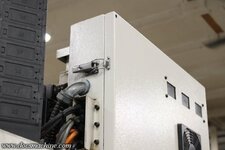
Next up was the back electrical enclosure- both of them, really- which had to be literally taped shut because the original screws were gone.

Without being able to properly close the door, the external switch- that is, the flappy bit you, the hapless user, actually turns- doesn't engage properly. So I've been leaving the door open and turning the internal switch rod/linkage thing manually. Still safe-ish, my hand is miles away from anything energized, but clearly not an ideal situation.

I have no idea what these things used for bolts or screws to hold the door shut originally, probably some specialty thing. It's not something one needs to get into on a regular basis, so having to use a wrench or screwdriver isn't a big deal.

After noodling a bit, I found that a hunk of 1/2" round aluminum fits in there, and a piece roughly 3/4" long fills the space between the inner and outer lips of the sheetmetal door.

To this end, I cut off, faced, drilled, tapped and counterbored two sections of said round, fitted each with a 30mm 6.0x1.0 screw (this machine uses metric fasteners) and made a couple screws that fit the holes in the door just about perfectly.

Trak043.jpg

The upper enclosure won't be so simple. It has similar holes in the door corners, but no threads in the mating sheetmetal.
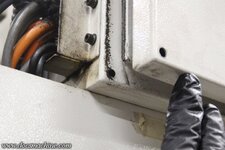
Trak044.jpg

Obviously, once the door is closed, you can't get in there with a wrench to hold a nut, there's nothing to hold a cut or shaped add-on threaded bit, the lip of the opening precludes a Nut-Sert, and I'm not about to dismantle the enclosure full of electronic servo drives in order to tack-weld anything to it.

I'm thinking I'll have to make little L-shaped bits to go in each corner, with a small countersunk screw on each 'leg'. I suppose I could just 'glue' a similar tab into place with something like RTV- after all, it only has to hold the bit from spinning, there's not a lot of torque on it. Maybe buy a latch... we'll see.

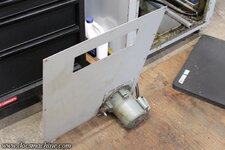
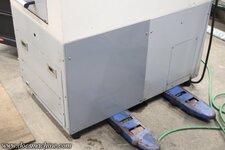
Last, there was a sheetmetal cover panel missing from the right side, which was an easy little project. A quick measurement, have the guys at the metal shop shear me a chunk of .090" steel, and that's almost it..

The cover goes on the right side, and encloses the chip drawer and coolant tub:

Trak045.jpg

Note how I've never even used it, and there's no oil or coolant in it... and yet it's still leaking. :)

Anyway, easy enough panel, the guys sheared to to size, so all I had to do was measure and drill four holes, dig up some metric fasteners, and buff the sharp edges and corners with an air grinder. (That is, a grinder powered by air, not one intended for grinding air. Just figured I should clarify. :) )

Trak046.jpg

And then, of course, as per long-established procedure, degrease, a coat or two of etch primer, and two coats of Rustoleum machine grey.
Trak047.jpg
I wasn't expecting an exact match, though it's worth noting the cap of the can was very close to the same shade as the original panels. Either way, it's better than a big open hole chips and oil can fall out of.

Doc.
 

Grant Gunderson

Well-known member
Joined
May 17, 2013
Messages
2,318
Location
Bellingham, WA
It was a matter of some operator- or several, over the years- getting carried away with an air hose.

They weren't just using it to blow off the part of the vise, they were clearly using it to try and "sweep" chips down into the chip tray, and cleaning off the enclosure walls and the like.

Under the toolchanger door is open- the "floor" slopes towards the chip tray. That's so coolant can drip off the tools, of course, and run into the sump with the rest. But the air hose also drives a bunch of the chips and coolant back up into the toolchanger enclosure- and pretty viciously. See how there was a ton of chips and coolant on the back side of the carriage.

Doc.
Could you add a rubber flap to prevent errand air from pushing more up?
 
OP
D

DocsMachine

Well-known member
Joined
Sep 16, 2006
Messages
1,848
Could you add a rubber flap to prevent errand air from pushing more up?

-Possibly, but it'd be better to simply not go so nuts with the air hose. After all, the hose was getting a lot of junk up on the Y-axis screw and rails, too. I figure I'll save the air hose for blowing off the vise and parts, and use a pusher or broom of some sort to scrape the chips into the tray.

Bigger machines will have a "garden hose", connected to the coolant system, that the operator will use to "wash down" the interior. I could theoretically hook up something like that, but I'll be using cutting oil, not water-based coolant.

Anyway... The posts up to this point were from earlier this year. We're caught up now, and the following have been from this last week. :)

I'd done that preliminary cleaning inside- nearly a year ago- but recently, I'd had occasion to take one of the side panels off, which revealed a new smear of crud that needed to be attended to.

22trak-003.jpg

More Purple Power, a toothbrush, some paper towels, and some elbow sweat got it looking a lot better. The little side bellows were tricky, and I didn't want to start spraying the cleaner where it'd drip into the sump. (Or rather, be dripping while the sump isn't there. )

22trak-004.jpg

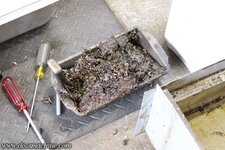
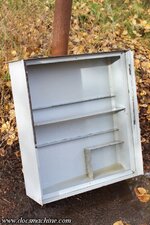
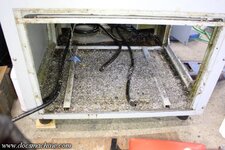
With the side cover, too, wiped down and reinstalled, I turned my attention to the chip tray and sump. On this machine, there's a chip-tray "drawer" above the sump- which catches the bulk chips, while letting the coolant drop through a screen and down into the sump. The chip tray will need to be cleaned out fairly often, the sump only on occasion.

22trak-005.jpg

Now, as mentioned, some user or series of users, got a little carried away with the air hose. They kept the table and the upper work area clear, but blew a ton of chips all over everything else- the underside of the table and the rails, all over the head, up into the tool changer, and all over around the tray and sump.

So in some cases, I didn't just need to clean the drawers themselves, but also the surrounding areas, piles packed into corners, etc.

The tray itself was fairly clean, though the paint was starting to chip and peel. The chips were kind of 'baked on' with old dried coolant, but a scraper took care of that.

22trak-006.jpg

And with both drawers out, you can see how there's a bunch of loose chips that were almost certainly blown out of the tray with an air hose.

22trak-007.jpg

Also note, right in the center, that small white hose? That's an automatic lubricator line- and lord knows where it goes, and how long that point has gone without lube. Before I button the sumps back up, I'll chase that down.

And speaking of sumps, this is what I found when I took the cover and pump off:

22trak-008.jpg

The pile of chips at the left is what I washed off the underside of the table back in January. The rest is... basically oily mud. Anyone want to hazard a guess as to what it is? My best guess is steel "fines"- micro chips- that rusted in the coolant, combined with the evaporated, oily dregs of the coolant itself. After the water evaporated off, that left the oils, which oxidized into brown mud, too.

My best guess. Either way, it was icky, gooey, sticky and nasty.

On the plus side, it scraped up fairly easily.

22trak-009.jpg

That is, it wasn't "baked on" or hard and crusty, it was just thick, sticky goo. And plenty of it:

22trak-010.jpg

Once I had it mostly scraped out, I took it out front, dumped in a quart of Purple Power straight from the jug, and scrubbed the bejeebers out of it with brushes and scrapers. The Purple "cut" the goop remarkably well, and after a good dose of scrubbings and rinsings with the pressure washer, it came out nice and clean.

22trak-011.jpg

The chip tray cleaned up as well- though thankfully with a lot less effort- and while I didn't want to completely disconnect the pump, with a little care I was able to also clean off the sump cap, and most of the more egregious gunk from the pump itself.

22trak-012.jpg

That was about all I had time for, today. I still need to chase down that broken hose, scrape and clean the bottom of the machine a little, and maybe think about swapping some hoses while I'm there, before I button it back up.

Doc.
 
OP
D

DocsMachine

Well-known member
Joined
Sep 16, 2006
Messages
1,848
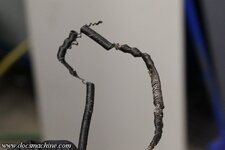
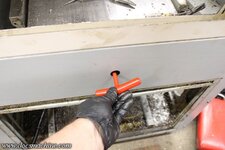
That simple broken line mentioned earlier has, of course, snowballed into a major issue. I chased it towards the back of the machine, where it (under my finger) connected to this distribution block.

22trak-013.jpg

That led over to the left side of the machine, where it connected to the automatic oiler. Meaning the ways of this machine have likely had little or no lubrication since whenever that line broke,

So, now I gotta chase it down. The two heading off to the left go up to the top of the machine, where I was able to eventually trace them to the Z-axis rails. The line heading to the right- crossing the orange cable at the very top right corner- is the feed line from the auto-oiler.

After some poking and prodding and getting a more powerful flashlight, I found the end of the black wire "spring" anti-crush cover, dangling in the breeze right next to the transformer enclosure.

22trak-014.jpg

That led uphill, into where the Y-axis ballscrew sits.

22trak-015.jpg

That leads, through a disturbingly convoluted path, to the front of the table, to this set of distribution blocks.

22trak-016.jpg

Here, I really started to wish I had a proper service manual. I have the operation and maintenance manual (downloadable off their website) but I have yet to find a service and repair manual. That's one of several questions I'll be asking when I call them tomorrow.

Anyway, I thought it'd be easier to access this stuff, to repair the lines, if I could take the stainless coolant cover off. To do that I had to take the table off, which was actually fairly simple, other than the fact it weighs just slightly less than a Sherman tank.

22trak-017.jpg

And, just in case any of you ever have to work on a 2Op or the later VMC2, there's this hole in the front through which you can turn the Y-axis ballscrew with an Allen wrench. That allows you to manually position the table, if need be.

22trak-018.jpg

With that off, I'd hoped to be able to remove the way cover, but after closer examination, there was no reason to- the hose I'm after runs under the casting the cover is attached to.

22trak-019.jpg

I may still take it off, just to clean under there- Captain AirHose, whoever he was, got chips everywhere.

And speaking of chips, I was glad I'd taken the table off anyway, as a ton of chips were tightly packed into the space between the coolant cover and the table carriage.

22trak-020.jpg

Now, getting down to business, the broken line comes into this distribution block, at the top left:

22trak-021.jpg

But, some of you eagle-eyed viewers might note another little problem, with the broken output hose going to the left way rail. The front way cover had a significant dent in it, so I'm assuming a piece of cut-off material, or a tool, maybe, landed in between the table and the door frame, and got crunched in there when the table came full forward. (Which is it's "home" position, as well as the tool-change position.)

More troublesome, that fitting apparently had a spring-loaded check-valve in it:

22trak-022.jpg

That may also be a sort of residual pressure valve, to help the oil distribute to all the corners, rather than just whichever one has the least resistance.

Either way, I now have to replace that entire run of hose, and at least one hose end with the check valve.

All before I can even think about putting the sump and chip tray back in.

22trak-023.jpg

Oh, well, I kind of expected something like this- after all, I found numerous problems like that on the Omniturn lathe, too. It's just a case of here, I hope, the lack of lubrication didn't unduly wear the rails and the like.

On that front, I will say the base "floor" was not flooded with oil- dried coolant, yes, but not puddles of oil, which would not have dried. Suggesting that the hose was broken possibly even after it had been taken out of service. Had it been run extensively after breaking, you'd think the automatic oiler would have made quite the puddle under there- and even if it'd run out, there'd still be notable traces.

Either way, I gotta run it as is- that is, after replacing the hose, I mean I'm not going to start swapping the linear rails unless I absolutely have to. (Rails are $800 a set, and ballscrews $1,000 each.)

But, for now, I'm stuck 'til I can get more information.

Doc.
 

bimmer1980

Well-known member
Joined
Feb 5, 2009
Messages
2,103
Location
York, PA
Thanks for sharing the details. I think this is a reminder of the trials of buying used machines, and just planning for the necessary issues. Of course, the cost of a new machine is another story....

Would you mind sharing the cost of this machine so we have some thing to compare against? I'm pretty familiar with the cost of Bridgeport manual machines, but I don't have a good sense of the CNC intro costs.... PM if you'd rather not share on the open forum.

Regardless, looking forward to when you have this machine up and running. I have enjoyed reading about your projects on your website as well.
 
OP
D

DocsMachine

Well-known member
Joined
Sep 16, 2006
Messages
1,848
Would you mind sharing the cost of this machine so we have some thing to compare against?

-New, these were $36K. Including shipping, tooling and repair parts, I have roughly $17K into this one. More than I wanted, and probably a lot more than you lower-forty-eighters would have sunk into it, but heavy stuff comes at a stiff premium in Alaska, and I was willing to spend a bit more on a machine that fit my physical size, weight and working area requirements.

Doc.
 
OP
D

DocsMachine

Well-known member
Joined
Sep 16, 2006
Messages
1,848
None of those hoses look like they were properly terminated. Do they have olives for the compression fittings?

-I'm... not sure how you could consider them not properly terminated. :)

The top two connections on that aluminum block, shown (with the one broken fitting) are straight-in, tubing, nut and olive. The lower two are Bijur style flow restrictors along with check valves. There's several of those in the system, which of course provides some "backpressure" so that oil makes it to all the different outlet ends, rather than whichever one has the least restriction.

You should have some of the same kind of things in your Monarch apron- I have several on my Springfield.

That said, I did find two lines that were not well terminated, I believe in large part because the two distribution blocks were mis-machined. (I have an early model version- not long after this one, they used a proper Bijur manifold.) We'll see those addressed shortly.

Doc.
 
OP
D

DocsMachine

Well-known member
Joined
Sep 16, 2006
Messages
1,848
As I already had the table off, and could see a bunch of extra junk in there, I went ahead and pulled the way cover off, too...

22trak-024.jpg

Which revealed the casting the table actually rides on. The "saddle" actually hangs below this "bridge", with the two wings seen on the sides, supporting the actual work table.

22trak-025.jpg

Spent a few more minutes cleaning off the old oils and chips, and wiping down a few other cracks and crevices here and there.

22trak-026.jpg

And, one of the other things I thought I'd better attend, was this front cover/way wiper.

22trak-027.jpg

That dent is very probably where the table crashed into something, as it came full-forward. Probably a part that had either been cut off of a workpiece, or possibly a workpiece that had been kicked out of the vise and fell there.

Either way, something caught in there, the table moving to "home" smashed into it, and the bending cover broke the tube fitting. (For those keeping score at home, there were two breaks in the line- this one, and the main one underneath and towards the back, that I spotted when I pulled the coolant sump out.

I was hoping the way wipers were simple strips of material, with steel covers, but nope. Turns out they're steel strips, with a rubber coating of some kind, with a "wiper blade" edge.

Replacements aren't terribly expensive from SWI, but I've been toying with the idea of making new steel strips, and using those to hold some rubber (actually urethane) strips

Anyway, I stripped the old & nasty wipers off, scrubbed it down with some more Purple Gunk, and hammered out some of the nastier dents, bends and other wee-haws.

22trak-028.jpg

After that, I took a closer look at where he old tube went, and got an idea of what's going on. First, a quick shot of the base "bay" of the machine, looking towards the back:

22trak-029.jpg

The loop in the foreground is the electrical cable for the coolant pump, the two hoses at the bottom are the coolant lines themselves, the round white thing is an accumulator tank for the air system (mainly the toolchanger and the door-assist rams) and the square box on the right holds the power transformer and junction box.

Now, here's what I'm looking at:

22trak-030.jpg

The tubing in question is the one dangling down (through the "com" :) ) and it goes around the then into the black cable chain. We're looking at the underside of the "saddle" the table sits on, so that's the moving part. The other end of the cable chain is attached to the underside of the "bridge"- the red casting- that the saddle rides on.

That is attached at two places to the bridge, and then... is sort of just draped across the screw.

22trak-031.jpg

I'm rather surprised they don't have any kind of, you know, dedicated channel for this line. It's really just draped across and fed through a gap on the side of the ballscrew mount. No hole, no channel, no drilled port. Just sort of stuck in there as an afterthought.

And, as you can see, that's where the damage occurred. I can't honestly figure out how it got damaged- the tubing at that point doesn't move, and I don't really know if the table moves far enough back to potentially "squash" it.

But by golly it's squashed all right.

22trak-032.jpg

Squashed, severed, bashed, you name it.

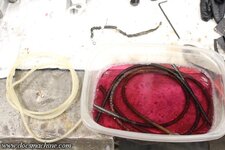
I snipped the damaged part off the outer "spring" protective sleeve, blew out the old hose in case I need it for one of the shorter sections, and dunked the rest of the sleeve in more Purple Gunk to get the old oily goop off.

22trak-033.jpg

I'm going to need to get in there with a light and maybe one of those little endoscope cameras or something, and see if I can't find- or make- a better route for the tubing.

See that grey "box" in the center-top of the first pic? That's just part of the coolant-return chute. Kind of wondering if I can't poke a hole in that, and run the tubing through with a grommet- and maybe a wad of good RTV. Or maybe an actual bulkhead fitting.

We'll see.

Doc.
 

Grant Gunderson

Well-known member
Joined
May 17, 2013
Messages
2,318
Location
Bellingham, WA
-I'm... not sure how you could consider them not properly terminated. :)

The top two connections on that aluminum block, shown (with the one broken fitting) are straight-in, tubing, nut and olive. The lower two are Bijur style flow restrictors along with check valves. There's several of those in the system, which of course provides some "backpressure" so that oil makes it to all the different outlet ends, rather than whichever one has the least restriction.

You should have some of the same kind of things in your Monarch apron- I have several on my Springfield.

That said, I did find two lines that were not well terminated, I believe in large part because the two distribution blocks were mis-machined. (I have an early model version- not long after this one, they used a proper Bijur manifold.) We'll see those addressed shortly.

Doc.
In your photos it looks like the housing for the hoses was stripped back way past where the compression nuts go. Almost like they used the wrong size of nut / olive for the line and made it work by stripping the housing, leading to premature failure.

My monarch uses all metal lines. My Bridgeport has flexible lines and the outer housing sheath goes into the compression nut just like on every hydraulic bike line I’ve ever done. Anytime a flexible line enters a fixed point such as a compression nut you have a week point, so adding an additional strain relief if those lines are moving with the machine travel might be cheap insurance.

Anyways, would it make sense to replace some of that flexible line with hard lines?
 
OP
D

DocsMachine

Well-known member
Joined
Sep 16, 2006
Messages
1,848
In your photos it looks like the housing for the hoses was stripped back way past where the compression nuts go. Almost like they used the wrong size of nut / olive for the line and made it work by stripping the housing, leading to premature failure.

-Oh, I see what you're getting at. No, it's standard 4mm plastic tubing, with a tightly-wound steel-wire "spring" type sheath to armor it against pinching or abrasion.

Anytime a flexible line enters a fixed point such as a compression nut you have a week point, so adding an additional strain relief if those lines are moving with the machine travel might be cheap insurance.

-There's only three points where the tubing moves; one connection to the table, one connection to the gantry, and one connection to the head. Each of those are run through small cable chains, which keep them from snagging, and keep the flexing to a minimum.

Anyways, would it make sense to replace some of that flexible line with hard lines?

-Not really. Obviously we can't with the flexible parts, unless I go with something like teflon brake line with the braided steel cover.

As for the rest, it's possible, but it wouldn't buy any real security, as it's all already pretty well protected and armored. On this table, the most vulnerable spot is that front edge (obviously) but everything else is pretty well enclosed.

Doc.
 

Grant Gunderson

Well-known member
Joined
May 17, 2013
Messages
2,318
Location
Bellingham, WA
-Oh, I see what you're getting at. No, it's standard 4mm plastic tubing, with a tightly-wound steel-wire "spring" type sheath to armor it against pinching or abrasion.

Doc.
Gotcha. It interesting I’m used to seeing the wire built into the sheathing with a smooth outer surface.
 
OP
D

DocsMachine

Well-known member
Joined
Sep 16, 2006
Messages
1,848
My tubing came in, along with a pack of "olives" (more on those in a moment) so I figured I'd blow the day getting this thing back together. (At least, as much as I could.)

I started by giving the thing yet another cleaning:

22trak-034.jpg

Without disassembling the thing even further, that's about as clean as it's going to get. Some of those chips are stuck hard, and it's extremely awkward to try and get a hand or arm in there. But, overall, it's a lot better than it was.

While I was at it, I scrubbed some of the undersides of the head assembly, too:

22trak-035.jpg

Again, hardly a comprehensive detailing, but it's a lot better than it was. (I'm so used to just being able to hose everything down with degreaser and pressure wash it clean. )

This is how much more debris came out of just the "bridge" and saddle.

22trak-036.jpg

Now, with that over, it was time to run the tubing. Unfortunately, there was absolutely no other easy way to route the tubing past the screw mount. All I could do is run it through on the same side the cable chain was on, rather than "cross over" like the original was, for whatever reason.

22trak-037.jpg

In that pic, it still needs to be bolted to the underside of the bridge, and the cover "spring" thing pushed in from the back side to protect where it goes through the firewall.

With that run, I bundled the three hoses back up and ran them up top, getting all the clips and whatnot back into place.

22trak-038.jpg

And then, it was time to slip the way cover back on... but first...!

22trak-039.jpg

There's little signatures like that on each one of my machines, most of which will probably never be found. :)

Then the freshly-cleaned cover goes back on, and is screwed back down.

22trak-040.jpg

And then, the table. Which only cost me the ends of two fingers, a disc and a hernia. :D

22trak-041.jpg

Finally, I could clean off the distribution blocks and start hooking the hoses back up.

22trak-042.jpg

The tubes leading out from the block have little check valves, or residual pressure valves. Those help the oil go everywhere, not just to whichever outlet has the least resistance. The inlet line, as well as the crossover that hooks the two together, just has a nut with an "olive", or compression collar, compression ferrule, whatever you want to call it.

22trak-043.jpg

The factory arrangement also has these little tubes, seen at the end of the hose, that I think is supposed to act like an anti-crush. The collar can't tighten so much it collapses the tube.

However, I found that the collars crimp and hold very well, without that insert, which I take as a restriction in the line. I thought maybe it was supposed to have a restriction, but each through-fitting has one so I suspect that's not the case. I left 'em out.

Now, one issue I found was that the feed line to the first block, and one side of the crossover line, hadn't sealed. The port in the block was drilled too deep, so the ferrule never 'crimped'. Both hoses just pulled right out.

The only fix I could think of for that was to either make a new block, or make a longer olive. So I did that.

22trak-044.jpg

Stock on the left, my new one on the right. And that was just barely long enough, so the second one I made slightly longer still.

22trak-045.jpg

And there we go, Fresh hose, properly sealed and crimped, the rest of the lines in place, save for the lower left one, which, as you'll recall, was broken. That new fitting should be in Monday, and hopefully it's the right one.

22trak-046.jpg

I should also get my new way wipers, so those can go on once the last hose is in place, and that should pretty much do it for "under the hood" here.

Doc.
 

Grant Gunderson

Well-known member
Joined
May 17, 2013
Messages
2,318
Location
Bellingham, WA
Now, with that over, it was time to run the tubing. Unfortunately, there was absolutely no other easy way to route the tubing past the screw mount. All I could do is run it through on the same side the cable chain was on, rather than "cross over" like the original was, for whatever reason.

22trak-037.jpg
I run a lot of internal hydraulic cables on E-bikes (Brakes and seat posts). For those, Park makes a really good tool set that helps you all new lines in while pulling the old set out. I also have some Laparoscopic Grasping Forceps that make it easier as well.


The tubes leading out from the block have little check valves, or residual pressure valves. Those help the oil go everywhere, not just to whichever outlet has the least resistance. The inlet line, as well as the crossover that hooks the two together, just has a nut with an "olive", or compression collar, compression ferrule, whatever you want to call it.

22trak-043.jpg

The factory arrangement also has these little tubes, seen at the end of the hose, that I think is supposed to act like an anti-crush. The collar can't tighten so much it collapses the tube.

However, I found that the collars crimp and hold very well, without that insert, which I take as a restriction in the line. I thought maybe it was supposed to have a restriction, but each through-fitting has one so I suspect that's not the case. I left 'em out.

Now, one issue I found was that the feed line to the first block, and one side of the crossover line, hadn't sealed. The port in the block was drilled too deep, so the ferrule never 'crimped'. Both hoses just pulled right out.

The only fix I could think of for that was to either make a new block, or make a longer olive. So I did that.

22trak-044.jpg

Stock on the left, my new one on the right. And that was just barely long enough, so the second one I made slightly longer still.

22trak-045.jpg
Those little tube inserts, are there to keep the Olive from crushing in under the clamping pressure of the compression nut. Without them, the hoses can and will eventually compress and pull out. I deal with these all the time on MTB brake lines (5mm Vs 4mm, but same idea). They also come with different length of ****** on the end of the tube inserts, and each MFG uses these own, and they are not cross compatible. Usually that deeper section of the bore is straight so a longer olive wont work, and you need to use a tube insert with a longer ****** on the end. Curious if you know who makes your distribution block and if they have there own specs? Does Bijur make different inserts for different distribution blocks?
 
To avoid these ads, REGISTER NOW!
OP
D

DocsMachine

Well-known member
Joined
Sep 16, 2006
Messages
1,848
For those, Park makes a really good tool set that helps you all new lines in while pulling the old set out.

-Interesting, but thankfully not necessarily needed here. The trickiest bit was running the hose past the screw mount- the "firewall"- and that only took a few minutes. For the rest, it was easy enough to lay some old cardboard down over the gunk at the bottom of the chassis, and lay on it- and a creeper- to run the rest. It's all mostly open, rather than inside larger tubes or something.

That tool would be handy, however, if I ever had to replace the hoses for the vertical (Z-axis) rails, as those do, in fact, go through crowded channels at the back corners of the machine.

Those little tube inserts, are there to keep the Olive from crushing in under the clamping pressure of the compression nut.

-That's what I figured, but after the olive had been crimped, those inserts would still basically just fall out. I figured there wasn't enough compression to collapse it far enough.

Without them, the hoses can and will eventually compress and pull out. I deal with these all the time on MTB brake lines[...]

-And there's the big difference. This oiler runs at considerably lower pressures than a brake line. I admit I don't know what the system runs at, but it's an oiler- it only runs for a second or two, giving a "shot" into the system. I'd wager peak pressure at the pump is less than 100 psi, and probably barely 20-30 once it sees the Bijur restrictors. Remember, the whole system is open, the oil is supposed to leak out. :)

Curious if you know who makes your distribution block and if they have there own specs? Does Bijur make different inserts for different distribution blocks?

-The distribution blocks on my particular machine, I believe, were probably made in-house by the manufacturer of the mill. (The chassis and major components are made in Taiwan, and assembled and wired in the US.)

I believe they were mis-machined, or perhaps more likely, machined for a different sort of fitting. Possibly something like this, where I believe the smooth end seats at the bottom of a drilled hole, such as in the casting of a machine tool, rather than something like this, which is what was on my table.

The latter are reversible- the nut and olive can be used at either end, and the flow direction oriented as necessary, depending on if you're feeding into a part, or out from a part.

The later Trak machines- and everything shown in the manuals- shows those two separate blocks replaced by a single off-the-shelf Bijur manifold, mounted to the side of the table. (Or rather, the carriage the table rides on.) I'd have swapped to that, here, except my carriage is not drilled & tapped to mount it, and there's no room in there to be able to do so. (Only about 4" clearance from the table to the side wall.)

And yes, Bijur, and other manufacturers, make a ton of different metering valves. Besides different threads and thread combinations (8mm, 5/16" imperial, 1/8" NPT, I think 1/16" NPT, etc.) there's a 'restriction rating', or whatever they call it. #000 is the most restrictive, #5 is the least, and each number doubles the flow rate. That is, a #2 allows twice as much oil past as a #1, and so on.

The restriction, as I'm sure you know, is to briefly maintain some pressure in the oiling system, so that some of the oil will go to each of the outlets, rather than all of it heading just for the one with the least overall restriction.

Your 10EE apron should have something of the sort, and my Springfield apron and carriage has three or four of them.

Doc.
 
OP
D

DocsMachine

Well-known member
Joined
Sep 16, 2006
Messages
1,848
Got the last of the sleeve/armor on the tubing going back to the distribution block, and zip-tied it up and out of the way.

22trak-049.jpg

Zip ties? Well, yeah. The manual shows the block screwed to some of the framework in there, but on this machine, it was just laying in the bottom of the chassis, and there's no sign anywhere of a place it was attached. There's drips of dried oil on it, showing it was hanging vertically for a long period, so I'm assuming that, unless there's a mount or bracket missing somehow, the block was just zip-tied to something.

That done and the back buttoned back up, I remembered there's one other thing I hadn't done yet- extracted that broken bit from the last line. Turned out fairly easy, I found an EZ-Out that fit just right, tapped it in and twisted the fragment right out.


22trak-050.jpg

So, once the fitting comes in, it'll just be a matter of plunking it into place and tightening down.

One thing that did come in yesterday, though, was my replacement way wipers. The old ones had worn and were cracking, so I ordered a new set- at least, the ones that are available- and went ahead and installed the rear ones.

22trak-051.jpg

Easy-peasy, although they didn't have the little side ones for the back, so I trimmed the worn edges a little to be a bit smoother, and that should help. After all, they're not seals, they're just wipers to keep chips and swarf off the moving bits.

22trak-052.jpg

And, since I'm done in there- I hope- I wiped down the side access panels again, and reinstalled those. Which gets us down to that last hose, the front hose guard and front way wipers, and the chip-tray/sump assembly. (And a couple other miscellaneous bits. :) )

Doc.
 
OP
D

DocsMachine

Well-known member
Joined
Sep 16, 2006
Messages
1,848
Back at the beginning, I mentioned that the sight glass for the coolant sump had gotten smashed, probably by a forklift tine or misguided pallet jack. (Keeping in mind this machine was designed to be moved with a pallet jack.)

However, the coolant level is really only important with the water-based stuff, due to constant evaporation. I plan on using cutting oil, which will only "go away" as traces on the swarf and parts. It'll still drop after a while, but nowhere near as fast as water-based.

I did noodle a couple different ways to make a proper glass, as well as looking for off-the-shelf replacements (the factory is out of stock) but in the end, I had better things to spend my time on. So I just made a blanking plate.

Two blind 3/8" holes, drilled and tapped...

22trak-053.jpg

The block faceted to make it somewhat more low-profile and anti-snag...

22trak-054.jpg

Wiped down and deburred...

22trak-055.jpg

It could have been thinner, I suppose, but I wanted the bolt holes to be blind, so they couldn't leak through, themselves. Shortest bolts I had were 3/4", and I wouldn't have wanted them much shorter anyway, to maximize thread engagement.

And test-fitted.

22trak-056.jpg


I'd toyed with ideas for O-ring grooves and the like, but again, time is short and I have other things that need done. Even with O-rings, I'd have likely smeared some RTV on there anyway, so when it comes time to install it proper, I'll degrease everything, and just give it a good thick coat of a high quality RTV. (Though I also need to whang a dent out of the panel, first, too.)

No, it's not ideal, or all that elegant, but it plugs the hole and I won't have to worry about it anymore. It's also more or less bulletproof, and can't be smashed open by an errant pallet jack or other impact.

Doc.
 

Grant Gunderson

Well-known member
Joined
May 17, 2013
Messages
2,318
Location
Bellingham, WA
-And there's the big difference. This oiler runs at considerably lower pressures than a brake line. I admit I don't know what the system runs at, but it's an oiler- it only runs for a second or two, giving a "shot" into the system. I'd wager peak pressure at the pump is less than 100 psi, and probably barely 20-30 once it sees the Bijur restrictors. Remember, the whole system is open, the oil is supposed to leak out. :)
My concern would be them working their way back out if there is any movement of the lines near the fitting. When these fail on bikes, its not due to the pressure for the fluids, is do to the movement of the hoses going into the master cylinder. They never fail at the caliper end, as the cables is always held firm and isn't moving on that end. All plastics "creep" under pressure, and movement exacerbates it. So the compression of the olive without the inner insert allows the hose to eventually collapse down just enough to become loose. Just something to keep in mind.
The later Trak machines- and everything shown in the manuals- shows those two separate blocks replaced by a single off-the-shelf Bijur manifold, mounted to the side of the table. (Or rather, the carriage the table rides on.) I'd have swapped to that, here, except my carriage is not drilled & tapped to mount it, and there's no room in there to be able to do so. (Only about 4" clearance from the table to the side wall.)

And yes, Bijur, and other manufacturers, make a ton of different metering valves. Besides different threads and thread combinations (8mm, 5/16" imperial, 1/8" NPT, I think 1/16" NPT, etc.) there's a 'restriction rating', or whatever they call it. #000 is the most restrictive, #5 is the least, and each number doubles the flow rate. That is, a #2 allows twice as much oil past as a #1, and so on.

The restriction, as I'm sure you know, is to briefly maintain some pressure in the oiling system, so that some of the oil will go to each of the outlets, rather than all of it heading just for the one with the least overall restriction.

Your 10EE apron should have something of the sort, and my Springfield apron and carriage has three or four of them.

Doc.
On my lathe, someone had drilled one of the Bijur meters out to do just what you had described. I am replacing it with the proper Bijur connector.

Those Bijur fittings and paraphernalia are stupid expensive. I just got another tinny box from fluid line to do the apron lines and it was over $400. I think a good drug addiction wold be cheaper!

For what your CNC cost new, is a bit surprising to see such a rats nest of cables and hoses. Guess thats how they maximize profits these days.
 
OP
D

DocsMachine

Well-known member
Joined
Sep 16, 2006
Messages
1,848
My concern would be them working their way back out if there is any movement of the lines near the fitting.

-Both ends of all the lines are well secured, at least, save for the dangling distribution block at the back, but that doesn't move on anything like a regular basis.

The flexing sections of any of the lines, is in the middle of a run, with considerable sections before and after clipped, clamped and otherwise retained.

For what your CNC cost new, is a bit surprising to see such a rats nest of cables and hoses. Guess thats how they maximize profits these days.

-That's pretty much how any CNC is going to look. There's oil lines, limit switch connections, air hoses, electrical connections to lights, encoders, door interlocks and solenoids... For the oil lines, on a given 3-axis machine, there's going to be six ballway rails, usually with two "trucks" each, for a total of twelve oiler connections. All of which have to have moving sections, but also are routed out of the way of axis travel and away from chip and debris damage.

Your 10EE was made by master craftsman who took pride in their work. Most CNCs are made on an assembly line, and as a commodity product. Get it together and get it out the door, it's got a job to do. :)

(It's also worth noting that one 1945 10EE cost more, in today's money, than two of these Trak mills do now. The Monarch in '45 cost around $5,000, which is the equivalent of more than $82K today. A new 2Op [technically now called the VMC2] is about $36-$38K.)

Doc.
 

dutchgray

Well-known member
Joined
Sep 28, 2014
Messages
6,462
Location
Dorset. England.
To be fair 10EE's are one of the top group of machines in that size range, but all good toolroom quality lathes were serious money in their day, good house money or at least a years wage for those running them.
In most first world places the current pricing for good manual machines represents a terrific bargain and also signifies just how little use industry has for them.
At least from the UK, many good small machine tools get exported as they are worth more abroad than here.
 
OP
D

DocsMachine

Well-known member
Joined
Sep 16, 2006
Messages
1,848
To be fair 10EE's are one of the top group of machines in that size range, but all good toolroom quality lathes were serious money in their day, good house money or at least a years wage for those running them.

-You also have to remember that there basically was no such thing as a "home shop machinist" back then. If you owned a machine tool, it was for a specific purpose- you were manufacturing something, or you were using it to keep other machines in operation (farm tractors, combines, etc.) Very few people had a lathe or mill "just for fun", and if they did, it was an older and/or simpler model- no one had an eighty-thousand-dollar-equivalent lathe to keep a couple tractors going. :)

In most first world places the current pricing for good manual machines represents a terrific bargain and also signifies just how little use industry has for them.

-Yep. The machines were generally made well enough they've lasted this long- long enough to become obsolete. So still-good-but-unwanted machines today sell for pennies on the dollar- cheap enough we CAN buy them up "just for fun".

Doc.
 
OP
D

DocsMachine

Well-known member
Joined
Sep 16, 2006
Messages
1,848
Now [cracks knuckles] we're getting down to the wire, ladies and gentlemen. My last fittings came in today, so of course once I was done with the afternoon's powerboating, had gotten that pesky stockbroker's meeting out of the way and fed the cat, I ran right out and installed it.

22trak-057.jpg

A couple extra zip-ties and that should be it, the lube plumbing back in shape.

22trak-058.jpg

Now, in order to test it, I had to fire it up. The lube pump is electric, and there's no manual button or lever. So I booted the thing up for the first time in the better part of a year, worked my way through a menu or two, and entered the service code for the lube pump.

22trak-059.jpg

There I was able to cycle the pump two or three times, and was, actually, kind of surprised to see how rapidly the tubing filled up.

However, a quick inspection showed one of my cleaned, but not replaced, fittings, was leaking.

22trak-060.jpg

Nothing wrong with the fitting, just that it wouldn't 'seat' in the distribution block. Same issue as led me to make those longer 'olives' on the other connections. Wasn't sure how to fix that, apart from wrapping the fitting with Teflon tape or something, since it'd seated at the hex shoulder.

But, I'd gotten a pair of the new fittings in, I figured I could try swapping it with the other new one.

And that worked!

22trak-061.jpg

With that leak-tested and apparently successful (it's hard to tell if/when it's actually coming out at the bearings and trucks) I reinstalled the sheetmetal tubing cover, and the new way wipers.

22trak-062.jpg

That left just a few other things, but reminded me that most of the movement on this thing- like "homing" and whatnot- can only happen with the door closed. And the windows are filthy.

22trak-063.jpg

I cleaned them off as best I could, though at some point I may try removing them entirely, and trying to repolish the plastic. I want to try that with the Omni's sliding door, too. Southwest has replacement panels for the door, but they're $160 each.

That said, one of that last major bits was the encoder handwheel:

22trak-064.jpg

Which works fine, but I wanted the little crank handle back. The knob alone isn't available, so I was forced to buy an entire encoder, which wasn't cheap.

But, a little bit of work got that installed...

22trak-065.jpg

And we're back up to full speed.

22trak-066.jpg

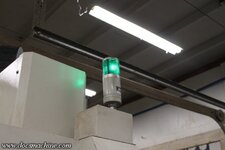
After that, I booted it up again, re-homed it, noticed for the first time the green light comes on when it's ready-to-use...

22trak-067.jpg

And, finally, after nearly thirteen months, started up and heard the spindle run for the very first time..

22trak-068.jpg

Or rather, didn't hear it run. It's not just quiet, it's silent.

22trak-069.jpg

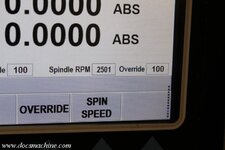
I only brought it up to 2,500 RPM (remember, it's a 10K spindle) but I heard nothing. The cooling fans for the drive enclosure, which run whenever the machine is on, are louder than the spindle.

I still need to put the coolant sump back together, but we're coming down to the wire, folks! Slip the vise back in place, tram it, finish those vise jaws, and then read the manual again, about cutting that test part.

Oh, and maybe order some cutters. :)

Doc.
 
OP
D

DocsMachine

Well-known member
Joined
Sep 16, 2006
Messages
1,848
Comin' down to the wire, ladies and gentlemen!

Several months ago, I made a McMaster order, and tacked on a couple of nice, stainless lever-latches. I needed some #6 screws for it (or 4mm, but, y'know... ick) and finally swung by Homey-Dee and picked some up, along with some nylock nuts.

A few minutes with the drill, and voila`!

22trak-070.jpg

That drive-enclosure door is finally secure, and no longer flappin' in the wind. Tick another one off the list. :)

And on that note, since we're getting down to that very system as a last part of this project- I hope- I had two quick things I wanted to do today. First, to remove the coolant pump so I can give it and the last corner of the sump "lid" a good scrubbing.

22trak-071.jpg

The outside of the pump was just a case of scrubbing with some Purple, though I found out rather quickly that leaving it sit for even just a few minutes, softened the paint a little. After giving it a cursory scrubdown, I got an old plastic coffee can, filled it with about a 30-70 mix of Purple and water, and let the pump end soak.

22trak-072.jpg

I need to find out if I can run the coolant pump manually in the control, and maybe try to circulate some of the cleaner a few times. I'm sure the inside of the pump is pretty crusty.

And, while that's soaking, I scrubbed and degreased the block-off plate, and the area around the mounting holes, smeared everything with some good RTV, and bolted 'er into place.

22trak-073.jpg

Hopefully that'll be good and cured by the time I fill the sump with oil, and hopefully be a good seal. (Yes, I wiped up the squeeze-out and other smears. :D )

And at that point, since the 'lid' only took a minor scrubbing, I set that in place, cleaned off the screws and bolted it down.

22trak-074.jpg

Once the pump is well scrubbed, and I've given the chassis another good sweep-out, I can reinstall the pump, hook the hoses back up, and slide that puppy back in place.

Later, I bolted it back to the 'lid' of the sump, knifed about an inch off the end of each coolant hose to get a bit of fresh material, got those secured, and slid it all back into place.

22trak-075.jpg

The only hiccup in the process was, as I was slicing off one of the hoses, I got a dribble of green coolant. Apparently there was still some in the lines. So brilliant me, I put an air hose on the spout end up by the spindle, and blew it out- expecting just a few drips and drabs.

Turns out there was still about half a quart in there. Most of which wound up on my pant leg and shoe. :D

Yes, my brilliance can be a burden, sometimes...

Anyway, the last bit is the fine-chip filter, and I have two on the way. Probably be here Thursday. I also picked up some stainless buttonhead screws of the correct thread, and swapped those in where I'd had a black oxide, or one was missing entirely. The two at the front of the sump are stripped, so I may wind up retapping those to 6mm.

Not gonna dump any cutting oil in until the last minute. I want to "dry run" the test program a couple of times, get some practice 'finding' the part and all that, before I commit to an actual cut.

Doc.
 
OP
D

DocsMachine

Well-known member
Joined
Sep 16, 2006
Messages
1,848
Still waiting to get some more last-minute bits in before I get too hog-wild with this thing. My fine-chip sump screens came in today, and they just slip in below the chip drawer, on top of the sump lid:

22trak-076.jpg

Simple aluminum frame with a bit of steel mesh, maybe a touch finer than typical window screening.

And then I spent some time playing with the control- it's worth keeping in mind that I'm still pretty green with CNC in general, and this control in particular. I just need to futz with it some more, just don't go expecting fancy parts from me right away. :)

One thing I did do was ran the spindle up a little higher, to 8,500 RPM.

22trak-077.jpg

Got a little louder than before, as you might imagine, but is still very smooth and quiet. My manual mills are three times louder at a quarter the speed. :D

On potential worry, though, is the Y axis, the one I just was working on, sounds a bit "gritty" as I jog it. Again, it went who-knows-how-long without lube, and got the worst of the coolant-and-chips splash, so there may be a chance those rails may be worn.

Although on the plus side, of all the rails in the machine, those are the easiest to get to and replace. On the con side, it'd still be a nasty, expensive and time-consuming job. We'll have to wait and see.

Doc.
 

merkyworks

Well-known member
Joined
Nov 11, 2016
Messages
587
Location
Texas
Wow seeing your Vee-Twin Autococker vid brings me back 25 years when I played paintball with a Bob Long Autococker :rocker:
 
OP
D

DocsMachine

Well-known member
Joined
Sep 16, 2006
Messages
1,848
Autocockers are still a popular marker... And I was the first one to make a double-barrel. :)

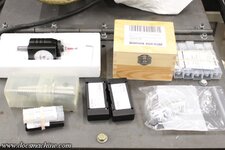
Christmas came early! Or at least, it might seem that way if I didn't have to pay nearly a grand of actual money for all this... Good thing I'm rich, eh?

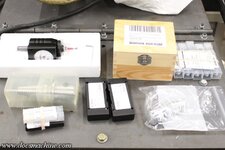
All these goodies came in today:

22trak-078.jpg

The big ticket bit being a Haimer 3D "Taster", or test indicator. It was a lot more than I wanted to spend, but it's basically considered the hot ticket for edgefinding in a CNC mill, and, to be perfectly honest, I'm gonna need all the help I can get. :)

I got one with a 10mm shank (apparently the only other option being a 3/4" shank, or an integral CAT-40) and figured that, rather than using an expensive ER collet holder just for this (which isn't intended to spin) I'd find a cheap Weldon (side screw) holder and use that.

And, interestingly enough, I found just the thing on eBay, a Weldon BT-30 holder in 10mm... for just ten bucks. Which was suspiciously cheap, but again, it almost doesn't matter how well it's made. The Haimer can be "zeroed" like a 40-jaw chuck, so even if the shank hole was off center, it'd still work just fine.

And hey, ten bucks! :)

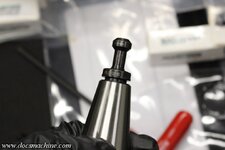
I even had some spare Maritool pullstuds, and figured I'd plunk one in... except...

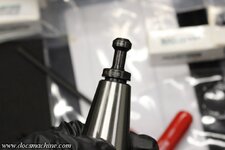
22trak-079.jpg

The Maritool studs reach deeper into the toolholder body, supposedly to reduce "bulging" at the thin end of the taper. But in this case, the cheap toolholder isn't tapped deep enough, and so I can't "seat" the pullstud. There's also no easy way to hold the stud in a chuck so I can turn off a couple threads, and didn't want to just take some off with a bench grinder.

So in this case, I'll just order another stud that looks like it might fit- and who cares about the quality, since this holder will never see actual cutting forces.

Fortunately, I also picked up a 10mm collet for one of the ER-16 holders I have... except...

22trak-080.jpg

I'd gotten the "low profile" nuts with these, and with the indicator body, there was no way to get a wrench on it, without having the shank stick out more than I wanted.

Fortunately, I also picked up a 10mm collet for the ER-20 holders as well. :D No worries here, I picked up cheap ones since, again, concentricity on these really won't matter. (And... er, I ordered them on eBay before I found the solid Weldon holder. :) )

And, when I'd ordered the first batch of tooling for this machine a year ago, I also got a holding fixture for tightening them.

22trak-081.jpg

But, I haven't gotten around to actually mounting it anywhere, so just for the moment, I slapped it in the mill vise, which has smooth jaws and won't mark up the holder.

Anyway, with that snugged up, I lit up the machine again, installed that holder, and with a half-thou B&S indicator, dialed in the tip as best I could.

22trak-082.jpg

The adjustments are a bit fiddly, because you can get down to a fraction of a thou, but with a little patience, I was able to get it down to maybe 0.0003" TIR.

22trak-083.jpg

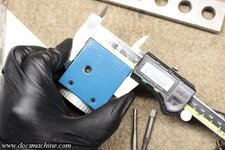
One other goodie I got, as kind of a backup or at least alternate option for the Z setting, is this little blue cube:

22trak-084.jpg

Works kind of the same way as the Haimer, you touch the tool down on the top pad, and keep moving it down 'til both the big dial and the little one read zero. At which point the tool is exactly 2.000" from the surface.

In my case, a quick check on the manual mill showed a bit of an issue, so I had to tweak it. There's two studs on either side of the center pad, and the tops of these are also supposed to be exactly 2.000"- and when checked, they were spot on.

22trak-085.jpg

But, laying a straightedge across the top of all three, showed it was reading about two thou low.

22trak-086.jpg

The instructions don't say, but a little experimenting showed that these two smaller screws in the side, rather crudely adjust the zero point.

22trak-087.jpg

(I think the big one just holds the plunger in.) Anyway, with a little fiddling, and a few choice curse words, I was able to zero the needle. Technically the dial face itself can be rotated, but my ADD insisted the needle must point straight up. :)

22trak-088.jpg

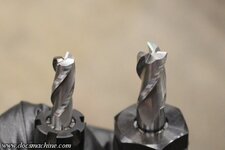
Also in the sack of goodies was a starting handful of wickedly-sharp solid-carbide 3-flute endmills, some in 3/8" and some in 1/2".

22trak-089.jpg

Lookin' forward to trying those.

And finally, since I had the machine powered up again, after playing with a few of the other settings just to get a little more familiar with them, just before shutting it down, I ran the spindle up to a full 10K RPM:

22trak-090.jpg

Still surprisingly quiet and very smooth. And at this point, I should be pretty well set, at least for the moment. A little more reading and I should be ready to cut a chip!

Doc.
 
Last edited:
OP
D

DocsMachine

Well-known member
Joined
Sep 16, 2006
Messages
1,848
Well... we at least learned something today. :)

I had set aside the day specifically to try and load and test-run (a dry run, anyway) the supplied test program.

Except there is no test program. I'd thought I read in the manual that it was located in the control's c: drive. After several hours of manual reading and poking around on their website, it seems this machine cannot store more than one program at a time. The manual meant to load it from your c: drive into the USB key.

So I don't, in fact, have the test program. Nor can I find it anywhere on the manufacturer's website. I did download their "offline" software- basically lets you play with the controls and practice setting things up, without running the actual machine- and when I get a moment to poke through that, I'll see if the test program is included there.

If I hit "RUN", it apparently loads what is presumably the last program it ran. For lack of better options, I set the zeroes high and out of the way, and tried to run it- with an empty, capless collet holder in the spindle.

It appeared to 'cut' a 4"or so circle, fairly slowly, and at only about 1,100RPM. I'm guessing it might have been a steel part? Everything seemed smooth and normal.

Then tried to toolchange- kind of fun, as I haven't seen the ATC operate automatically before. (Oh, and according to the display, it "thinks" there's a single tool still in the rack.)

BUT... It might have almost crashed. I had my thumb on the E-stop while it was running, and it looked like the spindle was moving too far back in the ATC rack. I only had a fraction of a second to decide, and hit the 'stop just in case.

AND... It gave a Y-axis ' soft limit' alarm, which I took to be unrelated to the E-stoppage, though I may be wrong about that. And I had to manually push the ATC carriage back into place, to finally clear and re-home it.

Looks like I may have to realign the tool pockets with the spindle- not 100% sure they're off, of course, but might be the safest bet in any case. If it breaks the plastic fingers, they're replaceable, but you have to realign it anyway. The manual has the procedure, and it's fairly straightforward, just a little time-consuming.

Looking on the website for the test program showed something interesting. They have a download to "restore" the OS, but here's the thing- my machine's serial number tag calls it an M10. The download page I'm looking at says the serial number should have a DQ in it, which mine does.

BUT... it also says the M10 runs XP Embedded, and mine clearly shows CE Embedded when it boots. The download page shows the M11 runs CE. It also shows a physically larger drive enclosure over the M10- and I have that larger enclosure, too.

So, it seems I have the M10 chassis, but apparently it's been refitted at some point to the M11 control.

Interestinger and interestinger.

I'll play with the offline software tomorrow, and if that test file isn't there, I'll call the company on Monday and see what's up.

Doc.
 
OP
D

DocsMachine

Well-known member
Joined
Sep 16, 2006
Messages
1,848
Christmas came early! Or at least, it might seem that way if I didn't have to pay nearly a grand of actual money for all this... Good thing I'm rich, eh? :)

All these goodies came in late last week:

22trak-078.jpg

The big ticket bit being a Haimer 3D "Taster", or test indicator. It was a lot more than I wanted to spend, but it's basically considered the hot ticket for edgefinding in a CNC mill, and, to be perfectly honest, I'm gonna need all the help I can get. :D

I got one with a 10mm shank (apparently the only other option being a 3/4" shank, or an integral CAT-40) and figured that, rather than using an expensive ER collet holder just for this (which isn't intended to spin) I'd find a cheap Weldon (side screw) holder and use that.

And, interestingly enough, I found just the thing on eBay, a Weldon BT-30 holder in 10mm... for just ten bucks. Which was suspiciously cheap, but again, it almost doesn't matter how well it's made. The Haimer can be "zeroed" like a 40-jaw chuck, so even if the shank hole was off center, it'd still work just fine.

And hey, ten bucks! :)

I even had some spare Maritool pullstuds, and figured I'd plunk one in... except...

22trak-079.jpg

The Maritool studs reach deeper into the toolholder body, supposedly to reduce "bulging" at the thin end of the taper. But in this case, the cheap toolholder isn't tapped deep enough, and so I can't "seat" the pullstud. There's also no easy way to hold the stud in a chuck so I can turn off a couple threads, and didn't want to just take some off with a bench grinder.

So in this case, I'll just order another stud that looks like it might fit- and who cares about the quality, since this holder will never see actual cutting forces.

Fortunately, I also picked up a 10mm collet for one of the ER-16 holders I have... except...

22trak-080.jpg

I'd gotten the "low profile" nuts with these, and with the indicator body, there was no way to get a wrench on it, without having the shank stick out more than I wanted.

Fortunately, I also picked up a 10mm collet for the ER-20 holders as well. No worries here, I picked up cheap ones since, again, concentricity on these really won't matter. (And... er, I ordered them on eBay before I found the solid Weldon holder. :) )

And, when I'd ordered the first batch of tooling for this machine a year ago, I also got a holding fixture for tightening them.

22trak-081.jpg

But, I haven't gotten around to actually mounting it anywhere, so just for the moment, I slapped it in the mill vise, which has smooth jaws and won't mark the holder.

Anyway, with that snugged up, I lit up the machine again, installed that holder, and with a half-thou B&S indicator, dialed in the tip as best I could.

22trak-082.jpg

The adjustments are a bit fiddly, because you can get down to a fraction of a thou, but with a little patience, I was able to get it down to maybe 0.0003" TIR.

22trak-083.jpg

One other goodie I got, as kind of a backup or at least alternate option for the Z setting, is this little blue cube:

22trak-084.jpg

Works kind of the same way as the Haimer, you touch the tool down on the top pad, and keep moving it down 'til both the big dial and the little one read zero. At which point the tool is exactly 2.000" from the surface.

In my case, a quick check on the manual mill showed a bit of an issue, so I had to tweak it. There's two studs on either side of the center pad, and the tops of these are also supposed to be exactly 2.000"- and when checked, they were spot on.

22trak-085.jpg

But, laying a straightedge across the top of all three, showed it was reading about two thou low.

22trak-086.jpg

The instructions don't say, but a little experimenting showed that these two smaller screws in the side, rather crudely adjust the zero point.

22trak-087.jpg

(I think the big one just holds the plunger in.) Anyway, with a little fiddling, and a few choice curse words, I was able to zero the needle. Technically the dial face itself can be rotated, but my ADD insisted the needle must point straight up. :D

22trak-088.jpg

Also in the sack of goodies was a starting handful of wickedly-sharp solid-carbide 3-flute endmills, some in 3/8" and some in 1/2".

22trak-089.jpg

Lookin' forward to trying those.

And finally, since I had the machine powered up again, after playing with a few of the other settings just to get a little more familiar with them, just before shutting it down, I ran the spindle up to a full 10K RPM:

22trak-090.jpg

Still surprisingly quiet and very smooth. And at this point, I should be pretty well set, at least for the moment. A little more reading and I should be ready to cut a chip!

Doc.
 
OP
D

DocsMachine

Well-known member
Joined
Sep 16, 2006
Messages
1,848
Addendum: I'm not sure how I'd have gotten the test program, had I bought this machine new- I presume on a disc?- but the manufacturer was more than happy to send me a copy.

BUT... that led to another problem. I couldn't get the mill to read a USB drive.

This machine is interesting, in that by design, it can't store more than one program. Try to load a second, it dumps the first. No biggie there, but it does mean you have to either install the new program every time from a USB, or through the network. (There's an ethernet port- I haven't tried it.) And I couldn't get it to read a USB, period, regardless of what was on it.

On advice from some generally techy types, it was suggested that the control might be limited in how large a drive it can "see". My Omniturn lathe, for example, can't use anything bigger than a 2GB thumb drive.

The smallest I had- which I was using- was 8GB, and the smallest anyone had for me to borrow was 4GB.

The 4GB, however, worked. I plugged it in and the control recognized it immediately. I didn't have a program on it, but at least it knew it was there.

So, when I get a chance, I'll load up the test program, let it "cut air" a few times, and then maybe we can finally cut a chip. :D

Doc.
 
OP
D

DocsMachine

Well-known member
Joined
Sep 16, 2006
Messages
1,848
Interesting. The test-part program calls for a 3/4" tool, but the manual description for running said program, calls for a 1/2" tool. The physical test part that came with the machine was clearly cut with a 1/2". I had wondered if that was just notation in the program, and that the machine would actually go by what size tool was set in the tool table.

Nope. If what the tool table says isn't the same as what the program calls for, it throws up a warning and you have to change one or the other. They have to agree.

Second, and this threw me a bit, you have to load the program before you load the tools. I have no idea if this is common with other mills- of course, my entire library of experience is exactly one right now- but that's different from the Omni, in that I can set those tools at any point, and use them on any program as long as we know sizes and offsets.

In this case, presumably given the very small toolchanger, you install and re-set the tools each time, for each new program. For one program, "Tool #1" might be an endmill, for the next program it might be a face mill, for another, it might be a different size endmill, and so on.

And the third thing is, the machine natively 'thinks' in metric. Not really a surprise, but I was looking in the program to see if I could find the tool size, and for a moment there couldn't find anything that said "0.750". I did find "19.05" though (actually "9.050000"- yes, six decimal places) and the more I looked and understood the program (such as my understanding can be at the moment) yup, all the dimensions are in millimeters, and the feeds and rapids in what must be millimeters per minute (much too large to be mm/rev.)

Not really a problem- I can, of course, work in metric if I need to- but it will be an additional route towards screwing something up when I have a brain-fart and put in 0.375" rather than 9.525mm or something. (I remember once getting in a drawing, supposedly done on Solidworks, where the dimensions were given in metric, decimal inch, and in some places, fractional inch. And more often than not, they didn't agree- the one I can recall was something like 9.35mm [often out to four decimal places, so it may have been something like 9.3542] but the decimal inch given was .312", or 5/16".)

Oh, and the format for the program is absolutely nothing like anything I've seen before. Again, very limited experience, but I have been reading what books I can about G-code and the like. This program shows no G-code of any kind, and what seems to me to be an odd coordinate layout. I'm clearly not looking at the raw G-code like I do on the Omni- I'm looking at a sort of "shell", I guess, sort of Windows over DOS sort of thing. Plain-text commands like "Feedrate" and "Circlestart" rather than GXX or GYY.

Doc.
 

bugnut

ALLIANCE MEMBER
Joined
Jul 14, 2012
Messages
3,850
Location
Central Ohio
Doc, quick thought that there may be a parameter setting that is used for switching the machine from thinking metric to inches. Enjoy following your adventures!
 
OP
D

DocsMachine

Well-known member
Joined
Sep 16, 2006
Messages
1,848
I know there's a parameter for what it displays- and it came set in decimal inch. (Point in fact, the keys on the control panel are labelled in decimal inch.) I don't know if there's one that changes what it'll accept that's written into the program.

Not a big deal, of course. As I said, I can work in metric if I need to, and being a mill, chances are slim I'm going to be hand-writing any code. Whatever I use as a post-processor will simply do the conversion as necessary for me.

Doc.
 
To avoid these ads, REGISTER NOW!
Top Bottom