To avoid these ads, REGISTER NOW!

Inside Doc's Shop...

OP
D

DocsMachine

Well-known member
Joined
Sep 16, 2006
Messages
1,848
Okay, I got the new pull stud in for the cheap toolholder, and guess what? It didn't fit either. That made me think the threads aren't tapped deep enough, and so what likely happened was the seller found that and plunked it back in eBay, cheap just to get rid of it.

Generally you don't want to be modifying toolholders- they're under a great deal of force, and for higher spindle speeds, balance can very much be an issue.

So, since this stud- a cheap one- was coolant-thru, I could support it in the chuck with the tailstock, and so in this case, it was fairly easy to turn about a third of the threads off.

22trak-091.jpg

Except that wasn't the problem.

The problem was that straight section just above the threads- the collar below the flange. That is supposed to seat fairly snugly into the threaded portion to help keep everything straight and true. This was what caught the original pullstud, and was even worse on this one.

Good thing I'm so analytical and observant, eh? :)

Anyway, it was close, so I just decided to tighten it into place. Probably only a thou of interference, maybe less than that, and the stud isn't has hard as it probably should be.

But that revealed a second problem- the drive flange notches were too small.

22trak-092.jpg

It wouldn't fit on my tightening fixture, and measuring, the slots were 20 thou smaller than a known-good one.

No wonder it was so cheap.

But, again, this is just an indicator holder, and will never be spun (I hope) and will never see cutting forces, so I didn't care. The body was pretty hard, and I didn't have a good carbide cutter I wanted to throw at it, so I just relieved one side of each ear with a Dremel. (Cue shocked gasps from the audience.)

22trak-093.jpg

That let it seat quite nicely.

22trak-094.jpg

Toying with the idea of hitting it with a thin wash of Prussian Blue to see how the taper seats, but even that's not all that important here.

Finally, I chucked the whole mess up in the lathe, and turned about 1/4" off the end- that chamfered section. That shortened up the whole assembly a little. I then turned a thick brass disc, since the shank of the indicator didn't have a Weldon flat and I didn't want the setscrew to mar it, shortened the setscrew appropriately (I didn't have a supply of metric setscrews to swap in) and that does it- one complete Haimer 3D Taster assembly with BT-30 taper.

22trak-095.jpg

I had also gotten in a shiny new, compact-size actual Noga indicator arm, and a slightly used Girod .0005" indicator, so I got those set up and indicated in the... er, indicator.

22trak-096.jpg

This time I got it within a half thou- trying to get it any closer was really fiddly. But, she's ready to go, as soon as I need the durn thing. :D

And speaking of indicators, while I was looking around eBay for a decent deal on a Noga and a name-brand indicator, the "also recommended" section offered me a no-name Asian import Noga clone arm, with half-thou indicator... for $26.

22trak-097.jpg

That magnet is not as strong, the arm is not as smooth, and I have not closely assayed the indicator, but it works and the action is smooth, so just as a backup, or to use on less-critical projects, that was probably $26 well spent.

But, with the good ones, I now have an indicator I can keep with the mill- I'd been needing more anyway, so I don't have to keep moving the same one between all these machines.

Finally, I played about with the machine a bit more, and tried a couple things, but nope, it still won't do what I need it to- or perhaps more correctly, I'm not doing what IT needs me to.

One thing I did discover, was that there's a "visualizer", that will show you the toolpath:
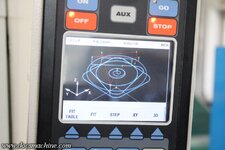
22trak-098.jpg

I don't know yet how to- or even if I can- rotate the image for a better look at certain angles, and note it shows the path of the centerline of the tool, NOT the path of the profile of the tool. I have not tried any of those other options shown at the bottom yet, so maybe it will. I'm still learnin'.

Doc.
 
To avoid these ads, REGISTER NOW!

dutchgray

Well-known member
Joined
Sep 28, 2014
Messages
6,462
Location
Dorset. England.
Don't you just love cheap import tooling that isn't made to the correct specs.

I see Vertex offers a Noga arm clone, don't know if it would be any good but their stuff is usually ok.

Noga stuff can be hard to get in the UK, a few industrial suppliers sell it at very high cost, but there is very little available on ebay or Amazon.
I actually bought my Noga arm from Amazon.com as it was way cheaper to ship it from the US and pay the taxes than buying it here, but last time I looked that option seemed to have gone, it was Shars who supplied it on Amazon I recal.

I was looking at the inside hand countersink deburing tool they sell and they are about £50 here.
 

tool_scrounge

Well-known member
Joined
Jul 20, 2010
Messages
4,170
Location
Southern California
I have given up on cheap import tooling and search around for low mileage quality stuff. This only works of course if you have the time and are not in desperate need of something specific now. A friend just picked up a low cost spin indexer and a set of 5C collets. the collets did not fit. I loaned him a Hardinge 5C collet and that fit the spin indexer fine. He has been sanding the import collets down to fit…
 

slodat

ALLIANCE MEMBER
Joined
Feb 6, 2010
Messages
3,679
Location
Central-ish, WA
I've had good luck with Shars, TPAC Tools, and CME for budget priced import wares. Specifically, CAT40 ER tool holders. I bought a full set of Shars radius gages last week. They will absolutely do the job for what I need. The comparable Starrett setup would have been over $800. The Shars was about $150. There's some give and take with the import stuff. I don't buy import shell/face mills, insert mill tooling, etc.
 
OP
D

DocsMachine

Well-known member
Joined
Sep 16, 2006
Messages
1,848
Don't you just love cheap import tooling that isn't made to the correct specs.

-Well, in this case, for this specific use, to be honest it was ideal. :D Ten bucks for the holder, another $15 for the pull stud, and a few minutes' fettling, and I had a perfectly usable indicator holder. Which beats using a $150 collet holder and collet to do the same job.

On the cheap mag base, the 'arm' portion works pretty well, though it's definitely not as smooth as the Noga. The magnet, however, is probably less than half the strength. It's damn near refrigerator-magnet strength.

It'll do fine for times the arm can sit flat on a 'tabletop'- the top of a mill vise, the top of the lathe carriage, etc. But if you have to stick it to the side of the mill column or other "off axis" work, I wouldn't trust the holding power.

The indicator's not bad, especially if you're just surveying- like dialing in a 4-jaw, or tramming a vise. That is, you don't care what the actual measurement is, just how much movement there is from one side of the part to the other.

But, it's really bad about changing direction. I used it to tram a mill vise last night, and just reversing to go back to the other end of the jaw, would move the needle over a thou, almost a thou and a half. Lots of side-to-side slop.

But hey, what do you expect for $26? :D

Noga stuff can be hard to get in the UK, a few industrial suppliers sell it at very high cost[...]

-Yeah it wasn't easy to find what I wanted even here, and no matter who sells it, they aren't cheap.

However, I've been dealing with handfuls of mismatched bases, bars and indicators for years- I figured if I'm gonna have a decent CNC capable of holding half-thou or better tolerances in the shop, I might as well get good support tooling to go with it.

I have given up on cheap import tooling and search around for low mileage quality stuff.

-Ditto, to an extent.

There were a lot of import- and often the low end of import at that- tools I had to use just to get off the ground at the beginning, because no matter how bad it was, it was better than no tool at all. (Like those cheap triangular-insert lathe tool kits. Absolute junk, but they got me out of some scrapes, and with care, could do good work.)

But over the years I've been sneaking back toward the better tooling, as I can afford it- or as I find a good deal on something used.

The "good stuff" is worth every penny... but you gotta have those pennies in the first place. :)

Doc.
 

tool_scrounge

Well-known member
Joined
Jul 20, 2010
Messages
4,170
Location
Southern California
But over the years I've been sneaking back toward the better tooling, as I can afford it- or as I find a good deal on something used.

The "good stuff" is worth every penny... but you gotta have those pennies in the first place. :)

Doc.
I was fortunate my folks were into tools and my Mom went to every garage sale in a pretty big radius in So Cal. So I started buy tools at a really young age (5?). I started buying machines around 12 as I knew I would be leaving home at some point and I had money from working for myself. Reasonable quality US made stuff was plentiful and relatively inexpensive at that window in time, so that is what I picked up. Still
Took a long time to get a critical mass of stuff. So if you need it now, not the best route unless you can get a deal for use stuff on eBay.
 
Last edited:

dutchgray

Well-known member
Joined
Sep 28, 2014
Messages
6,462
Location
Dorset. England.
On another hand I am currently trying to sell a lot of 25 used BT40 tool holders, mostly ER collet holders, mostly of German manufacture and even at £50 on Ebay there has been no takers, admittedly some are a bit rough and probably should be scrapped, I guess there isn't much of a hobby market for BT40.

I may end up scrapping them.

Friday last my scrap guy came round with a brace of 150mm Samchully 3 jaw power chucks, brand new never used pulled from new lathes. I didn't buy them as unfortunately it was heavily raining Friday and the scrap guy had done nothing to keep them dry while transporting them in an open plastic box, they were already going rusty.
 
OP
D

DocsMachine

Well-known member
Joined
Sep 16, 2006
Messages
1,848
I was fortunate my folks were into tools and my Mom went to every garage sale in a pretty big radius in So Cal.

-Heh. Trying to buy tools in SoCal is cheating- the worst you have to deal with is somebody getting there ahead of you. :)

Machines and tooling basically never come up for sale up here. First few years I was in business, it was an ENCO or Smithy catalog, or nothin'. eBay didn't usually have machinist stuff, nobody sold anything as large as a whole lathe, of course Craigslist didn't exist...

Every now and then somebody would have "machinist stuff" in the classifieds, or even the early CL, but it'd turn out to be a fistful of rusty drill bits, some ground-to-a-nub HSS lathe bits, an old 0-1 mic that looks like it'd been used as a C-clamp, two taps and one die- for something like 12-24.

On another hand I am currently trying to sell a lot of 25 used BT40 tool holders, mostly ER collet holders, mostly of German manufacture and even at £50 on Ebay there has been no takers, admittedly some are a bit rough and probably should be scrapped, I guess there isn't much of a hobby market for BT40.

-Well, from what I've seen, most people with a decent VMC, are actually kind of leery about buying used toolholders. Generally speaking, toolholders tend to last the life of the machine, or very close to it, so other machine owners tend to think the only reason the holders are being sold is they're worn out of spec. Especially if they're cheap.

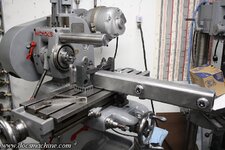
I know I was 'burned' enough times buying used NMTB40 holders for my Nichols horizontal mill, that I'm pretty leery myself.

Doc.
 

dutchgray

Well-known member
Joined
Sep 28, 2014
Messages
6,462
Location
Dorset. England.
I realise my market for the used tool holders is the one hobby guy who bought an old tired CNC mill for scrap money and it came with no tooling, but they just won't sell, I will probably save the ER collet nuts and scrap them eventually.
With used tooling I much prefer to get it from a going out of business machine/ job shop, as its usually still good, but you have to be where machine shops are and nowadays if its an auction they are all online so pricing is high.
 
OP
D

DocsMachine

Well-known member
Joined
Sep 16, 2006
Messages
1,848
New Video! This one shows- sort of- the process I went through to develop a repalcement part for an old paintball gun- the brass thing seen in the previous video.


I was hoping for a little better detail, but I'm still very new at this. Lemme know what 'cha think.

Doc.
 
OP
D

DocsMachine

Well-known member
Joined
Sep 16, 2006
Messages
1,848
Finally, after waiting an entire week :D Part Five... and a half! ... is up!

[VIDEO]

Sat down and finished up the kit I set aside for myself, raided my parts bins for some goodies, got 'er assembled and timed.... and then Ma Nature dumped another foot- and counting- of snow on us.

Stand by, hopefully I can have a proper shooting video this coming week.

veetwin173.jpg

Doc.
 
OP
D

DocsMachine

Well-known member
Joined
Sep 16, 2006
Messages
1,848
I made almost everything you see there, save for the grip frame and the regulators. (The vertical doodad with the red "CP" sticker.)

Doc.
 
To avoid these ads, REGISTER NOW!
OP
D

DocsMachine

Well-known member
Joined
Sep 16, 2006
Messages
1,848
Yup, Doc is indeed a dull boy. Spend most of Christmas Day in the shop. :)

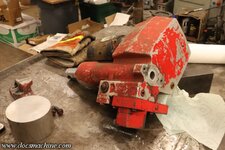
This is a self-contained hydraulic pump and ram, commonly used on older Western snowplows. The kind you'll see on small trucks.

plow1.jpg

It's an older model, and uses a bolt-on mounting eye that goes on that unpainted flange-looking area on the right. The eye itself is a cast aluminum piece, seen at the far left, and if you abuse the truck and plow, doesn't last long.

And, being an older unit, Western stopped supporting this model a while back, and replacement eyes are no longer available. My client, in this case, has three of them on different vehicles, all of which were in pretty sad shape anyway, but this last big blast of snow finished them off.

So, as they're not available anymore, and having one made will undoubtedly be a lot cheaper than replacing the entire plow ($4K to $6K, depending) it fell into my lap.

I told the guy that it's only held on by two 5/16" bolts- which is enough since they're in compression. The bolts just hold the eye on, the body of both parts takes the pressure. If the eye stops failing, the next thing to go will be the bolts. He agrees, and says he's looking into tweaking the mountings so that they're not under whatever forces caused the old ones to break.

So I picked up some thick coins of aluminum, earlier this week...

plow2.jpg

And started designing. The steel one was the clients attempt at a homebrew repair- it fits and works, but that middle hole of the flange is open to hydraulic pressure in the system. The factory piece has an O-ring boss, but the guy had tried using a hand-cut gasket and RTV- which didn't work.

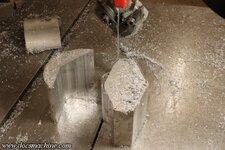
My recently-re-illuminated bandsaw made short work of chopping the block down to size....

plow3.jpg

Then a bunch of other milling, drilling, belt-grindering, more milling, more bandsawing and occasionally filing...

plow4.jpg

Got us something that kind of looks like a shiny new mounting eye.

plow5.jpg

And mounted.

plow6.jpg

Yes, I fitted the O-ring too.

Now waiting for the client to come and get it, fit it to one of the good pumps (this one's a parts unit) and test-fit it. It should fit, and as noted, he's supposed to be tweaking the mounting a little, so hopefully it'll last. If it fits, I also need to make three more.

Doc.
 
OP
D

DocsMachine

Well-known member
Joined
Sep 16, 2006
Messages
1,848
For Christmas this year, my present to myself was a "small wheel" attachment to my 2x72" belt grinder.

smallwheel1.jpg

The knifemakers use these to help form fingergrooves and other small details on knife handles. I've always wanted one of these, but usually had to make do with Dremels, a cheap spindle sander, or just plain files. I have a couple upcoming projects where something like this would make that sort of thing easier and quicker, so I splurged. smile.png1672699854671.gif

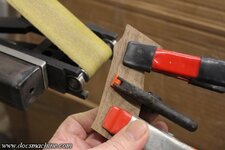
And, to try it out, I had a couple of rough-sawed walnut panels I'd cut to fit a paintball gun frame. I threw on a semi-fine belt, and spent a few minutes dressing those down to size.

smallwheel2.jpg

smallwheel3.jpg

Not by any stretch my best work. As with any tool, there's a pretty solid learning curve here, plus a need for patience. The belt grinder can take off a LOT of material in a big hurry, so one has to learn to take it slow.

smallwheel4.jpg

The slab of walnut I chose started out a little too thick, and it's tough to just grind these thin. Plus I kept scorching the wood- the wheel kit came with instructions to carefully watch the belt speed so you don't burn up the tiny bearings (and they do get hot!) but even slowed down to 60% (on the dial, anyway) if I pressed too hard I'd get dark scorch marks.

This set didn't come out too bad, but I want to start over with one of the thinner slabs I have. Take a little more time to fit and profile them better.

Doc.
 
OP
D

DocsMachine

Well-known member
Joined
Sep 16, 2006
Messages
1,848
The biggest and best yet! The full restoration of about the closest thing paintball has to an antique marker. :D


Made in limited numbers back in '86 and '87, and rare enough most players have never even heard of them, let alone played with one. I bought a couple of them, disassembled and missing some important pieces, back in '99, and they've been in storage ever since. After finding a third on eBay, I decided it was time to dust 'em off and finally get put 'em back together.

Let me know what you think!

Doc.
 
OP
D

DocsMachine

Well-known member
Joined
Sep 16, 2006
Messages
1,848
For those that haven't been following my work the last few years, I have an older Logan lathe, that I converted over to CNC using the Centroid Acorn controller. It's proven handy, even after I picked up an Omniturn CNC lathe, but one (of several) limitations is it can only use a single tool.

The cross slide I made is not well suited for gang tooling (the tool plate to spindle center is relatively high, and will probably put a lot of strain on the dovetail ways) and for some jobs that require multiple tools, it's of course time consuming to keep swapping quickchange toolpost blocks.

That's where this comes in:

enco001.jpg

That's the adorably tiny six-tool automatic turret off an Emco Compact 5 CNC lathe. I happened to spot it on eBay just after it got listed, and while the price was a lot higher than I'd have liked to pay, with a little juggling of finances I decided to get it.

Should be easy to adapt to the Logan slide...

enco003.jpg


Though I'll likely have to fab a taller block to get the center heights right. And I found a how-to from another Centroid Acorn user, about adapting this exact style of turret to an Acorn-converted lathe. It's not quite a bolt-on, there's some trickery with the motor controls, but the fellow says it's functional and reliable.

enco002.jpg

On the motor, I was kind of surprised- I was expecting a stepper of some kind, but this is just a straight-up 12VDC motor. It just runs for X seconds to index the turret past the ratchet stop, then reverses for Y amount of time to seat the turret on said stop. The guy with the conversion has a sort of timed power supply, and added a Hall effect sensor so the controller can spin the rotor and find out where "tool #1" is. And can thus make tool selections after that.

It's not overly fast, I assume it's a worm drive inside, but still, being able to automatically change tools, speeds up a complex job by quite a bit.

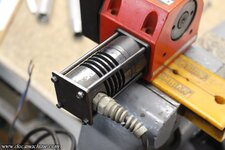
One other bit of oddity is the way the tools are retained:

enco004.jpg

A pretty normal pair of setscrews retains a typical 3/8" or 1/2" tool... except the screws come in from underneath.

That's kind of a requirement for the way the turret is laid out, but still seems a but odd- because then the tips of the setscrews take all the cutting pressure.

Now, the Compact 5 was, in effect, a training machine, not a proper production lathe. It's meant for light duty, nonferrous, etc. so the arrangement probably wasn't seen as an issue. And I'm not sure there's any real way I could change it, even by making an all-new turret plate.

The direction of the cutting force has to be counterclockwise, as we're looking at it here, because that's the direction the ratchet stop holds it. (You don't want the worm and gear holding against cutting forces.)

Stand by, I need to collect some parts.

Doc.
 
OP
D

DocsMachine

Well-known member
Joined
Sep 16, 2006
Messages
1,848
That's loosely based off a Rockwell variable-speed floor model I had a number of years ago.

It was a nice drill, but the absolute slowest spindle speed was like 400 RPM, and for some reason it had no rack and gear to raise and lower the table. Loosen the clamp, and if you weren't holding it, it'd crash to the floor.

The spindle was too fast for anything but wood, or smaller drills in any metals. I'm given to understand those models optionally had an 1125 RPM motor rather than a 1725, which would have cut that spindle speed down to about 260-ish, but at the time I simply didn't use it enough.

I sold that off, and eventually bought an Arboga 8-speed gear head, with a slowest speed of something like 60 RPM, plus the VFD I put on the motor. That's a LOT more useful, and even moreso with the factory X/Y mill-style table.

Doc.
 

tool_scrounge

Well-known member
Joined
Jul 20, 2010
Messages
4,170
Location
Southern California
Thanks for the info, I also have one of the 17” Delta variable speed drill presses. I found the Reeves drive squeal just as annoying as the ~380 rpm minimum speed. I finally converted it to the factory step pulley configuration with a large industrial Leeson DC motor. The lower + variable speed is nice, but it is not quite in the same class as a Arboga.
 

jarhead

Well-known member
Joined
Jul 9, 2006
Messages
704
Location
Colorado, near Morrison
Finally managed to produce a somewhat decent (for a neophyte :D ) shop video, and thought I'd start a thread here, both for it and hopefully for more in the future.

For those that don't know me- which is all but, like, two of you :D - I'm "Doc", I'm a professional machinist that just happens to specialize in paintball guns, believe it or not. Been around for a while, posted a time or two, but not exactly a leading member.

The video in question is the start of a short series where I build, from scratch, a body kit to make a double-barreled paintball gun, which I call the Vee-Twin.


There's a few other videos in there you gets might like, though I'm just getting started, and let's face it, the quality of most of them isn't gonna win any awards. :)

Lemme know what'cha think!

Doc.
I am enjoying this
Where did you get that shell mill you are using on the Grizzly? Are the inserts a decent price?

I have a G9902 mill and a G0750G lathe

Thanks, Joe
 

Monza Harry

Well-known member
Joined
Dec 29, 2018
Messages
1,433
Location
Windsor ON
Doc for your new tool-holder/quick-change tool post, I see enough room [from a photo guesstimate] to remove the set screws [or use them as an interlock(?)] and mill the the top to accept a tapered gibb, then a single screw on the end will clamp the tool bit. Did I read the photos correctly? Harry
 
OP
D

DocsMachine

Well-known member
Joined
Sep 16, 2006
Messages
1,848
The lower + variable speed is nice, but it is not quite in the same class as a Arboga.

-The Rockwell was a commodity drill, not much better than a home shop piece. An Arboga is an industrial drill, meant for a shop that intends to work it.

Mine had been crashed- as in tipped over and crashed. The guy had bought it along with a bunch of other stuff he wanted, at an auction, and it was simply included. He didn't want to junk it, but also didn't have the time to fix it. I was more than happy to sink a little time into it- I got a $2,500 (used!) drill for about $500 all told.

Where did you get that shell mill you are using on the Grizzly? Are the inserts a decent price?

-That's a Glacern integral-R8-shank FM45 facemill. I'm using the sharp aluminum inserts, and while they're not cheap- $180 for a 10 pack- I've used the bejeebers out of that mill, and I'm still on the first corner of the first set.

Doc for your new tool-holder/quick-change tool post, I see enough room [from a photo guesstimate] to remove the set screws [or use them as an interlock(?)] and mill the the top to accept a tapered gibb, then a single screw on the end will clamp the tool bit.

-Yeah, a fellow over on HSM showed a 3D printed test piece he'd made, that worked about like that. And that's certainly an option.

Realistically, it's going to be a bit of a trick just getting this thing connected up to the controller- I need external reversing replays, timers, and two separate power supplies, besides whatever it'll take to directly interface with the Centroid. Plus I'll have to fab up some sort of position sensor, so the control knows where #1 is.

For the time being I'll run it as-is, and just shim the tools as necessary to get them on center. (Now that I think about it, I'll have to see where the round-shank "on center" is compared with the square shank slots.)

I can always get tricky either making a new turret rotor or modding the old one, once it's mounted and wired.

Doc.
 

slodat

ALLIANCE MEMBER
Joined
Feb 6, 2010
Messages
3,679
Location
Central-ish, WA
-That's a Glacern integral-R8-shank FM45 facemill. I'm using the sharp aluminum inserts, and while they're not cheap- $180 for a 10 pack- I've used the bejeebers out of that mill, and I'm still on the first corner of the first set.
These inserts can be had on ebay from Chinese sellers for $1/ea or so. I have purchased several hundred inserts from China. Whether or not they are worth a **** is beyond my level of inspection. They have worked great for me in shell mills from Maritool and Mitsubishi.
 
OP
D

DocsMachine

Well-known member
Joined
Sep 16, 2006
Messages
1,848
And it's been my experience that the cheap inserts aren't worth the cost.

I have, for example, some DGMT (as I recall) inserts, sharp honed, bought from a Chinese seller for maybe $2 each. I've burned up most of a box of those so far, in less time than I've run just one corner of those Glacern inserts.

Moving from HSS to carbide inserts was a big step up, and almost as big was moving from cheap knockoff inserts to good name brand. I'm still burning my way through a handful of the cheapies, but as I run out, I've been replacing them with name brands like Kyocera.

I know they're expensive, but I make my living with these machines. Good inserts last longer (often a LOT longer) and give me a better finish.

Doc.
 

dutchgray

Well-known member
Joined
Sep 28, 2014
Messages
6,462
Location
Dorset. England.
A hobby machinist can get away with cheap inserts, being either Chinese or name brand but sourced on the secondary market usually ebay (there are loads of sellers with a few boxes of good inserts but it's usually a one time deal, so you end up lacking consistency, with Chinese I will buy from UK resellers who put their name on, you will pay double what the cheapest direct from China inserts cost but those in my experience have been total rubbish)
When it's your business, you just buy them from you chosen industrial supplier and get the grade that's best for your application, spending time looking for a deal on ebay is not cost effective in that situation.
I'm sure there are "fake" branded inserts on Ebay as well.
 
OP
D

DocsMachine

Well-known member
Joined
Sep 16, 2006
Messages
1,848
If anyone's interested, I now have a video channel over on Utreon, in addition to the YouTube channel.

At the moment it's just a copy of the YT stuff, but I plan to utilize some of Utreon's subscription-only features before too long.

Doc.
 
Last edited:
OP
D

DocsMachine

Well-known member
Joined
Sep 16, 2006
Messages
1,848
This one's a client project from last year, but I suspect you lads and ladies might get a kick out of it. :)

Had a fellow putting together a hot-rod shop, mainly for himself. He wanted an English Wheel, and considering the costs of good ones, shipping to Alaska, and the fact he wanted some features not commonly found on commercial products, he decided to build his own. He did most of the welding and fab, I did the machine work and a small bit of the designwork.

One of the things he wanted was a wheel set that could be turned 90 degrees- so that the sheetmetal could be worked left-to-right or in-and-out. So he made the upper wheel saddle and a mount that would eventually be welded to the frame, and I milled it true and square, so that it'd sit securely on any one of the four sides.

Ewheel01.jpg

The face to which the saddle (yoke?) indexes, is replaceable so that it can adjust for wear, if necessary.

I then centered, located and drilled the axle hole, so that no matter which way the yoke is turned, the wheel remains centered.

Ewheel02.jpg

For aesthetics- the client wanted a good-looking machine, too- I then milled the nose of the yoke round, true to the axle bore.

Ewheel03.jpg

The yoke is clamped to the mount with a chunk of 1" allthread, and to make it hand-adjustable, I made a large handwheel nut for it.

Ewheel04.jpg

Ewheel05.jpg

The original plan was to just have a plain axle for the upper wheel, so I made an axle for it, and milled an aluminum knob, again so it could be moved or loosened by hand.

Ewheel06.jpg

That's 100% manual, by the way. No CNC. :)

Ewheel07.jpg

And so here's what it looked like, ready to weld to the overall frame.

Ewheel08.jpg

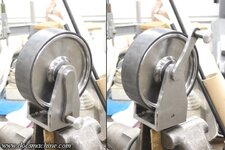
But, he revised the plan shortly after that. The original idea was to have the lower wheel on a cam, as a "quick release" to get the part out, but he found a better idea online. So I bored the yoke out again...

Ewheel09.jpg

Fabbed up a couple of eccentric bushings, a handle and a spring-loaded locking pin...

Ewheel10.jpg

And we had a quick-release lever that would move the wheel about 3/16" or so, allowing the operator to slide the worked piece in and out without applying extra wheeling, or to slide in a piece and wheel just the middle area of the panel.

Ewheel11.jpg

More pics coming...

Doc.
 
OP
D

DocsMachine

Well-known member
Joined
Sep 16, 2006
Messages
1,848
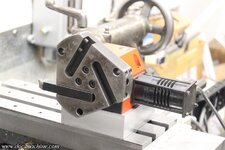
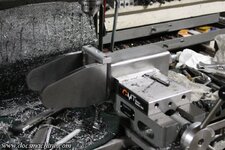
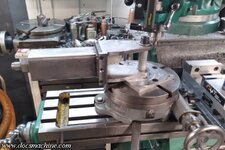
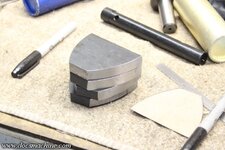
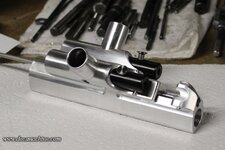
The client had two sets of lower wheels, and wanted the option to use either one. Both sets used different bearings, and that meant different axles, so I made two lower saddles. And, of course, rather than just cutting straight-sided triangles, I set up the rotary table again and gave them a bit of flair.

Ewheel12.jpg

Ewheel13.jpg

These saddles got bolted together rather than welded, and the mounting bolts got slotted a bit so that they could be positioned exactly under the upper wheel, as needed.

Ewheel14.jpg

Et voilá! (Which I'm pretty sure is French for "Check that sh*t out!" :) )

Ewheel15.jpg

Each axle has flats on the ends so they seat into the saddles, and the axles can't rotate or walk out. But they can just be lifted right up, and the wheel replaced with a different radius as needed.

The lower mount was a bit tricky. He first brought it to me "full length", as he wasn't sure where it was going to need to be cut off. That meant I needed a right-angle iron, a spare milling vise, and a bit of a tweak to the head of my mill, in order to drill and tap the mounting holes.

Ewheel16.jpg

Later, after it'd been cut to length, and the slop adjusters made, I had to adjust the mounting a little to true things up to the column. The horizontal mill makes that sort of thing easy:

Ewheel17.jpg

And finally, he needed a beefy "kick wheel" to adjust the wheel tension. He'd bought some rolled ACME allthread and some nuts, so we fabbed up the inner adjuster bits, and for the wheel itself, I turned a thick coin of mild, welded one of the ACME nuts in, and then bored the OD for some beefy bars.

Ewheel18.jpg

I wasn't able to press-fit these due to space limitations in my press, so I cross-drilled holes through those bores, and TIG welded the rods into the hub.

Ewheel19.jpg

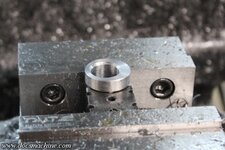
Now, the plan was to have the wheel removable, in case something gets bent or damaged, or the screw wears out, etc. So we didn't want to just weld the wheel to the screw. So for that, I milled up this little "dog bone" key- again, that's 100% manual, no CNC. :)

Ewheel20.jpg

A recess was milled into the wheel and screw, and the key bridges that to lock the two together.

Ewheel21.jpg

Two countersunk screws hold the key in place, and the center threaded hole is in case the key ever needs to be extracted.

Ewheel22.jpg

To add suspenders to that belt, I took the other extra ACME nut and added a bolt boss. Once slit, I had a "locking" nut, so that with it tightened down to the top of the wheel, added just that much more strength and rigidity to the assembly.

Ewheel23.jpg

And here she is all finished and in use!

Ewheel24.jpg

Ewheel25.jpg

I'm told it works great, and the client is very happy with it. (It's hard to tell, but that's a '55, I think, Ford truck, with a Coyote, T56 and 8.8 on bags back there. :) )

Let me know what you think!

Doc.
 
To avoid these ads, REGISTER NOW!
Top Bottom