OP
DocsMachine
Well-known member
- Joined
- Sep 16, 2006
- Messages
- 1,916
Okay, I got the new pull stud in for the cheap toolholder, and guess what? It didn't fit either. That made me think the threads aren't tapped deep enough, and so what likely happened was the seller found that and plunked it back in eBay, cheap just to get rid of it.
Generally you don't want to be modifying toolholders- they're under a great deal of force, and for higher spindle speeds, balance can very much be an issue.
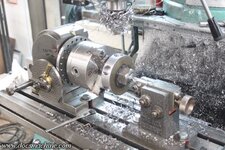
So, since this stud- a cheap one- was coolant-thru, I could support it in the chuck with the tailstock, and so in this case, it was fairly easy to turn about a third of the threads off.

Except that wasn't the problem.
The problem was that straight section just above the threads- the collar below the flange. That is supposed to seat fairly snugly into the threaded portion to help keep everything straight and true. This was what caught the original pullstud, and was even worse on this one.
Good thing I'm so analytical and observant, eh?
Anyway, it was close, so I just decided to tighten it into place. Probably only a thou of interference, maybe less than that, and the stud isn't has hard as it probably should be.
But that revealed a second problem- the drive flange notches were too small.

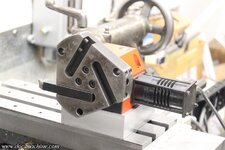
It wouldn't fit on my tightening fixture, and measuring, the slots were 20 thou smaller than a known-good one.
No wonder it was so cheap.
But, again, this is just an indicator holder, and will never be spun (I hope) and will never see cutting forces, so I didn't care. The body was pretty hard, and I didn't have a good carbide cutter I wanted to throw at it, so I just relieved one side of each ear with a Dremel. (Cue shocked gasps from the audience.)

That let it seat quite nicely.

Toying with the idea of hitting it with a thin wash of Prussian Blue to see how the taper seats, but even that's not all that important here.
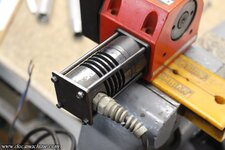
Finally, I chucked the whole mess up in the lathe, and turned about 1/4" off the end- that chamfered section. That shortened up the whole assembly a little. I then turned a thick brass disc, since the shank of the indicator didn't have a Weldon flat and I didn't want the setscrew to mar it, shortened the setscrew appropriately (I didn't have a supply of metric setscrews to swap in) and that does it- one complete Haimer 3D Taster assembly with BT-30 taper.

I had also gotten in a shiny new, compact-size actual Noga indicator arm, and a slightly used Girod .0005" indicator, so I got those set up and indicated in the... er, indicator.

This time I got it within a half thou- trying to get it any closer was really fiddly. But, she's ready to go, as soon as I need the durn thing.
And speaking of indicators, while I was looking around eBay for a decent deal on a Noga and a name-brand indicator, the "also recommended" section offered me a no-name Asian import Noga clone arm, with half-thou indicator... for $26.

That magnet is not as strong, the arm is not as smooth, and I have not closely assayed the indicator, but it works and the action is smooth, so just as a backup, or to use on less-critical projects, that was probably $26 well spent.
But, with the good ones, I now have an indicator I can keep with the mill- I'd been needing more anyway, so I don't have to keep moving the same one between all these machines.
Finally, I played about with the machine a bit more, and tried a couple things, but nope, it still won't do what I need it to- or perhaps more correctly, I'm not doing what IT needs me to.
One thing I did discover, was that there's a "visualizer", that will show you the toolpath:
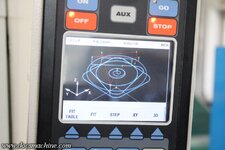
I don't know yet how to- or even if I can- rotate the image for a better look at certain angles, and note it shows the path of the centerline of the tool, NOT the path of the profile of the tool. I have not tried any of those other options shown at the bottom yet, so maybe it will. I'm still learnin'.
Doc.
Generally you don't want to be modifying toolholders- they're under a great deal of force, and for higher spindle speeds, balance can very much be an issue.
So, since this stud- a cheap one- was coolant-thru, I could support it in the chuck with the tailstock, and so in this case, it was fairly easy to turn about a third of the threads off.
Except that wasn't the problem.
The problem was that straight section just above the threads- the collar below the flange. That is supposed to seat fairly snugly into the threaded portion to help keep everything straight and true. This was what caught the original pullstud, and was even worse on this one.
Good thing I'm so analytical and observant, eh?
Anyway, it was close, so I just decided to tighten it into place. Probably only a thou of interference, maybe less than that, and the stud isn't has hard as it probably should be.
But that revealed a second problem- the drive flange notches were too small.
It wouldn't fit on my tightening fixture, and measuring, the slots were 20 thou smaller than a known-good one.
No wonder it was so cheap.
But, again, this is just an indicator holder, and will never be spun (I hope) and will never see cutting forces, so I didn't care. The body was pretty hard, and I didn't have a good carbide cutter I wanted to throw at it, so I just relieved one side of each ear with a Dremel. (Cue shocked gasps from the audience.)
That let it seat quite nicely.
Toying with the idea of hitting it with a thin wash of Prussian Blue to see how the taper seats, but even that's not all that important here.
Finally, I chucked the whole mess up in the lathe, and turned about 1/4" off the end- that chamfered section. That shortened up the whole assembly a little. I then turned a thick brass disc, since the shank of the indicator didn't have a Weldon flat and I didn't want the setscrew to mar it, shortened the setscrew appropriately (I didn't have a supply of metric setscrews to swap in) and that does it- one complete Haimer 3D Taster assembly with BT-30 taper.
I had also gotten in a shiny new, compact-size actual Noga indicator arm, and a slightly used Girod .0005" indicator, so I got those set up and indicated in the... er, indicator.
This time I got it within a half thou- trying to get it any closer was really fiddly. But, she's ready to go, as soon as I need the durn thing.
And speaking of indicators, while I was looking around eBay for a decent deal on a Noga and a name-brand indicator, the "also recommended" section offered me a no-name Asian import Noga clone arm, with half-thou indicator... for $26.
That magnet is not as strong, the arm is not as smooth, and I have not closely assayed the indicator, but it works and the action is smooth, so just as a backup, or to use on less-critical projects, that was probably $26 well spent.
But, with the good ones, I now have an indicator I can keep with the mill- I'd been needing more anyway, so I don't have to keep moving the same one between all these machines.
Finally, I played about with the machine a bit more, and tried a couple things, but nope, it still won't do what I need it to- or perhaps more correctly, I'm not doing what IT needs me to.
One thing I did discover, was that there's a "visualizer", that will show you the toolpath:
I don't know yet how to- or even if I can- rotate the image for a better look at certain angles, and note it shows the path of the centerline of the tool, NOT the path of the profile of the tool. I have not tried any of those other options shown at the bottom yet, so maybe it will. I'm still learnin'.
Doc.