To avoid these ads, REGISTER NOW!

Intermixing Metric and SAE Sizes in Tool Storage

eyeball

Well-known member
Joined
Jul 14, 2011
Messages
407
Even if you are unfamiliar with the standard used on your project it only takes one trip to the tool box to figure it out.

If you are not familiar with the standard, you are most likely (like me) a home hobbiest that is just tinkering in the garage. In that case is the possible time savings of mixing the tools worthwhile?

If the point is to have similar sized sockets on the same rail regardless of standard, how much time would you spend at cleanup time trying to remember if 3/8 comes before 10mm? What comes first? 11mm or 7/16?

Count me out...


Sent from my iPad using Tapatalk
 
To avoid these ads, REGISTER NOW!

DadsTools

Well-known member
Joined
Jul 27, 2017
Messages
1,852
I believe this might be an issue of perspective. Say for example, you have no distinction in your thought processes between SAE and metric. All you see in your perspective approach is a series of wrenches in graduating sizes, and likewise a series of graduating fasteners with the simple task before you of matching one to the other. Within this limited context there is almost a child-like simplicity that I can appreciate. In such a system, not only would having two measuring systems be overly complicated, but even having size markings on the wrenches would be unnecessarily distracting.

Say you were in a post-apocalyptic world like in one of those movies, and you're an offspring of the survivors having no formal education. You're confronted with machines of all kinds you need to fix and have access to a shop fully equipped with all kinds of tools. Remember, you don't know the wrench markings from squat. From that perspective, you would most likely proceed exactly as the OP suggested. This child-like simplicity would indeed be the most efficient approach. So I think those who are overly critical of the OP's thought are lacking some imagination and insight.

HOWEVER: this is NOT the way we are taught to think about machines and their maintenance, either from a theoretical or a practical perspective. Envisioning geometry and dimension lies at the very heart of working on machines. And this kind of inner-envisioning extends far beyond simple mating of a fastener head with a specific size tool.

For example, let's say we need to replace a set of piston rings. Not only are we envisioning the location, attachment and dimensional wear on the rings relative to the cylinder wall, we are also envisioning these same elements with the new replacements. This is long before we actually get to see the cylinders and pistons with our own eyes. We're also going to need to envision the dimensions of the rings, clearances, boring the cylinders to a specification, etc. All of this requires thinking about exact sizes in precise measurements.

Another factor is the ability of a mechanic--whether a professional or a shade tree--to anticipate each step in the process. Not unless you want to re-invent the wheel every time you have a repair. Sizing systems are fundamental to this anticipatory thinking, and to the envisioning of the entire procedure prior to beginning. Even down to knowing what tools you'll need before the job starts to insure you have them on hand. Then you need a system to organize those tools so you can access what you need, when you need it. All this is fundamental to being a good repairman, whether amateur or professional--that is, if you aspire to more than just being a hack. Understanding SAE and metric is a fundamental part to this entire way of thinking.

If the OP is only concerned with hacking away at something, then why even bother with any kind of tool organization? Organizing tools is part of the above-described processes. Any organization is done according to a standard. If you ar5e going to make up your own unique and novel standard, why ask advice from anyone schooled in the established standard???? They will be no help to you in a one-man world of your own creation.

My advice? Learn how to do it right, for all the above reasons, wherein matching a fastener size with a specific tool is only a small fragment of the process. A kid who picks up a guitar and starts hacking away at it can get pretty good at it, but when they begin to take professional lessons, the teacher needs to have them forget everything they know and start anew from scratch with the right way to hold your thumb, finger position, picking the strings, etc, because only with these correct techniques can one advance beyond a certain proficiency. Otherwise, you'll always be a hack. If that's your goal, then ask advice in forums populated by all other hacks. That's not the Garage Journal. Try Flea Market Flip or something like that.

Learn how to do it right. What's "right" is right for a reason.
 

Coach James

Well-known member
Joined
Jun 24, 2005
Messages
8,933
Location
Sandhills of North Carolina
I keep my SAE and metric separate now, but I did mix them once. The result was almost a disaster as the tools were getting ready to fight.

The SAE tools were from the hood and had pulled their guns. On the other hand, the metric tools all had good kung fu. It seems my metric tools all came from the same village in China where they were taught kung fu by "Teacher" before he was murdered by the village gangster.

Thankfully, I was able to get them into different drawers before there was any bloodshed.

Coach
 

crasher98

ALLIANCE MEMBER
Joined
Jan 29, 2013
Messages
215
Location
NW LA
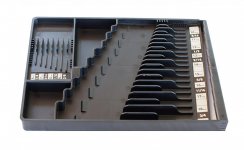
This thread reminds me of this wrench organizer - I'm sure it works for some people, but it always struck me as an incitement to commit an unnatural act:

https://www.garagejournal.com/forum/attachment.php?attachmentid=737974&stc=1&d=1518921511

That said...

I have a 1998 Jeep Wrangler that I THINK is supposed to be all metric, but sometimes I wonder; that was back in the Daimler-Chrysler days, which by all accounts was not a happy relationship so who knows - maybe 'passenger side metric, driver side SAE' was either part part of the problem or part of the divorce. And it's not just me -- once on a jeep forum a kid wrote about his TJ, "I swear to god, sometimes it seems like my jeep is half metric, half standard, and half Martian!" That made me laugh because I knew exactly what he was talking about, except I would add that the fouth half is frickin torx bolts. I hate those things.

Then add in that my jeep was a DD in the chicago area for about 10 years, and the idea that fasteners come in certain "sizes" gets a little hypothetical -- especially on the undercarriage I bring both sets of sockets/wrenches out and try them all until something seems to fit.
 

Attachments

  • tool sorter wrench organizer.jpg
    tool sorter wrench organizer.jpg
    110.1 KB · Views: 67
OP
O

oldschoolcraft

Well-known member
Joined
Dec 31, 2017
Messages
1,829
Location
Bay Area, California
Thanks for all the replies so far. I appreciate the professionals taking time out of their day to respond to an amateur.

The one point I am still having trouble on is that most of the things I take apart, I don't know if it's metric or standard before I start. It's not like I'm work in a garage where a Honda comes in and I know it's metric.

I'm taking apart an old lawnmower, or an old office chair, old house light, old garage door parts. I don't think it's reasonable for anyone to possibly know if these things were assembled with metric or standard by looking at them. Brand names are worn off. Over time, brands change country of manufacture and even if I saw the brand, I wouldn't know what year it was made -- did X company outsource to China yet in this year and switch to Metric?

In my mind, if I worked primarily on stuff where I absolutely knew by looking at it, whether it would be metric or standard (Honda rolled in), then of course, 100%, have them separate. No need to mix in standard tools and slow you down.

But if you're like me and work primarily on stuff where I have no clue, it seems to make sense that intermixing lets me get to the right size faster. Rather than try 4 different hex keys in standard before realizing none are a great fit and switching to metric, I could have found the right one faster if they were mixed. There's also confusion because the chair I took apart wasn't super high quality, so maybe I had found the right size hex key on the standard set, but the fastener was out of spec. Either way, I had to switch to my metric hex keys and try 3 or 4 of them there before I found the right one.

There's a lot of comments about learning to be better with trade skills. Please correct my ignorance, but I can only assume that means to become a better predictor over whether the item was made in metric or standard. The office chair I took apart was probably made in China so in retrospect, I should have tried metric first. Perhaps over time I'll get better at guessing.

I'm here to learn from the pros and even though I know I come across nuts, I appreciate constructive feedback on my idea.
 

Aaron_W

Well-known member
Joined
Feb 6, 2018
Messages
2,938
Location
Northern California
I'm also an amateur tinkerer.

Personally I keep them separate, because I will quickly figure out if I am going to be dealing with metric or SAE. Sure the first nut or bolt I might be guessing, but after that I'm most likely only dealing with one or the other.

They are in the same box, so it literally just takes a second from SAE to metric when I play the 3/8 too small, 7/16 to big, 11mm BINGO!!!! game. From that point on I will only futz with that system unless I find that some odd ball used another type of fastener. On an older item it is entirely possible that someone made a repair using what they had on hand and it doesn't match.


That is just my preference, I really don't think it is a dumb idea if it works for you. It might even stop others from asking to borrow your tools. :evil:
 

PFSard

Well-known member
Joined
Sep 12, 2013
Messages
2,423
Location
Mesa, AZ
I'm taking apart an old lawnmower, or an old office chair, old house light, old garage door parts. I don't think it's reasonable for anyone to possibly know if these things were assembled with metric or standard by looking at them. ..... Perhaps over time I'll get better at guessing.

I wouldn't mix together.

Grab a couple Standard and a couple Metric wrenches that would seem to be best fit. Hopefully, the hardware on each device is not mixed metric and standard, as was the case on some autos I worked on (Mitsubishi comes to mind back in the 1980s).

And over time, you'll have a more trained eye (until you get old and your eyes start failing you LOL Like mine are now).
 

eyeball

Well-known member
Joined
Jul 14, 2011
Messages
407
I have a 1998 Jeep Wrangler that I THINK is supposed to be all metric, but sometimes I wonder; that was back in the Daimler-Chrysler days, which by all accounts was not a happy relationship so who knows - maybe 'passenger side metric, driver side SAE' was either part part of the problem or part of the divorce.


I have have a 1997 and feel your frustration. The drive train predates the Daimler days so it is SAE. The body is metric.


Sent from my iPad using Tapatalk
 

turnthewrench 2.0

Well-known member
Joined
Dec 23, 2017
Messages
518
Location
FL
I have have a 1997 and feel your frustration. The drive train predates the Daimler days so it is SAE. The body is metric.


Sent from my iPad using Tapatalk

I bought my SAE combos and flare nut wrenches because of my 95 Cherokee Sport. It had a mix of both.
 

crasher98

ALLIANCE MEMBER
Joined
Jan 29, 2013
Messages
215
Location
NW LA
I have have a 1997 and feel your frustration. The drive train predates the Daimler days so it is SAE. The body is metric.


Sent from my iPad using Tapatalk

I bought my SAE combos and flare nut wrenches because of my 95 Cherokee Sport. It had a mix of both.

Ha! Thanks, I didn't realize my jeep is actually "bi", but it's good to know I wasn't going either crazy or blind when I was trying to figure out those fasteners. I never came across that info on a jeep forum, altho presumably it's there somewhere. But usually you can get good advice on them, like "whenever you finally get a torx bolt out you should throw it as far as possible into a field".

And it's also good to know about the flare nut wrenches; I've never worked on the jeep's brake lines yet but I only have metric flare nut wrenches - might have more tools to buy!

Returning to the OP's original P: I'm not a professional mechanic, but here's my advice: you should arrange your tools however works best for you, and if anyone tries to give you **** about it tell them to eff off. And if you decide to keep all of your wrenches together, I even found you a nice organizer - here's the actual link: https://www.amazon.com/dp/B00H49FD8E/?tag=atomicindus08-20. And who knows - if you ever end up with a late 90s jeep, all the tools you'll need to work on it will be in one place, nicely organized!
 

turnthewrench 2.0

Well-known member
Joined
Dec 23, 2017
Messages
518
Location
FL
And it's also good to know about the flare nut wrenches; I've never worked on the jeep's brake lines yet but I only have metric flare nut wrenches - might have more tools to buy!

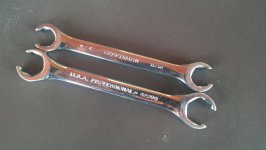
I had to replace the brake booster and pump. Rounded off a nut with a metric combo... Took a trip to Sears and bought the SAE flare nuts. That was back in 09 when they still had the USA Pro line. Ended up buying the combos as well.
 

Attachments

  • WP_20170826_13_59_32_Pro.jpg
    WP_20170826_13_59_32_Pro.jpg
    144 KB · Views: 22

PCMusicGuy

Well-known member
Joined
Feb 15, 2009
Messages
854
Location
Houston, TX
Seeing that double boxed end wrench made me think, is there any manufacturer out there that has done metric on one side and the closest SAE equivalent on the other? Ratcheting maybe? I suppose if no ones knows off hand I can look it up.
 

American Locomotive

Well-known member
Joined
Jan 8, 2017
Messages
11,014
Location
Rhode Island
Thanks for all the replies so far. I appreciate the professionals taking time out of their day to respond to an amateur.

The one point I am still having trouble on is that most of the things I take apart, I don't know if it's metric or standard before I start. It's not like I'm work in a garage where a Honda comes in and I know it's metric.

I'm taking apart an old lawnmower, or an old office chair, old house light, old garage door parts. I don't think it's reasonable for anyone to possibly know if these things were assembled with metric or standard by looking at them. Brand names are worn off. Over time, brands change country of manufacture and even if I saw the brand, I wouldn't know what year it was made -- did X company outsource to China yet in this year and switch to Metric?
Once again, you're making an issue out of a non-issue. How does mixing them make anything any faster? What if you grab the wrong 4 "mixed" wrenches? You'd then have to go back and try another 4 and hope you got it right.

You're better off just getting hex-key sets with holders - like from Bondhus, Wiha, PB Swiss, etc.. Just bring the whole collection of metric and SAE with you. I do it at work all the time. I just put the hex wrench holders right in my pockets.

Same thing with sockets - get rails of sockets and its not a big deal at all to carry your SAE rail and your metric rail out to wherever you're going.
 
Last edited:

thooks

Well-known member
Joined
Aug 3, 2011
Messages
3,333
Location
In Custody, Coweta County GA
Why is everyone trying to re invent the wheel lately?

Go use your tools, instead of trying to overthink stuff...

It's what they teach in college now. Make it your own. You have the better way.

But first, let's put it in a spreadsheet.


4-1/2 hours later, it's lunch time. Then forget what you were going to do today, so let's head to the craft beer brewery.
 

thooks

Well-known member
Joined
Aug 3, 2011
Messages
3,333
Location
In Custody, Coweta County GA
Here's a tip for the OP-

Most vehicles born after 2000 are all metric. Doesn't matter the make.

Most **** you buy at a retail store today has metric fasteners.

Old school stuff like spark plugs, some older lawnmower stuff, and stuff that is native to the US (stuff based on US manufacture from years ago) will most likely be SAE.
 

6PTsocket

Well-known member
Joined
Mar 12, 2014
Messages
4,593
I wish we'd have gotten away from metric sometime back when FDR was in office.

I keep SAE and metric separate though.
You think it is a good idea to be the only country in the world on SAE? It may be familiar but any impartial judge will admit it *****. With parts made all over the World it is a recipe for being left behind.

Sent from my SM-G900V using Tapatalk
 

6PTsocket

Well-known member
Joined
Mar 12, 2014
Messages
4,593
Posts about asking what is the best of the best of the best, name-dropping Knipex, Wiha, money is no object, then posts like this. lol, OK...

Dunno, the biggest downside to me would be using the wrong sized wrench and rounding off a fastener. Some sizes between systems are only a short and curly sized away from doing this:
14mm < 9/16" < 15mm

Your suggestion is a solution looking for a problem. It seems to me that it would take a hell lot more time figuring out how to reinvent the wheel, combine all of your sockets and wrenches, making custom storage solutions for them than to simply grab a wrench, try it out for size, put it back and grab another if the fit ain't right.

Post less, wrench more. Folks have been wrenching for centuries, built skyscrapers and even went to the moon before the interwebz.

Its Miller Time.
The closest may be 3/4 which is only .05" bigger than 19mm.

Sent from my SM-G900V using Tapatalk
 
To avoid these ads, REGISTER NOW!

6PTsocket

Well-known member
Joined
Mar 12, 2014
Messages
4,593
I have tons of sae tools..rarely use them b/c everything is metric. My grandfather has CMan stuff from the 60's and 70's, all real nice stuff. All SAE and pretty useless today.
It all conlmes down to what you work on. They are invaluable to classic car guys and working on old tractors

Sent from my SM-G900V using Tapatalk
 

Yarpo

Well-known member
Joined
Feb 11, 2017
Messages
1,357
Location
Minnesota
It all conlmes down to what you work on. They are invaluable to classic car guys and working on old tractors

Sent from my SM-G900V using Tapatalk

My entire toolbox at work is all standard tools, only two metric tools in the box, a 10mm socket and a 19mm ratcheting wrench. Firetrucks are still using SAE so I'm a little sad that I'm considering careers, because it'll be all metric where I'm going
 

6PTsocket

Well-known member
Joined
Mar 12, 2014
Messages
4,593
I really don't see the need to over complicate things by interweaving your tools. If I'm not sure a bolt is metric or standard, I'll just bring both my socket rails or wrench holders. Or, I'll just bring a few sockets of SAE and Metric that seem close. It's really not a big deal.


I regularly interchange 1/2" and 13mm when I'm in the junkyard and only have a handful of tools to keep things light. I've used 1/2" sockets on 13mm bolts, and 13mm wrenches on 1/2" bolts. It works basically all the time. Maybe if you have a wrench that was made on the small size, and a bolt a little on the large size it wouldn't work.

14mm "cheats" nearly perfectly with 9/16", and 13mm "cheats" less perfectly with 1/2", but usually the tolerances of tools and fasteners are generous enough that it works.
13mm for 1/2", yes. The other way around is iffy. It is a very tight fit or a no fit.

Sent from my SM-G900V using Tapatalk
 

6PTsocket

Well-known member
Joined
Mar 12, 2014
Messages
4,593
Thanks for all the replies so far. I appreciate the professionals taking time out of their day to respond to an amateur.

The one point I am still having trouble on is that most of the things I take apart, I don't know if it's metric or standard before I start. It's not like I'm work in a garage where a Honda comes in and I know it's metric.

I'm taking apart an old lawnmower, or an old office chair, old house light, old garage door parts. I don't think it's reasonable for anyone to possibly know if these things were assembled with metric or standard by looking at them. Brand names are worn off. Over time, brands change country of manufacture and even if I saw the brand, I wouldn't know what year it was made -- did X company outsource to China yet in this year and switch to Metric?

In my mind, if I worked primarily on stuff where I absolutely knew by looking at it, whether it would be metric or standard (Honda rolled in), then of course, 100%, have them separate. No need to mix in standard tools and slow you down.

But if you're like me and work primarily on stuff where I have no clue, it seems to make sense that intermixing lets me get to the right size faster. Rather than try 4 different hex keys in standard before realizing none are a great fit and switching to metric, I could have found the right one faster if they were mixed. There's also confusion because the chair I took apart wasn't super high quality, so maybe I had found the right size hex key on the standard set, but the fastener was out of spec. Either way, I had to switch to my metric hex keys and try 3 or 4 of them there before I found the right one.

There's a lot of comments about learning to be better with trade skills. Please correct my ignorance, but I can only assume that means to become a better predictor over whether the item was made in metric or standard. The office chair I took apart was probably made in China so in retrospect, I should have tried metric first. Perhaps over time I'll get better at guessing.

I'm here to learn from the pros and even though I know I come across nuts, I appreciate constructive feedback on my idea.
A quick look at the bolt heads will answer that question in most cases. SAE stuff has the 1to 6 radiating lines, indicating that it is grade 3 to grade 8 strength. Metric stuff has numbers like 8.8 or 10.6. It is not actually one number, as the numbers on either side if the decimal point represent two different specs. Metric ratings are called class rather than grade. An unmarked SAE is lower than grade 3 and not likely found in a car. Stainless stuff is often marked with another syystem and tou will see things like A2 for the alloy. The more you know,about hardware the less of a mystery it will be what you are working on.

Sent from my SM-G900V using Tapatalk
 

PelicanPines

ALLIANCE MEMBER
Joined
Apr 30, 2014
Messages
38,144
Location
New Jersey, USA, Earth, My own reality
What was your reason for doing this and how has it been working out?

By moving the wrenches over and relabeling a few allowed me to add 2 or 3 larger size wrenches and make room for my 10mm socket wrench (to which I use a lot).

More than any reason... it was done to make room for "More Wrenches"...

I love it... several times when I honestly don't know if a nut is metric or SAE... I pull that drawer open... decide the size then move my direction to the socket, wrench, etc I rather use.

I don't think I would want to live without it.

I can't see doing an incremental size mixture of sockets tho...
 

cherrybomb

Well-known member
Joined
Oct 18, 2016
Messages
893
Location
Near Madison Wi.
For the weekend warrier like me,I store my wrenches together.I have less to keep track of.I believe forget the number and use what fits the best.Different brands have slightly different tolerances.A open end might not fit,where the box end of the combo is a bit more relaxes.Don't ever admit on GJ that you used what fit the best,The tolerances of the hardware sometimes can get you in trouble,the paint,rust,how many times the fasteners been removed.Thats why I store together and use what fits.Top quality tools keeps a guy out of trouble too!
 

Gmonkee

Well-known member
Joined
May 9, 2010
Messages
2,918
metrinch anyone? spline drive...

There are a million better moysetraps built since the 60's to cover the need for metrics and standard stuff.

The Brits found metric and whitworth have a lot of close enoughs too. I tried it and got a dead ringer on 15 and 18 mm in one wrench. Quite useful on my job.

You get used to it by using the mixed bag.
 

eyeball

Well-known member
Joined
Jul 14, 2011
Messages
407
"whenever you finally get a torx bolt out you should throw it as far as possible into a field".


Off topic but that sounds like a “MrBlaine” quote... for those who don’t haunt the Jeep forums, MrBlaine is a well known presence on Jeepforum.com, wranglerforum, etc.
 

bpjr

Well-known member
Joined
Sep 2, 2013
Messages
554
Location
Florida east coast
I keep metric in one stack of boxes and sae in another stack. They sit next to each other but aren't combined in any way.
 

sberry

Banned
Joined
Jun 18, 2005
Messages
35,747
Location
Brethren, Michigan
I am 90 percent sae. But not all mine are in traditional sets, some wrenches on racks and along with sockets the ones i really use are ' stripped out of sets and put on the carts. I mark the 10 and 13 as they are easily confused with others.
 

Attachments

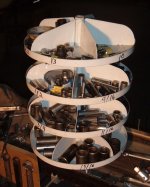
  • socket tray.jpg
    socket tray.jpg
    92.3 KB · Views: 33
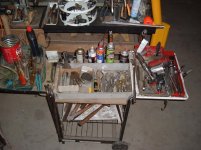
  • tool cart b.jpg
    tool cart b.jpg
    151 KB · Views: 34

jdoe213

Well-known member
Joined
Aug 16, 2013
Messages
179
Location
Anderson, SC
I like the idea. I have never thought about doing it. It would work good for me, but they would have to be labeled very well. If I were to grab 4 sockets that were very similar in size and climb under a car, when I got done I would want to be able to put them back in their place without having to think about which one goes next.
Great topic. Way to go, thinking like no one else has ever thought before.
 

PNWguy

Well-known member
Joined
Jan 3, 2018
Messages
494
Location
Near Grants Pass, OR
Me? Never.

My truck (Dodge), motorcycle (Suzuki), chainsaws (Stihl, Husky & Echo) are all metric.
My car (71 MGB GT) is all SAE.

Every once in a while I have to fumble through a few wrenches to determine if an unknown fastener is metric or SAE, but not often enough to matter.
 

JUNK-MAN

Well-known member
Joined
Nov 28, 2014
Messages
1,485
Location
PA
I used to have only my 1/4" like this but I really didn't like it, I usually can guess the size just by looking at it and I usually know by what it is if its gonna be sae or mm but with them intermixed some sizes are very close and takes extra time to check the size...

Sent from my SM-G930V using Tapatalk
 

Spiffers

Well-known member
Joined
Jul 4, 2018
Messages
92
Location
Tennessee
I've got my cheapo Walmart ratcheting wrenches set up this way so they all fit in the same holder.
 
To avoid these ads, REGISTER NOW!
Top Bottom