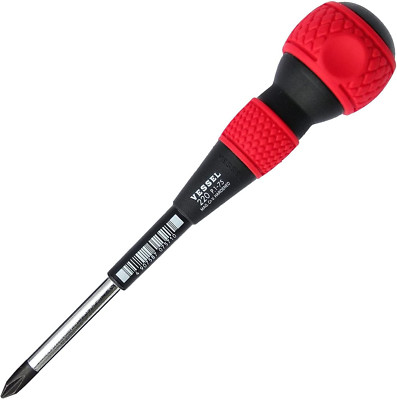
That's the one set from Vessel I would avoid. Almost all other screwdrivers they offer are made in their factory in Japan, but these are not. Crystaline lineup from Vessel is their entry level but they're top quality too.
I's due to regulations and laws and paperwork... It is easier in Japan to examine JIS standards than ISO, and then also far easier than examining DIN standards in Japan. Their examiners do not have the right accreditation as they would in that case need to report to the German centers. Instead they base their own standards on the German ones and then just report to their institution regarding the compliance.
Maybe I can explain with a similar example in metrology. Most large companies and universities in Japan and in the world have its own metrology lab. The equipment in those labs calibrates the scales and calipers and other measuring equipment. The equipment those labs use is calibrated based on bigger regional metrology centres. Those regional centres are calibrated based on national metrology labs. But all of those labs are calibrated based on the Bureau international des poids et mesures (BIPM) centre in Paris. It would make no sense for every factory to send their equipment to france for calibration... Similar with standards, it is way easier to manage local standards even if they are based on foreign ones.
PB Swiss does the same when new for sure. Did it as a party trick at work a few times. My impacta was also magnetized when new.
“
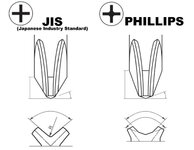
The standard in question is JIS B 4633 and has been updated. The current standard is JIS B 4633, 98th Edition, October 20, 2023.
So, Japanese cross point screwdrivers are still made to JIS B 4633.
The updated Japanese standard is equivalent to ISO 8764-1 and ISO 8764-2, the same standards that cover Phillips screwdrivers. I believe the measurements in the Japanese standard are not identical to the ISO measurements but are within the ISO tolerances.”
If “JIS B 4633” changed, then the actual “JIS standard” may have changed, but anyone looking for a “JIS B 4633” standard screwdriver, to match one they previously purchased, may wind up with a screwdriver with a different geometry, than than a previously purchased “JIS B 4633” standard screwdriver.
Without knowing specifics on how the “JIS B 4633” standard was updated, there is no way for a user to know if the change in the standard might cause problems, or differences in function.
If the change us something like the accuracy dimensions or precision of the bits have to be within .0001 inches of tolerance under the updated standard, verses .001 inches of dimension under the old standards, or the changes in spec are from equivalent inches to metric dimensions, then there would likely be no issue.
If the changes to the standard gave to due with geometry, such as specific angles, or depth of the driver gullets, then there could be differences for a user in actual use and function, and the changes to the standard should be known, and properly noted to users who may not actually purchase the standards specifications from the standard agency (which is usually not inexpensive).
Further, if a tool user purchases a current JIS specified driver from a dealer, made to “JIS B 4633”, but then purchases older stock “JIS B 4633” specified drivers, the “new/old stock” “JIS B 4633” may not work for the purchaser, and the purchaser may have no clue why drivers, made to the “exact same spec”, may not function the same, other than thinking the manufacturer has **** quality control.
This was one of the issues with pliers from US manufacturers.
The manufacturer would mention that x cutter meant a certain government spec, but the US manufacturer would not actually tell you what that spec meant.
Fir a tool like eire cutters, or pliers with built in cutters, knowing whether you can cut hard wire like piano wire, or just general steel wire, and the maximum and minimum gauge wires you can safely cut, without destroying the cutter edges, is actually important.
European manufacturers on the other hand seem to be or gave been required to list these specs, or at least are all in the habit of doing so.
An individual tool buyer is unlikely to spend several hundred dollars, or whatever the price is, to purchase the specification standard from the standards agency, although I presume some larger corporations might.
I’m not even sure a large public library or university would have those specification standards.